I've long loved Grant Morrison's Doom Patrol, of course, but never checked out the series that first introduced the team, written by Arnold Drake and drawn by Bruno Premiani, originally as part of the anthology series My Greatest Adventure, then in their own series after just six issues. The Doom Patrol predated the X-Men by a few months, and built off the example of the Lee/Kirby Fantastic Four — with their constant bickering and sense of isolation, they always felt more like Marvel's fallible, very human heroes than DC's self-assured icons. The Doom Patrol are outcasts, their "powers" having resulted from horrible accidents that left them changed and disfigured in various ways, no longer able to fit in with normal society. Rita Farr, once a glamorous actress, is the least changed: she initially isolates herself because she can't control her size-changing powers, and would unpredictably grow or shrink, but even after she gains control of these powers, she identifies herself as apart from society, even though she could easily reintegrate. The other 2 team members, Cliff Steele (whose accident left him so destroyed that only his brain remains, encased in a robot body) and Larry Trainor (irradiated with nuclear radiation, wrapped in bandages and possessed by an energy-based "Negative Man"), are more thoroughly ostracized, considered freaks by the "normal" populace whose lives they routinely save. Drake regularly comes up with outrageous concepts to confront these weird heroes, pitting them against the equally odd Brotherhood of Evil (led by a disembodied brain in a jar) or the shape-changing Animal-Vegetable-Mineral Man.
It's got all the usual problems of comics this old, being mainly targeted at kids, so there's a certain sloppiness and repetitiveness that nobody, I'm sure, expected to matter one bit. As was common at the time, in the early issues the writer and artist weren't even being credited except when someone happened to ask about it on the letters page, a sign of the status of these artifacts and those who made them. The dialogue often just consists of the gang narrating how they're going to foil their latest threat, some of the scenarios cross over from inspired weirdness to just plain dumb, and the fact that Mr. 103 is a barely different retread of A-V-M Man (and that Beast Boy taps into a similar power set as well) is perhaps a sign of the idea well running dry later in the run, at least as pertains to concocting new superpowers. Still, there's a reason these characters and this run have endured. A big part of the appeal is just how strange it all is, and how striking it is to find a goofy kids' comic that deals so candidly with issues of self-image, ostracization, and the frustration of being trapped in a flawed body. Cliff is constantly treating his robot body as disposable, warping and destroying himself, an approach that reaches its peak in an amazingly weird story in #87 where Cliff defeats a villain by using parts of his robot body to get around traps, until he's just an armless, legless torso pinning down the bad guy with metal dead weight.
These characters are very human despite their weirdness, though, and in between the outlandish fight scenes and stiff exposition, they express some very raw, poignant emotions, ranging from Cliff and Larry's sexual frustration (they both yearn for the pretty Rita, though she never seems to even acknowledge them as romantic or sexual possibilities, much preferring the less visibly weird Mento) to the Chief's increasingly desperate attempts to get out of his wheelchair and finally participate in adventures in a physical way rather than just as an advisor. Drake even extends this sympathy to the villainous Madame Rouge, with a long-gestating subplot in which the Chief tries to rehabilitate her, getting in touch with the good side that's been suppressed by the evil Brain's manipulations. This plot reaches its wacky, visually stunning apex in a sequence where Premiani draws Rouge's face being cracked, as though seen in a broken mirror, then stretched apart, until she's literally and physically divided into two twisty, stretchy beings intertwining and fighting — it's an amazing sequence, a perfect example of the visual and conceptual imagination that flows through this series.
It's also a great example of Drake's willingness to let plots gestate over time, as the Chief/Rouge plot develops in scenes scattered here and there across months of comics before it finally takes center stage. He often plotted across issues, writing around the obligatory villain-of-the-month to develop larger plots, like the courtship and eventual marriage between Rita and Mento. There's also the green-skinned, shape-shifting Beast Boy, who's slowly introduced into the title and gradually develops over much of the run's second half, the plot with his evil guardian undergoing many twists and turns across many months worth of stories before he's adopted by Rita and Mento, forming a nuclear family of the weird. Drake's multi-issue storytelling contrasted against a lot of other comics from the time, which tended much more towards done-in-one or two-part tales rather than this kind of extended continuity. The team went out with a bang, too, in a final issue where the Doom Patrol, given the choice between their own lives and the lives of a remote fishing community, chose to sacrifice themselves for the sakes of a few normal people. It's a noble and very unusual ending for a very unusual series and a very unusual cast of characters.
Monday, September 30, 2013
Monday, September 23, 2013
Green Lantern/Green Arrow
This is an important series, a landmark of comics history in which Dennis O'Neil, assisted most notably by penciller Neal Adams, transformed the Green Lantern series into a soapbox for social commentary and polemics, many of them voiced through GL's new costar, Green Arrow, who was recast as a modern-day leftist Robin Hood. It's a pretty astonishing transformation. Before #76, the first issue tagged as Green Lantern/Green Arrow, there was no regular writer on the Green Lantern ongoing, and O'Neil was just one of several writers doing an issue or two at a time, telling generic, disposable, instantly forgettable tales of GL facing off against monsters, aliens, robots, etc. There's nothing in the preceding dozen or so issues, including those written by O'Neil, to prepare one for #76's slap in the face, in which GL and GA face off against a corrupt landlord, and in which GL is famously confronted by a black man who accuses him of doing lots for aliens with purple or blue skin, but nothing for those on his own world with black skin.
Immediately, the duo take off on a trip across America, accompanied by a disguised Guardian from Oa, encountering racism, poverty, drug use, and other social and political issues. By today's standards, O'Neil's writing is preachy, unsubtle, and often rather ludicrous, and he has a tendency for trotting out Nazi comparisons at the slightest provocation. It's politics-for-dummies, in its way as simplistic and morally black-and-white as the GL vs. Sinestro stories that had earlier defined this title. But these are still important comics, elevating these characters beyond the repetitive, thematically threadbare stories that had previously contituted their monthly adventures, suggesting that comics, even superhero comics, could have real moral content and could deal with the real world, however clumsy these efforts often are at tackling these themes.
That sense of a stab at realism is aided in a big way by Neal Adams, whose grainy, gritty art is as much of a game-changer as O'Neil's new stories. With the first O'Neil/Adams issue, this immediately looks and feels like a whole different book, its new street-level themes mirrored in Adams' realistically rendered faces and love of shadowy textures. O'Neil, for his part, doesn't really maintain the same level of commitment throughout this sequence of issues. The initial burst of socially conscious stories lasts a mere four issues before the heroes are once again confronting cosmic menaces and supervillains, albeit with a pronounced allegorical undercurrent to it all. This synthesis is most powerful in a story that casts the villainous Black Hand as an agent of a sinister conspiracy to keep people docile through consumerism; elsewhere, O'Neil offers up muddled and incoherent satires of Nixon/Agnew and women's liberation, with the latter story nearly sabotaging the whole run by making feminists into (literal!!!) harpies.
But then comes probably the most infamous story of this series, the two-part tale in which Green Arrow's "ward" Speedy becomes a drug addict. It's easy to mock now, and there's no question that, like all of O'Neil's work in this period, there's a thread of camp outrageousness here, as well as an over-the-top preachiness that makes the moralizing speeches come across like an after-school special. At the same time, the story is remarkably candid about drug use, and remarkably sympathetic (given the tenor of the times) towards the addicts, who with exceptional self-awareness lay out their reasons for turning to drugs, saying that drugs help them forget the problems of their lives, help them ignore the racism and neglect they face from their elders and the rest of society. It's probably the most morally complex of the GL/GA stories, because though in the end the heroes catch the villain who's peddling the drugs, it feels like a pretty hollow victory, underscored by having the story's last pages take place at a funeral for an overdose victim. This particular villain is caught, but there's a sense that nothing has changed, that the problem is a lot larger and can't be solved with mere fisticuffs or simplistic ideas of "justice" — a pretty mature admission from the superhero comics of the time. Adams also turns in one of his very best sequences in the form of a harrowing page on which Speedy, withdrawing cold turkey, staggers around under the watchful and sympathetic eye of Black Canary, who's helping him through his pain. It's beautifully rendered but horrifying, Adams' expert handling of body language perfectly capturing the young addict's anguish in just a few nearly silent panels.
The O'Neil/Adams run ended with #89, a hamfisted but oddly compelling mash-up of Jesus' death with an environmentalist parable, notable for unsparingly making GL's girlfriend Carol Ferris kind of the villain here, and the story ends with GL blowing up one of her airplanes in a burst of righteous anger. The series blew up too — it won awards but apparently never sold well. O'Neil continued the saga with backup stories in The Flash, with Adams sticking around for the first 3 installments, long enough to give Green Arrow and Black Canary a relatively graceful goodbye before O'Neil started churning out GL solo adventures. O'Neil revived the series years later, but without Adams (Mike Grell drew many of the new issues) and without the social commentary. The issues O'Neil wrote from #90 on, starting in 1976, have very few traces of the earlier series' political ideology or issue-oriented themes. There are scenes here and there that reference poverty or race or drugs, but never in the sustained way that the earlier run had done. Instead, it's a return to space opera, alien invaders, alternate dimensions, and so on, and it's mostly a bore in comparison to the vitality and emotional excess of the original O'Neil/Adams run. There's some camp appeal here — Sinestro disguised as a jester; the bizarre saga of Itty Bitty, a flower-shaped alien who dies and comes back as a zombie flower; Hal Jordan as a trucker who mostly stashes his rig in space while fighting alien menaces; Hal hooking up with and nearly marrying Guy Gardner's psychic gypsy girlfriend. It can be fun, and silly, and Grell (in particular among the several pencillers who rotate through these issues) is a fine artist, but the series is always a pale shadow of its former identity, and it's never quite clear why exactly Green Arrow is tagging along on all these spacefaring adventures at all. His presence was really only required to be a voice of social consciousness and down-to-earth realism, both attributes purposefully missing from the rebooted series.
Immediately, the duo take off on a trip across America, accompanied by a disguised Guardian from Oa, encountering racism, poverty, drug use, and other social and political issues. By today's standards, O'Neil's writing is preachy, unsubtle, and often rather ludicrous, and he has a tendency for trotting out Nazi comparisons at the slightest provocation. It's politics-for-dummies, in its way as simplistic and morally black-and-white as the GL vs. Sinestro stories that had earlier defined this title. But these are still important comics, elevating these characters beyond the repetitive, thematically threadbare stories that had previously contituted their monthly adventures, suggesting that comics, even superhero comics, could have real moral content and could deal with the real world, however clumsy these efforts often are at tackling these themes.
That sense of a stab at realism is aided in a big way by Neal Adams, whose grainy, gritty art is as much of a game-changer as O'Neil's new stories. With the first O'Neil/Adams issue, this immediately looks and feels like a whole different book, its new street-level themes mirrored in Adams' realistically rendered faces and love of shadowy textures. O'Neil, for his part, doesn't really maintain the same level of commitment throughout this sequence of issues. The initial burst of socially conscious stories lasts a mere four issues before the heroes are once again confronting cosmic menaces and supervillains, albeit with a pronounced allegorical undercurrent to it all. This synthesis is most powerful in a story that casts the villainous Black Hand as an agent of a sinister conspiracy to keep people docile through consumerism; elsewhere, O'Neil offers up muddled and incoherent satires of Nixon/Agnew and women's liberation, with the latter story nearly sabotaging the whole run by making feminists into (literal!!!) harpies.
But then comes probably the most infamous story of this series, the two-part tale in which Green Arrow's "ward" Speedy becomes a drug addict. It's easy to mock now, and there's no question that, like all of O'Neil's work in this period, there's a thread of camp outrageousness here, as well as an over-the-top preachiness that makes the moralizing speeches come across like an after-school special. At the same time, the story is remarkably candid about drug use, and remarkably sympathetic (given the tenor of the times) towards the addicts, who with exceptional self-awareness lay out their reasons for turning to drugs, saying that drugs help them forget the problems of their lives, help them ignore the racism and neglect they face from their elders and the rest of society. It's probably the most morally complex of the GL/GA stories, because though in the end the heroes catch the villain who's peddling the drugs, it feels like a pretty hollow victory, underscored by having the story's last pages take place at a funeral for an overdose victim. This particular villain is caught, but there's a sense that nothing has changed, that the problem is a lot larger and can't be solved with mere fisticuffs or simplistic ideas of "justice" — a pretty mature admission from the superhero comics of the time. Adams also turns in one of his very best sequences in the form of a harrowing page on which Speedy, withdrawing cold turkey, staggers around under the watchful and sympathetic eye of Black Canary, who's helping him through his pain. It's beautifully rendered but horrifying, Adams' expert handling of body language perfectly capturing the young addict's anguish in just a few nearly silent panels.
The O'Neil/Adams run ended with #89, a hamfisted but oddly compelling mash-up of Jesus' death with an environmentalist parable, notable for unsparingly making GL's girlfriend Carol Ferris kind of the villain here, and the story ends with GL blowing up one of her airplanes in a burst of righteous anger. The series blew up too — it won awards but apparently never sold well. O'Neil continued the saga with backup stories in The Flash, with Adams sticking around for the first 3 installments, long enough to give Green Arrow and Black Canary a relatively graceful goodbye before O'Neil started churning out GL solo adventures. O'Neil revived the series years later, but without Adams (Mike Grell drew many of the new issues) and without the social commentary. The issues O'Neil wrote from #90 on, starting in 1976, have very few traces of the earlier series' political ideology or issue-oriented themes. There are scenes here and there that reference poverty or race or drugs, but never in the sustained way that the earlier run had done. Instead, it's a return to space opera, alien invaders, alternate dimensions, and so on, and it's mostly a bore in comparison to the vitality and emotional excess of the original O'Neil/Adams run. There's some camp appeal here — Sinestro disguised as a jester; the bizarre saga of Itty Bitty, a flower-shaped alien who dies and comes back as a zombie flower; Hal Jordan as a trucker who mostly stashes his rig in space while fighting alien menaces; Hal hooking up with and nearly marrying Guy Gardner's psychic gypsy girlfriend. It can be fun, and silly, and Grell (in particular among the several pencillers who rotate through these issues) is a fine artist, but the series is always a pale shadow of its former identity, and it's never quite clear why exactly Green Arrow is tagging along on all these spacefaring adventures at all. His presence was really only required to be a voice of social consciousness and down-to-earth realism, both attributes purposefully missing from the rebooted series.
Monday, September 9, 2013
Vertigo Voices
The four one-shots covered below were released in 1995 on the Vertigo Voices sub-imprint, a series of creator-owned one-offs that, by design or coincidence, were unified by a focus on warped psychology. Unlike some of Vertigo's other attempts at spin-off imprints or events, these one-shots were strikingly successful in creative terms, all four of them great examples of these creators at their best.
Face (Peter Milligan & Duncan Fegredo) - This book's depiction of a slow spiral into horror is really difficult to bear, and that's what makes it so great. Peter Milligan would later examine the questions about identity and appearance raised here in his Human Target comics, but whereas those books had more of a hard-boiled noir/detective genre approach, this is intense, unsettling psychological horror. A plastic surgeon moves out to a remote island with his wife to perform elaborate surgery on a reclusive artist, and, as such stories are apt to play out, the isolation reveals fractures in the surgeon's marriage even as the artist (and his clingy manservant) seem to be teetering on the brink of sanity themselves. Milligan's plotting is dense and unpredictable, and the story takes several unexpected twists and turns before its grisly ending, its instability aided by the fact that David, the surgeon, is a supremely unreliable narrator who keeps casually tossing out lies and half-truths to both his wife and the reader, contradicting himself at every turn. Fegredo's art is scratchy and gritty, with a fine grasp of gesture and body language, and when the story requires rapid descents into gore or surrealist hallucination, he's able to leap into the abyss with the best of them. It's a perfect classical horror tale, in the lineage of Eyes Without a Face and other horror movie meditations on identity, aesthetics, marriage, sexuality, and the nature of monsters.
Tainted (Jamie Delano & Al Davison) - Stunning, creepy, and psychologically engrossing, this is prime Delano, a sympathetic but unflinching case study of three people, each fucked-up and damaged in his or her own way. George, a wealthy orphan, rents out part of his big inherited house to Lisa, a nurse, and Steve, a strung-out addict. Alternating between these three characters, with special emphasis on George, Delano creates a potent and disturbing portrait of dysfunction and disconnection. George is a haunted character, cut off from sexuality, superficially a good man but obviously disturbed in some pretty deep ways — it's apparent from early on what the nature of his shameful secret past might be, but its gradual unfurling is nonetheless horrifyingly mesmerizing, leading inexorably towards the revelation that every reader suspects is there all along. George's entanglement with Lisa, a rape victim who sees her fantasy games with this damaged man as a way of re-empowering herself, only complicates the intense emotions and disquieting forebodings that wind through this tale. For his part, Davison is a perfect collaborator, giving these characters and their surroundings a weighty, fleshy realism that is occasionally disrupted in subtle ways by distortions, skewed angles, shapes warped beyond recognition, before snapping back to the hard surety of reality. He depicts slippages into fantasy or nightmare without the usual signifiers, preferring very subtle distortions until the horrifying visual symbolism of the ending. This is a great short story, drawing on familiar archetypes and ideas but presenting them with sensitivity, psychological insight, and a keen grasp of the unspeakable horrors lurking within the human mind.
Kill Your Boyfriend (Grant Morrison & Philip Bond) - This is probably the most famous of the Vertigo Voices one-shots, mainly by virtue of Morrison's name, though it's definitely nowhere near as great as Face or Tainted. Still, it's a good book in its own right, kind of a more grounded adjunct to Morrison's The Invisibles, which was running simultaneously. It's a portrait of a young girl who's bored and alienated in suburbia, and harbors fantasies of violence and sexuality which she finally indulges by running off with a bad boy who leads her on a crime spree. So it's a pretty familiar tale that Morrison is riffing on here, and he doesn't entirely transcend that familiarity, but he does imbue this book with a great deal of biting wit and a serious consideration of some of his usual themes about society and rebellion. He makes this story all about conforming to roles and expectations; the girl acts out because that seems to be the only outlet available to her, because even her most mild deviations from what's considered the norm are looked on with suspicion. Her father calls her a slut, with mingled disgust and excitement, while rifling through her frilly underwear, and those same underwear later lead the police to some negative conclusions about the girl; any girl who might want to explore her sexuality is automatically viewed with distrust. When society tries to suppress and hide all of this stuff, it expresses itself anyway in warped and disturbing ways, in violence and rage, and that thematic focus ties this book to Morrison's less realistic social commentaries in The Invisibles and The Filth. It's also a darkly charming book, thanks in part to Philip Bond's clean-lined, elegant art, so well-suited to rendering these attractive, sexy young people, as well as Morrison's habit of having the girl address the reader directly, justifying her actions in a running commentary that amounts to a shrugging admission that she had nothing better to do.
The Eaters (Peter Milligan & Dean Ormston) - In contrast to Milligan's other Vertigo Voices issue, The Eaters is less straight-up horror, despite its focus on cannibalism, and more a darkly comic satire that might be seen as the American counterpart to Morrison's maiming of British suburban culture in Kill Your Boyfriend. Milligan follows a family of "eaters" — they hate the derogatory term "cannibals" — as they travel around the country in an RV they won in a contest from an apple-pie company, killing people along the way for dinner. It's a scattershot and unrelenting satire, depicting this family as the quintessential all-American Christians, justifying their murderous appetites with questionable interpretations of vague Bible verses, while criticizing the junk-food culture and societal neglect they see all around them on their cross-country tour. They're Christian hypocrites, feeding the poor with stew made from the corpses of over-stuffed junk-food gorgers, convinced that their own lifestyle is the healthiest and the most morally correct. All the symbols of the American middle class are distorted here: religion, family, mom's cooking and apple pie, corrupt politicians, fast-food burgers and charity for the poor and homeless. The family is pursued by a vengeful apple pie salesman, who bathes every night in a bath tub full of sickly yellowish-green apple pie filling, obviously artificial and practically glowing neon, precisely the kind of mass-produced factory-made junk that this family has cut out of their lifestyle.
Face (Peter Milligan & Duncan Fegredo) - This book's depiction of a slow spiral into horror is really difficult to bear, and that's what makes it so great. Peter Milligan would later examine the questions about identity and appearance raised here in his Human Target comics, but whereas those books had more of a hard-boiled noir/detective genre approach, this is intense, unsettling psychological horror. A plastic surgeon moves out to a remote island with his wife to perform elaborate surgery on a reclusive artist, and, as such stories are apt to play out, the isolation reveals fractures in the surgeon's marriage even as the artist (and his clingy manservant) seem to be teetering on the brink of sanity themselves. Milligan's plotting is dense and unpredictable, and the story takes several unexpected twists and turns before its grisly ending, its instability aided by the fact that David, the surgeon, is a supremely unreliable narrator who keeps casually tossing out lies and half-truths to both his wife and the reader, contradicting himself at every turn. Fegredo's art is scratchy and gritty, with a fine grasp of gesture and body language, and when the story requires rapid descents into gore or surrealist hallucination, he's able to leap into the abyss with the best of them. It's a perfect classical horror tale, in the lineage of Eyes Without a Face and other horror movie meditations on identity, aesthetics, marriage, sexuality, and the nature of monsters.
Tainted (Jamie Delano & Al Davison) - Stunning, creepy, and psychologically engrossing, this is prime Delano, a sympathetic but unflinching case study of three people, each fucked-up and damaged in his or her own way. George, a wealthy orphan, rents out part of his big inherited house to Lisa, a nurse, and Steve, a strung-out addict. Alternating between these three characters, with special emphasis on George, Delano creates a potent and disturbing portrait of dysfunction and disconnection. George is a haunted character, cut off from sexuality, superficially a good man but obviously disturbed in some pretty deep ways — it's apparent from early on what the nature of his shameful secret past might be, but its gradual unfurling is nonetheless horrifyingly mesmerizing, leading inexorably towards the revelation that every reader suspects is there all along. George's entanglement with Lisa, a rape victim who sees her fantasy games with this damaged man as a way of re-empowering herself, only complicates the intense emotions and disquieting forebodings that wind through this tale. For his part, Davison is a perfect collaborator, giving these characters and their surroundings a weighty, fleshy realism that is occasionally disrupted in subtle ways by distortions, skewed angles, shapes warped beyond recognition, before snapping back to the hard surety of reality. He depicts slippages into fantasy or nightmare without the usual signifiers, preferring very subtle distortions until the horrifying visual symbolism of the ending. This is a great short story, drawing on familiar archetypes and ideas but presenting them with sensitivity, psychological insight, and a keen grasp of the unspeakable horrors lurking within the human mind.
Kill Your Boyfriend (Grant Morrison & Philip Bond) - This is probably the most famous of the Vertigo Voices one-shots, mainly by virtue of Morrison's name, though it's definitely nowhere near as great as Face or Tainted. Still, it's a good book in its own right, kind of a more grounded adjunct to Morrison's The Invisibles, which was running simultaneously. It's a portrait of a young girl who's bored and alienated in suburbia, and harbors fantasies of violence and sexuality which she finally indulges by running off with a bad boy who leads her on a crime spree. So it's a pretty familiar tale that Morrison is riffing on here, and he doesn't entirely transcend that familiarity, but he does imbue this book with a great deal of biting wit and a serious consideration of some of his usual themes about society and rebellion. He makes this story all about conforming to roles and expectations; the girl acts out because that seems to be the only outlet available to her, because even her most mild deviations from what's considered the norm are looked on with suspicion. Her father calls her a slut, with mingled disgust and excitement, while rifling through her frilly underwear, and those same underwear later lead the police to some negative conclusions about the girl; any girl who might want to explore her sexuality is automatically viewed with distrust. When society tries to suppress and hide all of this stuff, it expresses itself anyway in warped and disturbing ways, in violence and rage, and that thematic focus ties this book to Morrison's less realistic social commentaries in The Invisibles and The Filth. It's also a darkly charming book, thanks in part to Philip Bond's clean-lined, elegant art, so well-suited to rendering these attractive, sexy young people, as well as Morrison's habit of having the girl address the reader directly, justifying her actions in a running commentary that amounts to a shrugging admission that she had nothing better to do.
The Eaters (Peter Milligan & Dean Ormston) - In contrast to Milligan's other Vertigo Voices issue, The Eaters is less straight-up horror, despite its focus on cannibalism, and more a darkly comic satire that might be seen as the American counterpart to Morrison's maiming of British suburban culture in Kill Your Boyfriend. Milligan follows a family of "eaters" — they hate the derogatory term "cannibals" — as they travel around the country in an RV they won in a contest from an apple-pie company, killing people along the way for dinner. It's a scattershot and unrelenting satire, depicting this family as the quintessential all-American Christians, justifying their murderous appetites with questionable interpretations of vague Bible verses, while criticizing the junk-food culture and societal neglect they see all around them on their cross-country tour. They're Christian hypocrites, feeding the poor with stew made from the corpses of over-stuffed junk-food gorgers, convinced that their own lifestyle is the healthiest and the most morally correct. All the symbols of the American middle class are distorted here: religion, family, mom's cooking and apple pie, corrupt politicians, fast-food burgers and charity for the poor and homeless. The family is pursued by a vengeful apple pie salesman, who bathes every night in a bath tub full of sickly yellowish-green apple pie filling, obviously artificial and practically glowing neon, precisely the kind of mass-produced factory-made junk that this family has cut out of their lifestyle.
Monday, September 2, 2013
I Die At Midnight, The Geek, Prez: Smells Like Teen President
I Die At Midnight (Kyle Baker) - Part of Vertigo's pre-millennial V2K series, this is a fine example of Kyle Baker's briskly paced, animation-inspired humor comics. It's the story of a man who, distraught over a failed romance, swallows a bottle of pills to kill himself on New Year's Eve, only to have his lover return, apologizing and wanting to make up with him. The man then desperately casts about for a way to cure himself before the pills take effect, without letting his lover know that he was so unbalanced. It's frenzied dark comedy, which Baker communicates equally with his expressive, cartoony artwork and the typeset, wryly funny dialogue that he sets beside his images. As in most of Baker's work, he doesn't use word balloons as in traditional comics, preferring to set the dialogue and the occasional narrative captions beside and below the panels — the format resembles animation cells with a script running alongside them, though despite this separation, Baker's words and images definitely work together towards the overall comical effect.
Baker's work from the late '90s on tends to (over)use digital backgrounds, and in this book the Photoshop paste-ups, computerized blurring of figures to connote depth, and sporadic use of digitally constructed objects can be distracting, even if the style is arguably appropriate when Baker uses it for gaudy Times Square backdrops. But the focus, as always in his work, is on his figure drawings, and in that respect he's as great as ever, using exaggerated body language and malleable, mugging facial expressions to give his characters a rubbery energy and sense of motion on the page, a further connection to animation. Baker's humor and energy are more than enough to overshadow the occasional rough digital eyesore, and I Die At Midnight is another fine farce from a master of the form.
The Geek (Rachel Pollack & Mike Allred) - Part of the weird Vertigo Visions series that included Vertigo-ized modern interpretations of obscure old DC characters. This one updates Brother Power the Geek, an ill-fated attempt by Joe Simon to tap into hippie subculture in the '60s, and whose original series lasted just two issues. Brother Power was a living mannequin who, in Pollack's update, is enslaved by a constantly shifting evil being who embodies a carnival barker, a businessman involved in corporate takeovers, a neo-Nazi leader, and other icons of greed and violence. Pollack is presumably staying true to Simon's conception of the character as a wandering signifier for hippie ideals, fighting yuppies and racists and corporate flunkies, but it's all so bluntly polemical and at the same time incoherent in its narrative. Pollack intermingles Brother Power's journey with scenes involving the hero's friend Cindy, who is fleeing a life of prostitution to join a feminist goddess-worship protest group called PMS. Mike Allred would seem to be the perfect artist for this material, with its naive hero and the sweet relationship between Brother Power and Cindy, and his art is the main appeal here, though it's hardly his most compelling work, either. This is a forgettable look at a forgotten character; the early Vertigo era produced so many memorable new slants on older ideas that it's easy to overlook the many failed attempts to revitalize old DC properties.
Prez: Smells Like Teen President (Ed Brubaker & Eric Shanower) - This is another of the Vertigo Visions one-shots, this time focusing on an even odder Joe Simon concoction who was also part of DC's transparent attempts to appeal to teenagers in the late '60s and '70s. Brubaker's update concerns a Cobain-like Generation X-er who believes he may be Prez's son, and seeks out the retired teen president across an America that's gone way downhill in the wake of Prez's idyllic fantasy presidency. This was pretty early in Brubaker's career, and the result feels very rough and amateurish, a collection of simple political ideas expressed in very blunt fashion. It's an obvious attempt to tap into Generation X skepticism by depicting a society in which '60s-style idealism really did remake the country for a brief period, before the end of Prez's terms in office signalled a return to business as usual. Some nice sentiments, and Eric Shanower's wispy, delicately inked art is quite nice, but the wordy political conversations and complete lack of subtlety make it a slog to read.
Baker's work from the late '90s on tends to (over)use digital backgrounds, and in this book the Photoshop paste-ups, computerized blurring of figures to connote depth, and sporadic use of digitally constructed objects can be distracting, even if the style is arguably appropriate when Baker uses it for gaudy Times Square backdrops. But the focus, as always in his work, is on his figure drawings, and in that respect he's as great as ever, using exaggerated body language and malleable, mugging facial expressions to give his characters a rubbery energy and sense of motion on the page, a further connection to animation. Baker's humor and energy are more than enough to overshadow the occasional rough digital eyesore, and I Die At Midnight is another fine farce from a master of the form.
The Geek (Rachel Pollack & Mike Allred) - Part of the weird Vertigo Visions series that included Vertigo-ized modern interpretations of obscure old DC characters. This one updates Brother Power the Geek, an ill-fated attempt by Joe Simon to tap into hippie subculture in the '60s, and whose original series lasted just two issues. Brother Power was a living mannequin who, in Pollack's update, is enslaved by a constantly shifting evil being who embodies a carnival barker, a businessman involved in corporate takeovers, a neo-Nazi leader, and other icons of greed and violence. Pollack is presumably staying true to Simon's conception of the character as a wandering signifier for hippie ideals, fighting yuppies and racists and corporate flunkies, but it's all so bluntly polemical and at the same time incoherent in its narrative. Pollack intermingles Brother Power's journey with scenes involving the hero's friend Cindy, who is fleeing a life of prostitution to join a feminist goddess-worship protest group called PMS. Mike Allred would seem to be the perfect artist for this material, with its naive hero and the sweet relationship between Brother Power and Cindy, and his art is the main appeal here, though it's hardly his most compelling work, either. This is a forgettable look at a forgotten character; the early Vertigo era produced so many memorable new slants on older ideas that it's easy to overlook the many failed attempts to revitalize old DC properties.
Prez: Smells Like Teen President (Ed Brubaker & Eric Shanower) - This is another of the Vertigo Visions one-shots, this time focusing on an even odder Joe Simon concoction who was also part of DC's transparent attempts to appeal to teenagers in the late '60s and '70s. Brubaker's update concerns a Cobain-like Generation X-er who believes he may be Prez's son, and seeks out the retired teen president across an America that's gone way downhill in the wake of Prez's idyllic fantasy presidency. This was pretty early in Brubaker's career, and the result feels very rough and amateurish, a collection of simple political ideas expressed in very blunt fashion. It's an obvious attempt to tap into Generation X skepticism by depicting a society in which '60s-style idealism really did remake the country for a brief period, before the end of Prez's terms in office signalled a return to business as usual. Some nice sentiments, and Eric Shanower's wispy, delicately inked art is quite nice, but the wordy political conversations and complete lack of subtlety make it a slog to read.
Monday, August 19, 2013
Egypt, Girl, Mercy
Egypt (Peter Milligan, Glyn Dillon & Roberto Corona) - A seven-issue miniseries from the height of Peter Milligan's fertile Vertigo period in the '90s. It's a weird trip through time with Vincent Me, a self-loathing and self-absorbed loser who finds himself thrown into ancient Egypt, albeit an ancient Egypt that seems off in some pretty major ways. It's mind-bending stuff, and Milligan has a lot of fun pushing Vin through some pretty outrageous happenings, slowly transforming him into a better person by forcing him to wallow, quite literally at times, in shit, and to inhabit other roles and other identities, to see, again quite literally, through someone else's eyes.
The tone of the book is irreverent and often humorous, thanks to Vin's sarcastic running commentary, but there are also moments (and images) of startling violence or spiritual power. It's Milligan's look at the power and meaning of religion, about its capacity for misuse and manipulation by those who seek only a way to yoke the faithful, the gullible believers eager to subjugate themselves to a system where only the rich and powerful few have real rights, and everyone else is left to be trampled beneath the feet of gods. In the end, it's not religion or faith or spirituality that redeems Vin, but his own experiences and what he learns from them, his own willingness to change and to confront what's made him such a weak and flawed man.
Glyn Dillon drew the first two issues of the miniseries, and then was replaced by Roberto Corona. The artists have a similar enough style that the transition isn't jarring, but Corona's art is simpler, less detailed, tending to mute the outrageous ideas and intense emotions that Milligan is stirring up here, while Dillon's slightly heavier artwork isn't as prone to blank-faced characters and flat scenery. It's a shame that Dillon didn't draw the whole series, but the slight step down in art once Corona took over doesn't detract too much from the series' energetic oddness and compelling ideas.
Girl (Peter Milligan & Duncan Fegredo) - This three-issue miniseries was published as part of Vertigo's "Vérité" line, a brief experiment dedicated to more "realistic" titles without the supernatural or horror elements of a lot of other Vertigo offerings of the mid-'90s. It feels like a sister title to Grant Morrison's Kill Your Boyfriend, from a year earlier, another book about a lower-middle-class British girl whose boredom and disconnection drive her to let her violent fantasy life burst out into reality. As good as the Morrison book is, Milligan actually delivers an even more bracing, angrier, punkier variation on the theme, as well as a far more grounded examination of the everyday reality of the British working class. Milligan's dialogue perfectly captures a certain brand of slurred, insolent British slum dialect, and his portrait of the dysfunctional home life surrounding fifteen-year-old Simone is as unflinching and utterly realistic as a Mike Leigh film. It's a devastating depiction of a crumbling working class neighborhood where nobody has any hope or prospects, where bored teens ride filthy elevators up and down all day, puncturing condoms with syringes in a sick facsimile of a game, where everyone pours their only money into hopeless lotto tickets, where brutality and rape and ugliness are just part of the scenery.
It's no wonder, in this milieu, that Simone starts to crack, spurred on by her happier, healthier blonde doppelganger Polly. Milligan builds upon the grimy realism of the first issue by gradually letting slip more and more just how much of Simone's reality is a put-on or a fantasy or a skewed vision of what's really going on. It's interesting to compare Girl to Kill Your Boyfriend, because while Morrison, ever enamored of chaos and rebellion, makes his book's anti-heroine consistently charming and fun even as she descends into violence and anarchy, Milligan's vision is far darker and less open to the appeal of this empty rebellion.
The first issue opens with Simone preparing to burn down a warehouse where lottery tickets are stored, before jumping back in time to trace her path to this point. But when the story finally circles around to this point again, Milligan quickly and casually deflates Simone's fiery plans in a darkly humorous splash page, then has her retreat into a different kind of fantasy altogether. The point is that Simone is trapped: damned if she rebels, damned if she becomes just another Bollockstown burnout loser, damned if she just opts out and exists in a series of nested fantasies. The bleak poetry of Milligan's language and the dark beauty of Duncan Fegredo's art combine to make this an unforgettable portrait of working-class despair. The Milligan/Fegredo collaboration resulted in a remarkable body of work at Vertigo, a vital partnership on books like this one, the one-shot Face, Enigma, and assorted short stories.
Mercy (J.M. DeMatteis & Paul Johnson) - An obscure early Vertigo one-shot that probably deserves its obscurity. This is J.M. DeMatteis expressing his New Age spiritual beliefs in a particularly direct way, and unlike his similarly spiritual and really great Dr. Fate run, this comic comes off as vague, insubstantial, and devoid of real characters or plot. It's a study of a man on life support, his spirit floating outside his body and wandering around the world, watching as a beautiful woman who he calls Mercy intervenes in the lives of some unhappy, suffering people. The characters and situations are utterly generic, a fact that isn't helped by DeMatteis' avoidance of dialogue: the entire book is narrated in caption boxes by the free-floating spirit as he wonders why Mercy is helping these people.
Paul Johnson's painted art, similar in style to Dave McKean but somewhat less abstract at times, is absolutely gorgeous, and there are moments when he captures a smiling face bathed in light or a similar image of joy with such conviction that the book's hopeful spiritual theme is communicated in spite of the banality of DeMatteis' writing. These moments are rare, though, and for the most part, no matter how good this comic looks, it can't overcome the trite scenarios (a bitter married couple and an isolated, mourning old woman) that DeMatteis is dealing with. There's no specificity here, no real depth of character. Dr. Fate dealt with similar themes of spirituality, human change, and faith, but it did so (in a superhero context, no less) with real, substantial characters whose stories allowed DeMatteis' messages to arise organically. That's not the case here, as the narration simply hammers home these banal ideas about mercy and the spirit and a general message to be good and do good and be happy and so on.
The tone of the book is irreverent and often humorous, thanks to Vin's sarcastic running commentary, but there are also moments (and images) of startling violence or spiritual power. It's Milligan's look at the power and meaning of religion, about its capacity for misuse and manipulation by those who seek only a way to yoke the faithful, the gullible believers eager to subjugate themselves to a system where only the rich and powerful few have real rights, and everyone else is left to be trampled beneath the feet of gods. In the end, it's not religion or faith or spirituality that redeems Vin, but his own experiences and what he learns from them, his own willingness to change and to confront what's made him such a weak and flawed man.
Glyn Dillon drew the first two issues of the miniseries, and then was replaced by Roberto Corona. The artists have a similar enough style that the transition isn't jarring, but Corona's art is simpler, less detailed, tending to mute the outrageous ideas and intense emotions that Milligan is stirring up here, while Dillon's slightly heavier artwork isn't as prone to blank-faced characters and flat scenery. It's a shame that Dillon didn't draw the whole series, but the slight step down in art once Corona took over doesn't detract too much from the series' energetic oddness and compelling ideas.
Girl (Peter Milligan & Duncan Fegredo) - This three-issue miniseries was published as part of Vertigo's "Vérité" line, a brief experiment dedicated to more "realistic" titles without the supernatural or horror elements of a lot of other Vertigo offerings of the mid-'90s. It feels like a sister title to Grant Morrison's Kill Your Boyfriend, from a year earlier, another book about a lower-middle-class British girl whose boredom and disconnection drive her to let her violent fantasy life burst out into reality. As good as the Morrison book is, Milligan actually delivers an even more bracing, angrier, punkier variation on the theme, as well as a far more grounded examination of the everyday reality of the British working class. Milligan's dialogue perfectly captures a certain brand of slurred, insolent British slum dialect, and his portrait of the dysfunctional home life surrounding fifteen-year-old Simone is as unflinching and utterly realistic as a Mike Leigh film. It's a devastating depiction of a crumbling working class neighborhood where nobody has any hope or prospects, where bored teens ride filthy elevators up and down all day, puncturing condoms with syringes in a sick facsimile of a game, where everyone pours their only money into hopeless lotto tickets, where brutality and rape and ugliness are just part of the scenery.
It's no wonder, in this milieu, that Simone starts to crack, spurred on by her happier, healthier blonde doppelganger Polly. Milligan builds upon the grimy realism of the first issue by gradually letting slip more and more just how much of Simone's reality is a put-on or a fantasy or a skewed vision of what's really going on. It's interesting to compare Girl to Kill Your Boyfriend, because while Morrison, ever enamored of chaos and rebellion, makes his book's anti-heroine consistently charming and fun even as she descends into violence and anarchy, Milligan's vision is far darker and less open to the appeal of this empty rebellion.
The first issue opens with Simone preparing to burn down a warehouse where lottery tickets are stored, before jumping back in time to trace her path to this point. But when the story finally circles around to this point again, Milligan quickly and casually deflates Simone's fiery plans in a darkly humorous splash page, then has her retreat into a different kind of fantasy altogether. The point is that Simone is trapped: damned if she rebels, damned if she becomes just another Bollockstown burnout loser, damned if she just opts out and exists in a series of nested fantasies. The bleak poetry of Milligan's language and the dark beauty of Duncan Fegredo's art combine to make this an unforgettable portrait of working-class despair. The Milligan/Fegredo collaboration resulted in a remarkable body of work at Vertigo, a vital partnership on books like this one, the one-shot Face, Enigma, and assorted short stories.
Mercy (J.M. DeMatteis & Paul Johnson) - An obscure early Vertigo one-shot that probably deserves its obscurity. This is J.M. DeMatteis expressing his New Age spiritual beliefs in a particularly direct way, and unlike his similarly spiritual and really great Dr. Fate run, this comic comes off as vague, insubstantial, and devoid of real characters or plot. It's a study of a man on life support, his spirit floating outside his body and wandering around the world, watching as a beautiful woman who he calls Mercy intervenes in the lives of some unhappy, suffering people. The characters and situations are utterly generic, a fact that isn't helped by DeMatteis' avoidance of dialogue: the entire book is narrated in caption boxes by the free-floating spirit as he wonders why Mercy is helping these people.
Paul Johnson's painted art, similar in style to Dave McKean but somewhat less abstract at times, is absolutely gorgeous, and there are moments when he captures a smiling face bathed in light or a similar image of joy with such conviction that the book's hopeful spiritual theme is communicated in spite of the banality of DeMatteis' writing. These moments are rare, though, and for the most part, no matter how good this comic looks, it can't overcome the trite scenarios (a bitter married couple and an isolated, mourning old woman) that DeMatteis is dealing with. There's no specificity here, no real depth of character. Dr. Fate dealt with similar themes of spirituality, human change, and faith, but it did so (in a superhero context, no less) with real, substantial characters whose stories allowed DeMatteis' messages to arise organically. That's not the case here, as the narration simply hammers home these banal ideas about mercy and the spirit and a general message to be good and do good and be happy and so on.
Monday, August 12, 2013
The Atom
Sword of the Atom (Gil Kane & Jan Strnad) - This miniseries represented a radical reinvention of Ray Palmer, the Atom, a decisive break and a fresh new status quo for the character. This kind of story, taking a character out of his familiar surroundings, has often been used to provide a new perspective on a character — it seems to be popular at Marvel over the past few years with books like "Planet Hulk" or Rick Remender's Captain America — and it's rarely been as effective as it is here. Writer Jan Strnad completely destabilizes Palmer's life in the first issue's opening pages, as Palmer discovers his wife Jean cheating on him with a partner in her law firm. Enraged and depressed, instead of trying to reconcile, Palmer decides to flee to the Amazon jungle on a scientific research mission, but his plane crashes and his shrinking equipment malfunctions, leaving him permanently shrunken to six inches tall. This turns out to be the perfect size to get picked up by a tribe of tiny yellow-skinned aliens living in a miniscule city in the midst of the jungle, and the Atom becomes a warrior in an alien rebellion, assisting a group of rebels in fighting against a king whose rule has been compromised by a scheming, evil advisor. In the process, the Atom falls in love with the princess who is aiding the rebellion against her own father, and once her current lover is conveniently killed off, she immediately falls in love with the Atom too, seemingly before her previous suitor's body has even been fully devoured by the ants that kill him.
It's all somewhat silly pulp, but that's kind of the point: the series transforms the Atom into a barbarian hero, riding into battle on a frog and attacking lizards or rats or alien soldiers with a sword held aloft. It's very fun, though it wouldn't be nearly as compelling if it wasn't drawn by Gil Kane, whose sharp, realistic renderings give weight and intensity to the pulpy action. It's very dynamic work, quickly making this tiny world feel real, its over-sized animals menacing and frightening, the alien supporting cast quickly delineated into a handful of strong personalities who form the political backdrop for the Atom's adventures here. Strnad checks in every so often with Jean, who believes Ray to be dead and tries to move on with her new lover before abruptly (and inexplicably) deciding that Ray must be alive after all. The emphasis is always on the Atom's adventures in the jungle, though, and the few brief detours to the normal-sized world don't distract from the series' focus. It's not the most sophisticated series, and there seems to be an unfortunate editorial mandate to summarize the whole plot every issue despite it being just a four-issue miniseries, but for its inventive concept and Kane's elegant realization of it, it is well worth seeking out.
The original miniseries was followed over the next few years by three one-off specials that continued the story, and despite repeated editorial pleas for readers to demand an ongoing series, one never took off. The first special is an extended recounting of the miniseries with narration taken from a book written about the Atom's adventures, and climaxing with Ray and Jean calling it quits for good so Ray can go back to the Amazon to find his yellow-skinned princess again. The second special is more substantial, dealing with a war between the Atom's tribe and a rival group of aliens — though the rather contrived plotting necessary to bring Jean down to the Amazon again suggests some reluctance to truly make a clean break with the past and run with this new direction for the characters. The third special, with Pat Broderick doing a fine job of replacing Kane on art, is a bit sluggish to start and has some odd narrative inconsistencies with the rest of this material, but it climaxes with a chilling, gory second half packed with zombie horror, suggesting a desire to turn the Atom into a real pulp/genre hero, comfortable in Conan-esque warrior action, sci-fi adventures, and EC-style horror alike. It was not to be, though, and Sword never transitioned into the ongoing series that might have pursued this genre-hopping direction further.
Power of the Atom (Roger Stern, William Messner-Loebs, Tom Peyer & various artists) - Instead of embracing Sword's direction, the Atom returned in a new series that brought him traumatically back to normal-sized civilization, his lover and her alien society destroyed in a fire, leaving the grief-stricken Atom to pick up the pieces of his old life again. Written by Roger Stern and drawn at first by Dwayne Turner, the series got off to a very slow start by rehashing the Sword material and throwing the Atom against a number of generic threats while various suplots slowly percolated. Also, Turner's art over the first 5 issues is really rough and boring — once he's replaced by John Byrne (for a one-issue fill-in on #6) and Graham Nolan, the more dynamic art makes the series much more palatable. Still, despite some interesting character beats for Ray in these early issues, things don't fully take off until Stern introduced the creepy, very odd new villain Humbug in #10, and then developed the character of Jean's new husband Paul into an actual compelling, if unlikeable, character.
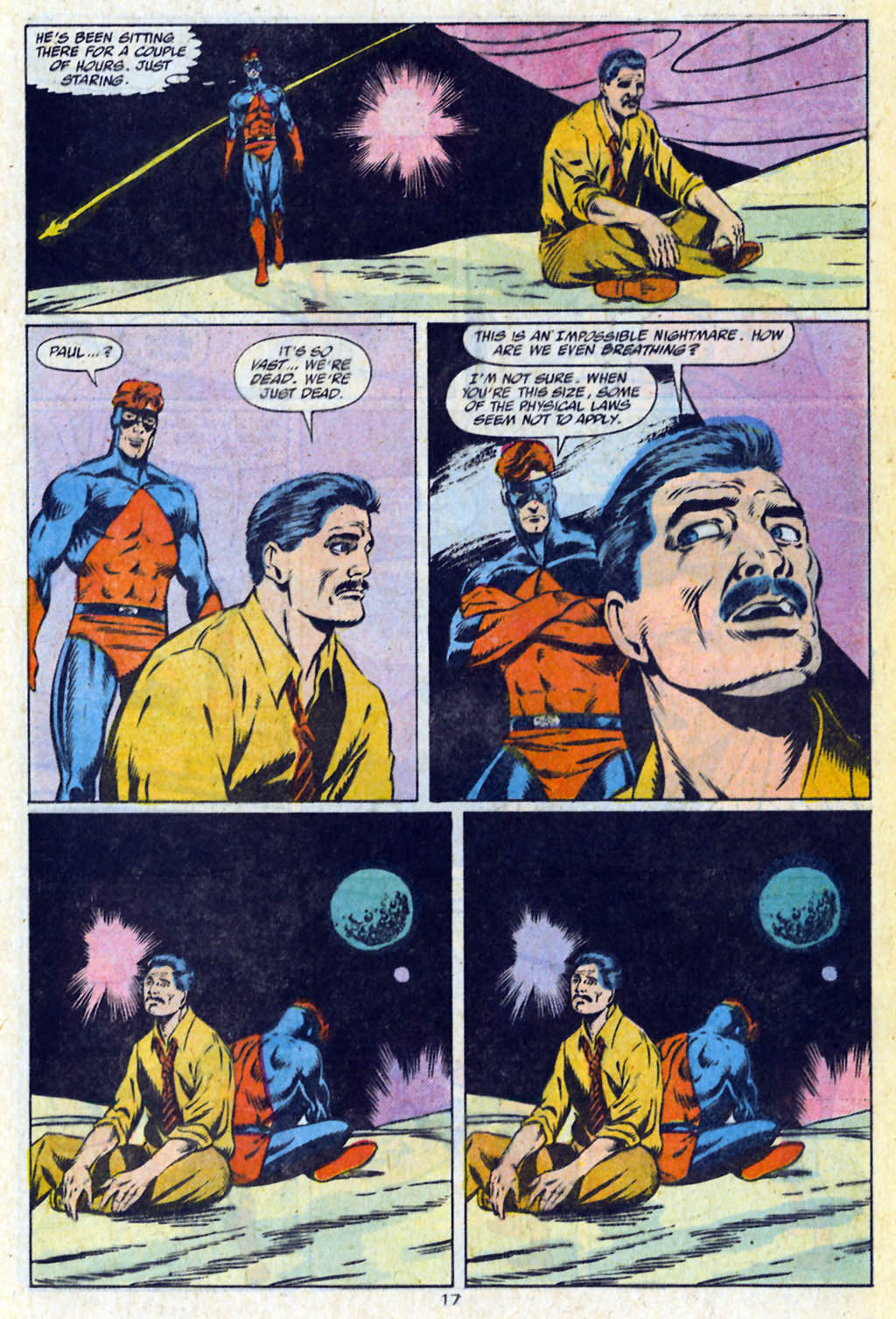
William Messner-Loebs then guested as writer for issues #12-13, and immediately elevated the series to a new level. His two issues explore some of the obvious ramifications of dealing with a size-changing hero, ideas that, strangely enough, had been ignored in the Stern-written issues. In #12, Ray and Paul shrink down, first so that they're surrounding by an enormous carpet jungle, then shrink even further until they pass into a strange alien universe of electrons and microscopic particles, with Nolan rendering this miniature world as outer space, with atoms as planets floating in the void. It's potent stuff, and Messner-Loebs makes this journey into the microscopic as metaphysical and emotional as it is physical. In #13, Ray enters a woman's body to stitch together some hemorrhaging blood vessels, and again it provides an opportunity for Nolan's visual imagination to cut loose, as well as really confronting what it means for a man to be able to shrink like this and enter spaces usually reserved for remote scientific study. Messner-Loebs brings to this series an emotional and thematic depth missing from the uneven Stern issues that preceded this point, as well as a strong sense of humor and attention to character, as seen especially in the comically staged riot, juxtaposed against a warm, funny Jean/Ray scene, that closes this two-issue run.
It's a shame that Messner-Loebs didn't stay with the Atom for longer, but by this point the title's impending cancellation must have been obvious. Stern brought in Tom Peyer, then a new name in comics, to write the series' final storyline. Peyer did a good job of wrapping up this 18-issue run, pushing Atom to the breaking point, bringing out darker aspects of the character not seen since the Sword days. In Peyer's first issue, he juxtaposes some dark comedy with a pair of inept kidnappers against the Atom's gradual realization that the CIA has betrayed him, and this issue climaxes when he learns the full extent of that betrayal. Issue #17, with a ferocious Atom launching himself on a mad revenge quest, is a real scorched-earth blast of a comic, doing a great job of channelling everything that was so fun about the barbarian warrior Atom from Sword. It's a strong ending to a series that took way too long to find its footing, but the second half of its run has lots of good stuff, mostly from Messner-Loebs and Peyer, though even the Stern issues in the second half are stronger than they had been at first.
The Atom Special #1-2 (Tom Peyer & Steve Dillon/Luke McDonnell) - A pair of one-shots from 1993 and 1995, during a stretch when Ray Palmer once again had no ongoing series of his own. The first of these specials is a fun, free-wheeling bit of weirdness that draws on the character's complicated recent history and approaches him with equal doses of humor and seriousness. Steve Dillon's deadpan art is equally well-suited to the wry humor and the sudden bursts of darkness or violence that dot this very odd comic. Palmer is depicted as an immature jerk, with a supporting cast — his ex-wife, the man she cheated on him with, and the friend who exposed his secret identity to the world — who are just as unlikeable. Palmer is confronted with visions of his past (drawn from both preceding series and his appearances in Suicide Squad), believing he's going crazy as he's haunted by the various deaths and betrayals that have troubled him over the years.
Peyer packs the book with wacky images: a tiny time portal with a periscope poking out of it, a man with a clock embedded in his face, the Atom judo-flipping a cat, the Atom building a microscopic house made of actual atoms in a sad attempt to escape humanity. It all climaxes with a deliciously gory end for the story's villain, and Palmer being reunited with his nasty supporting cast so they can all trade cruel barbs again. Ha ha, good times. Unfortunately, when Peyer returned with a second special two years later (this one drawn by Suicide Squad veteran Luke McDonnell), Palmer had inexplicably been de-aged to 17 years old by Zero Hour, one of DC's periodic obsessive continuity reshufflings. It's an odd choice, and it takes a lot of the air out of this issue, since much of it concerns tired fish-out-of-water jokes with Palmer not understanding the ways in which society or technology had changed since he was 17 — if DC for some reason thought this change was necessary to reinvigorate the character, it obviously did not work.
It's all somewhat silly pulp, but that's kind of the point: the series transforms the Atom into a barbarian hero, riding into battle on a frog and attacking lizards or rats or alien soldiers with a sword held aloft. It's very fun, though it wouldn't be nearly as compelling if it wasn't drawn by Gil Kane, whose sharp, realistic renderings give weight and intensity to the pulpy action. It's very dynamic work, quickly making this tiny world feel real, its over-sized animals menacing and frightening, the alien supporting cast quickly delineated into a handful of strong personalities who form the political backdrop for the Atom's adventures here. Strnad checks in every so often with Jean, who believes Ray to be dead and tries to move on with her new lover before abruptly (and inexplicably) deciding that Ray must be alive after all. The emphasis is always on the Atom's adventures in the jungle, though, and the few brief detours to the normal-sized world don't distract from the series' focus. It's not the most sophisticated series, and there seems to be an unfortunate editorial mandate to summarize the whole plot every issue despite it being just a four-issue miniseries, but for its inventive concept and Kane's elegant realization of it, it is well worth seeking out.
The original miniseries was followed over the next few years by three one-off specials that continued the story, and despite repeated editorial pleas for readers to demand an ongoing series, one never took off. The first special is an extended recounting of the miniseries with narration taken from a book written about the Atom's adventures, and climaxing with Ray and Jean calling it quits for good so Ray can go back to the Amazon to find his yellow-skinned princess again. The second special is more substantial, dealing with a war between the Atom's tribe and a rival group of aliens — though the rather contrived plotting necessary to bring Jean down to the Amazon again suggests some reluctance to truly make a clean break with the past and run with this new direction for the characters. The third special, with Pat Broderick doing a fine job of replacing Kane on art, is a bit sluggish to start and has some odd narrative inconsistencies with the rest of this material, but it climaxes with a chilling, gory second half packed with zombie horror, suggesting a desire to turn the Atom into a real pulp/genre hero, comfortable in Conan-esque warrior action, sci-fi adventures, and EC-style horror alike. It was not to be, though, and Sword never transitioned into the ongoing series that might have pursued this genre-hopping direction further.
Power of the Atom (Roger Stern, William Messner-Loebs, Tom Peyer & various artists) - Instead of embracing Sword's direction, the Atom returned in a new series that brought him traumatically back to normal-sized civilization, his lover and her alien society destroyed in a fire, leaving the grief-stricken Atom to pick up the pieces of his old life again. Written by Roger Stern and drawn at first by Dwayne Turner, the series got off to a very slow start by rehashing the Sword material and throwing the Atom against a number of generic threats while various suplots slowly percolated. Also, Turner's art over the first 5 issues is really rough and boring — once he's replaced by John Byrne (for a one-issue fill-in on #6) and Graham Nolan, the more dynamic art makes the series much more palatable. Still, despite some interesting character beats for Ray in these early issues, things don't fully take off until Stern introduced the creepy, very odd new villain Humbug in #10, and then developed the character of Jean's new husband Paul into an actual compelling, if unlikeable, character.
William Messner-Loebs then guested as writer for issues #12-13, and immediately elevated the series to a new level. His two issues explore some of the obvious ramifications of dealing with a size-changing hero, ideas that, strangely enough, had been ignored in the Stern-written issues. In #12, Ray and Paul shrink down, first so that they're surrounding by an enormous carpet jungle, then shrink even further until they pass into a strange alien universe of electrons and microscopic particles, with Nolan rendering this miniature world as outer space, with atoms as planets floating in the void. It's potent stuff, and Messner-Loebs makes this journey into the microscopic as metaphysical and emotional as it is physical. In #13, Ray enters a woman's body to stitch together some hemorrhaging blood vessels, and again it provides an opportunity for Nolan's visual imagination to cut loose, as well as really confronting what it means for a man to be able to shrink like this and enter spaces usually reserved for remote scientific study. Messner-Loebs brings to this series an emotional and thematic depth missing from the uneven Stern issues that preceded this point, as well as a strong sense of humor and attention to character, as seen especially in the comically staged riot, juxtaposed against a warm, funny Jean/Ray scene, that closes this two-issue run.
It's a shame that Messner-Loebs didn't stay with the Atom for longer, but by this point the title's impending cancellation must have been obvious. Stern brought in Tom Peyer, then a new name in comics, to write the series' final storyline. Peyer did a good job of wrapping up this 18-issue run, pushing Atom to the breaking point, bringing out darker aspects of the character not seen since the Sword days. In Peyer's first issue, he juxtaposes some dark comedy with a pair of inept kidnappers against the Atom's gradual realization that the CIA has betrayed him, and this issue climaxes when he learns the full extent of that betrayal. Issue #17, with a ferocious Atom launching himself on a mad revenge quest, is a real scorched-earth blast of a comic, doing a great job of channelling everything that was so fun about the barbarian warrior Atom from Sword. It's a strong ending to a series that took way too long to find its footing, but the second half of its run has lots of good stuff, mostly from Messner-Loebs and Peyer, though even the Stern issues in the second half are stronger than they had been at first.
The Atom Special #1-2 (Tom Peyer & Steve Dillon/Luke McDonnell) - A pair of one-shots from 1993 and 1995, during a stretch when Ray Palmer once again had no ongoing series of his own. The first of these specials is a fun, free-wheeling bit of weirdness that draws on the character's complicated recent history and approaches him with equal doses of humor and seriousness. Steve Dillon's deadpan art is equally well-suited to the wry humor and the sudden bursts of darkness or violence that dot this very odd comic. Palmer is depicted as an immature jerk, with a supporting cast — his ex-wife, the man she cheated on him with, and the friend who exposed his secret identity to the world — who are just as unlikeable. Palmer is confronted with visions of his past (drawn from both preceding series and his appearances in Suicide Squad), believing he's going crazy as he's haunted by the various deaths and betrayals that have troubled him over the years.
Peyer packs the book with wacky images: a tiny time portal with a periscope poking out of it, a man with a clock embedded in his face, the Atom judo-flipping a cat, the Atom building a microscopic house made of actual atoms in a sad attempt to escape humanity. It all climaxes with a deliciously gory end for the story's villain, and Palmer being reunited with his nasty supporting cast so they can all trade cruel barbs again. Ha ha, good times. Unfortunately, when Peyer returned with a second special two years later (this one drawn by Suicide Squad veteran Luke McDonnell), Palmer had inexplicably been de-aged to 17 years old by Zero Hour, one of DC's periodic obsessive continuity reshufflings. It's an odd choice, and it takes a lot of the air out of this issue, since much of it concerns tired fish-out-of-water jokes with Palmer not understanding the ways in which society or technology had changed since he was 17 — if DC for some reason thought this change was necessary to reinvigorate the character, it obviously did not work.
Monday, August 5, 2013
Green Arrow
Green Arrow: The Longbow Hunters (Mike Grell) - This was the start of what turned out to be an epic run by Mike Grell on this character, a three-issue miniseries that revitalized Green Arrow and attempted to introduce him into the new "grim and gritty" era of superheroes the same way Frank Miller had for Batman. It's an interesting, lovingly made work with some contradictions and problems that prevent it from being a total classic, even if it is still one of the essential GA tales. Grell wrote and drew the series, and his art is gorgeous, alternating between multiple styles: some panels pop out in hyper-realistic detail, others are sketchy and minimalistic, and others have more of an in-between, conventional superhero style. The contrasting styles work really well together, and it's all held together by Julia Lacquement's sumptuous colors, which look like they're done with a mix of paints and colored pencils. The book simply looks AMAZING, even if Grell is a better draftsman than he is a designer, and some of his page layouts are somewhat cluttered and confusing.
The story is interesting, too, and Grell gets a lot right. He establishes Oliver Queen (he's never really called Green Arrow in Grell's comics except on the covers) as a character outside of his superhero identity, an aging radical who still holds on to some of his idealism, as he wonders what he should be doing as he gets older. Grell also does a great job of setting up the romance between Ollie and his longtime girlfriend Dinah Lance, AKA Black Canary. The love and tenderness and emotional connection between this pair are richly developed in their scenes together. Probably the high point of the series is the moment when Ollie, feeling old and wanting to start a family, asks Dinah to have a child with him — her devastating response is framed by Grell in one of his hyper-realistic panels, her sad face highlighted by the bold, photo-like styling of this panel.
That emotional richness is one reason why it's such a shame that Grell ultimately can't think of anything better to do besides falling back on the clichéd old trope of having the hero's girlfriend kidnapped, tortured and sexually assaulted, causing him to go on a revenge quest. The fact that the damsel-in-distress here is herself a hero with a long history in the DC universe only makes it worse; Dinah, of all people, shouldn't be relegated to woman-in-refrigerator status, a mere victim to spur on her man's violence, especially since elsewhere Grell does so much more with these characters and their relationship. There's something shallowly "dark" about all this implied rape and sexualized violence, a sense that the series is just trying to respond to the era's imperative to make every hero grittier and more violent. Moreover, such excess isn't necessary: the series is most "mature" when it candidly deals with the main characters' feelings for one another and their conflict over starting a family, not when it resorts to shock-value violence and sexual torture. There's a lot to like here, in the gorgeous art and the compelling characterization — of Ollie, Dinah and also the new character Shado, who would become very important to Grell's GA — but the more violent and sexualized moments too often feel forced and unnecessary.
Green Arrow #1-80 (Mike Grell & various artists) - Following the success of Longbow Hunters, Grell moved on to write (but mostly not draw) an ongoing GA series for 80 issues. I read it in a condensed period of time, but still, by the end, it was all but impossible to remember why I had enjoyed it at the beginning of the run. There's no getting around it: this goes way downhill after a while. At first, though, it's pretty good, not without some of the same problems that marred Longbow Hunters, but still solid enough. Nice interactions between Ollie, Dinah and, at times, Shado, who pops up for arcs at predictable intervals. Some decent issue-oriented action with Ollie taking on street crime, prostitution, drugs, the environment, and all the kinds of often-hamfisted social issue stories you'd expect from a Green Arrow series.
Moreover, the first 34 issues or so provide a nice arc and a nice resolution to some of the issues raised by Longbow Hunters — notably, a sequence that mirrors the one where Ollie rescues Dinah, except with her taking the active role this time, thereby neatly calling back to the earlier scene and this time letting Ollie know how it might have felt for Dinah to be the helpless victim being rescued by him. There's also the heartbreaking scenes that follow this rescue, when Ollie and Dinah decide they might want to start a family after all. And then, well, it all goes off-track.
The subsequent "Black Arrow Saga" is promising but doesn't live up to its potential, sacrificing drama and action to introduce the annoying new character of Marianne and her especially annoying accompanying narrative boxes. Then Ollie goes off on his own for a year, wandering the world through a series of dismally boring and predictable adventures. When he gets back, it's not much better, and except for the inevitable appearances by Shado, who shows up about once a year for a four-part arc, the series trods through one forgettable two-parter after another. There are especially abysmal stories that riff on various pop culture touchstones, like clumsy takes on Shane and Cat People. There's a very odd story about the death penalty that ties itself into moral knots trying to deal with this issue in the context of a vigilante hero who has at times killed those he felt deserved it.
The series reaches its nadir in issue #75, which throws in a ton of guest spots and tries to stir up some cringeworthy drama out of nothing. It's all over not long after that. The run has its moments, mostly early on, but it never really rises to the level of greatness, and Grell keeps sabotaging the best attributes of the series, neglecting the great Ollie/Dinah romance in favor of disposable and rushed "issue" stories, while Dinah too often disappears into the background for long stretches. The big action arcs, often focusing on Shado or the morally ambiguous assassin Eddie Fyres, are better, with Grell spacing out just enough emotional beats to keep the series from ever becoming completely brainless. It's an important and often interesting run, and it contains the seeds of a truly great and revolutionary take on these characters, but Grell is never able to bring it all together into a satisfying whole for any sustained period.
Brave and the Bold: Green Arrow/The Butcher/The Question (Mike Grell, Mike Baron & Shea Anton Pensa) - A lousy six-issue spin-off miniseries that teams up these three fringe characters. The story is a mess, involving a conspiracy between the IRA and various Native American tribes, with weapons deals and rebellions and terrorist attacks, but rather than seeming like a twisty action plot, it's just a confusing jumble that never makes much sense or really deals with its underlying issues in an interesting way. It winds up just being an excuse for some lame action. But the worst aspect of the series is definitely Pensa's art, which just doesn't work at all on any level. It's sketchy and cartoony and stylized, which is fine, and there are panels here and there where I can sort of see what he's going for — a garish, cartoonish style reminiscent of Moebius' more humorous moments. For the most part, though, it's just hideous and unclear. Pensa's terrible at character definition, so the large cast is impossible to keep track of, the Question just looks like Green Arrow without a beard, and at one point there's a villain who looks exactly like Ollie. Dinah, meanwhile, looks like Mick Jagger. This isn't a good story to begin with but the ugly art just makes it intolerable, easily the worst thing to come out of Grell's entire Green Arrow run.
Shado: Song of the Dragon (Mike Grell, Michael Davis Lawrence & Gray Morrow) - In contrast, this is a really great spin-off, featuring Shado finally on her own, without Ollie around (he appears only in a brief flashback/memory). The story is somewhat formulaic, and indeed it drives home that Shado is a great character about whom there are a limited number of stories that can be told, and most of them just involve her fighting the yakuza. But this series finally allows her a moment to shine on her own, without being a player in a Green Arrow plot, and she definitely carries the miniseries, with some help from a small cast that's assembled around her. The story touches on the usual Shado themes — particularly the driving forces of honor and destiny — and surrounds her with other characters who have their own conceptions of honor, their own ideas of the things they must do. But the art is the real star: Lawrence inked by Morrow, for a style that's thoroughly realistic in its figures and faces, but stylized in the loose, free-associative page layouts. Lawrence also provides rich color washes that give the book a very sensual and almost abstract feel. There are some occasional data dumps about Japanese history or the characters' histories, so the writing isn't always that graceful, but for the art and the overall feel of this mini, it's well worth reading.
Green Arrow: The Wonder Year (Mike Grell & Gray Morrow) - Late in Grell's run on Green Arrow, he offered up this miniseries detailing Ollie's origin. It's his attempt to do a Year One-style take on the character, but like a lot of Grell's work on this character, it falls short of its aspirations and its promise. On the plus side, it's a great-looking comic, a worthy successor to Longbow Hunters in that respect at least. Morrow is mostly inking and finishing over Grell's layouts and pencils, and the art is sumptuous and richly varied. The regular Green Arrow series often looked very good, but Grell really trotted out the big guns, artistically, for these Prestige miniseries, and the amount of work that went into making this look so good is very apparent. It's a shame the story isn't worthy of such effort. Grell, during his run, disposed of all of Ollie's trick arrows and gimmicks and attempted to make him a realistic, street-level hero. This origin story fits awkwardly with that approach, constantly calling attention to how ridiculous it is to run around with a bow-and-arrow and a Robin Hood costume fighting crime. There's a level of suspension of disbelief that Grell has to overcome here, to sell the idea that this idle rich guy, changed by his experience of being stranded on an island, dresses up as Robin Hood and runs around fighting bad guys, and he can never quite get this across. The story is nothing much, either, riffing on the 60s and 70s radical student groups as a figure from Ollie's past gets tangled up in a conspiracy stretching back to a decades-old terrorist attack by one of those groups.
The story is interesting, too, and Grell gets a lot right. He establishes Oliver Queen (he's never really called Green Arrow in Grell's comics except on the covers) as a character outside of his superhero identity, an aging radical who still holds on to some of his idealism, as he wonders what he should be doing as he gets older. Grell also does a great job of setting up the romance between Ollie and his longtime girlfriend Dinah Lance, AKA Black Canary. The love and tenderness and emotional connection between this pair are richly developed in their scenes together. Probably the high point of the series is the moment when Ollie, feeling old and wanting to start a family, asks Dinah to have a child with him — her devastating response is framed by Grell in one of his hyper-realistic panels, her sad face highlighted by the bold, photo-like styling of this panel.
That emotional richness is one reason why it's such a shame that Grell ultimately can't think of anything better to do besides falling back on the clichéd old trope of having the hero's girlfriend kidnapped, tortured and sexually assaulted, causing him to go on a revenge quest. The fact that the damsel-in-distress here is herself a hero with a long history in the DC universe only makes it worse; Dinah, of all people, shouldn't be relegated to woman-in-refrigerator status, a mere victim to spur on her man's violence, especially since elsewhere Grell does so much more with these characters and their relationship. There's something shallowly "dark" about all this implied rape and sexualized violence, a sense that the series is just trying to respond to the era's imperative to make every hero grittier and more violent. Moreover, such excess isn't necessary: the series is most "mature" when it candidly deals with the main characters' feelings for one another and their conflict over starting a family, not when it resorts to shock-value violence and sexual torture. There's a lot to like here, in the gorgeous art and the compelling characterization — of Ollie, Dinah and also the new character Shado, who would become very important to Grell's GA — but the more violent and sexualized moments too often feel forced and unnecessary.
Green Arrow #1-80 (Mike Grell & various artists) - Following the success of Longbow Hunters, Grell moved on to write (but mostly not draw) an ongoing GA series for 80 issues. I read it in a condensed period of time, but still, by the end, it was all but impossible to remember why I had enjoyed it at the beginning of the run. There's no getting around it: this goes way downhill after a while. At first, though, it's pretty good, not without some of the same problems that marred Longbow Hunters, but still solid enough. Nice interactions between Ollie, Dinah and, at times, Shado, who pops up for arcs at predictable intervals. Some decent issue-oriented action with Ollie taking on street crime, prostitution, drugs, the environment, and all the kinds of often-hamfisted social issue stories you'd expect from a Green Arrow series.
Moreover, the first 34 issues or so provide a nice arc and a nice resolution to some of the issues raised by Longbow Hunters — notably, a sequence that mirrors the one where Ollie rescues Dinah, except with her taking the active role this time, thereby neatly calling back to the earlier scene and this time letting Ollie know how it might have felt for Dinah to be the helpless victim being rescued by him. There's also the heartbreaking scenes that follow this rescue, when Ollie and Dinah decide they might want to start a family after all. And then, well, it all goes off-track.
The subsequent "Black Arrow Saga" is promising but doesn't live up to its potential, sacrificing drama and action to introduce the annoying new character of Marianne and her especially annoying accompanying narrative boxes. Then Ollie goes off on his own for a year, wandering the world through a series of dismally boring and predictable adventures. When he gets back, it's not much better, and except for the inevitable appearances by Shado, who shows up about once a year for a four-part arc, the series trods through one forgettable two-parter after another. There are especially abysmal stories that riff on various pop culture touchstones, like clumsy takes on Shane and Cat People. There's a very odd story about the death penalty that ties itself into moral knots trying to deal with this issue in the context of a vigilante hero who has at times killed those he felt deserved it.
The series reaches its nadir in issue #75, which throws in a ton of guest spots and tries to stir up some cringeworthy drama out of nothing. It's all over not long after that. The run has its moments, mostly early on, but it never really rises to the level of greatness, and Grell keeps sabotaging the best attributes of the series, neglecting the great Ollie/Dinah romance in favor of disposable and rushed "issue" stories, while Dinah too often disappears into the background for long stretches. The big action arcs, often focusing on Shado or the morally ambiguous assassin Eddie Fyres, are better, with Grell spacing out just enough emotional beats to keep the series from ever becoming completely brainless. It's an important and often interesting run, and it contains the seeds of a truly great and revolutionary take on these characters, but Grell is never able to bring it all together into a satisfying whole for any sustained period.
Brave and the Bold: Green Arrow/The Butcher/The Question (Mike Grell, Mike Baron & Shea Anton Pensa) - A lousy six-issue spin-off miniseries that teams up these three fringe characters. The story is a mess, involving a conspiracy between the IRA and various Native American tribes, with weapons deals and rebellions and terrorist attacks, but rather than seeming like a twisty action plot, it's just a confusing jumble that never makes much sense or really deals with its underlying issues in an interesting way. It winds up just being an excuse for some lame action. But the worst aspect of the series is definitely Pensa's art, which just doesn't work at all on any level. It's sketchy and cartoony and stylized, which is fine, and there are panels here and there where I can sort of see what he's going for — a garish, cartoonish style reminiscent of Moebius' more humorous moments. For the most part, though, it's just hideous and unclear. Pensa's terrible at character definition, so the large cast is impossible to keep track of, the Question just looks like Green Arrow without a beard, and at one point there's a villain who looks exactly like Ollie. Dinah, meanwhile, looks like Mick Jagger. This isn't a good story to begin with but the ugly art just makes it intolerable, easily the worst thing to come out of Grell's entire Green Arrow run.
Shado: Song of the Dragon (Mike Grell, Michael Davis Lawrence & Gray Morrow) - In contrast, this is a really great spin-off, featuring Shado finally on her own, without Ollie around (he appears only in a brief flashback/memory). The story is somewhat formulaic, and indeed it drives home that Shado is a great character about whom there are a limited number of stories that can be told, and most of them just involve her fighting the yakuza. But this series finally allows her a moment to shine on her own, without being a player in a Green Arrow plot, and she definitely carries the miniseries, with some help from a small cast that's assembled around her. The story touches on the usual Shado themes — particularly the driving forces of honor and destiny — and surrounds her with other characters who have their own conceptions of honor, their own ideas of the things they must do. But the art is the real star: Lawrence inked by Morrow, for a style that's thoroughly realistic in its figures and faces, but stylized in the loose, free-associative page layouts. Lawrence also provides rich color washes that give the book a very sensual and almost abstract feel. There are some occasional data dumps about Japanese history or the characters' histories, so the writing isn't always that graceful, but for the art and the overall feel of this mini, it's well worth reading.
Green Arrow: The Wonder Year (Mike Grell & Gray Morrow) - Late in Grell's run on Green Arrow, he offered up this miniseries detailing Ollie's origin. It's his attempt to do a Year One-style take on the character, but like a lot of Grell's work on this character, it falls short of its aspirations and its promise. On the plus side, it's a great-looking comic, a worthy successor to Longbow Hunters in that respect at least. Morrow is mostly inking and finishing over Grell's layouts and pencils, and the art is sumptuous and richly varied. The regular Green Arrow series often looked very good, but Grell really trotted out the big guns, artistically, for these Prestige miniseries, and the amount of work that went into making this look so good is very apparent. It's a shame the story isn't worthy of such effort. Grell, during his run, disposed of all of Ollie's trick arrows and gimmicks and attempted to make him a realistic, street-level hero. This origin story fits awkwardly with that approach, constantly calling attention to how ridiculous it is to run around with a bow-and-arrow and a Robin Hood costume fighting crime. There's a level of suspension of disbelief that Grell has to overcome here, to sell the idea that this idle rich guy, changed by his experience of being stranded on an island, dresses up as Robin Hood and runs around fighting bad guys, and he can never quite get this across. The story is nothing much, either, riffing on the 60s and 70s radical student groups as a figure from Ollie's past gets tangled up in a conspiracy stretching back to a decades-old terrorist attack by one of those groups.
Subscribe to:
Posts (Atom)