Showing posts with label Suicide Squad. Show all posts

Monday, July 1, 2013

Suicide Squad

John Ostrander's creation of a new Suicide Squad (in the pages of the Legends crossover) resulted in one of the great series of the '80s. There had been an earlier Suicide Squad that appeared in a few installments of The Brave and the Bold in the late '50s and early '60s, but though Ostrander carried over some material and characters from that concept, his own Suicide Squad was a fresh idea. The premise — a government-sponsored team which recruits imprisoned criminals for dangerous missions — allowed for characters from all over the DC Universe to be mashed together and set against one another, and also allowed for a multitude of tones and types of stories. Suicide Squad was primarily an espionage/action book, but along the way there was also plenty of traditional capes-and-cowls superhero action, broad humor, dense political sagas, wild interdimensional sci-fi, and crossovers with everyone from Batman to the Doom Patrol. Its material was catholic, both in terms of the types of stories covered and the types of characters who might show up in its pages, but what was consistent was the sharpness of its storytelling and the depth of character that was explored in virtually every villain or anti-hero who joined the Squad, however briefly.

Ostrander was joined, starting with issue #23, by his wife and fellow comic writer Kim Yale, who was rarely absent as co-writer once she joined the book. Whether written by Ostrander solo or in collaboration with Yale, though, Suicide Squad was almost always an engaging and utterly unique book. From the beginning, it was an outlet for a jaundiced, realpolitik view of world affairs and the ways in which governments function, or don't function. The Suicide Squad is representative of all the shadowy, morally questionable things committed in the name of patriotism or democracy or security, and nobody represented that idea as well as Amanda Waller, the head of the Squad and one of Ostrander's most enduring creations. The Wall was a fierce brick of a woman, without powers but nevertheless able to cow and corral her unruly superpowered subordinates. In one of the series' goofiest and craziest stretches, the team travels to Apokolips and Waller actually goes toe to toe with Granny Goodness, the only logical choice for her counterpart among Darkseid's minions. For the most part, though, she's a far more grounded character, a realistic avatar of government intrigue and hard-nosed common-sense, a woman who takes no shit from anyone. In one memorable scene, she even tells off President Reagan, sarcastically asking him if he remembers the days when the US actually had social programs to help people.

Indeed, the presence of Reagan (and later Bush I) in these pages grounds the book in the real politics of the late '80s and early '90s. Beyond Waller's sardonic put-down of Reaganomics, there was very little overt political commentary in Suicide Squad. Ostrander and Yale were never the least bit preachy or didactic, preferring to implicitly critique the whole system through their stories about political corruption, back-door deals, fiercely duelling intelligence agencies, and the moral vacuum that engulfs the corridors of power. Genuine heroes are rare here, and when they do appear — as in the character of Nemesis — their morally driven choices often drive them right out of the book's orbit. Waller herself isn't always a sympathetic figure, and she's as morally compromised as anyone else in the book; she's an anti-hero, though at times Ostrander even toys with making her into an outright villain. The group's missions aren't as clearcut as the typical superhero fight, either, in that it's often not clear if the Squad is even on the right side, or if there is a "right" side in these complex conflicts.

That's why the book was at its weakest whenever it bowed to conventional superhero ideas of good vs. bad. The epic, 11-part "Janus Directive" storyline was a crossover with several other books, primarily Paul Kupperberg's Checkmate! and Ostrander's own parallel books, Manhunter and Firestorm. The story starts out promisingly, with shadowy assassinations and obscure plots, but soon becomes mired in endless fight scenes and unfortunately delivers a far more conventional threat than Ostrander usually turned to in his own series. In the end, it seems like a poorly conceived crossover attempt, especially when the final part, in Captain Atom, turns out to have almost nothing to do with the whole preceding story.

In its early days, even beyond this crossover, Suicide Squad was occasionally hampered by being overly connected to other DC books. Ostrander was writing both Firestorm and Manhunter during the same era, and he introduced the Squad in the Legends miniseries, so the early issues especially are constantly dotted with those little editorial caption boxes pointing to issues of these other comics, as well as singling out backstories for various characters in still other comics. It makes it feel at times that Suicide Squad isn't standing on its own or telling its own story; thankfully this tendency soon fell away. In the aftermath of the uneven "Janus Directive," especially, with Yale now onboard, the book became increasingly consistent, its pacing assured, leaping from one action-packed, multi-part arc to the next without ever sacrificing the book's emphasis on character. After "Janus," there wouldn't be another crossover or tie-in until #58's installment in George Perez's "War of the Gods," which Ostrander and Yale mostly use for various character beats before unleashing the inevitable big battle in the issue's second half. (Ostrander and Yale also, hilariously, took this opportunity to kill Grant Morrison, as in the character of "the writer" who had written himself into DC continuity in Animal Man.)

Other than this, Ostrander and Yale kept Suicide Squad pretty self-contained, with its own coherent cast and concerns. Starting around the time of the "Phoenix Gambit" storyline in issues #40-43, Suicide Squad really came into its own as a globe-trotting espionage book, the characters mostly not in costume anymore, undertaking spy missions around the world. The book takes on a brilliant late Cold War tone, depicting the conservative and reactionary forces still struggling to maintain the old orders in various ways, even as Gorbachev's glasnost pushes the US and the USSR towards peace. This approach reaches its frenzied peak in issues #53-57, an extended arc dealing with multiple international forces competing over a cache of Soviet weapons stolen in Afghanistan to be sold to the yakuza. The Suicide Squad finds themselves entangled in a massive struggle that involves terrorists, gangsters, rebels, and spies representing multiple governments, all in a gray zone where crime, war, and government interests overlap in interesting ways.

At the same time, Suicide Squad was also always a character-driven book, with a host of strong personalities: troubled heroes, ambiguous anti-heroes, and villains in various states of reform, whether permanent or transitory. It was Yale, annoyed by the treatment of Barbara Gordon in Alan Moore's The Killing Joke, who came up with the idea of giving the wheelchair-bound Barbara a new role and a potential new place in the DC Universe as a disabled character, unable to reassume the Batgirl role. Yale and Ostrander's distaste for The Killing Joke was certainly not unique to them — many criticized Barbara's diminishment to a victim, a prop, a plot device, crippled for the effect it would have on other characters — but they were the only ones with the vision to actually see storytelling possibilities for the character beyond her crippling. After Killing Joke, Barbara almost never appeared in any DC comics, and it seemed her fate was to fade away into obscurity, and maybe eventually be cured by some writer who wanted to bring back Batgirl (as finally happened anyway in the New 52). Instead, Yale and Ostrander imagined new possibilities for Barbara, creating the Oracle persona and gradually weaving her into the Squad.

In her first few appearances, she's just a voice emanating from a computer, though Yale and Ostrander quickly started planting clues before revealing her identity as Barbara Gordon. She then took on a more active role with the Squad starting with issues #48-49, which put the spotlight on Oracle and provided Barbara, at long last, with an opportunity to vent her own feelings about her fate at the hands of the Joker — something which, astonishingly, no one had really bothered to do before this, two years after The Killing Joke. In #59, Barbara comes face to face with Batman for the first time as Oracle, a poignant and sharply written encounter that was their most substantial meeting in years. The fact that no one in the actual Batman books was telling these stories more or less proves how little anyone at DC thought of Barbara, how little they thought of her crippling as something that actually happened to her as a character — she was a plot device, no more, forgotten as soon as the violence committed against her had provided its shocks. Yale and Ostrander alone refused to forget her, and their revitalization of the character paved the way for Barbara's important role in future Batman stories as well as a central part in the much-loved Birds of Prey.

That Oracle had her start in the pages of Suicide Squad is indicative of the strong character work that epitomizes this series. Ostrander and Yale frequently delved into the psychologies and pasts of these characters; for a book founded on the principle of throwing expendable, washed-up villains into action, it's extraordinarily sympathetic towards these characters and much attention is paid to motivation and history. This is evident as well in the Deadshot miniseries that was spun off from Suicide Squad, featuring some exceptional art from regular Squad artist Luke McDonnell, here inking himself and really playing up the angular, angry quality of his linework, so well-suited to these dark tales. This brutal, unflinchingly grim four-issue detour took a sometimes-impenetrable enigma and opened him up tremendously without erasing his essential characterization as a remorseless assassin. Ostrander and Yale dare to exploit a familiar genre cliché — the hero, or anti-hero, tearing through ranks of bad guys to save a loved one — and subtly turn it upside-down by having Deadshot perpetrate all this vengeful violence essentially out of obligation to the convention, rather than a real attachment to his son, who's been kidnapped and threatened with death. Deadshot does what he's supposed to, he kills anyone who gets in his way, and he exacts his brutal vengeance, but he seems to care little about the boy he's doing all this for, and he doesn't so much as pause to shed a tear or reveal a shred of humanity when the series reaches its grim climax. This mini also elaborated on Deadshot's sordid family history, and all this spills over again into the main series a few issues later, as the assassin becomes even more unhinged than usual at a crucial moment. Still later, Deadshot goes through some fascinating psychological back-and-forth relating to his identity, his costume, and his name.

Even a character like Dr. Light, who is generally treated as a joke, has some poignancy in the hands of Ostrander and Yale — they too see him as pathetic, a shell of a villain plagued by anguish over his continual defeats at the hands of child superheroes, but his torment is dealt with seriously even in the context of stories that mock him. It's a delicate line; he's a subject of humor but his very status as a joke provides some degree of empathy in these same stories. This approach reaches its apex in the bonkers issue #52, which is an all-out slapstick farce (with appropriate cartoony, Looney Tunes-esque art by Jim Fern) dealing with the character's death and resurrection (and death and life and...). Captain Boomerang is another continual source of comedic relief throughout this series, acknowledging that he could basically never be anything but a joke, but also infusing him with real personality and attitude, treating him as a real character, an irrepressible rogue, rather than a disposable caricature. Ostrander and Yale extended this approach to almost everyone they dealt with; there are no wasted characters here, no cardboard cutouts, even if a particular character doesn't wind up sticking around for very long.

That's what makes Ostrander and Yale's Suicide Squad so special. The premise seems to promise mayhem and death above all, a meat-grinder for second-tier characters. Instead, this husband-and-wife team created an inventive, constantly changing title where forgotten and discarded characters were treated with respect and empathy, fleshed out and given some depth even if it they were fated to die a few panels later. And the long-running characters who defined the book — The Wall, Rick Flag, Eve Eden, Bronze Tiger, Vixen, Boomerang, Deadshot, Count Vertigo, Oracle, as well as a rich supporting cast of non-combatants — were treated to lengthy, nuanced character studies, in some cases lasting for the entire 66-issue run. Indeed, when the series was cancelled due to low sales, Ostrander and Yale dedicated much of the final issue to brief sequences exploring (and in some cases resolving) the characters' long-running psychodramas, and the last page of this last issue is memorably given over to a tense and incredibly powerful sequence at last resolving a long-gestating subplot involving Count Vertigo's contemplation of suicide.

This serial characterization was woven together with political intrigue and commentary, undeniably thrilling action, pies to the face, ghosts, devils, and bursts of horrifying violence. Who, after reading these issues, can forget Duchess killing the Manticore by ripping off his tail and beating him with it? And who could forget Barbara's silent, tearful reaction to the death of a friend? Or "Boomerbutt" stranded on an unpopulated island? Or the tense moment when a sweating, shaking Bronze Tiger must face the truth about his own history of violence and rage? Suicide Squad was a book big enough, and smart enough, to encompass all these extremes of humor, violence and emotion, and that is what made it so great.

Thursday, May 9, 2013

Weekly Comics: May 8, 2013

3 New Stories (Fantagraphics) - Pamphlet-format comics from indie publishers are pretty rare these days, with most smaller publishers having migrated towards the bookstore market and "graphic novels." So it's nice when something like this comes along, an actual floppy comic with three stories by Dash Shaw. I suspect the demise of Fantagraphics' anthology MOME may have something to do with this release, as these little experiments are exactly the kind of thing that Shaw would've published in those pages. With no regular outlet for these kinds of short stories, which have always formed a significant portion of his artistic output, he's assembled a few of them here. The middle story is a very short "adaptation" of a Girls Gone Wild segment, similar in form to the dating-show adaptations Shaw did in MOME, though not as substantial — he doesn't manage to burrow into the emotional core of this shallow video product the way he had with his earlier TV/video adaptations. "Object Lesson" is a pointed surrealist piece about the current economic situation, a barbed satire in which an out-of-work detective is sent back to high school due to a clerical error, while his family starves and resorts to eating the dog, his wife encouraging him to, "Lower your standards. Abolish your goals. Cower. Give up. Please." Throughout the comic, Shaw's drawings are overlaid on collages of paintings and photographs, full of symbols — Spider-Man, gold coins, a desert vista — that comment on the action and also serve as backgrounds and coloring. It's a potent, ambiguous portrait of a society where standards, goals, and morality have been rendered obsolete, where education is a bad joke, where making money means resigning oneself to serving a ridiculous system. Similarly, the final story depicts a children's prison where kids have been jailed for petty offenses, prevented from deviating in even the smallest ways from a restrictive series of laws and orders. On the chillingly nonchalant final page, the relentlessly upbeat heroine shrugs off the violence she's seen, a sign of how this kind of system encourages detachment and dehumanization. This is undoubtedly a bleak little comic, but as usual with Shaw, it's also formally inventive and unforgettably potent, communicating some very strong emotional and political truths through its blunt symbolism.

Astonishing X-Men #62 (Marvel) - I wasn't reading this title before its recent involvement in the conclusion of David Lapham's Age of Apocalypse, but I figured I'd check in on this follow-up issue in the hopes that some surviving AOA characters might still be hanging around. No such luck, but this issue is a decent enough, low-key character piece. I'm not sure if the book is always like this, but Marjorie Liu does a good job, in the complete absence of action, of providing quiet character beats and relationship dramas. Very simple stuff, as basic as Kitty Pryde leaning her head on Wolverine's shoulder, after getting shuffled to the side by her boyfriend Iceman during an earlier awkward moment. Artist Gabriel Hernandez Walta's elegant, expressive art is perfectly suited to this kind of understated drama; it's all in the body language, the subtle facial expressions, the careful staging of the characters within the frame. I have a feeling things are bound to head into more conventional mutant action soon enough, but I would happily read a quiet little book like this on a regular basis.

Avengers #11 (Marvel) - Jonathan Hickman's dual run on this title and New Avengers continues to sprawl; while New Avengers has been almost unrelentingly dark and grim and single-minded, the adjectiveless title is looser, epic in scope, leaping around from one thing to the next like a careening pinball, crashing from one shard of plot to another. Here, a group of Avengers attempt to infiltrate an A.I.M.-sponsored weapons deal, posing as gambling fun-seekers while they try to suss out clues. With Mike Deodato's glossy art giving the whole thing an Ocean's Eleven heist movie glow, this issue has a lighter tone than most of Hickman's work on these titles so far. It doesn't always work, and some stabs at humor over Black Widow's plan to take violent shortcuts feel very forced, but most of the issue is quite fun. The highlight is Cannonball and Sunspot convincing a couple of A.I.M. agents to skip the obligatory fight scene and have a fun weekend of boozing and partying instead, a sequence that wouldn't be tonally out of place in Matt Fraction's Hawkeye. Meanwhile, to satisfy those seeking some action, a Shang Chi fight scene is threaded through the whole issue. This is a pretty minor piece of the overall puzzle, probably the weakest single issue of Hickman's Avengers yet, and only at the end is an important piece of information delivered. This will be a mere blip in the eventual omnibus (which is the perfect format for these epic Hickman runs) but as a single issue it's just on a slightly lower level than the rest of the series has been.

Avengers Assemble #15AU (Marvel) - Big surprise, but while Age of Ultron itself has been very good, most of these AU tie-in issues are very unnecessary. This one's set in the early hours of Ultron's takeover, and has Captains Marvel and Britain going up against Ultron with the help of some very whimsical British heroes who, if I'm not mistaken, were invented especially for the occasion. Al Ewing guests for regular writer Kelly Sue DeConnick, and Butch Guice is excellent as ever, but it's all pretty much pointless, because what can any of these tie-ins show besides variations on heroes failing to beat Ultron? Ewing indulges in some fun-enough Britophilia, and there are some nice but all-too-brief sequences when the video-game-infiltrating hero Computer Graham matches pixels with Ultron, but otherwise this is pretty forgettable.

Batman #20 (DC) - The conclusion of Scott Snyder and Greg Capullo's Clayface two-parter is just OK, which compared to some of what's gone on in this title, is a minor triumph. Compared to the ridiculous revelations that capped the Owls storyline or the sputtering non-event of the Joker story, a straightforward Clayface battle that ends with the villain viciously imitating the recently dead Damien Wayne is definitely a step up. There are still some rather head-scratching moments, like Batman pretending to wear a DNA mask taken from Bruce Wayne, but for the most part this is decent if unexciting. It's also odd how out-of-step the relatively well-balanced Bruce seen here is with the grief-stricken lunatic Peter Tomasi is depicting in Batman and Robin, one of the problems with there being something like ten Batman-related titles coming out every month. Unfortunately, there's still no sign of Snyder getting back to the tight noirish detective stories of his pre-New 52 Batman work, and since he's now gearing up for what promises to be a full year's worth of excruciatingly boring origin stories, this ship probably isn't going to be righted anytime soon.

Batman & Red Hood #20 (DC) - In the wake of Damien Wayne's death in Grant Morrison's Batman Incorporated, Peter Tomasi's Batman and Robin is being retitled a few times to co-star first Red Robin and now Red Hood, with other Batman sidekicks and friends set to appear in the title in coming months. Other than Morrison himself, Tomasi seems to be the main Bat-writer dealing with the fallout of Damien's death, and specifically its effect on Bruce, as seen most memorably so far in #18, a silent issue in which Patrick Gleason's brooding art captured the grieving father's rage and despair over the loss of his son and crimefighting partner. Now Tomasi and Gleason have Batman working through the five stages of grief with help from his friends, and it's been heartbreaking and really well-done, a very powerful companion piece to Morrison's work — while Morrison barrels forward towards the likely epic conclusion of his years-long run, Tomasi pauses in the shadows, dealing with the emotional meltdown that follows Bruce's personal tragedy. In this issue, Batman is especially brutal, both with the assassins who he and Red Hood bust up (Batman purposefully deadens the nerves in their hands so they'll never be able to shoot a gun, or feed themselves, again) and in his dealings with Jason Todd, the man under the Red Hood mask and once a Robin himself. The issue's climax is really powerful, both in what it says about Batman's grief over Damien, and in the hurt reaction of Jason, who feels like he deserves better than this cruel manipulation. As in the last issue, where Batman tried to recruit Frankenstein to help him bring Damien back to life, Tomasi is dealing with the messy, ugly, awkward reality of grief, and the raw, ferocious emotions spilling across these pages are really compelling.

Chin Music #1 (Image) - A new horror/supernatural series from Steve Niles (of 30 Days of Night fame) and artist Tony Harris. I was anticipating some good gritty horror, but I didn't think much of this virtually impenetrable first issue, which doles out very little text or dialogue or actual plot — for an introductory issue, there's surprisingly little to hold onto here. Some kind of supernaturally powered guy (a google search tells me he's named Shaw, though the issue isn't so informative) is attacked in what seems to be pre-Twentieth Century Egypt. He's burned and stripped down to a skeleton, which somehow still lives, and flees (or is sent) through time to Prohibition-era Chicago, where he quickly comes into contact with Elliot Ness (who barely reacts to the spectacle of an Arabic-speaking living skeleton) and Al Capone. There's just not much here, and the time travel stuff seems very cutesy, the kind of time travel story where a fight between supernatural beings is used as an explanation for the Sphinx losing its nose, and where the main character will immediately meet any famous historical figures who happen to be in his time. The history-changing ending isn't enough of a hook to bring me back for more, nor is Tony Harris' art, which is nice and moody but can't distract from the essential slightness of this issue.

Constantine #3 (DC) - Yeah, so Peter Milligan's run on Hellblazer wasn't the most exciting or greatest in the title's history, but it was good, and I can't stop thinking about it when reading the new tales of Constantine in the mainstream DC universe. Everything Milligan (and many other writers in Hellblazer's storied history) did well has been jettisoned. The supporting cast is anemic and poorly developed, with characters showing up out of nowhere and heading back there as soon as their plot function has been fulfilled. The book is relentlessly plot-driven, with none of the downtime or weird diversions that always made Hellblazer so fun. And most importantly, Constatine's essential aimlessness has been sacrificed. One of the best things about Constantine was always that he wasn't a hero, that he almost never set out to do big quests for their own sake, but now not only does he have a mission, it's a mission that's explicitly spelled out in the intro box that appears on each issue's title page. It's just totally the wrong approach: Jeff Lemire and Ray Fawkes throw in all the superficial signifiers, the cigarettes and British lingo, but the soul, the attitude, the warped and wild aesthetic, is lost in translation.

Fearless Defenders #4 (Marvel) - Cullen Bunn's had a pretty disappointing career at Marvel so far, and this is the first book he's done for them that really has something to recommend it. It's a goofy, pulpy B-movie kind of book, with an all-female cast, and it has a breezy quality to its action and its banter. Will Sliney's art is slick and his women are undoubtedly sexy, but the book thankfully doesn't resort to outright cheesecake. It's pretty much the definition of a fun, lightweight action comic that's easy to read but not necessarily essential.

Infinity - Free Comic Book Day (Marvel) - Despite not going to a comic shop on Saturday, I did snag a couple of FCBD books at my local shop, including this one. This is a teaser for Jonathan Hickman's upcoming Infinity miniseries, a summer event involving Thanos coming to Earth. As expected, it's all set-up to establish a sense of encroaching doom, but it's beautifully illustrated by Jim Cheung, who turns in some of the best work I've ever seen from him. The alien creatures who serve Thanos are just seething with menace. I'm looking forward to this event, which will probably play like a brief, violent outgrowth from Hickman's larger Avengers run. Also included here is a brief and not bad Thanos/Destroyer fight story from 1977, written by Scott Edelman and drawn by Mike Zeck. Plus a very short excerpt of Warren Ellis' upcoming Avengers graphic novel, way too brief to get any idea of what it'll be like, though the back-and-forth patter between Captain America and a few other Avengers has some nice spark to it.

The Private Eye #2 (Panel Syndicate) - This is Brian K. Vaughan and Marcos Martin's new self-published, digital-only, pay-what-you-want comic, which so far is great for reasons well beyond its attention-getting distribution method. It's set in a future where the era of Internet over-sharing backfired in such a spectacular fashion that now everyone is obsessed with privacy, with most people hiding their names and identities behind masks and role-playing constructs of various degrees of complexity, shedding skins whenever they feel like it. It's a fascinating idea and a wonderfully realized world: one of Vaughan's strengths has always been taking fantasy or sci-fi concepts and building very real-feeling worlds around them, and this one is no exception. Martin's gorgeous art (with a big help from colorist Muntsa Vicente) renders this world vibrant and exciting, stuffed with people hiding behind all sorts of masks, as the underground private eye Patrick Immelmann finds that his client has been murdered. Martin lends a noirish neon-lit vibe to the many night scenes here, particularly a haunting trip to a fringe area where abandoned trains and sewer tunnels have been converted into makeshift homes for masked drug users and dealers.

Prophet #35 (Image) - Brandon Graham's revival of Rob Liefeld's Prophet is one of the most ambitious mainstream comics out, a wild and at times barely coherent sci-fi epic that has taken its time showing its hand with regards to what the hell is going on. The picture is a bit clearer now, with an ancient empire starting to re-emerge while rebels gather their forces to resist, and this issue alternates between the two stories, while also alternating between artists, since Graham has gathered a small staple of artists and associated each one with a different set of characters. Simon Roy handles the perspective of the "New-Father" Prophet who serves the empire, while Giannis Milonogiannis draws the "Old Man" Prophet and his group of anti-empire rebels. Graham exploits the contrast between Roy's thick lines and lumpy forms and Milonogiannis' comparatively thin, minimalist work (which is much closer aesthetically to Graham's own art) to delineate the two groups and their stories, which at this point are still very separate but seem fated to unite eventually. As always, there's lots to love here on a sheer conceptual level, from the way Graham treats a battle scene like a video game or a diagram, with little icons representing the gradually depleting forces on each side, to the Old Man's poignant confrontation with an artifact from his past. Also, the previous issue's backup story by Matt Sheean and Malachi Ward continues here, more evidence of Graham's great taste in showcasing indie auteurs doing great sci-fi work. This serial is nicely creepy and ambiguous, concerning a man sacrificed to a giant monster and methodically going to work in the creature's insides.

Suicide Squad #20 (DC) - The first issue of a new run on this title by Image writer Ales Kot. I haven't checked in on this book since its brainless first issue (by Adam Glass), and Kot is certainly a big improvement over that inauspicious debut. It's all setup, but so far it seems like Kot is planning on introducing some interesting plots, and he's got a good handle on the kind of damaged psychologies that made John Ostrander and Kim Yale's Suicide Squad one of the best series of the '80s. I'm still thrown off by the new skinny, sexy Amanda Waller, which remains a bizarre character design choice, but otherwise this is setting up exactly the kinds of frayed minds and bitter tension that should drive this book. Telling a confirmed death-wish case like Deadshot that he now essentially will not be allowed to die is a great start, and Waller, together with her shadowy associate, seems to be pushing all of her inmates to the breaking point in similar ways. Of course, the revelation of Waller's partner in this at the end of the issue is just icing on the bloody cake, since this particular character has been begging for someone to pick up his story since before the New 52 started. A good start, and it's nice for once to be adding a New 52 title back onto my list rather than dropping one.

Thor: God of Thunder #8 (Marvel) - This is great comics. Jason Aaron hasn't exactly been rushing this introductory God Butcher storyline, but the deliberate pacing has allowed Esad Ribic to deliver countless great images along the way, and it's been great fun to watch the story's three versions of Thor struggling against the implacable Gorr. This issue is where it all starts to come to a head, with the young Viking Thor's story finally intersecting with that of the modern Thor and the old Odin-esque one-eyed Thor. Aaron introduces Thor's granddaughters, the future goddesses of thunder — one of whom confesses to "impure thoughts" about her hunky young grandfather — and delivers a kick-ass final page that promises much more adrenaline-fueled action to come.

Ultimate Comics: Ultimates #24 (Marvel) - The President Cap storyline comes to a rather inauspicious end, with Sam Humphries basically shrugging away the one cool idea of his run so far, not that he did too much to really explore Cap as President in the past few issues. Making Captain America the President for the long run would have been bold and provided plenty of potential stories, so it's a shame that Humphries doesn't seem interested in following through on that possibility. Other than that, there's not much here, though it's funny that between this issue and Uncanny Avengers, this week has two separate comics where Thor must destroy falling space debris before it lays waste to a city.

Uncanny Avengers #8 (Marvel) - When Rick Remender brought his epic Uncanny X-Force to a close, I thought that was it, that he'd said all he had to say, but instead the current arc of his new series seems to be just picking up where he left off. It's a credit to Remender that he's been able to tell this many stories about various versions of Apocalypse without it getting a stale, but somehow it's still thrilling to see these threads being picked up yet again, the contagious evil of Apocalypse passed on to yet more new avatars, here with Kang and Red Skull thrown into the mix. Most of the characters from Remender's X-Force aren't here, and the Avengers have been added to the mix, but this still feels like Uncanny X-Force, a sustained study of evil, nature and nurture, the moral implications of violence, and guilt and responsibility.

The Walking Dead #110 (Image) - One of those talky issues where nothing much happens, besides Robert Kirkman backing away a bit from his introduction of a black self-styled "king" who kept a pet tiger, a character who verged on racist caricature when first introduced. Making him a zookeeper who basically feeds off of other people's legends about him redeems the character somewhat, as does acknowledging that he's kind of a male version of fan-favorite Michonne, who self-styled herself as a badass urban samurai with a sword that she's apparently not as well-trained with as she pretends to be (not that that's stopped her from being an actual badass with it all through the series). Anyway, this plot is still crawling towards the eventual big confrontation with the villainous Negan, perhaps a little too slowly even by Kirkman's usual patient standards.

Wolverine #3 (Marvel) - After the frenzied one-two punch of this series' first two issues, Paul Cornell slows things down a bit for this one, as Wolverine teams up with Nick Fury Jr. (yep, still a ridiculous character) to track down some aliens. The slower pace reveals that this maybe isn't as good or fun as it initially seemed to be. Wolverine's new supporting cast seems to be made up of pub-crawling cast-offs from Hellblazer, and their introduction is really awkward, and then there's lots of fighting for very unclear reasons, and by the end it seems as though the only reason to stick around at all is Alan Davis' still-brilliant cartoony art.

Thursday, September 15, 2011

DC's New 52, Week 2 (September 14, 2011)


This week, I continue my examination of DC's New 52 initiative with my reviews and rankings of the 13 books from the second full week of the new line. My reviews of the first week's releases are here.

I'll also be following up on Monday with my thoughts on a few other non-DC releases. Once the New 52's first month is over, this column will be expanding into a proper roundup of everything I'm reading week by week.

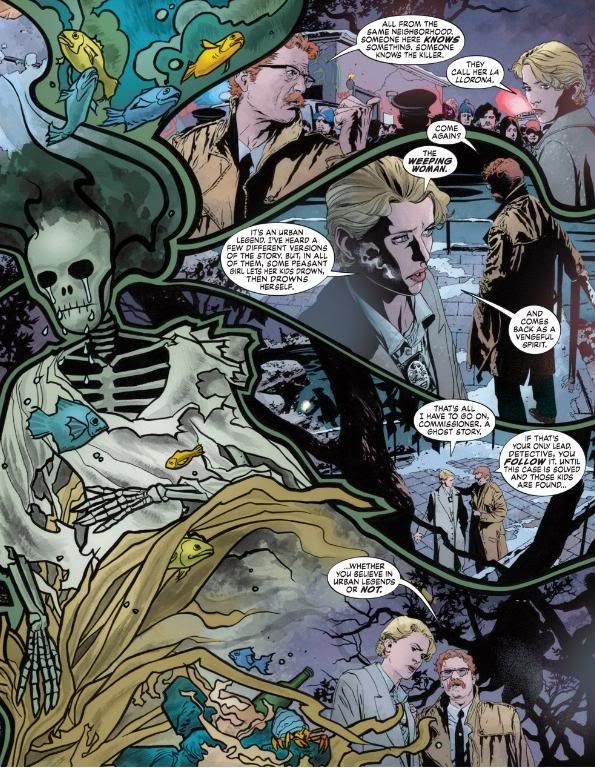
1. Batwoman #1 - The Greg Rucka/J.H. Williams Batwoman stories in Detective Comics were some stunning, exciting comics, largely because of Williams' brilliant layouts, with their kinetic intensity and startling double-page spreads. Now Williams has taken this great character — a red-haired ex-military lesbian who's taken up the mantle of the bat — into her own solo series, and Williams has also gone (more or less) solo, writing and drawing with some writing assistance from W. Haden Blackman. This character hasn't been changed a bit by the reboot; Williams' Batwoman was already in progress before the relaunch, and he reportedly only made a few tweaks to slot the character into the new status quo. The long-awaited result is gorgeous, as expected, and apparently no amount of exposure to Williams' idiosyncratic style can get one used to it, because it's still pretty overwhelming. In one of the best double-page sequences, a police crime scene investigation is arranged in panels circling around the central image of a skeleton, but in contrast to the grim procedural in the radial panels, the skeleton itself is almost whimsical, a dreamlike, haunting image that's an eerie evocation of the story's supernatural themes.

Batwoman, who unlike her iconic model is defined as much by red as by black, is a perfect fit for Williams' bold style, and the fight scenes where she goes tumbling and leaping across the page are as astonishing as they were in Detective Comics. Williams has a keen sense of motion, and that motion is communicated as much by the placement of panels as by the figures within the panels. This is great, all set-up like so many of the other New 52 books, but in this case one hardly notices and it's all over too quickly.

2. Demon Knights #1 - This is just a straight-up blast. It's one of the oddball outliers in the New 52, set in the Dark Ages with a cast of warriors, magicians and demons. It's written by Paul Cornell, who wrote last week's Stormwatch #1, and while it's saddled with a few of the same speaking-in-exposition problems as that title, the overall tone is much breezier and cleaner, and Cornell is much more successful here at setting things up without getting bogged down in the details. Instead, the story moves at a propulsive pace to introduce the demon Etrigan, trapped in the body of a man, and his companion Xanadu, and rapidly throw them into what promises to be an epic battle, with sorcerers and dragons on the opposing side. It's good fun, briskly readable and clever. The art, by Diogenes Neves and Oclair Albert, is gorgeous, too, finely detailed and expressive, with an Old World sensibility that's perfectly suited to the story and the setting. The best moment, simultaneously creepy and exhilarating, is the scene where the evil sorcerers speak to a demon through a possessed baby, a sign of the kind of warped imagination this series will have to offer. This promises to be a gory, riotous romp.

3. Frankenstein: Agent of S.H.A.D.E. #1 - Banking on the appeal of Grant Morrison's version of this iconic character from his Seven Soldiers project, writer Jeff Lemire recasts Frankenstein's monster as a member of a superhuman organization tasked with dealing with the paranormal. And now he's got a team of partners similarly modeled on the famous Universal monsters. As one would expect, Lemire and artist Alberto Ponticelli deliver a fun, freaky tour through the world of S.H.A.D.E., with the organization's headquarters — a microscopic complex housed in a 3-inch metal ball that floats through the world — providing an array of magic and pseudoscientific delights. Ponticelli's loose but detailed art is perfectly suited to both the crowded high-tech corridors of S.H.A.D.E. headquarters and the bloody chaos of the big fight scenes at the end of the issue. In comparison to last week's Animal Man #1, this was always going to be the comparatively conventional Lemire book from the new DC line, but it's still a promising start.

4. Green Lantern #1 - Green Lantern is, along with Batman, one of the characters whose status quo isn't changing much during the New 52 relaunch, so it's definitely to the credit of writer Geoff Johns that, even though I haven't been following this series, I had no problem at all getting caught up to speed as he leaps back into the already-in-progress story here. The pink-skinned Sinestro is a new Green Lantern, somewhat against his will, former Lantern Hal Jordan has been stripped of his powers and is struggling to readjust to life on Earth, and these two come together by the end of the issue. It's set-up for what looks to be a war against Sinestro's own one-time allies, who have enslaved his homeworld. It's not the most exciting issue, but it does a good job of setting up the characters and the conflicts; it's clear, concise Storytelling 101. A lot of these first issues (notably last week's Stormwatch) have struggled with exposition overload, but Johns gets all the necessary information out quickly without making it seem like his characters are spitting out constant plot summaries and descriptions. On the negative side, the Earthbound story with Hal and his girlfriend Carol Ferris is not especially compelling, and Johns resorts to well-worn clichés like the scene where Carol thinks Hal is going to propose, but instead he just makes an innocuous financial request. I also couldn't believe Johns included the laughable scene where Hal, still thinking like a hero, busts in on what looks like domestic abuse but is actually just a movie set. Seems like every struggling hero does that at one point or another. Still, despite some of the lame plotting in Hal's story, this was a decent first issue that had a tougher job to do than some of the other debuts, since Johns isn't really working with the clean slate that most of the other titles have.

5. Superboy #1 - Despite the reset continuity, most of the DC New 52 aren't telling origin stories for the characters. This book is an exception, tracing the early life of the clone Superboy, raised in a tank in a government lab until he breaks out just before being terminated. It's a decent origin story, internally narrated by the self-aware (and overly wordy) Superboy, but the art, by R.B. Silva and Rob Lean, provides most of the pleasure here. The style is bold and cartoony, with thick black lines defining the outlines of characters and objects. The ending is very abrupt, and seems to be setting up Superboy's involvement with the Teen Titans, but before that rushed conclusion this is fine if rather standard superhero fare.

6. Batman and Robin #1 - Much like last week's Detective Comics #1, this is a safe, even boring middle of the road Batman story. The idea that Bruce Wayne wants to finally get past the founding trauma that made him Batman is nice, though the dialogue between Bruce and his son Damian (the newest Robin) in that scene is really heavy-handed. Peter Tomasi's dialogue is awkward in general, actually. The rest of the book is basic superhero action, with a radiation-themed villain hiding in the shadows and dipping people in pools of glowing green sludge to "erase" them. The art by Patrick Gleason and Mick Gray is good enough, the writing is clunky ("because I'm tired of marking the night I watched my father bleed out from his sucking chest wound and my mother from a hole in her throat.") and the whole thing is fairly unexciting. It does have the most laugh-out-loud ridiculous cameo appearance of the purple-hooded woman who apparently appeared in the Flashpoint miniseries that initiated this reboot. This woman appears randomly in the background of every New 52 first issue, which is very silly to begin with, but her glowing purple form in the background of a swim meet here definitely takes the prize as her goofiest manifestation yet.

7. Deathstroke #1 - For some reason this week seems to be a dumping ground for a lot of DC's grim and gritty blood-splattered titles. Of those books, Deathstroke acquits itself best, because it at least shows some traces of a sense of humor, and because it makes an attempt to give its central character some personality and some emotion. Even if the latter basically amounts to Slade Wilson's anger at realizing that he's a mercenary whose rep has lost its luster, that's still more character and motivation than is seen in some of these other first issues. Joe Bennett's art, balanced between gritty/gory and cartoony, strikes the perfect tone as well, and the fact that there's room here for a tossed-off joke at competitor Marvel's expense — Deathstroke slices the head off a startled J. Jonah Jameson lookalike, sending his cigar flying — suggests that this isn't a comic that takes itself too seriously.

8. Resurrection Man #1 - This issue contains a pun that's one of the most cringeworthy pieces of writing I've come across in the new DC comics so far: "I can taste the metal of his piercings. Thankfully I can't taste the metal playing on his iPod." Ugh. So yeah, it apparently took two writers, Dan Abnett and Andy Lanning, to come up with that. This comic should probably get trashed just for that, and for some of the other clunkers sprinkled through the dialogue, but in spite of its lame writing it does have an intriguing central character, a guy who's always coming back to life with new abilities. The Resurrection Man himself is cool enough that the two scenes here where he comes back to life are the definite highlights. The art, by Fernando Dagnino, is rough, sketchy and shadowy in a way that recalls a lot of old Vertigo series; it's sometimes appealing and sometimes really awkward-looking, especially in some of the postures and the sexed-up drawings of the female bad guys. So this is a really strange book: poorly written, unevenly drawn, and yet somehow still just a bit compelling if only because it's not yet another forgettable superhero riff. This isn't a strong start, at all, but at least there's some hope of improvement.

9. Mister Terrific #1 - This issue starts off well enough, with a light and charming aerial fight sequence that feels like what last week's Static Shock was trying to be. Then the main character, a tech entrepreneur who calls himself, with a mix of humility and arrogance, "the third smartest man in the world," goes into the inevitable flashback exposition mode, which inexplicably transitions into him telling his story to a girlfriend. Then there's some mystery, some heavy-handed sparring between the girlfriend and one of Mr. Terrific's admiring assistants, and finally a last-minute twist with Mr. Terrific turning bad. It's fun enough, and has some enjoyably cartoony art by Gianluca Gugliotta, but it's not exactly memorable or substantial in any real way.

10. Grifter #1 - Not a whole lot to say about this one. Grifter is one of the Wildstorm characters who DC has absorbed into their main universe with this reboot, but his DC debut isn't terribly thrilling. It's written by Nathan Edmonson, whose dialogue is pedestrian but at least not as ugly as some of the worst offenders from the New 52. The story's a really basic one, about a con man who gets mixed up with some kinds of aliens and is now being pursued by them as well as by the American military and the people he's cheated in his last con. There's some pointless chronological jumping around — a gimmick that a lot of these books engage in, seemingly just to jazz up what's otherwise a very straightforward story. But at this point the threat isn't very well-defined, nor is the central character, so I don't see much point in sticking around.

11. Suicide Squad #1 - Yeah, you know what you're getting the minute you take a look at the cover of this one, which features the Joker's sidekick Harley Quinn with a new busty look and a new super-skimpy costume. This is sheer brains-free mayhem, which opens with the Suicide Squad — a team of death row killers conscripted by force to perform secret missions — captured and being tortured for information about their latest mission. The team is introduced (and tortured) one by one, with the pain triggering flashbacks so we get a glimpse of each member's character and history. It's "gritty," and kind of flippant in its casual brutality, and totally superficial. It'd be redeemed by a better sense of humor, but writer Adam Glass unfortunately doesn't seem to have much to offer in that department.

12. Legion Lost #1 - This is just mediocre in every way. The titular team seems to be a bunch of generic temporally displaced heroes who try to stop a catastrophe in the past (our own time, roughly) and get trapped there instead. Pete Woods' art is some of the worst to mar any of the New 52 books: not as aggressively bad as Rob Liefeld's, but it's lazy and personality-free, which may be even worse in a way. Fabian Nicieza is the writer, and he doesn't add much personality either. The DC editorial edict of explaining everything as if to an audience of two-year-olds continues to be galling, and this book suffers for not really having anything else to offer. Certainly the characters are non-entities: two of them apparently die at the end of the issue, to little effect, both because it's fairly obvious that both could have and probably did escape, and because even if they did die, who cares? And who cares about this comic?

13. Red Lanterns #1 - Maybe it's because I have no familiarity whatsoever with any of these characters, but... what the hell is going on with this comic? It's about these aliens who spit blood from their mouths, and they have a lot of rage, and there's lots of blood and other fluids being spilled, and they're all fighting constantly, and did I mention they're really angry? The word "rage" appears on almost every page. Considering that this whole DC relaunch is supposed to make the DC universe more friendly to new readers, this book can only be considered a failure on that point, since it borders on incoherence. The bulk of the book is exposition, as the main character, Atrocitus, narrates his past and explains why he's so pissed off all the time. Everything around him is a hash of ugly, garish nonsense courtesy of penciller Ed Benes, and the main idea (the universe is an awful place, violence is everywhere) is continually hammered home with not a trace of subtlety. But then, this seems like the wrong place to look for subtlety or intelligence. I do like that there's a (blood-spitting, rage-filled) alien cat that isn't depicted as a humanoid with a cat's fur and head, but actually moves like a cat, on four legs, and pounces on his enemy's heads. This is pretty dismal stuff, though, which is a shame since Peter Milligan at his best is one of the most imaginative and exciting writers in comics. No trace of that writer here.