Showing posts with label Deathstroke. Show all posts

Monday, November 14, 2011

Weekly Comics: November 9, 2011

Batman and Robin #3 (DC) - This is becoming a slow-burning surprise favorite for me out of DC's New 52, getting better with each issue. This is especially true because Peter Tomasi is increasingly focusing on the "and Robin" part of the title, making this a book about Damien Wayne's struggles with the way he was raised versus the noble ideal offered up by his father Bruce and his mentor/peer Dick Grayson. Damien's interactions with the stolid, unshakeable Alfred are a lot of fun, and this issue opens with a chess match between the butler and the boy wonder, drolly funny and sharply written. Tomasi has a good feel for the uneasy relationship between Bruce and Damien: the boy looking up to his father but also straining against the bonds of this relationship, while Bruce, long used to being the chilly loner despite his succession of sidekicks, is a much cooler and more distant father to his troubled son than Dick Grayson was during his stint as Batman. Damien takes typical preteen rebellion and gives it a sinister twist because he's not only resisting parental guidance, he's straining against Bruce's strict no-killing code and insistence on self-control and restraint. But there's also a real joyous side to Damien when he's allowed to break free, which tempers the darker aspects of his character; it's hard to stifle a smile when he tells a crook, "I'm sure you didn't leave your hole tonight thinking you'd get your ass kicked by a ten-year-old!"

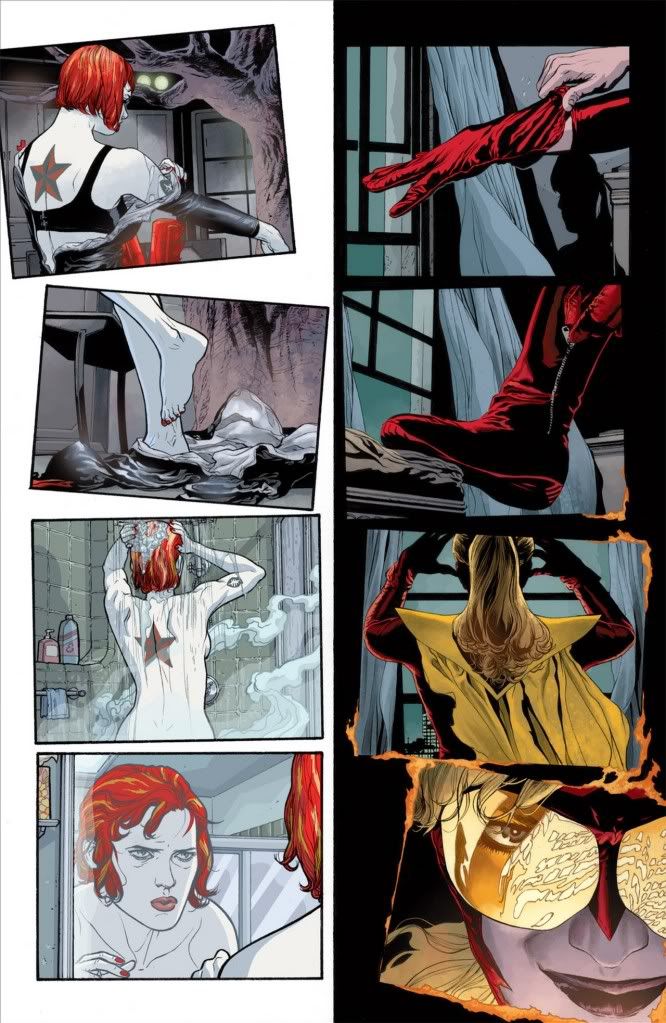
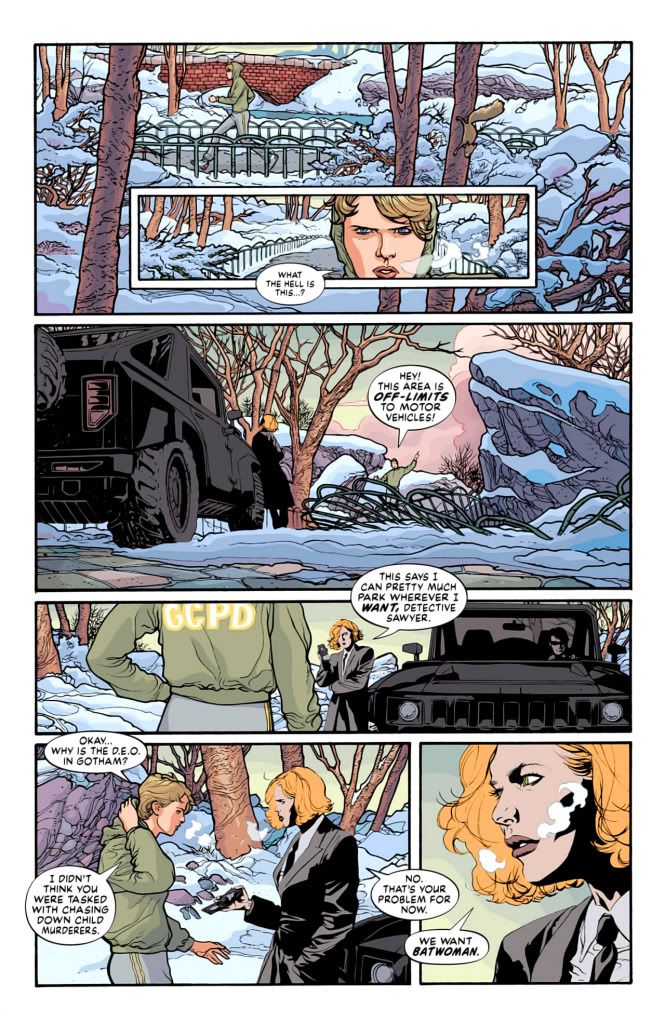
Batwoman #3 (DC) - This is the best issue of this series that J.H. Williams has done since going solo after his run on the character with Greg Rucka in Detective Comics. Williams is continuing to build on the foundation built during that earlier story, here opening with Kate Kane sucked under water by a vengeful spirit who summons the spectre of Kate's dead sister, trying to prompt the hero to let go of it all, to give in to despair. The result is a gorgeous, evocative few pages where the image of Kate as Batwoman is replaced by the image of her sister, a visual evocation of Kate's unarticulated, subconscious desire to join her sister in death. Of course she breaks free, and the next few pages are given over to a wonderful few pages where Batwoman fights with Agent Chase, who's investigating her and trying to figure out her secret identity. Williams' fight scenes, spread over the jaw-dropping double-page layouts that have come to be expected from his work, have a stuttery kinetic quality that suggest events happening in flashbulb bursts of motion, each pose frozen and cordoned off by the lines that zigzag across the page to indicate different intersections of time and space. This is also the issue where Williams' delineation of different styles for Kate's civilian life and her nocturnal adventures as Batwoman really pays off in a big way. When Kate returns to her apartment from her ordeal, dripping wet, in full costume but without her mask, her presence seems like an intrusion, a violation of the scrupulous separation between bright, colorful ordinary life and the dark, shadowed world of the costumed hero. That's the point, as Kate tells her cousin Bette, who she's been training to be a hero as well, that Bette should quit and go back to her normal life. Kate wants to keep these worlds separate, to banish her cousin from the darkness and danger of the superhero's life, to protect her from the fate of her own mad, corrupted sister. Then there's a wonderful silent page where, on the left half, Kate undresses and takes a shower, stripping back into her civilian identity, while on the other half of the page, surrounded by a deep black border, Bette puts on her costume and prepares to go out into the night. There's an acute sense in this series of identity as a costume one takes on and off, switching roles with clothing, existing in two different spheres that are represented by entirely different aesthetics.

Deathstroke #3 (DC) - Kyle Higgins has quickly proven in these three issues that he has a very limited set of ideas for this series, so he's just going to keep repeating them over and over in the hopes that it will be seen as thematic consistency instead of redundancy. This is the issue where Deathstroke's repeated insistence that he just wants respect, that he's worried that people think he's lost his touch, becomes particularly wearisome. The end of the issue throws in a few new wrinkles, tying back into the first issue and establishing that the Harmory characters in that issue weren't just a disposable punchline but were setting up something bigger. But it's not quite enough to keep me interested or make me want to continue reading what's turning out to be virtually the same book every month: Deathstroke gets a job, decapitates a bunch of people, easily dispatches everyone he encounters, and then goes all Rodney Dangerfield and complains that he gets no respect. Joe Bennett and Art Thibert give the book an attractive, unshowy art style that makes all the gore seem very matter-of-fact, but their contributions aren't reason enough to keep reading either.

Green Lantern #3 (DC) - Geoff Johns continues to do a good job of balancing the dichotomy of his central characters Sinestro and Hal Jordan: the one-time villain who's now been restored to the role of an unlikely hero, and the hero who's actually kind of a stubborn, arrogant asshole. Their interactions form the core of this book, as they define themselves against and in relation to one another, each convinced that the other is evil or idiotic or in the wrong. This is an interesting dynamic and the bitter repartee between these two old adversaries, each of them totally locked into their respective worldviews, totally drives this comic and especially this issue. The actual action, in which Sinestro and Jordan confront Sinestro's former corps for the first time, is just a quick burst at the end of the book that leads to a cliffhanger that only someone who's never read comics before could really believe is actually a cause for concern. Nevertheless, I'm definitely interested to see where this series is going, and I'm enjoying Johns' approach to these two rather unlikeable heroes/anti-heroes.

The Incredible Hulk #2 (Marvel) - I haven't been following the Hulk's comics before this new series, so I'm not sure exactly what happened to split up the Hulk and Bruce Banner, but this issue's examination of Banner's obsession with his missing other half is compelling anyway. Jason Aaron casts Banner as a deranged mad scientist in contrast to the serene, isolated Hulk, who just wants to be left alone, hidden away under the earth with his Moloid friends. This issue is all about setting up the obvious conflict between Hulk and Banner that will be coming in future issues. In the meantime, Aaron delivers the crowd-pleasing diversion of the Hulk battling some killer sharks, because hey, why not? I'm not sure how I feel about the gang of monster-hunters who are heading after Banner, though, what with the leader continually repeating that she's not related to Dr. Doom despite a shared last name, and the lame meta jokes like having a hunchbacked former mad scientist sidekick named Mr. Gor. Marc Silvestri's art is scratchy and densely hatched, and it's nice even though he seems to have an army of collaborators helping out. I don't think I've ever seen this many artistic credits on a single issue; between pencils, ink, finishes and "pencil assists," there are 11 credited artists on this comic. The result is sometimes a little inconsistent in terms of the level of detail, but not as bad as you'd think from that array of artists.

PunisherMAX #19 (Marvel) - This latest arc of Jason Aaron's PunisherMAX is at least as much about the Kingpin as it is about the Punisher himself. While this issue mostly focuses on Frank Castle's bleak internal monologue, the battle-weary drone of an old man accustomed to blood and pain, it's also about the Kingpin's gradual process of toughening himself to fill the larger-than-life role he's taken on, to really become the iconic villain he's meant to be. Interestingly, Aaron's Wilson Fisk has thus far been very passive and melancholy, a man drawn up inside of himself, having done atrocious things to achieve a position of power only to realize that he barely cares about the power. Now he's finally drawing out of that self-imposed shell, even as his adversary the Punisher cruelly antagonizes Fisk by disinterring the Kingpin's dead son. Steve Dillon's art is blunt and effective, powerfully depicting all the routine violence that surrounds these haunted, angry men, and also the ways in which all this horror has been written on their faces and in their bodies. Aaron is very much following in the footsteps of Garth Ennis on this series, and he doesn't depart too far from that model, but there's something about the combination of Aaron's writing and Dillon's art that makes this Punisher an even more tragic, sad, eerily empty character than ever.

Rachel Rising #3 (Abstract Studio) - Wow, this issue really ups the ante for the freakiness of this great series. Here, the newly resurrected Rachel seems to be getting flashes of portent about the violent deaths of other women, all of which seem to be linked by the mysterious blonde woman who's wandering through town, igniting feelings of misogyny and rage that lead to murder. Violence against women is the common thread, an ancient evil that exploits latent feelings of distrust, jealousy and self-doubt. Terry Moore's clean, bold art, with its copious white space and elegantly minimal faces, is just breathtaking, and creates an especially powerful atmosphere in the silent scenes (like the opening sequence in a jazz bar). Rachel herself is depicted with strangely shaded eyes that, together with her gothy makeup and the rope burns around her neck, make her an increasingly eerie central character. The highlight is the scene where she finds herself inexplicably compelled to confront a woman in a bar bathroom, telling her, "Your wedding bed will be a shallow grave... your lungs full of mud. Something old will violate you and you will feel it... making its home in you." This is a shivery, fascinating horror story, one of my favorite new series and already a worthy successor to Moore's Echo.

Uncanny X-Force #17 (Marvel) - Rick Remender's epic "Dark Angel Saga" hurtles on towards its conclusion next month, and this penultimate issue is a great example of Remender's virtuosic control of this kind of fast-paced storytelling. This issue expertly balances visceral action with the intense psychodrama at the core of the saga, the corruption of Archangel by Apocalypse's evil influence and the struggles of Archangel's lover Psylocke to prevent the world-devastating plans of her love without destroying him in the process. Several scenes in this issue take place in memory, on the psychic plane, and here Jerome Opena's woodcut-like hash marks are especially beautiful. As Psylocke attempts to break free of her corrupted lover's control, her mind returns to the memory of their first meeting: the dialogue is witty and urbane, a verbal dance of seduction, but Opena's shaded faces and the muted color palette (by Dean White, an unsung star on this book) suggest the heartbreak to come from this blossoming romance. The action continues to be strong, too, as characters from the alternate reality Age of Apocalypse join in both on the side of X-Force and as the allies of Archangel. This is just a great series, encompassing all the epic drama and intense stakes that characterize the best superhero comics.

Wolverine #18 (Marvel) - Well this is pretty ridiculous. And writer Jason Aaron seems to know it. He's relishing telling a deliberately campy, over-the-top story here, with a villainess who leads back directly to the Dragon Lady from legendary comic strip Terry and the Pirates. This drug kingpin's lavish, outlandish daily rituals — bathing her feet in the blood of any woman who claims to be more beautiful than her, dining on delicacies like "butterfly brains," refilling her pillows nightly with the feathers of a 1000 doves — definitively establish that this is a camp movie serial villain, an exaggeratedly evil adversary who'd twirl her moustache if she had one to twirl. Equally silly is Wolverine's new ally, Fat Cobra, a big tattooed sumo type who just wants to make a meal of a dragon. This is a quirky comic that climaxes with Wolverine and his allies riding towards their enemies in the bellies of a trio of dragons, and Aaron maintains an appropriately irreverent tone as he weaves a collage of kung fu clichés with imaginative conceits like the villains' underground poppy field or the concept of using dragons as drug mules.

Thursday, October 13, 2011

Weekly Comics: October 12, 2011

American Vampire: Survival of the Fittest #5 (Vertigo) - The final installment of this Nazi vampire spinoff miniseries plays out like a full-on action movie climax. Scott Snyder knowingly and lovingly hits all the expected beats, with the hero sacrificing himself to save the girl, giving her a final kiss as a sendoff before he storms into the center of the Nazi tanks, literally giving the finger to the enemy as he sings the Star-Spangled Banner. It's just that kind of over-the-top pulp craziness. It's also the kind of story where the heroes escape the Nazi vampires by leaping across a seemingly unpassable gap on a motorcycle as, behind them, the towering and recently unearthed godlike ancient vampires demolish the newer, uniformed monsters. Sean Murphy's manic hatching and exaggerated facial expressions are perfect for this explosive material, but he's equally excellent in the comparatively understated and moving coda in the final pages of the book. At that point, when the insanity has abated and the clamor of war faded away, Snyder and Murphy offer up a simple, moving epilogue and a surprisingly sweet last page.

Batgirl #2 (DC) - This series seems to have stirred up a lot of controversy just for giving Barbara Gordon back the use of her legs and making her Batgirl again after decades as the wheelchair-bound Oracle. I can't say I feel too strongly about that decision one way or the other, though the circumstances of Barbara's recovery continue to be pretty vague here. So, putting aside whether or not the basic idea is a good one, Gail Simone's new Batgirl is just a pretty good book about a very likable character whose internal narration wavers between anxiety over her return to superheroics and girlish euphoria at once again being able to swing through the air and fight bad guys. I could do with a little more of the enthusiasm and a little less of the hand-wringing, honestly. It makes sense, though, that this first arc's villain, the Mirror, is basically a personification of survivor's guilt, a perfect foil for a hesitantly recovering Barbara who isn't quite sure why she's experienced this "miracle." Barbara's new roommate is just a bundle of annoying quirks, and her boyfriend is bland, but this issue has some kinetic, intense fight sequences (fluidly rendered by Ardian Syaf) and the writing has a breezy quality even when it's mired in Barbara's self-doubt and uncertainty.

Batman and Robin #2 (DC) - Maybe it's just because I like Bruce Wayne's son Damien as a character, but I'm really digging the way this series seems to be focusing on Bruce's ongoing attempts to channel his son's killer nature and angry temperament into constructive pursuits. Peter Tomasi writes this father/son relationship well, especially in the scene where Bruce awkwardly questions Damien about homework before transitioning into the set-up for a Batman and Robin mission. It's an interesting relationship unlike the dynamic between Batman and any of his previous Robins, and it seems to be what's really driving this book so far. Although, it could just be that the actual villains here are pretty uninteresting, as Batman and Robin take on some generic weapons dealers. Then, at the end of the issue another nemesis shows up, and I'm unsure if I'm supposed to know who this is or not, but I don't, except that he was the guy killing the Russian Batman in the previous issue. I'm not too invested in the actual menace that Tomasi is haphazardly setting up here, whatever it is, but I'll keep coming back to see more of the central father/son relationship.

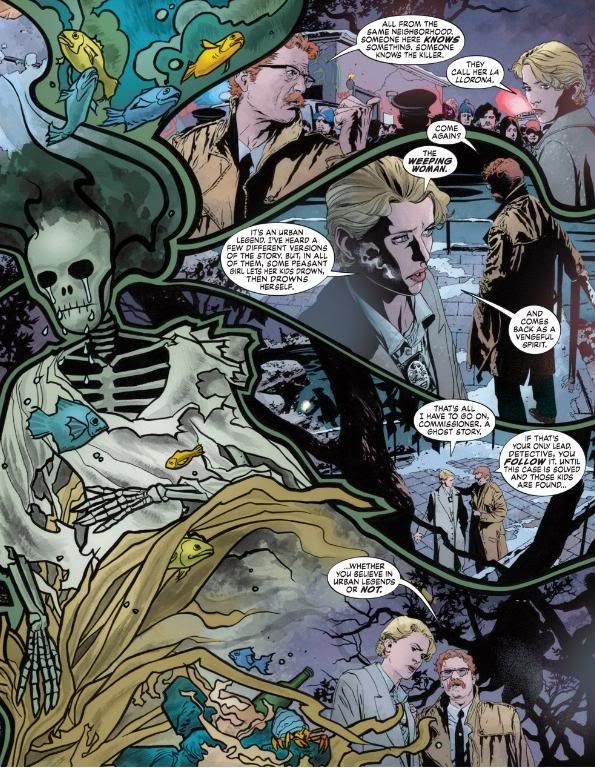
Batwoman #2 (DC) - At this point, it's almost easy to take JH Williams' interpretation of Batwoman for granted, even just two issues into the character's first solo title. His brilliant, sprawling double-page layouts and mastery of different styles is fully in place by this point. His action scenes are spiky and kinetic, full of pointed edges and panels-within-panels that call attention to points of impact or reveal the X-rayed anatomical contortions behind each well-placed kick. The panels become wavery and watery whenever the ghostly "weeping woman" makes an appearance, and the scenes in the ordinary civilian life of Kate Kane have a comparatively rigid panel structure and soft, brightly lit feminine colors to suggest the disparity between this woman's secret identity and her nightly crimefighting activities. This is an amazing comic in every way, guaranteed to be mindblowing month after month. The best scene in this issue is one in which Kate's detective girlfriend Maggie Sawyer walks around a supernatural crime scene, using the evidence to concoct a coherent story of what went down, and as she speaks the battle springs into life in the air around her, shaped by her conclusions and conjectures. Williams excels at this kind of diagrammatic layout. He excels, too, at jamming together contrasting styles, as he does when Maggie meets Cameron Chase, who's rendered in a shadowy noir style even in daytime, recalling her appearance in the short-lived Chase series that Williams illustrated back in 1998. The issue ends on an abrupt cliffhanger that suggests that the comic simply ran out of pages — Williams' plotting may be a little shakier than his jaw-dropping artwork — but otherwise this is yet another remarkable, unmissable installment in one of comics' most consistent visual treats.

Deathstroke #2 (DC) - I'm not sure what to say about this one, because even more than in the first issue, Kyle Higgins and Joe Bennett have just delivered a 20-page fight scene that takes all of two minutes to read, if even. It's got explosions, decapitations, and Deathstroke's rather quick destruction of a goofy, armored-up, roller-blading guy called Road Rage. There's not much at stake here, and barely a hint that the title character has even worked up a sweat after easily dispatching everyone who comes at him. It's lightweight and utterly disposable, with less of the quirky touches of personality and humor that spiced up the first issue. This comic is bound to just be the bloodbath-of-the-month and it does that just fine.

Demon Knights #2 (DC) - The first issue of this series was one of the bigger surprises of the New 52, since I didn't really have any expectations for it and it wound up being a whole lot of fun. This second issue lives up to the promise of throwing a whole bunch of DC's olden-times magic/immortal characters together to fight dragons and an evil queen. It's fast-paced and action-packed, inflected with the fun-loving spirit of warriors who love nothing more than digging into a tough fight and feasting on dragon meat when it's all over. Paul Cornell's dialogue has a peppy zing that mostly compensates for his characters' tendency to narrate their every move. This light-hearted style only occasionally gets tiresome, as when Cornell takes a cue from manga's jokey meta asides, which results in some very out-of-place dialogue. Other than such small dialogue issues, though, this remains a rollicking good time, gorgeously illustrated by Diogenes Neves and Oclair Albert, whose lush, European-influenced style is perfectly suited to this old-school wizards-and-demons adventure.

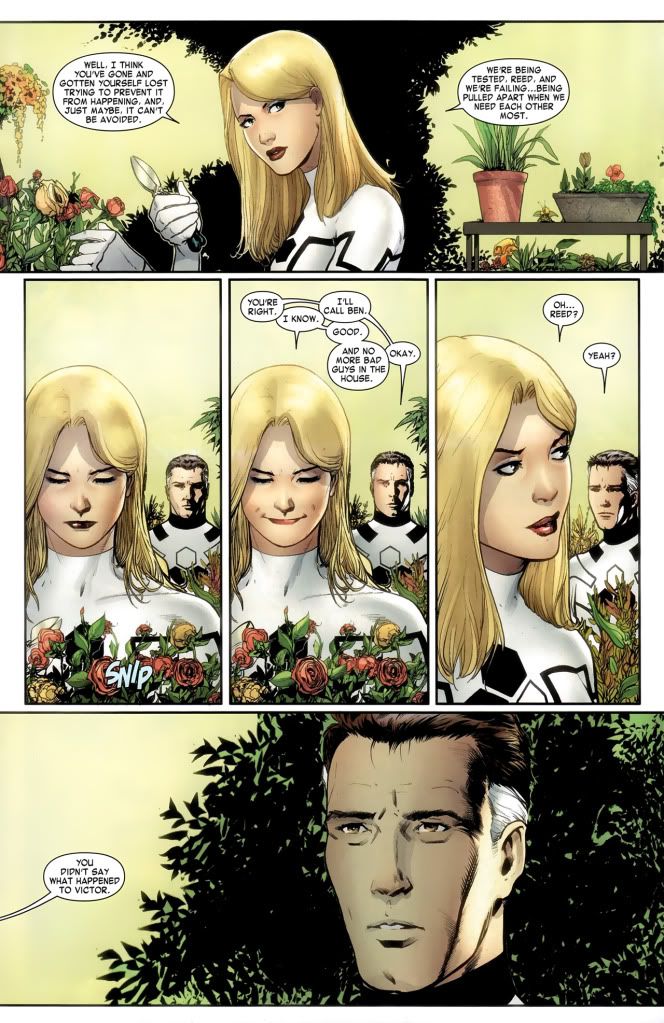
FF #10 (Marvel) - This is a pretty low-key set-up issue, a breather after last issue's climactic extended battle, which didn't so much conclude as take a momentary break. Jonathan Hickman continues to excel at hitting just the right emotional beats. The prime example here is a quiet scene between Sue and Reed Richards, staged so that Sue is looking away from her husband, facing the "camera," her expression mostly guarded but betraying a little smile, knowing and satisfied, when Reed tells her she's right. The scene plays out entirely in small shifts of facial expressions as husband and wife reconcile without laying it all out in so many words. Barry Kitson, filling in for regular artist Steve Epting, does an excellent job in moments like this, with a glossy, economical style that defines faces in a few graceful lines. Thanks to Hickman's facility for one-on-one dialogue scenes and Kitson's unshowy feel for the emotional nuance of Hickman's writing, what could have played out as a mere lead-up to bigger plots instead feels like a series of emotional climaxes for Reed and Sue, Ben Grimm, even the peripheral Inhuman Crystal and her Kree husband.

Frankenstein: Agent of S.H.A.D.E. #2 (DC) - This is stronger than the already good first issue of Jeff Lemire's Hellboy-ish paranormal series, because with most of the exposition out of the way Frankenstein and his troupe of monster soldiers just leap into action here. The best line comes early on, when Frankenstein slaps an old woman (she had it coming) and deadpans, "Frankenstein's vengeance does not discriminate on the basis of age." After that, there's more frenzied action sequences with massive monsters, rendered in scratchy scribbles of dark lines by Albert Ponticelli. Lemire takes a break in the middle of the issue to provide a backstory for one of his newly introduced monster characters, a female Creature from the Black Lagoon lookalike, which suggests that maybe each of these early issues will fill in the pasts of these new characters one by one. It's perhaps an inelegant way of shoehorning in exposition, but it works in this case because the flashback is packed with little bits of weird science fun, and because it ties in thematically with this issue's revelations about child sacrifice in the small town where this interdimensional infestation has broken loose.

Green Lantern #2 (DC) - It's not too surprising that Geoff Johns has wasted little time in getting Hal Jordan back in a Green Lantern costume after spending the first issue of this title powerless. It's not a total return to the status quo given that Jordan's power is now tied to his one-time nemesis Sinestro, but Jordan once again has a costume and a ring, even if it's not a "true" Green Lantern ring. Considering how clumsy and hackneyed the plotting of Hal's human misaventures were in that first issue, this is probably a good thing, and this issue establishes the terms of the unlikely Jordan/Sinestro team-up with some solid action. Sinestro's lesson to Hal has a hint of meta about it, an acknowledgment that for all the power of the Lantern rings, most of those who have wielded them have not changed worlds but simply constructed big green weapons to fight other superpowered beings. It's a distant echo of the end of Alan Moore's Miracleman, which questioned why superheroes with awe-inspiring power always thought so small. The point is perhaps erased when the very next scene involves Sinestro and Hal constructing big green weapons to kill a marauding alien, but it's nice to think that maybe Johns will work his way up to something more ambitious over time. This series isn't blowing me away so far, but it's offering up interesting, dynamic characters and some good old spacefaring action, and so far at least that's been enough.

The Punisher #4 (Marvel) - Though Greg Rucka's new series bears the name of antihero Frank Castle, the Punisher, what makes it worth reading is that, this time around, Castle isn't quite the center of his own book. In Rucka's first issue, the Punisher was a ghostly presence glimpsed out of the corner of one's eye, little more than a blurry flash of that white skull logo and the bloody evidence left behind in his wake. He's become a bit more of a physical presence in subsequent issues, and in this fourth issue he speaks more — 25 whole words — than he has in the previous three issues combined. But this is still a comic about the effect of the Punisher, the idea of the Punisher, more than it is about the man. That makes sense; the Punisher has starred in a lot of comics and has had a lot of writers define and redefine him. His psychology is pretty well established at this point. Rucka has decided to take the Punisher himself as a given, a powerful force tearing through New York's criminal underground, and his Punisher is more about the cops, journalists, and crime victims who would be glimpsed at the fringes of a more traditionally centered Punisher story. That street-level grit is affecting, especially when it comes to the continued emphasis on Rachel Alves, the survivor of a wedding day shootout that killed her new husband and most of her family. The Punisher is all about revenge, but Rucka seems interested in exploring crime and vengeance in ways that go far beyond the Punisher's simple, predictable, bloody retribution. In this, he's ably assisted by Marco Checchetto, whose art is gritty but somehow also soft-focused, as though there's a shadowy fog hanging over everything, blurring the black-and-white moral clarity of the Punisher's world. This issue is much more conventional in form than the brutal, near-wordless bloodletting of issue #3 or the destabilizing ambiguity of issue #1, but it continues Rucka's examination of the grimy nighttime world that revolves around Marvel's most ferocious antihero.

PunisherMAX #18 (Marvel) - If Rucka's Punisher stays fresh and interesting by taking a new approach to the character, Jason Aaron and Steve Dillon's MAX series is much more traditionalist. Aaron's Punisher is very much recognizable as the hardboiled killer of Garth Ennis' justly praised MAX run, an alternate take on the Punisher, free of mainstream Marvel continuity and also free to be much more explicit in terms of sex, language and especially all the inevitable blood and guts. Aaron doesn't do anything too daring here, just offers up more of the same for those who loved Ennis' Punisher. The book has been structured elementally, with each arc examining a character: Kingpin, Bullseye, then Castle himself. In the current "Homeless" arc, there's no such clear character focus, but Castle has been reduced to zero, having to rebuild his store of weapons, re-establishing himself as a force on the streets after a stint in jail. This is a Punisher book where Elektra can dispatch a room full of mob flunkies in memorably gruesome ways, tearing out eyeballs and sticking knives up men's noses, then screw the Kingpin on a bloody table for some reason. A few pages later, she goes to bed with Vanessa Fisk instead, a puzzling development that suggests the gleefully juvenile sensibility of this material. Dillon, with long experience drawing similarly trashy stories for Ennis, brings his characteristic physical heft to each disfigurement and death, each gory action sequence. But what he's best at, it turns out, is drawing Frank Castle himself, as an old and grizzled man with hard lines cut into his face as if out of granite, scowl lines etched so deeply into his skin that they're like wartime trenches. Castle's mask-like face is the real star of this series, the craggy visage of a man who's fought and killed his way to the brink of old age without exhausting his appetite for blood.

Resurrection Man #2 (DC) - Oddly enough, I still don't have much of a handle on whether this series is actually any good or not. It's an engaging concept — a guy who dies and is reborn every issue with a new power — written in a fast-paced, jagged style. In this issue, Mitch Shelley goes looking for answers about his own murky past, trying to figure out who he was while various supernatural entities and killer glam girls track him for their own mysterious purposes. Dan Abnett and Andy Lanning mostly go for a light, casual writing style that allows the issue to glide by quickly, though there are a few clunkers ("wow, pretty mad surfing skills there, Darryl") to serve as speed bumps. Similarly, Fernando Dagnino's art is not bad, but tends too much towards awkward pin-up poses, especially for the hitwoman villains, who seemingly lounge around in their underwear reading porno mags while waiting for their next mission. (They don't wear a whole lot more while on a mission, for that matter.) This second issue does little to improve upon the problems I had with the first, but there's still something goofily entertaining and intriguing about this off-kilter book. Its odd cast of characters includes the resurrecting man himself, glamorous hitwomen, angels, shape-shifting monsters, and it ends with Shelley plunked down into a weird netherworld with chalk-outlined bodies drawn on the ground and shadowy demons in the sky. If Abnett and Lanning simply mean to keep readers guessing and coming back for more off-kilter, uneven weirdness, so far they're succeeding.

The Shade #1 (DC) - James Robinson returns to one of the characters from his beloved Starman series for a 12-issue miniseries. Thankfully, he definitely does justice to the always-intriguing character of the Shade, capturing the witty, urbane tone of this character perfectly, as well as the emotional openness that characterized Robinson's best work. I haven't followed Robinson or the Starman characters after the end of the great original series, but this already seems like a worthy follow-up. This first issue establishes the scope and the tone of this material, opening with a philosophically inclined conversation between the Shade and Mikaal, one of several characters to bear the mantle of Starman. The dialogue is florid and romantic, as befits an ancient, gentlemanly character like the Shade, but it never gets weighted down by the stylized language. Instead, the dialogue zips and darts around with wit and insight, both in this conversation and a later scene between the Shade and his girlfriend. The action scenes are equally adept, particularly the showdown between Shade and Deathstroke that ends the issue. Cully Hamner's art is great and is especially strong when the Shade begins drawing shadows around himself, his red eyes shining from beneath the brim of his hat, his face becoming a maze of black patterns layered over his skin. Like Robinson's Starman, this is just great comics, with a relentless forward momentum and a real feel for the characters that perfectly balances the action. I'm really looking forward to more of this.

The Simpsons' Treehouse of Horror #17 (Bongo) - Traditionally, the "Treehouse of Horror" series has been the annual opportunity for The Simpsons, whether on TV or in print, to mess with the formula, to tell outrageous, surreal, gory stories where the usual rules of the characters don't apply. In the comic, this has often meant that this annual institution has been an opportunity for comic creators from outside the mainstream to tackle the iconic inhabitants of Springfield. This year, the real draw here is a story by Jim Woodring that closes the anthology. But first, Zander Cannon and Gene Ha turn in a loving homage to Nosferatu, with Mr. Burns as the vampire, Homer as Renfield, and Bart as the hapless visitor to the vampire's lair. Cannon and Ha have a lot of fun translating silent film aesthetics to print, including a line of musical notation that runs beneath the panels until Bart decides to turn the record off. It's a fun, quirky read with some clever nods to the story's cinematic source, and several panels recreate iconic compositions from the film, with the most effective being a few silent panels in which Burnsferatu creeps towards the "camera" through a stone archway. The second story in this issue, written by Jane Wiedlin of the Go-Go's with art by Tom Hodges, is much less successful. It starts as a lame and haphazardly plotted Star Wars pastiche (Hodges is an artist for Star Wars webcomics), tosses in some zombies, and it's just an unfunny tonal mess. Even the lettering is ugly.

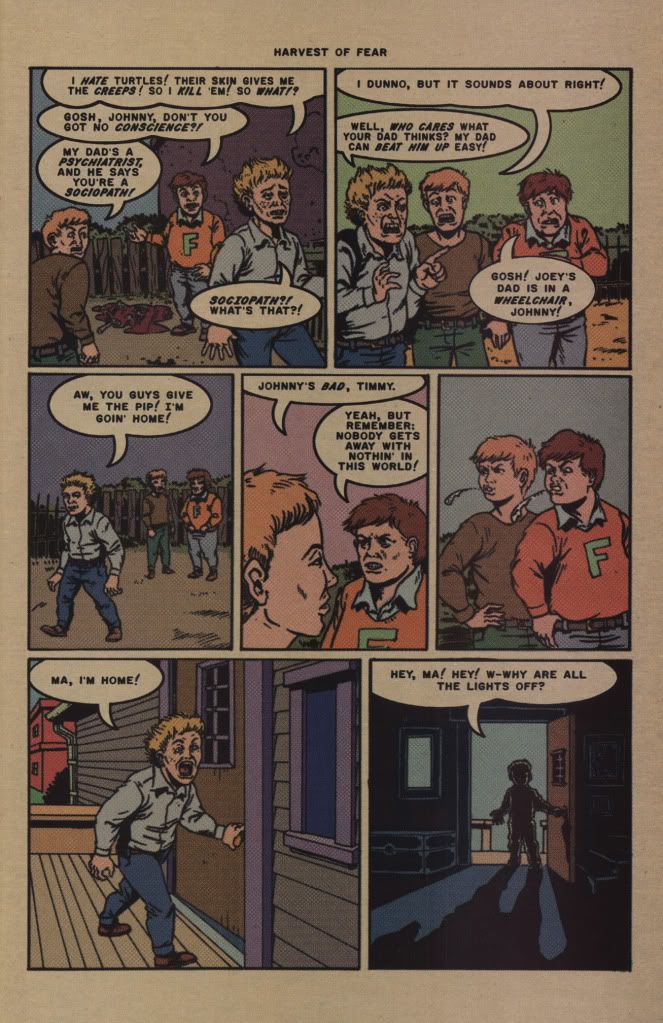
Unsurprisingly, Woodring's final story is the issue's primary treat, and it's great indeed. It's a tribute to the classic EC horror comics in which Bart discovers a third-rate EC knockoff comic that terrifies him. Woodring draws the comics within the comic in a throwback style and packs the story with meta gags and weird, unsettling imagery. The first story Bart reads starts with a boy brutally killing a turtle, which leads to a wonderfully awkward panel of his two friends spitting as they deliver the kind of unsubtle moral message that always acted as a counterbalance to the gore in EC-style comics. Woodring's slightly off-model drawings of the Simpsons characters go well with his subtly off-kilter humor. He ends the story with a fantastic meta flourish in which his comic mirrors the comic within the comic, merely implying the gory and gruesome ending. This issue is well worth a look for Woodring's story alone, and moments such as these make one wish that the Treehouse of Horror was more than a yearly event.

Superboy #2 (DC) - At some point, probably soon, I know I'm going to get tired of the new DC titles that offer up dependable, solid superhero entertainment but don't really rise above the pack. When that happens, I think Scott Lobdell's connected Superboy and Teen Titans are pretty sure to fall by the wayside. This is a decent second issue and not much more. There's still a lot of internal narration from Superboy here, infusing the book with the title character's continued quest for self-discovery. And there's a nice balance of governmental conspiracy plotting with, in the latter half of the issue, some all-out action. The rationale behind said action is weak enough that it transparently comes across as the writer deciding, "OK, now we need some action," but it's still pretty fun to watch Superboy and Rose Wilson thrash it out with some shark-like aliens. R.B. Silva's art is attractive and clean, slightly cartoony in a way that makes everyone look like teenagers, which is great for Superboy and slightly problematic for his handlers. All around, this is a good read but I just can't see this ever becoming a must every month.

Thursday, September 15, 2011

DC's New 52, Week 2 (September 14, 2011)


This week, I continue my examination of DC's New 52 initiative with my reviews and rankings of the 13 books from the second full week of the new line. My reviews of the first week's releases are here.

I'll also be following up on Monday with my thoughts on a few other non-DC releases. Once the New 52's first month is over, this column will be expanding into a proper roundup of everything I'm reading week by week.

1. Batwoman #1 - The Greg Rucka/J.H. Williams Batwoman stories in Detective Comics were some stunning, exciting comics, largely because of Williams' brilliant layouts, with their kinetic intensity and startling double-page spreads. Now Williams has taken this great character — a red-haired ex-military lesbian who's taken up the mantle of the bat — into her own solo series, and Williams has also gone (more or less) solo, writing and drawing with some writing assistance from W. Haden Blackman. This character hasn't been changed a bit by the reboot; Williams' Batwoman was already in progress before the relaunch, and he reportedly only made a few tweaks to slot the character into the new status quo. The long-awaited result is gorgeous, as expected, and apparently no amount of exposure to Williams' idiosyncratic style can get one used to it, because it's still pretty overwhelming. In one of the best double-page sequences, a police crime scene investigation is arranged in panels circling around the central image of a skeleton, but in contrast to the grim procedural in the radial panels, the skeleton itself is almost whimsical, a dreamlike, haunting image that's an eerie evocation of the story's supernatural themes.

Batwoman, who unlike her iconic model is defined as much by red as by black, is a perfect fit for Williams' bold style, and the fight scenes where she goes tumbling and leaping across the page are as astonishing as they were in Detective Comics. Williams has a keen sense of motion, and that motion is communicated as much by the placement of panels as by the figures within the panels. This is great, all set-up like so many of the other New 52 books, but in this case one hardly notices and it's all over too quickly.

2. Demon Knights #1 - This is just a straight-up blast. It's one of the oddball outliers in the New 52, set in the Dark Ages with a cast of warriors, magicians and demons. It's written by Paul Cornell, who wrote last week's Stormwatch #1, and while it's saddled with a few of the same speaking-in-exposition problems as that title, the overall tone is much breezier and cleaner, and Cornell is much more successful here at setting things up without getting bogged down in the details. Instead, the story moves at a propulsive pace to introduce the demon Etrigan, trapped in the body of a man, and his companion Xanadu, and rapidly throw them into what promises to be an epic battle, with sorcerers and dragons on the opposing side. It's good fun, briskly readable and clever. The art, by Diogenes Neves and Oclair Albert, is gorgeous, too, finely detailed and expressive, with an Old World sensibility that's perfectly suited to the story and the setting. The best moment, simultaneously creepy and exhilarating, is the scene where the evil sorcerers speak to a demon through a possessed baby, a sign of the kind of warped imagination this series will have to offer. This promises to be a gory, riotous romp.

3. Frankenstein: Agent of S.H.A.D.E. #1 - Banking on the appeal of Grant Morrison's version of this iconic character from his Seven Soldiers project, writer Jeff Lemire recasts Frankenstein's monster as a member of a superhuman organization tasked with dealing with the paranormal. And now he's got a team of partners similarly modeled on the famous Universal monsters. As one would expect, Lemire and artist Alberto Ponticelli deliver a fun, freaky tour through the world of S.H.A.D.E., with the organization's headquarters — a microscopic complex housed in a 3-inch metal ball that floats through the world — providing an array of magic and pseudoscientific delights. Ponticelli's loose but detailed art is perfectly suited to both the crowded high-tech corridors of S.H.A.D.E. headquarters and the bloody chaos of the big fight scenes at the end of the issue. In comparison to last week's Animal Man #1, this was always going to be the comparatively conventional Lemire book from the new DC line, but it's still a promising start.

4. Green Lantern #1 - Green Lantern is, along with Batman, one of the characters whose status quo isn't changing much during the New 52 relaunch, so it's definitely to the credit of writer Geoff Johns that, even though I haven't been following this series, I had no problem at all getting caught up to speed as he leaps back into the already-in-progress story here. The pink-skinned Sinestro is a new Green Lantern, somewhat against his will, former Lantern Hal Jordan has been stripped of his powers and is struggling to readjust to life on Earth, and these two come together by the end of the issue. It's set-up for what looks to be a war against Sinestro's own one-time allies, who have enslaved his homeworld. It's not the most exciting issue, but it does a good job of setting up the characters and the conflicts; it's clear, concise Storytelling 101. A lot of these first issues (notably last week's Stormwatch) have struggled with exposition overload, but Johns gets all the necessary information out quickly without making it seem like his characters are spitting out constant plot summaries and descriptions. On the negative side, the Earthbound story with Hal and his girlfriend Carol Ferris is not especially compelling, and Johns resorts to well-worn clichés like the scene where Carol thinks Hal is going to propose, but instead he just makes an innocuous financial request. I also couldn't believe Johns included the laughable scene where Hal, still thinking like a hero, busts in on what looks like domestic abuse but is actually just a movie set. Seems like every struggling hero does that at one point or another. Still, despite some of the lame plotting in Hal's story, this was a decent first issue that had a tougher job to do than some of the other debuts, since Johns isn't really working with the clean slate that most of the other titles have.

5. Superboy #1 - Despite the reset continuity, most of the DC New 52 aren't telling origin stories for the characters. This book is an exception, tracing the early life of the clone Superboy, raised in a tank in a government lab until he breaks out just before being terminated. It's a decent origin story, internally narrated by the self-aware (and overly wordy) Superboy, but the art, by R.B. Silva and Rob Lean, provides most of the pleasure here. The style is bold and cartoony, with thick black lines defining the outlines of characters and objects. The ending is very abrupt, and seems to be setting up Superboy's involvement with the Teen Titans, but before that rushed conclusion this is fine if rather standard superhero fare.

6. Batman and Robin #1 - Much like last week's Detective Comics #1, this is a safe, even boring middle of the road Batman story. The idea that Bruce Wayne wants to finally get past the founding trauma that made him Batman is nice, though the dialogue between Bruce and his son Damian (the newest Robin) in that scene is really heavy-handed. Peter Tomasi's dialogue is awkward in general, actually. The rest of the book is basic superhero action, with a radiation-themed villain hiding in the shadows and dipping people in pools of glowing green sludge to "erase" them. The art by Patrick Gleason and Mick Gray is good enough, the writing is clunky ("because I'm tired of marking the night I watched my father bleed out from his sucking chest wound and my mother from a hole in her throat.") and the whole thing is fairly unexciting. It does have the most laugh-out-loud ridiculous cameo appearance of the purple-hooded woman who apparently appeared in the Flashpoint miniseries that initiated this reboot. This woman appears randomly in the background of every New 52 first issue, which is very silly to begin with, but her glowing purple form in the background of a swim meet here definitely takes the prize as her goofiest manifestation yet.

7. Deathstroke #1 - For some reason this week seems to be a dumping ground for a lot of DC's grim and gritty blood-splattered titles. Of those books, Deathstroke acquits itself best, because it at least shows some traces of a sense of humor, and because it makes an attempt to give its central character some personality and some emotion. Even if the latter basically amounts to Slade Wilson's anger at realizing that he's a mercenary whose rep has lost its luster, that's still more character and motivation than is seen in some of these other first issues. Joe Bennett's art, balanced between gritty/gory and cartoony, strikes the perfect tone as well, and the fact that there's room here for a tossed-off joke at competitor Marvel's expense — Deathstroke slices the head off a startled J. Jonah Jameson lookalike, sending his cigar flying — suggests that this isn't a comic that takes itself too seriously.

8. Resurrection Man #1 - This issue contains a pun that's one of the most cringeworthy pieces of writing I've come across in the new DC comics so far: "I can taste the metal of his piercings. Thankfully I can't taste the metal playing on his iPod." Ugh. So yeah, it apparently took two writers, Dan Abnett and Andy Lanning, to come up with that. This comic should probably get trashed just for that, and for some of the other clunkers sprinkled through the dialogue, but in spite of its lame writing it does have an intriguing central character, a guy who's always coming back to life with new abilities. The Resurrection Man himself is cool enough that the two scenes here where he comes back to life are the definite highlights. The art, by Fernando Dagnino, is rough, sketchy and shadowy in a way that recalls a lot of old Vertigo series; it's sometimes appealing and sometimes really awkward-looking, especially in some of the postures and the sexed-up drawings of the female bad guys. So this is a really strange book: poorly written, unevenly drawn, and yet somehow still just a bit compelling if only because it's not yet another forgettable superhero riff. This isn't a strong start, at all, but at least there's some hope of improvement.

9. Mister Terrific #1 - This issue starts off well enough, with a light and charming aerial fight sequence that feels like what last week's Static Shock was trying to be. Then the main character, a tech entrepreneur who calls himself, with a mix of humility and arrogance, "the third smartest man in the world," goes into the inevitable flashback exposition mode, which inexplicably transitions into him telling his story to a girlfriend. Then there's some mystery, some heavy-handed sparring between the girlfriend and one of Mr. Terrific's admiring assistants, and finally a last-minute twist with Mr. Terrific turning bad. It's fun enough, and has some enjoyably cartoony art by Gianluca Gugliotta, but it's not exactly memorable or substantial in any real way.

10. Grifter #1 - Not a whole lot to say about this one. Grifter is one of the Wildstorm characters who DC has absorbed into their main universe with this reboot, but his DC debut isn't terribly thrilling. It's written by Nathan Edmonson, whose dialogue is pedestrian but at least not as ugly as some of the worst offenders from the New 52. The story's a really basic one, about a con man who gets mixed up with some kinds of aliens and is now being pursued by them as well as by the American military and the people he's cheated in his last con. There's some pointless chronological jumping around — a gimmick that a lot of these books engage in, seemingly just to jazz up what's otherwise a very straightforward story. But at this point the threat isn't very well-defined, nor is the central character, so I don't see much point in sticking around.

11. Suicide Squad #1 - Yeah, you know what you're getting the minute you take a look at the cover of this one, which features the Joker's sidekick Harley Quinn with a new busty look and a new super-skimpy costume. This is sheer brains-free mayhem, which opens with the Suicide Squad — a team of death row killers conscripted by force to perform secret missions — captured and being tortured for information about their latest mission. The team is introduced (and tortured) one by one, with the pain triggering flashbacks so we get a glimpse of each member's character and history. It's "gritty," and kind of flippant in its casual brutality, and totally superficial. It'd be redeemed by a better sense of humor, but writer Adam Glass unfortunately doesn't seem to have much to offer in that department.

12. Legion Lost #1 - This is just mediocre in every way. The titular team seems to be a bunch of generic temporally displaced heroes who try to stop a catastrophe in the past (our own time, roughly) and get trapped there instead. Pete Woods' art is some of the worst to mar any of the New 52 books: not as aggressively bad as Rob Liefeld's, but it's lazy and personality-free, which may be even worse in a way. Fabian Nicieza is the writer, and he doesn't add much personality either. The DC editorial edict of explaining everything as if to an audience of two-year-olds continues to be galling, and this book suffers for not really having anything else to offer. Certainly the characters are non-entities: two of them apparently die at the end of the issue, to little effect, both because it's fairly obvious that both could have and probably did escape, and because even if they did die, who cares? And who cares about this comic?

13. Red Lanterns #1 - Maybe it's because I have no familiarity whatsoever with any of these characters, but... what the hell is going on with this comic? It's about these aliens who spit blood from their mouths, and they have a lot of rage, and there's lots of blood and other fluids being spilled, and they're all fighting constantly, and did I mention they're really angry? The word "rage" appears on almost every page. Considering that this whole DC relaunch is supposed to make the DC universe more friendly to new readers, this book can only be considered a failure on that point, since it borders on incoherence. The bulk of the book is exposition, as the main character, Atrocitus, narrates his past and explains why he's so pissed off all the time. Everything around him is a hash of ugly, garish nonsense courtesy of penciller Ed Benes, and the main idea (the universe is an awful place, violence is everywhere) is continually hammered home with not a trace of subtlety. But then, this seems like the wrong place to look for subtlety or intelligence. I do like that there's a (blood-spitting, rage-filled) alien cat that isn't depicted as a humanoid with a cat's fur and head, but actually moves like a cat, on four legs, and pounces on his enemy's heads. This is pretty dismal stuff, though, which is a shame since Peter Milligan at his best is one of the most imaginative and exciting writers in comics. No trace of that writer here.