Showing posts with label Superman. Show all posts

Tuesday, November 1, 2011

More Weekly Comics: October 26, 2011

The Fury of Firestorm: The Nuclear Men #2 (DC) - Despite its blunt dialogue and half-baked racial politics, this series' first issue was messily intriguing, a smear of weird ideas and keyed-up hysteria. Gail Simone and co-writer Ethan Van Sciver deliver more of the same for the second issue, though if anything the dialogue is even more ungainly this time around, and the seams are showing more obviously in the exposition-speak and uneven pacing. Yildiray Cinar's art continues to be the most satisfying aspect of the comic, with a distinctive marker-line style that makes things look curiously washed-out and faded. It's a great-looking comic, and there are some cool, out-there ideas bouncing around here, as the two Firestorms embody opposite personalities and can come together as part of a larger whole. It's not really a good comic, though, and I'm not sure how much longer I can wait for it to get over its trainwreck weirdness and become legitimately worth reading.

Journey Into Mystery #630 (Marvel) - Every time an issue of this Kieron Gillen series comes out, I keep thinking that it's a book with a lot of promise. There are always flashes of wit and clever writing that suggest the truly great comic it could be but never quite is. This issue has paid off my patience in a big way, though, with the best issue Gillen's written yet, the first issue to really deliver on the promise that he's shown in crafting the adventures of Loki and the other Norse gods. The focus here is on Volstagg the Voluminous, one of my favorite of the Marvel Asgardians, the jolly fat man who's a lot smarter and a lot braver than the comic relief goofball he usually seems to be. So it shouldn't be a surprise that this issue just sparkles from beginning to end; it's funny and poignant and a great showcase for the fat god. The dialogue, always Gillen's strongest attribute, is really witty and packed with puns and fast-paced exchanges, like the mocking but affectionate back-and-forth between unlikely conspirators Loki and Volstagg. And then Volstagg returns to his family, and tells his children the story of his encounters with the evil Serpent, embellishing details freely and making himself look muscular and dashing in his visualizations of these tall tales. It's funny as hell and perfectly paced, with the best moment probably being when Volstagg gets carried away in imagining Ms. Marvel gushing over him, prompting a stern scowl from his wife. There aren't as many of the often-ponderous narrated caption boxes that Gillen has sometimes leaned too heavily on in previous issues: while his omniscent narrator can be stilted and boring, his control of the characters' voices is perfectly pitched. The bulk of this issue is dominated by Volstagg, and through Gillen's writing of the character (and artist Richard Elson's expressive body language and faces) one can practically hear the big god's booming tones and jovial jesting.

The Savage Hawkman #2 (DC) - Man, this is a staggeringly bad comic. I thought, after Tony Daniel's first issue, that I could put up with Daniel's gritty Frank Miller wannabe writing for the sake of Philip Tan's lush artwork, but now I fear I was wrong. This is a comic that opens with the terribly named alien villain Morphicius telling the hero, "your nth metal is burning my blood, Hawkman! But it is a good burn!" Kinky. There's more, much more, where that came from, as Daniel seems intent on proving what a bad writer he is on every page. As for Tan, his chaotic battle scenes are certainly cool-looking, if sometimes not especially clear — the title splash page is basically just a big mess of fire in which the two combatants are totally immersed — but the non-fight scenes don't fare as well. Tan's drawings of Hawkman's co-worker Emma as an emaciated beanpole with a deformed upper body are especially comical.

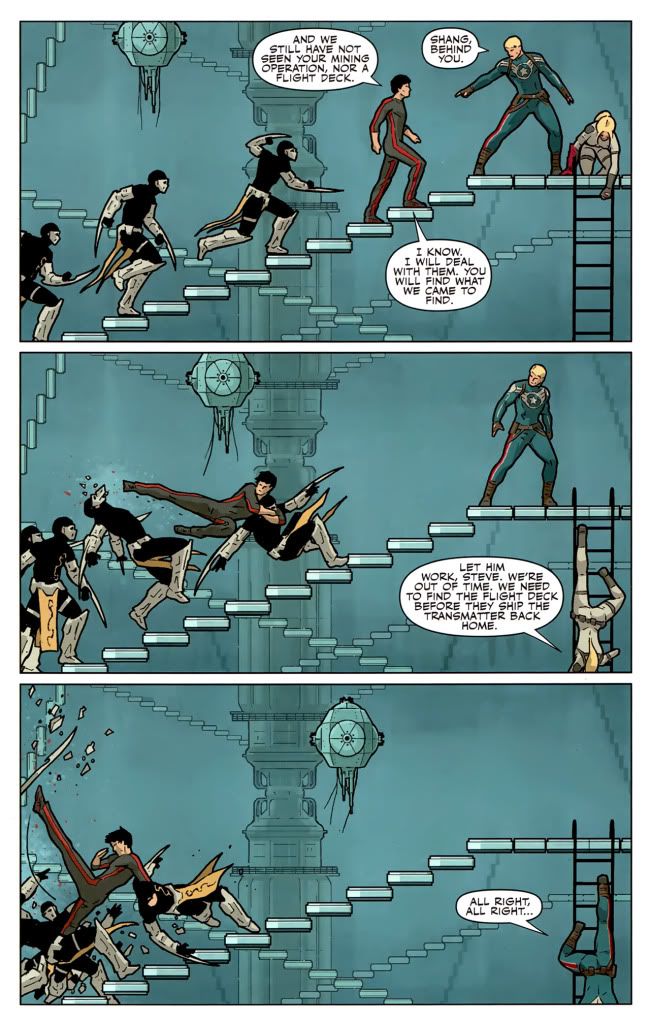
Secret Avengers #18 (Marvel) - This is Warren Ellis' third issue since taking over this series (after a solid but unfortunately abbreviated run by Ed Brubaker and a few lousy Fear Itself tie-ins by Nick Spencer) and he's turned it into just the kind of one-and-done secret mission thriller series that is one of his fortes. There's more than a hint of Planetary and Global Frequency in these issues, as Ellis makes each issue a standalone story in which Steve Rogers and a small roster of his secret agents must stop a potentially world-ending threat at the last moment. For this issue, it's just Rogers, Sharon Carter and Shang Chi infiltrating a secret base where the bad guys are smuggling out some material that could turn the Earth into a sun. For some reason, the base has warped gravity so that staircases run upside-down and up the walls, which gives David Aja an opportunity to draw mind-bending M.C. Escher layouts in which the heroes and the bad guys stalk each other at odd angles and have gravity-defying fights that start out upside-down and end with the combatants flying off-panel right-side-up. The action is brutal and efficient, and in between the fight scenes Ellis likes to pause for just a moment's breath, in which the team's resident scientist Beast often delivers elegant explanations for the multidimensional weirdness that's caused this latest threat. This is the kind of comic that Ellis could probably write in his sleep, a breezy sci-fi spy thriller with punchy dialogue and a new, inventively realized evil plot in each issue.

Superman #2 (DC) - George Pérez and Jesus Merino's Superman lacks the punchy modernism of Grant Morrison's new Action Comics, but that's obviously intentional. Just as Morrison's series chronicles the early adventures of an angry, hungry young Superman, Pérez is telling stories about a much calmer, more settled Supes who's grown into his power. While he retains the polemical, near-socialist idealism of Morrison's Superman, he's also been worn away a bit by the years. This is a very melancholy, lonely Superman who opens the issue brooding over star charts that show the location of his demolished home planet. Later, he sits in his aptly named Fortress of Solitude while Lois Lane, oblivious to his romantic pining over her, asks him to share what's bothering him. Like the first issue, this one focuses on a fight with a strange monster, though this battle is more inherently interesting and has a pretty clever conceptual hook: Superman can't see the monster while all the humans around him can. This means that he winds up relying on video feeds and televisions to fight the monster. The comic shows things from Superman's perspective, so that he seems to be fighting thin air while keeping an eye on video monitors that show what everyone else is seeing. It's nicely done, and feels like the kind of gimmick that might have provided a goofy single-issue hook for an old Silver Age issue of Superman. It also provides some visual interest that was mostly lacking in the first issue's comparatively generic fire monster. Pérez's writing is still wordy and old-school, overloaded with narration as Superman records his report about the day on his computer system. The overall effect is dense and meaty, ignoring recent trends towards minimalism and decompression.

Teen Titans #2 (DC) - Yeah, I'm done with this now. I gave this series the benefit of the doubt because I'd been pretty positive about the first issue of Scott Lobdell's Superboy, and the two books are basically telling one big story, but the first issue wasn't exactly thrilling. Now I'm ready to give up on Lobdell's New 52 work, because the second issue of Superboy wasn't anything special, and this series continues to underwhelm. Not much to say here, really. It's the kind of book that seems to think that introducing a character, giving him or her a power set and maybe one defining characteristic is the extent of characterization. The Wonder Girl/Red Robin relationship here is so one-note and simplistic: Wonder Girl just responds defensively to everything, while Red Robin makes puppy dog eyes at her. Nothing much here to make me want to read more.

The Unwritten #30 (Vertigo) - Though I'm a couple of weeks late here, this is the best issue yet of Mike Carey and Peter Gross' magical fantasy series. The most recent story arc has been delving into the rather sordid past of Tom Taylor's novelist father Wilson. This issue provides the climax of that story with an especially heartbreaking revelation about the comic book character the Tinker, a costumed hero who seems to have burst into the world from the pages of a short-lived newspaper serial. This series is, at heart, about the profound effect of fiction on those who read it and create it — as this issue makes clear, so many of this series' characters exist at a sort of junction between reality and fiction, their lives shaped by the stories that at times seem more real to them than "real life" itself. That's especially true of the Tinker, whose devastating story forms the bulk of this issue. As the comic cuts back and forth between a conversation between Tom and the Tinker and flashbacks from Wilson Taylor's journal that elucidate this strange character's past, a truly strange and powerful tragedy begins to take shape. What's especially powerful is the way Gross draws the Tinker at first in a bold, cartoony style that emphasizes his comic book origins, but as the issue goes along and the tragic truth about this character is revealed, his square-jawed heroic countenance fades into a wasted-looking old man.

Thursday, September 29, 2011

DC's New 52, Week 4 (September 28, 2011)


This is the final week of DC's New 52 initiative. As with the other weeks, it's a bit of a grab bag. There are no books here as strong as the best titles from previous weeks, but there's still some good stuff, a few surprises (I never expected Firestorm to be any good) and some stuff that I'm not sure why it's even being published.

1. Justice League Dark #1 - Now this is the kind of comic Peter Milligan is meant to be writing. Despite the title, this series is DC's attempt to fold a whole bunch of its Vertigo magical/supernatural characters into the mainstream DC universe, with a catch-all title dedicated to what's bound to be a pretty loose grouping of unconventional heroes. This is Milligan's forte, and that's immediately obvious as he spits out page after page of crazy reality-warping concepts and purplish prose. It reads like a pastiche of some of Milligan's peak work — particularly Shade the Changing Man, the title character of which is one of the main heroes here, and his short stint on Animal Man — but that's OK when he's coming up with something this entertaining and strange. Identical women hurl themselves into bloody traffic accidents, cows given birth to machinery, and a storm of razor sharp teeth slice Superman to bits while he muses that the teeth smell insane, which in turns prompts a narration box to counter, "but what is the smell of sanity?" The inclusion of the Justice League deliberately makes another old favorite Milligan point, that sometimes the world is just too strange to be understood or confronted by solid, noble heroes like Superman and Wonder Woman — sometimes the most damaged, wacky people are precisely the ones who can best cope with the world's lunatic shifts. The comic moves at a frantic pace and avoids the exposition trap by interspersing the obligatory character introductions with all the insane goings-on caused by the Enchantress. Mikel Janin's art is excellent, particularly in the epic sequence where the Justice League attempts to face the Enchantress. There's also a sly sense of humor here that manifests itself in things like Superman sensing that Cyborg is anxious by monitoring his oil levels.

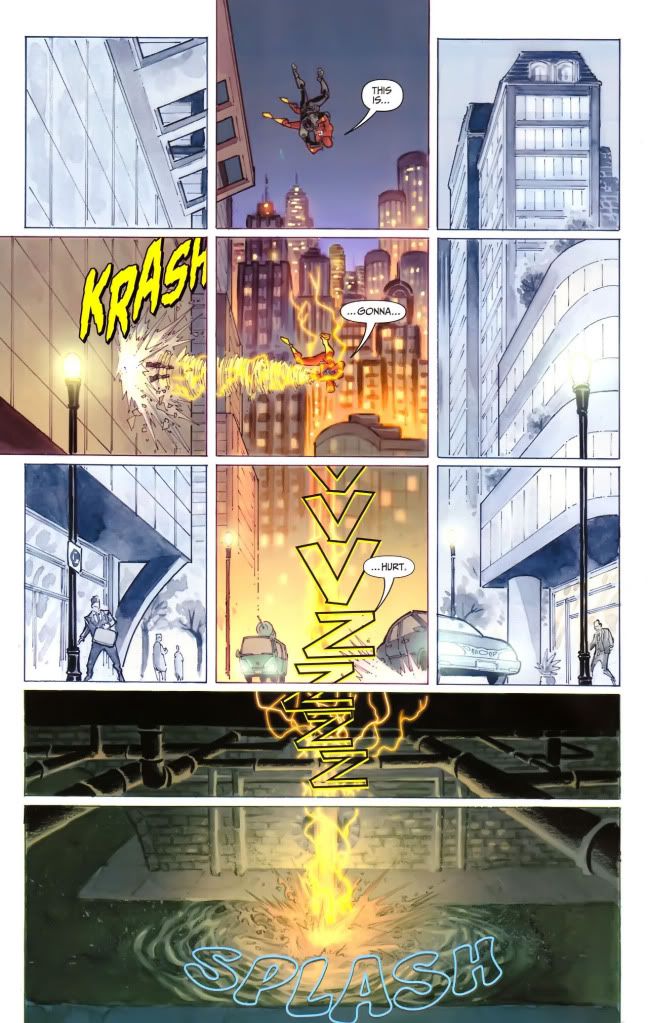
2. The Flash #1 - This is just a joyous, spirited superhero comic, as quick on its feet as the Flash himself. Writer/artist Francis Manapul (who gets some writing help from colorist Brian Buccellato) has delivered an energetic and fun first issue that gets everything just right as far as straightforward superhero antics go. Manapul's art is crisp and clean, with some inventive page layouts that communicate the constant sense of rapid motion that constitutes the heart of Barry Allen's power. Best of all is the page where the Flash, falling from a plane full of bad guys, tumbles down a series of panels in the center of the page, with the rest of the city rendered in the grid around him, so that the page as a whole looks like a segmented diagram of the city, with Barry's freefall ending below the street in the sewer that sprawls across the bottom of the page. It's all bright and beautifully colored, moving at a brisk pace without sacrificing the necessary character beats that establish the hero as an earnest, deliberate, serious young man in contrast to his hyper-kinetic powers. The pace is frantic enough and the art gorgeous enough that the initially generic-seeming villains aren't too much of a concern, and the issue ends with a series of quirky twists that suggests that even those stock, faceless baddies are pointing towards a much more interesting sci-fi plot ahead.

3. All Star Western #1 - It's great to see DC stretching into the past of its universe with this book, which focuses on Jonah Hex and Amadeus Arkham trying to solve a series of murders that are reminiscent of Jack the Ripper. This issue is especially fascinating in relation to Grant Morrison's travels into the history of Gotham City in The Return of Bruce Wayne and the rest of his Batman epic, and there are some obvious connections here in the characters of Hex, Arkham, the Wayne ancestors, and a secret society of wealthy Gothamites with some sinister secrets. More importantly, this is very well-done. It's wordy but well-written by Jimmy Palmiotti and Justin Gray, and Arkham's narration, with its attempts at analyzing his reluctant partner Hex, is engrossing and fits perfectly with the period setting. And then there's the art by Moritat, whose bold, thick lines often make each page look like gritty stained glass compositions.

4. Superman #1 - While Grant Morrison's Action Comics chronicles the early years of Superman's career as a feisty urban crusader, the hero's name title (written by George Perez and drawn by Jesus Merino) takes place in the present day of the new DC universe. This is an older, more established Superman, who still shows signs of the moralist hero of the common people established in Morrison's title, but without the same fiery anger and playful sensibility. The result is a solid superhero yarn that lacks the leaping, bounding excitement of Action Comics #1 but nevertheless seems to be setting up a fine superhero saga. The bulk of the issue concerns the first day of a new Daily Planet that's been taken over by a rival that the muckraking Clark Kent sees as a lousy gossip factory. As the merger goes into effect and Lois Lane takes charge of the new enterprise, Superman does battle with a mysterious alien fire monster. The action is fairly rote, and there's a random connection to Stormwatch #1 that suggests an eventual crossover but doesn't do much else. Still, it's interesting to see a Superman who seems so remote and lonely, and in that respect the last page, on which a dejected Clark slumps into an elevator while using his super-hearing to listen in on Lois chatting with her boyfriend, is especially effective and affecting.

5. The Fury of Firestorm: The Nuclear Men #1 - This is a weird one, and one where I didn't really know what to expect beforehand. Co-written by Ethan van Sciver and Gail Simone, and drawn by Yildray Cinar, it turns out to be an unlikely combination of high school melodrama, violent mercenary action, and explosive sci-fi craziness. Surprisingly, it winds up being a pretty entertaining issue that sets up a rivalry between two high school students: one black, one white; one a jock, the other a reporter for the school paper. The differences between these two are drawn pretty broadly, especially in the rather heavy-handed dialogue about race, but in formal terms the parallel editing and alternating narration streams keep the comic interesting. Cinar's art is very nice-looking, too, with lots of heavy blacks and strongly defined lines. The book's tone alternates, for much of its length, between action and high school drama before suddenly erupting, literally, with the transformation of the two leads into the superpowered fire creatures of the title. This is a fairly strong first issue with an interesting premise.

6. Aquaman #1 - This is a very self-aware Aquaman comic that knows that the titular hero is, for most people, kind of a joke, so writer Geoff Johns inserts plenty of nods to the jokes while trying to establish his hero as a badass with no sense of humor about his reputation. It's not great, and some of the dialogue in the later half of the book, when Aquaman visits a diner, is especially forced. An interview with a pushy blogger provides an opportunity for some clumsy faux-casual exposition, and Aquaman's humorless stoicism doesn't make him a very endearing hero. Just about all he does here is silently glower while everyone he meets wisecracks about fish and mermaids. More promising is the framing story involving some creepy-looking deep-sea Creature From the Black Lagoon outcasts, who provide a horror frame for Aquaman's on-land adventures.

7. The Savage Hawkman #1 - This is written by Tony Daniel, so of course it has a gritty, wordy tough guy voiceover running all through the issue. It's a style that's pretty common in these New 52 books, actually, though Daniel seems to be the worst offender. At one point, Hawkman calls himself "bud" while looking in the mirror; it's that kind of hard-boiled or maybe just overcooked narration. And the issue opens with Carter Hall taking his Hawkman costume, burying it in the ground, and shooting it with a gun as a symbolic gesture. That said, despite Daniel's tough guy posing, this is a decent first issue, especially when a sinister — and very Venom-like — alien threat is revealed in the later pages of the book. Most of the credit has to go to artist Philip Tan, whose detailed, textured work is gorgeous whether he's portraying ordinary scenes of archeologists at work or the increasing alien weirdness of the final few pages.

8. Teen Titans #1 - Well this just whizzes by; when I got to the last page and saw that it was over I was pretty shocked because it barely felt like I'd read anything. Which is both good and bad — it's certainly not plodding like Men of War or the Legion books, but it's also pretty fluffy. It's an assembling-the-team kind of issue with Tim Drake monitoring some other superhero teens so he can get a team together before a mysterious organization can get to the kids first. There's a very Speedball-during-Civil War moment involving Kid Flash, but other than that it's mostly about Tim and Wonder Girl, with a final page that ties back into Scott Lobdell's other book, Superboy. (I guess it's just fortunate that he doesn't seem to be tying the execrable Red Hood into these two titles as well.) It's a fast-moving book with a lot of attitude, even if some of it seems more than a little misplaced (like Tim Drake blowing up his penthouse).

9. Voodoo #1 - Considering that this is pretty much exclusively known as "that series about the stripper," everyone should know what to expect here. This makes Catwoman #1 look positively demure in comparison. Ron Marz sets this whole first issue in a strip club where the title character is one of the dancers, so naturally there are plenty of women posing in lingerie or with arms draped across their chests. It's basically a whole book of cutesy cheesecake drawings by Sami Basri, whose style is undoubtedly well-suited to drawing pretty ladies in their underwear. There's not much else here, of course, and since the issue ends with a grisly bloodbath that signals where the series is headed next, it seems like the creative team wanted to get all the sexy stuff out of the way up front before leaving the strip club setting behind. At this point, you might as well as just read a bona fide softcore porn comic, since this amounts to more or less the same thing. It doesn't have the playfulness and goofy fun of Catwoman, and though Basri's art is attractive he's no Guillem March, but neither is this as hateful as Red Hood and the Outlaws #1, still the low point in DC's treatment of its female characters. This just doesn't have much to offer besides pretty pictures and recycled clichés about strippers.

10. Green Lantern: New Guardians #1 - I'll give this issue credit for trying to approach the reboot in a slightly different way than most of the other New 52 — it rushes through an origin story in a couple of pages and then tries to introduce a whole bunch of other characters and a big cosmic plot by the end — but it just doesn't work. It reads like a condensed summary of a few issues at least, especially since central character Kyle Rayner is introduced, steps outside to go to the bathroom, gets a power ring, quickly adjusts to it and is then shown cruising around as a Green Lantern saving people. There's hardly any time to pause in order to establish him as a character or show his reactions to what should be a shocking event. Tony Bedard's trying to cram way too much into one issue here, and the result is that everything rushes by without having any impact; the main character's still a cipher, let alone the swarm of multi-colored alien Lanterns who show up to fight him by the end of the issue. The art, by Tyler Kirkham, is pretty good, and especially shows an affinity for creative visualizations of the Lantern powers: upon receiving his power ring, Rayner instantly turns the alien who gives it to him into a manga-styled imp, and later constructs a group of glowing green construction workers to catch a collapsing crane. This is pretty forgettable otherwise, though.

11. Blackhawks #1 - This is one of those issues where I'm really not sure what to say. It's not bad, exactly, just boring and undistinguished. It's about a team of UN paramilitary commandos, and they have clever nicknames like the Irishman (he has red hair!) and two of them have a secret romance that they have to keep from their superiors. And I'm getting a little sleepy just thinking about it, frankly. The art by Graham Nolan and Ken Lashley is sketchy and finicky but kind of stylish at times, but overall there's just nothing too interesting here besides some rehashed Bond movie action scenes and lots of technobabble.

12. I, Vampire #1 - Some editor at DC obviously realized, a few years after the rest of the world, that vampires are pretty hot these days, and that's clearly the only reason that this is a relaunch title. Whatever. It's boring as hell, and the structure is a mess with stilted dialogue between the two lead vampires running throughout the whole thing in caption boxes. All the usual vampire clichés are present and accounted for, of course, including the tortured vampire romance angle that's all the rage with the teens. Joshua Hale Fialkov's dialogue is mostly the kind of high melodrama that's supposed to suggest, for some reason, beings who have lived a very long time, with occasional diversions into cutesy vernacular that are all the more jarring for the general self-seriousness of everything else. The last thing anybody needs is this half-assed vampire book.

13. Batman: The Dark Knight #1 - What is the point of this book? Out of the 52 titles in DC's current relaunch, there are 11 titles about Batman or characters associated with Batman, including 4 titles that actually star Batman. I get it, DC wants as much Batman on the shelves as possible, but this seems like more than overkill. Particularly since this issue is just total junk with absolutely nothing to offer, treading over very similar ground to the other Batman first issues released during this month. Things do not start promisingly since the very first line of the issue is a caption box that reads, "fear is a cannibal that feeds upon itself." All of Paul Jenkins' writing is of a similar caliber: awkwardly phrased narration and stiff dialogue. David Finch, who co-wrote the book with Jenkins in addition to drawing it, contributes equally stiff poses, including a gratuitous pinup of a generic Bruce Wayne love interest in a super-short dress, lending more fuel to the fire of those decrying DC's unfailing sexualization of female characters. More than that this is just dumb, and utterly redundant when measured against the other Batman titles coming out now. Bruce Wayne goes to a party and gives a speech about Gotham's future, then faces a mob of escaped Arkham inmates, then squares off against the final page reveal of a buffed-up Two Face worthy of Rob Liefeld. It's like Jenkins has shuffled up the contents of Scott Snyder's far superior Batman #1 and filtered out anything smart or subtle or fun. This has some of the worst writing out of the whole New 52, and it absolutely has the worst last page out of any of these comics.