Showing posts with label Hulk. Show all posts

Sunday, May 10, 2015

Eleven Favorites of 2014

Of course it's kind of too late for this, but as I'm unpacking my comics from crates after renovations here and happily remember reading them, I do feel like a Best of 2014. Please excuse the snapshots, the scanner is still wrapped up somewhere. Here goes:

Eleven.
World's Finest Comics 196 by Bob Haney, Curt Swan, and George Roussos (DC). Featuring the Kryptonite Express! Well, dunno, somehow I couldn't find me a proper superhero series to love this year. Some very ok ones, but nothing really exciting. So I started buying old stuff to keep me happy, and one that I discovered was this issue, which is the only superhero comic I ever read as a child! I was kept on a strict diet of Asterix and Lucky Luke when I borrowed this issue from a culturally less protected playground acquaintance and it fried itself into my budding superbrain forever. Here's a scene I especially remembered, a description of which allowed me to find the issue through the web:


Now what's so amazing about this comic is that despite the haphazard mixture of elements (e.g. a top-hatted antique train collector cum mad genius crook more or less out of Jules Verne sleep-gassing train passengers with the help of trained flocks of bats), every element of the plot has the uncanny inevitability of the only story ever told.

Ten.
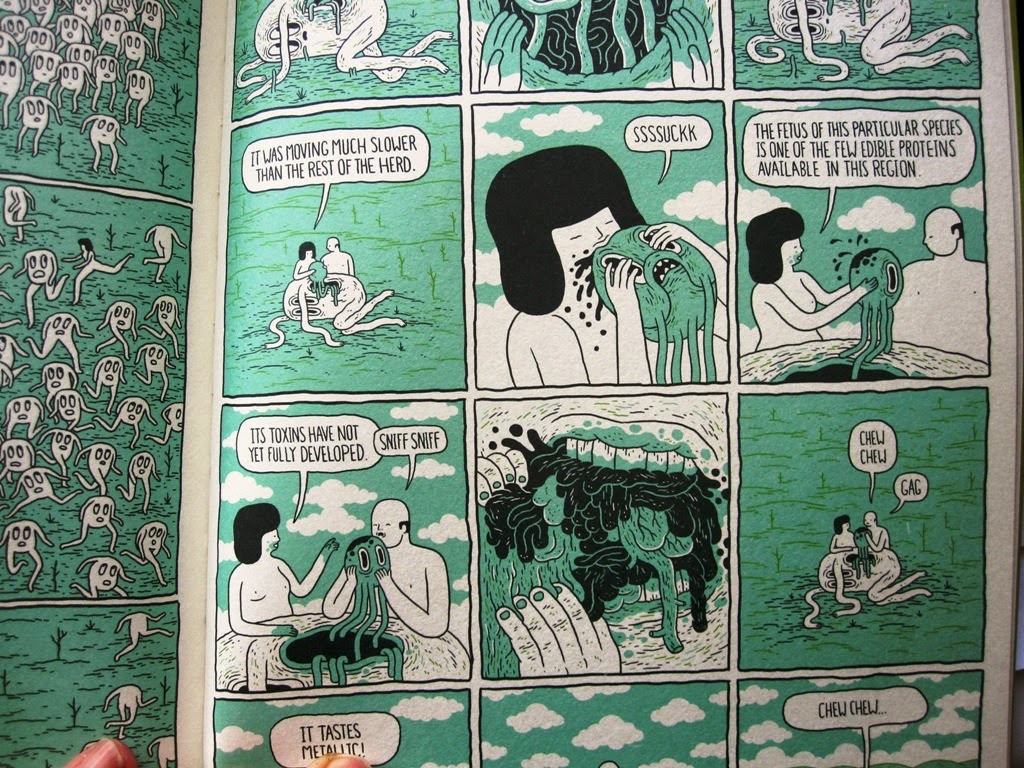
Safari Honeymoon by Jesse Jacobs (Koyama).


A newly married couple hunt gross insects and other creatures which in turn fight back by occupying them as host bodies. The book also works as the portrayal of a sick Garden of Eden with the guide as snake, or maybe everybody as snakes, and the author very much as God, unveiling to us the abstract geometry of all matter that makes up the fabric of life. Jacobs has also published a mini in 2014 titled Mathematical Solutions for a Global Crisis, which is in even mightier God mode. I'm not sure how much further in that direction I'd want to follow him, but for now he has some excellent survival tips.


Nine.
Juvenitive 3 by Jason Murphy (Subferior). This is about poses that can be struck with the help of a sort of rubberband figure, or sometimes a subcontrabass sax tubing figure, or a limp cushion figure with a bulb on top; poses that seem to reference classic cartoon slapstick situations without really playing them out. I've seen minis by Murphy where that didn't quite gel for me, but this issue has an extra looseness that makes it perfect. It also helps that some of the tableaux ...


seem to remind me of mid-60s Valerio Adami ...


(which is very much a good thing)


... and so on eight we have:
Pictures with connexions by Valerio Adami (Galleria Schwarz, Studio Marconi). "This catalog attempts to record a creative mechanism," the zine-like catalog itself informs us. It features a selection of 1966 paintings after found photos from magazines etc. An example will best show you the mechanism at play. On the cover, there's Matisse doing his best Freud impersonation:


On the first page there's Adami's mechanical translation of that:


Which shows, as the artist explains: "Me substituted for Matisse--while I am working in a pair of sky-blue [this we have to take on trust, most of the catalog is in b/w] Stirling Moss type overalls, associating the penis-pencil with Matisse's phrase, 'I have colors and brushes, and I must express myself with purity.'"

Seven.
Pyramid Scheme by Josh Burggraf and Victor Kerlow (Yeah Dude). One late night last year I watched an hour of Tex Avery cartoons to recapture the sense of anarchy they had offered me as a child (classic cartoons on tv was something I was allowed). They were still great but now they appeared almost mechanical in their excessive build-up toward one expectation after another to be stunted with a no-surprise surprise. The awesomeness now seemed to lie in the humorless precision of those variations on a long drawn-out punchline. (Very Germanic, no?)


That has nothing at all to do with the effortless absurdity of Pyramid Scheme, which feeds from completely different sources, except it fulfills my desire for no method at all. There's a bit of good-natured splatter that is maybe borderline anarchic, but it hides its mean temper behind tender lilac tones. Then there's real jokes or at least real silliness of the don't-touch-that kind with immediate payoffs. There are tons of references from, I guess, Donald Duck spacetrip adventures, to tripping in general, to Keith Richards snorting his father's ashes, and many more, none of which I get.


We must read panel for panel, because each panel drops the accents on a different beat, and on each page the characters completely change complexion anyway, as Burggraf has some serious chops and tugs stuff toward surreal battle scenes, while Kerlow favors a natural goofiness so during his pages objectives tend to be forgotten. Fun! (Isn't it sad, though, the small child protected only by his socialist gnome hat, alone in big space?)

Six.
Theth by Josh Bayer (Retrofit). I am sure this is the most proper comic I've read from Bayer so far, no scratching out or tipp-exing things, no sudden switches of pens, no careless stapling through the edges of pages ... but then this is serious, a classic coming of age story, or maybe a classic coming to terms with your comics addiction story.


The boy Theth (Seth with a lisp, I gather) also featured in Bayer's retellings of vintage ROM Spaceknight issues, which added depth by subtracting all that was not awesome from the original narratives. Now we get Theth's own viewpoint (somewhat cataracted by the edges of his spacesuit helmet's visor), and while to him comics are a vague proof that something must exist beyond his drab everyday existence (and beyond the limits established by his own personality flaws), comics are not at all a tool for escapism. Comics are a medium that allow you to imagine things and ask philosophical questions when you don't have the words for them. Quite clearly they will lead the discriminate reader, who struggles to analyze his own awestruckness, to a higher understanding of the world (though not to an understanding of comics themselves).

(The only reason this is not my favorite book of the year is that it's so very American and I had to grow up all by myself with just the one World's Finest issue that I had for only a week. You don't know how lucky you are.)

Anyway, you would have to call this a graphic novel. You can read the hell out of this book.


Five.
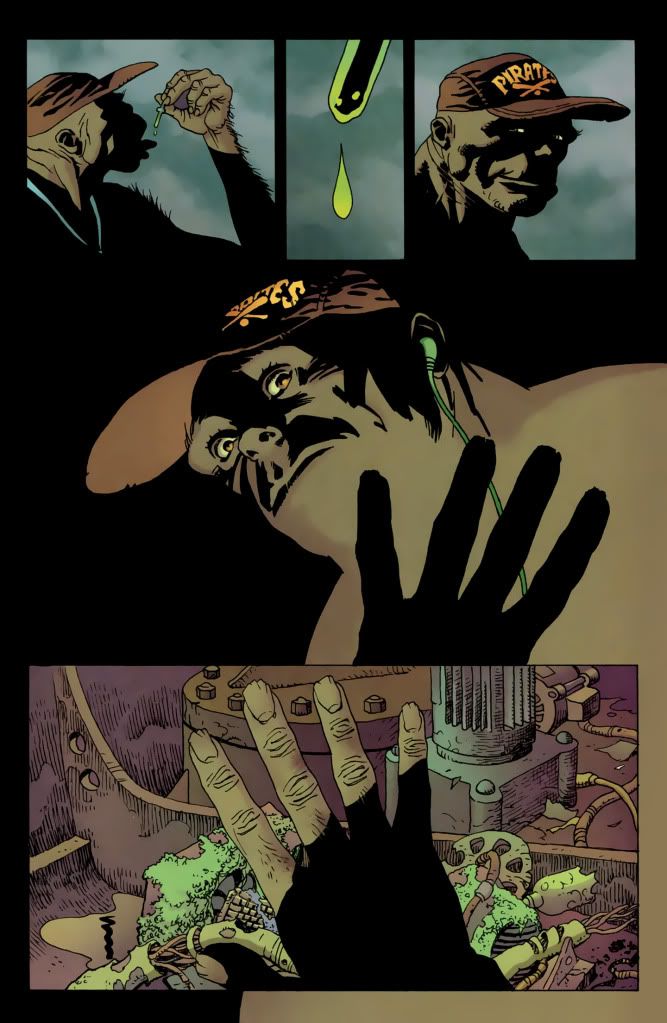
The Incredible Hulk 268 by Bill Mantlo and Sal Buscema (Marvel). I actually got this because Theth reads it in Bayer's first ROM from 2011. There Theth's mother picks up the issue and laments: "Everything you read is angry and weird. Life isn't some twilight zone where everything ends up with a scary twist." Theth in return thinks: "It's that stupid Hulk comic [in] which nothing even happens--it's supposed to be all eerie and dreamlike but it just doesn't feel as strong as they maybe wanted it to ... It's not fair that I should have to defend it, I'm not done judging it." ... But no, it is as strong as maybe they wanted it!


There's a benefit to reading this stuff from such a distance (locally and in time). Especially Marvel comics (much more than DC) from the 80s are so faded already (well, what I get from ebay) that they appear positively antique, or maybe timeless (which works because I as a German, while 14 in 1982 and so within the right age group, have never seen most products from the ads before). So the act of reading feels like excavating relics of a remote culture. It has become eerie, this mad, urgent energy, over the top emotionalism, the scream Buscema grafts onto many of the faces, at once unspeakably angry and limp with despair, pure creatureliness, and at the same time of course a mere ornament of the face, an author's trademark. And yet the comic for me exists beyond authorial intent, because I have no idea how to take it. Were they serious? If they were, the story ends on the most soul-crushing of notes, Hulk making short shrift of the Pariah: "Hulk will crush stone! Then let spirits find somewhere else to live!" (They do survive between the lines, happily.)

Four.
Eel Mansions by Derek van Gieson (Uncivilized Books). I would recognize few rules on which comics I like and which I don't, but one hard and fast rule would be that I hate comics in which faces illustrate or amplify what's being said in the speech bubble. Luckily, in Eel Mansions most of the characters are shooting sideway glances to check if the character on the other side of the page appreciates how they themselves will fully treasure their own wit. And they come up with wisecracks objectively out of step with proceedings around them, yet are safely contained inside their own circle of references. I guess it's the resigned self-delight of the characters which holds the whole thing firmly together despite all the willful switches (and appropriations, there's even a Moomin riff-off called Doomin) of styles.


I read the six minis (the last two in 2014); right now the book is out as a trade at twice the page size (the cramped lettering can be quite hard to decipher in spots, so more size will help, grrr ... but then again the squint you need for this equals the squint you need for a fading, dissolving old Marvel page, except you get tons more ink). I did not follow the plot, if plot there was, so I can't tell you what happens. Even when I try to pay close attention, ten pages later I can't remember anything as this seems constructed in a classic Russian novel kind of multiplying cast of character treatment. (This should have its own wiki page, also for spotting the references and links to the songs etc.) But then I'm not into plotlines anyway, so I read it for the vibrant tone, that of the blackest ever ink and of the conversation and the sly expressions on faces that always impress the observing reader by force of pose and personality.


Three.
The Invincible Iron Man 169 by Denny O'Neil, Luke McDonnell, and Steve Mitchell (Marvel).


Is it relevant that three years later Jeff Koons brought those same booze signs into the gallery space?


That was for his series Luxury and Degradation, and most comments on this Iron Man phase, during which Tony Stark boozes out completely (I'd count roughly 166 to 170 as the absolute classics before a SHIELD story, which includes strange aquamarine creatures, cuts in and starts undermining things), seem to remark on how the portrayal of alcoholism and abjection here is too simple or too corny or whatever, but I find Iron Man's drinking absolutely befitting a superhero and his mad actions highly deserving of a reward. The art is sometimes a bit wooden but always on the nose. The stakes are high, the battles senseless. 


Two.
My School Sunk into the Ground, So I Had to Dig to Get to My School Reunion and How to Make a Puppet by Malcy Duff (self-released). It's Year Two of my ongoing Malcy Duff addiction. So how do I rate him now I've got all the older minis I could possibly get and am reduced to following the current output? I still compulsively grab them from the shelves whenever I find myself with a free minute. Still let's say I'll place him on two, because I can't have the same number one every year. Also of course I can take it or leave it.

I'm not sure I can pinpoint how the new output varies from the previous. Maybe the rhythm is less quantized? You have heavily superimposed drawings followed by especially blockheaded blank pages ...

My School Sunk into the Ground also has electric dowsing (do you call it that?):


How to Make a Puppet comes in one of my favorite Duff covers (a sock performing a headstand on top of a chest of drawers, google it) and is sort of a reverie on the noble sport of table tennis (I seem to remember that an earlier mini by the author was mostly about tennis, so it might be enlightening to compare the two, but I have yet to unpack the crate that one's in).


It appears table tennis is a very lonely sport whose limited formal repertory can be reduced to the letter H. That formal repertory, though, can be found even beneath the self-estranged nature that we call a park, which we cross when on weekends we go and watch the library from afar. Loads to chew on! Incomparable linework, idiosyncratic timing.

I still cannot make a puppet.

One.
Isaac by Nathaniel Walpole (self-released). This is probably another coming-of-age story, like Theth, and also one about finding one's place within natural surroundings in a mutual truce, which relates it to Jacobs' Safari Honeymoon. Isaac is some sort of man creature with a phallic neckhead and a phallic tail and a not quite as but still phallic phallus, who has to learn to govern his typically male urges and not to fuck with nature and its creatures (including man) quite as willfully.


The drawings look much more awkward on the page than they do in these snapshots (it's not a mini but a school pad-like A4). They seem executed in no longer quite fresh fine-liner on sandwich paper, and the more naturalistic elements, like the members of a bronze age family Isaac does battle with, are rendered with schoolboy studiousness rather than freely inspired lines. (Or like an autobio comic. The denser textures are nice and deep, though.) This awkwardness seems very necessary somehow, in that the page is not mastered just like the narrative remains open. The whole thing has just the right degree of openness for me, a very selective viewpoint which never seems to transcend the given situation (or maybe Isaac is just a slow learner?) ... much richer than God perspective in the end.


Usually I'm all for mad skills, though, so I am very excited by the promise of some more recent drawings Walpole has posted on his tumblr, which show him experimenting with different speeds of line etc. Now a comic of these ...

P.S. On a historical note, Wassily Kandinsky was the first to try and develop an Isaac out of a horse during an improvisation in 1911:


He failed and chose abstraction instead. Probably he would have been more successful starting from a human figure, but these were never his forte. Still, see how close he got:


Thursday, May 2, 2013

Weekly Comics: May 1, 2013

It's been a long time since I posted here so I figured I'd catch up with some weekly comics. I won't be posting these updates every week, but checking in every once in a while on what's new.

Age of Ultron #7 (Marvel) - Last issue, in which Wolverine and Sue Storm travelled to the past to kill Hank Pym, signalled a big change in this series, and this issue pays that shift off really well. The duo travel back to a present that's now been massively shaken up by the repercussions of that murder; it's great that Bendis is upping the stakes like this, pulling the rug out from under the alternate future that had dominated the first six issues, replacing it with a whole new alternate future. Lots of fun seeing two Wolverines sparring, and there are tons of tantalizing mysteries about the nature of this new reality and what happened after Pym's death to lead to this point. Carlos Pacheco draws the scenes in the past, and they're gorgeous, and then Brandon Peterson takes over for the return to the present, and that's somewhat disappointing. Peterson's faces are really inconsistent, and in particular he makes Sue Storm look really weird in quite a few panels, especially when he tries to make her show emotion and instead just makes her look deformed.

All-New X-Men #11 (Marvel) - A whole issue of people yelling at each other and getting just to the verge of fighting without actually going all the way. And it's pretty fun, actually. Bendis already revealed that the original, time-travelling Angel would join Cyclops' renegade X-Men in the last issue of Uncanny X-Men, so this issue is just an extended exploration of how exactly that happened. Lots of dialogue, most of it dramatic and shrill, but it's refreshing that Bendis doesn't really fall into his familiar rhythms too much here — in general, taking over the X-Men books seems to have freed him up to explore some new voices and to get away, at least sometimes, from his usual writing tics. Not the most exciting issue in its own right but it's another piece of the puzzle and has some nice character beats along the way, particularly between Kitty Pryde and Jean Grey. And Stuart Immonen does a good job of giving the chaos a cartoony sheen.

Animal Man #20 (DC) - Back when I evaluated the first month of DC's New 52 reboot, I predicted that I'd continue enjoying the New 52 "as long as they keep their current creative teams and level of quality." That's turned out to be a very bad joke as DC has squandered almost all the good will and potential generated by the early New 52 successes, constantly shuffling creative teams and generally allowing very few titles to remain or become great. Even Animal Man, which early on was one of the best DC titles, soon lost its distinctive artist Travel Foreman and, even worse, became mired in a boring, purposelessly elongated crossover with Scott Snyder's Swamp Thing. These two books basically took over a year and a half to tell one story, but now it's finally over, leaving Animal Man to (hopefully) recover. This issue is a good sign of that recovery, continuing the metafictional story of a movie that Buddy Baker had starred in. When the first half of this movie played out way back in Animal Man #6, it seemed like filler at best, a stall tactic to keep pace with Snyder's Swamp Thing for the impending crossover. Now, the story takes on new resonances and new meanings in the aftermath of recent events, and this story of a slacker superhero struggling to recover his fractured family weighs heavily on Buddy. There's no direct tie-in to Buddy's real life until the very end of the issue, but there doesn't need to be: every panel seems freighted with secondary meaning and emotion. Very good use of what had previously seemed a throwaway concept, and I hope Jeff Lemire continues to guide this book out of the slog of "Rotworld" with such assurance.

Copra #6 (Copra) - Michel Fiffe's Copra is one of the greatest superhero comics around, especially notable since he does it all himself: writing, art, and self-publishing. Fiffe boldly combines familiar superhero archetypes and tropes — many of them drawn from obvious reference points like Suicide Squad or The Punisher — with a hallucinatory, strangely beautiful art style that renders these action-packed comics fresh and strange. As one letter-writer notes in the back of this newest issue, it's the union of new and old that makes it so special. This issue concludes the opening arc of the series, which focused on a team of government commandos forced to go underground after a villain's destruction of a small town is blamed on the Copra team. This issue is the final showdown with that villain, Vitas, who Fiffe boldly stylizes as an interlocking set of geometric shapes, his head a triangle atop a bulky body with spindly limbs that seem to be latched onto the ovals of his hips and torso. Fiffe's character design sense is impeccable, and over the course of the series' first 5 issues he introduced a massive cast of heroes and villains, all of whom have distinctive individual looks, so that in this issue's all-out melee the characters are clearly delineated even if most readers won't have a firm grasp on names or personalities. The bold style of Fiffe's art and his gorgeous pastel coloring makes these clashes visceral and thrilling in a way that more conventionally realized superhero battles just aren't, and when he cuts loose — as he does on a few pages where Vitas' form is warped by contact with the alien artifact at the center of this conflict — the results are downright stunning. Also notable is the melancholy of this issue's ending, in which Man-Head's final battle with Vitas is overlaid with his captioned memories of the family murdered by the villain, climaxing with a simple, evocative image that the hero succinctly declares "not a stupid memory." Just a great book in every way, and this is a more than satisfying conclusion to the first arc.

Dial H #12 (DC) - This has been one of the best DC titles since its debut: really only Wonder Woman deserves to be on the same tier. China Mieville's dizzying tale of dial-a-hero shenanigans just keeps getting crazier and crazier, adding new wrinkles and new ideas with every issue, never once wasting a moment or settling into a status quo. This issue shakes things up yet again, introducing a whole new cast of dial-users who appear in a frenzied battle in the issue's second half, everything so chaotic that there's hardly a moment yet to absorb quite what is happening here. This is just such a fun book, loaded with humor, bursting with big ideas. While other New 52 titles plod along, repeating familiar stories with familiar characters, Mieville is concocting a whole new lively universe of concepts and characters, starting from the basic premise of an old, forgotten DC title but expanding it at every turn. Alberto Ponticelli seems to be settling in as the new regular penciller now that Frankenstein is gone, and he's a perfect fit, his slightly skewed figures and faces ideal for expressing this title's wild aesthetic.

Earth 2 #12 (DC) - The long lead time involved in comics makes me think that it's just a haunting coincidence that this issue opens with a fight scene staged in the sky above Boston, with the people of Boston looking on in awe and fear. Still pretty unsettling. Anyway, this is the conclusion of the Dr. Fate storyline, which has honestly slowed this book down a bit too much and detracted from its generally strong first year. Here, after all this buildup, the villain is dispatched almost offhandedly, so the story just sputters to a close, having now introduced Dr. Fate as one of the book's heroes. At least the ending signals that Steppenwolf has finally made his presence known, so things should pick up again next month; the Apokolips material in this book has been really good.

Green Arrow #20 (DC) - I'm willing to give Jeff Lemire the benefit of the doubt, but four issues in, his Green Arrow isn't really bad so much as utterly forgettable, with little of substance and little reason to care about any of these characters — the villain Komodo is arguably the most realized character so far, and even he's not too deep. Andrea Sorrentino's art is nice, all moody and shadowy, but doesn't seem especially well-suited to this story, either.

Hawkeye #10 (Marvel) - Matt Fraction's Hawkeye has had a really strong and coherent aesthetic, even when regular artist David Aja is replaced by fill-ins. Francisco Francavilla, this issue's guest artist, doesn't fit as neatly into the series' overall look, but that's appropriate since this issue is a bit of a departure, taking on the perspective of an assassin working for the "bro"-happy mobsters who have dogged Hawkeye throughout this series. It's gorgeous work. Fraction weaves together the assassin's tortured, unhappy past with the present, in which the man, undercover, exchanges some flirtatious banter at a party with the female Hawkeye Kate Bishop. The pages in the present have a warm, calm vibe, with pages laid out in neat rows of square panels, all closeups of faces and hands as these partygoers bond, Kate not realizing who this man actually is. The flashbacks are more fragmentary, with Francavilla's pages exploding into baroque designs, panels fanning out from central acts of violence, yellow and red and orange flowing across the pages to contrast against the cool midnight blue of the Kate pages. Great design, great art, and a haunting story. More proof that this is one of Marvel's very best comics.

Indestructible Hulk #7 (Marvel) - Mark Waid's new take on the Hulk as a S.H.I.E.L.D. agent has been pretty fun right along, but it's reached new levels of insanity with this current arc — drawn by Walt Simonson! — in which Hulk time travels to the past and crosses over to the Asgardian realms, teaming up with Thor against Frost Giants. There's nothing here as wild as last issue's cliffhanger pinup of the Hulk lifting Thor's hammer (though that's paid off nicely with some unexpected humor) but it's just a solid, well-crafted issue of action. And seeing Simonson tackle Thor, one of his signature characters, is always a big pleasure.

Iron Man #9 (Marvel) - Kieron Gillen's Iron Man finally seems to be ramping up in a big way, and this is a promising start to what looks like it's going to be an epic new arc. Dale Eaglesham replaces Greg Land for this issue, and the difference is obvious. Eaglesham's art is as slick and shiny as Land's during the scenes of Iron Man and Death's Head stalking the android 451, all glistening metal surfaces, but with far more personality and weight than any of Land's stiff figures. Then, when Tony's confrontation with 451 gets upended at the end of the issue, and the android makes a big deal of using outdated film reels from the past, the shift in style that Eaglesham pulls off makes the effect as jarring and potent on the reader as it must be for Tony — the lush, shaded grayscale of those movie frames is a great contrast against all the shiny metal that dominates the rest of the issue.

The Movement #1 (DC) - Like a bad punchline, DC's tone-deaf attempt to cash in on the "Occupy" movement reeks of desperation. It's just silly, obviously the result of some out-of-touch editors trying to figure out what young people want, and winding up with teens in masks holding up smart phones and tablets emblazoned with the message "I C U." Gail Simone should know better, but apparently doesn't, so she gamely introduces all these generic teen characters amidst confusing and truncated fight scenes, while Freddie Williams II seems to have settled on a new style to imitate, channeling Sean Murphy and doing OK at it — the linework is decent, though the layouts are unnecessarily cluttered. But even a genuinely amazing artist couldn't really salvage such an ill-conceived project, and there's obviously little chance of this making it past its first year.

Swamp Thing #20 (DC) - Scott Snyder ducked off Swamp Thing after slogging through "Rotworld," leaving Charles Soule to pick up the pieces, with Kano providing the art. Soule's doing a pretty good job so far, dealing very poignantly with the aftermath of "Rotworld," which whatever else it did, left the title character feeling less human than ever, more adrift from what he once was. Here, Swamp Thing is trapped in a nightmare by Scarecrow's fear toxin, facing ghosts of the happy human life he might've had with Abby, while outside in the real world his plant powers run amok and nearly destroy Metropolis. There's a nice moment at the end of the issue where Swamp Thing points out that Superman, too, isn't human and only chooses to act human, though Soule has Supes respond in a pretty lame way, urging Swamp Thing to help people. Pretty good stuff, and Kano's art is more cartoony and clean than his predecessors, though he does ape the inventive layouts of Yanick Paquette, who himself was inspired by Steve Bissette's art on the old Alan Moore run. Nice sense of continuity.

Ten Grand #1 (Image) - The debut of a new series by J. Michael Straczynski and Ben Templesmith, distributed by Image on behalf of the new Joe's Comics imprint. It's a rather unexciting debut: Templesmith's art is fabulous, of course, and well-suited to the story's dark mood and supernatural content, his scratchy lines and eerie color work perfectly capturing the sense of menace lurking within this tale. The problem is that JMS substitutes a whole bunch of clichés for real characterization. The hero was a mob hitman until a rival violently cut short his lovey-dovey relationship with a sweetly generic girlfriend whose death now haunts the hero — and it was going to be his last mission before he ran away with her to live happily ever after! Really! The blending of noir/crime aesthetics with the supernatural reminds me in a general way of Fatale, and of course John Constantine too, so maybe with Hellblazer gone this will fill a hole for someone. But there's not enough in this first issue, beyond Templesmith's art, to really set this apart or suggest that it's going to be anything special.

Winter Soldier #18 (Marvel) - The Winter Soldier is so much Ed Brubaker's creation that it's hard to imagine anyone else shepherding the further adventures of the ressurrected Bucky, but writer Jason Latour and artist Nic Klein have done as good a job as anyone could expect. This series is fast approaching its cancellation — though it will surely be back around the time of the second Captain America movie — but it's been a fine continuation of the moody spy movie vibe of Brubaker's run. This issue marks the climax of a recent arc with Bucky trying to atone for one of his past assassinations, but when he comes face to face with the girl he orphaned, now known as the Electric Ghost, she doesn't seem interested in revenge or atonement or anything else you'd expect. In a nice twist, she spends the issue narrating her gradual process of separating from conventional human emotions, through a horrible childhood in a twisted training program, her life as a spy and assassin, her eventual revenge against those who had guided her life. But for Bucky himself she has no anger, and her rhetoric of transformation and transcendence makes her an intriguing villain. Klein's is fantastic throughout, switching between the moody blue-and-gray murkiness that has usually characterized this series' dark spy adventures, and a more cartoony style to illustrate the Ghost's childhood.

Worlds' Finest #12 (DC) - I'm not entirely sure why I'm still reading this companion series to Earth 2. It's usually just mildly pleasant, and it almost always features a whole squad of artists struggling to cobble together the visuals, but there's something about it that I find charming and enjoyable. The premise of these two women, in an unfamiliar world, taking different approaches to finding their own way in their new home, it's very poignant, and Paul Levitz has done a good job of exploring these characters and their friendship, even if not much has happened on the plot front. This issue is more of the same, though the war with Darkseid's creepy henchman Desaad seems to be heating up. Notably, here Power Girl gets her old costume back, "boob window" and all, which a lot of people will be excited about but I see as a step back — and I'm one of the few who had no problems with her sleek, streamlined newer costume. There's no attempt to explain the costume change here; in flashbacks she still has the old outfit and then when she suits up in the present she's back to the classic design. Meh.

X-Factor #255 (Marvel) - The "Hell On Earth War" is almost at an end now, and none too soon — Peter David's long run on this title has been going through a fallow patch with this arc, which suffers from being way too big for the book. David's X-Factor has excelled at smaller stories and character interactions, and its strengths are lost amidst a giant saga of demons fighting on Earth, even beyond the troubling question of why nobody besides X-Factor seems to have noticed all this city-destroying chaos. There's still room here for a few nice character beats, notably the bafflement and despair of Guido when he realizes that something is very wrong with Monet during their fight. Also, the understated sadness of Layla grieving for Madrox, and Tier finally making a decision. This title is ending soon, but thankfully David is promising some character-based issues about, among others, Layla and Longshot, after this storyline wraps up next issue, so hopefully this book will go out doing what David does best.

X-Men Legacy #10 (Marvel) - One of the big surprises of the Marvel Now initiative, Simon Spurrier's take on Professor X's son Legion has been thrilling and inventive and really cerebral. Literally cerebral, in fact, since much of it takes place in Legion's head, where he must contend with an unruly flock of alternate personalities, each embodying one of his many mutant powers, including a golden apparition of his father who seems to be the most sinister of the bunch. In this issue, Legion confronts another of the anti-mutant agitators who he's been tearing through of late, though this time the man — a victim of multiple mutant catastrophes, which have left him burned and confined to a wheelchair — is surprisingly sympathetic and reasonable in his anti-mutant agenda. Spurrier's been patiently building this story and it's really paying off: both Legion and his love interest/eventual antagonist Blindfold are now fully developed characters, and the sense of dread gradually accumulating like a black cloud over their heads is now really starting to thicken.

Monday, November 14, 2011

Weekly Comics: November 9, 2011

Batman and Robin #3 (DC) - This is becoming a slow-burning surprise favorite for me out of DC's New 52, getting better with each issue. This is especially true because Peter Tomasi is increasingly focusing on the "and Robin" part of the title, making this a book about Damien Wayne's struggles with the way he was raised versus the noble ideal offered up by his father Bruce and his mentor/peer Dick Grayson. Damien's interactions with the stolid, unshakeable Alfred are a lot of fun, and this issue opens with a chess match between the butler and the boy wonder, drolly funny and sharply written. Tomasi has a good feel for the uneasy relationship between Bruce and Damien: the boy looking up to his father but also straining against the bonds of this relationship, while Bruce, long used to being the chilly loner despite his succession of sidekicks, is a much cooler and more distant father to his troubled son than Dick Grayson was during his stint as Batman. Damien takes typical preteen rebellion and gives it a sinister twist because he's not only resisting parental guidance, he's straining against Bruce's strict no-killing code and insistence on self-control and restraint. But there's also a real joyous side to Damien when he's allowed to break free, which tempers the darker aspects of his character; it's hard to stifle a smile when he tells a crook, "I'm sure you didn't leave your hole tonight thinking you'd get your ass kicked by a ten-year-old!"

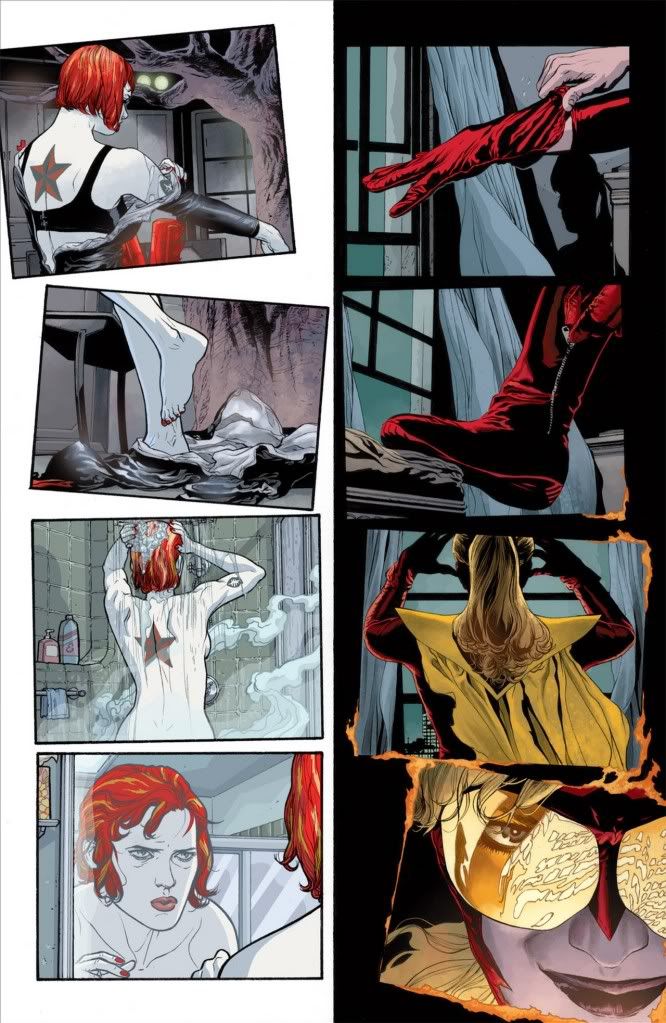
Batwoman #3 (DC) - This is the best issue of this series that J.H. Williams has done since going solo after his run on the character with Greg Rucka in Detective Comics. Williams is continuing to build on the foundation built during that earlier story, here opening with Kate Kane sucked under water by a vengeful spirit who summons the spectre of Kate's dead sister, trying to prompt the hero to let go of it all, to give in to despair. The result is a gorgeous, evocative few pages where the image of Kate as Batwoman is replaced by the image of her sister, a visual evocation of Kate's unarticulated, subconscious desire to join her sister in death. Of course she breaks free, and the next few pages are given over to a wonderful few pages where Batwoman fights with Agent Chase, who's investigating her and trying to figure out her secret identity. Williams' fight scenes, spread over the jaw-dropping double-page layouts that have come to be expected from his work, have a stuttery kinetic quality that suggest events happening in flashbulb bursts of motion, each pose frozen and cordoned off by the lines that zigzag across the page to indicate different intersections of time and space. This is also the issue where Williams' delineation of different styles for Kate's civilian life and her nocturnal adventures as Batwoman really pays off in a big way. When Kate returns to her apartment from her ordeal, dripping wet, in full costume but without her mask, her presence seems like an intrusion, a violation of the scrupulous separation between bright, colorful ordinary life and the dark, shadowed world of the costumed hero. That's the point, as Kate tells her cousin Bette, who she's been training to be a hero as well, that Bette should quit and go back to her normal life. Kate wants to keep these worlds separate, to banish her cousin from the darkness and danger of the superhero's life, to protect her from the fate of her own mad, corrupted sister. Then there's a wonderful silent page where, on the left half, Kate undresses and takes a shower, stripping back into her civilian identity, while on the other half of the page, surrounded by a deep black border, Bette puts on her costume and prepares to go out into the night. There's an acute sense in this series of identity as a costume one takes on and off, switching roles with clothing, existing in two different spheres that are represented by entirely different aesthetics.

Deathstroke #3 (DC) - Kyle Higgins has quickly proven in these three issues that he has a very limited set of ideas for this series, so he's just going to keep repeating them over and over in the hopes that it will be seen as thematic consistency instead of redundancy. This is the issue where Deathstroke's repeated insistence that he just wants respect, that he's worried that people think he's lost his touch, becomes particularly wearisome. The end of the issue throws in a few new wrinkles, tying back into the first issue and establishing that the Harmory characters in that issue weren't just a disposable punchline but were setting up something bigger. But it's not quite enough to keep me interested or make me want to continue reading what's turning out to be virtually the same book every month: Deathstroke gets a job, decapitates a bunch of people, easily dispatches everyone he encounters, and then goes all Rodney Dangerfield and complains that he gets no respect. Joe Bennett and Art Thibert give the book an attractive, unshowy art style that makes all the gore seem very matter-of-fact, but their contributions aren't reason enough to keep reading either.

Green Lantern #3 (DC) - Geoff Johns continues to do a good job of balancing the dichotomy of his central characters Sinestro and Hal Jordan: the one-time villain who's now been restored to the role of an unlikely hero, and the hero who's actually kind of a stubborn, arrogant asshole. Their interactions form the core of this book, as they define themselves against and in relation to one another, each convinced that the other is evil or idiotic or in the wrong. This is an interesting dynamic and the bitter repartee between these two old adversaries, each of them totally locked into their respective worldviews, totally drives this comic and especially this issue. The actual action, in which Sinestro and Jordan confront Sinestro's former corps for the first time, is just a quick burst at the end of the book that leads to a cliffhanger that only someone who's never read comics before could really believe is actually a cause for concern. Nevertheless, I'm definitely interested to see where this series is going, and I'm enjoying Johns' approach to these two rather unlikeable heroes/anti-heroes.

The Incredible Hulk #2 (Marvel) - I haven't been following the Hulk's comics before this new series, so I'm not sure exactly what happened to split up the Hulk and Bruce Banner, but this issue's examination of Banner's obsession with his missing other half is compelling anyway. Jason Aaron casts Banner as a deranged mad scientist in contrast to the serene, isolated Hulk, who just wants to be left alone, hidden away under the earth with his Moloid friends. This issue is all about setting up the obvious conflict between Hulk and Banner that will be coming in future issues. In the meantime, Aaron delivers the crowd-pleasing diversion of the Hulk battling some killer sharks, because hey, why not? I'm not sure how I feel about the gang of monster-hunters who are heading after Banner, though, what with the leader continually repeating that she's not related to Dr. Doom despite a shared last name, and the lame meta jokes like having a hunchbacked former mad scientist sidekick named Mr. Gor. Marc Silvestri's art is scratchy and densely hatched, and it's nice even though he seems to have an army of collaborators helping out. I don't think I've ever seen this many artistic credits on a single issue; between pencils, ink, finishes and "pencil assists," there are 11 credited artists on this comic. The result is sometimes a little inconsistent in terms of the level of detail, but not as bad as you'd think from that array of artists.

PunisherMAX #19 (Marvel) - This latest arc of Jason Aaron's PunisherMAX is at least as much about the Kingpin as it is about the Punisher himself. While this issue mostly focuses on Frank Castle's bleak internal monologue, the battle-weary drone of an old man accustomed to blood and pain, it's also about the Kingpin's gradual process of toughening himself to fill the larger-than-life role he's taken on, to really become the iconic villain he's meant to be. Interestingly, Aaron's Wilson Fisk has thus far been very passive and melancholy, a man drawn up inside of himself, having done atrocious things to achieve a position of power only to realize that he barely cares about the power. Now he's finally drawing out of that self-imposed shell, even as his adversary the Punisher cruelly antagonizes Fisk by disinterring the Kingpin's dead son. Steve Dillon's art is blunt and effective, powerfully depicting all the routine violence that surrounds these haunted, angry men, and also the ways in which all this horror has been written on their faces and in their bodies. Aaron is very much following in the footsteps of Garth Ennis on this series, and he doesn't depart too far from that model, but there's something about the combination of Aaron's writing and Dillon's art that makes this Punisher an even more tragic, sad, eerily empty character than ever.

Rachel Rising #3 (Abstract Studio) - Wow, this issue really ups the ante for the freakiness of this great series. Here, the newly resurrected Rachel seems to be getting flashes of portent about the violent deaths of other women, all of which seem to be linked by the mysterious blonde woman who's wandering through town, igniting feelings of misogyny and rage that lead to murder. Violence against women is the common thread, an ancient evil that exploits latent feelings of distrust, jealousy and self-doubt. Terry Moore's clean, bold art, with its copious white space and elegantly minimal faces, is just breathtaking, and creates an especially powerful atmosphere in the silent scenes (like the opening sequence in a jazz bar). Rachel herself is depicted with strangely shaded eyes that, together with her gothy makeup and the rope burns around her neck, make her an increasingly eerie central character. The highlight is the scene where she finds herself inexplicably compelled to confront a woman in a bar bathroom, telling her, "Your wedding bed will be a shallow grave... your lungs full of mud. Something old will violate you and you will feel it... making its home in you." This is a shivery, fascinating horror story, one of my favorite new series and already a worthy successor to Moore's Echo.

Uncanny X-Force #17 (Marvel) - Rick Remender's epic "Dark Angel Saga" hurtles on towards its conclusion next month, and this penultimate issue is a great example of Remender's virtuosic control of this kind of fast-paced storytelling. This issue expertly balances visceral action with the intense psychodrama at the core of the saga, the corruption of Archangel by Apocalypse's evil influence and the struggles of Archangel's lover Psylocke to prevent the world-devastating plans of her love without destroying him in the process. Several scenes in this issue take place in memory, on the psychic plane, and here Jerome Opena's woodcut-like hash marks are especially beautiful. As Psylocke attempts to break free of her corrupted lover's control, her mind returns to the memory of their first meeting: the dialogue is witty and urbane, a verbal dance of seduction, but Opena's shaded faces and the muted color palette (by Dean White, an unsung star on this book) suggest the heartbreak to come from this blossoming romance. The action continues to be strong, too, as characters from the alternate reality Age of Apocalypse join in both on the side of X-Force and as the allies of Archangel. This is just a great series, encompassing all the epic drama and intense stakes that characterize the best superhero comics.

Wolverine #18 (Marvel) - Well this is pretty ridiculous. And writer Jason Aaron seems to know it. He's relishing telling a deliberately campy, over-the-top story here, with a villainess who leads back directly to the Dragon Lady from legendary comic strip Terry and the Pirates. This drug kingpin's lavish, outlandish daily rituals — bathing her feet in the blood of any woman who claims to be more beautiful than her, dining on delicacies like "butterfly brains," refilling her pillows nightly with the feathers of a 1000 doves — definitively establish that this is a camp movie serial villain, an exaggeratedly evil adversary who'd twirl her moustache if she had one to twirl. Equally silly is Wolverine's new ally, Fat Cobra, a big tattooed sumo type who just wants to make a meal of a dragon. This is a quirky comic that climaxes with Wolverine and his allies riding towards their enemies in the bellies of a trio of dragons, and Aaron maintains an appropriately irreverent tone as he weaves a collage of kung fu clichés with imaginative conceits like the villains' underground poppy field or the concept of using dragons as drug mules.

Friday, October 28, 2011

Weekly Comics: October 26, 2011

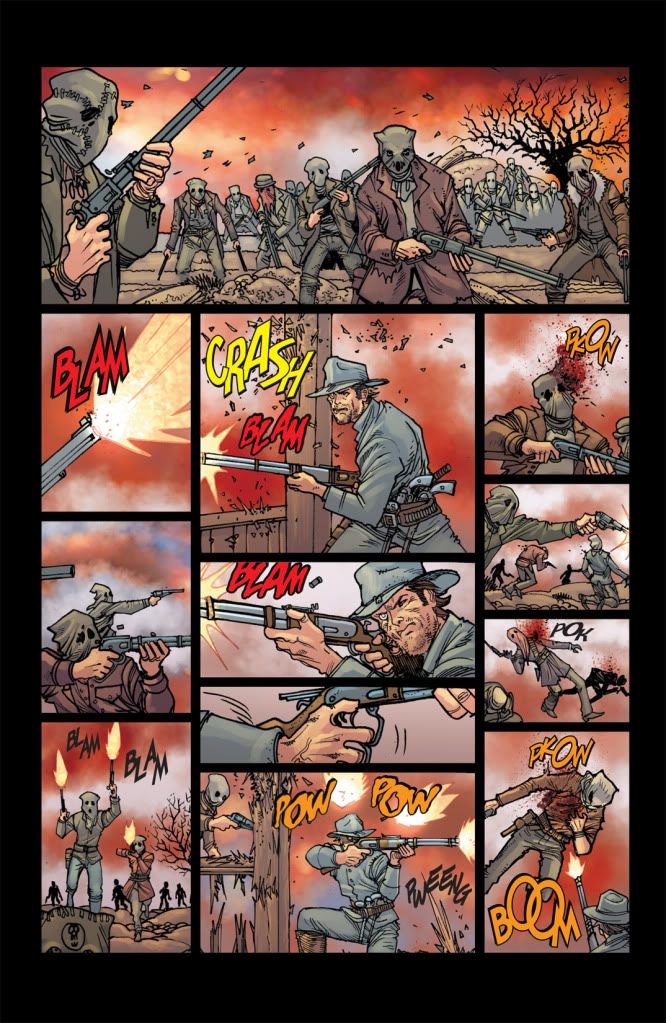
All Star Western #2 (DC) - Some people complained that the first issue of this series was too heavy on text box narration from Amadeus Arkham. Though the text-heavy first issue didn't bother me — it was a good way of delving into the characters of Arkham and bounty hunter Jonah Hex — it is nice to see that the second issue is much lighter on text and moves at a much brisker pace. The secret society that Hex and Arkham stumbled across last issue is now revealed as the same "religion of crime" that's been featured in Grant Morrison's Batman and the Greg Rucka/JH Williams III Batwoman. Between Morrison and Scott Snyder's work with Batman of late, there have been a lot of comics that have delved into the history of Gotham City, and this series now promises to tie in with that work in interesting ways. Justin Gray and Jimmy Palmiotti vary the pace here nicely, with a great shootout composed on a few busy pages full of frantic action panels. There are some occasional awkward moments in the writing (the very first page refers to "a more bloody destination") and even Moritat's generally fantastic artwork isn't always in top form. The staging of a fight scene between Hex and a hulking brute makes it pretty unclear where exactly the characters are in relation to one another, for instance. This issue also introduces a back-up feature about El Diablo, also written by Gray and Palmiotti, and drawn by the great Jordi Bernet, which justifies the book's title as something other than a Jonah Hex solo series. This short piece, in which El Diablo prepares to face down some zombies, is slight (like many backup features) but nicely drawn.

Aquaman #2 (DC) - Well at least this issue goes much lighter on the relentless Aquaman-is-a-joke punchlines from Geoff Johns' first issue. There are still traces of that annoyingly defensive tone, but for the most part integrated much more seamlessly, so this issue's gags — like the way Mera keeps getting called Aquawoman, or the scene where a cop doesn't quite recognize Aquaman without his orange shirt — are funny without being as blunt and obvious. I'm still not totally sold on this series but this is a decent issue, and the deep-sea monsters with their huge razor-sharp teeth are really creepy. Ivan Reis' art is mostly nice, too, especially during the gory battle scenes with the gilled monsters. Reis' youthful, square-jawed Aquaman is a pleasure to watch in action, but his facial expressions vary from awkward to just plain inscrutable. There are too many panels where Aquaman stares blankly straight ahead, his feelings or thoughts unclear. The tonal uncertainty in those moments is emblematic of this series as a whole.

Captain America & Bucky #623 (Marvel) - I've been really enjoying the World War II era stories in this comic of late, more than pretty much anything in Ed Brubaker's Captain America stories since around the time Steve Rogers came back from the dead. The basic gimmick here is that Brubaker, along with co-writer Marc Andreyko, is retelling the stories of this era from the point-of-view of the sidekick rather than the larger-than-life hero, and all of it is informed with an extra level of poignancy by the knowledge of Bucky's ultimate fate as developed during Brubaker's Captain America run. In this issue, Bucky comes face to face for the first time with the horrors of the concentration camps, probably an inevitability considering that this is an attempt to do a gritty war movie version of Bucky's life story. It's appropriately horrifying, the kind of story that never would have appeared in the original World War II Cap and Bucky comics. Chris Samnee's moody, wintery artwork — evoking the feel of David Mazzucchelli's Batman: Year One — makes the images of skeletal, silent prisoners especially heartbreaking. These World War II stories have been so generally good that it's a little disappointing that this series is now moving on, though the promise of checking in on Bucky's years as Soviet assassin the Winter Soldier is equally enticing.

Daredevil #5 (Marvel) - It's really wonderful to see the methodical way that artist Marcos Martin breaks down a fight scene into a flurry of small panels. Martin's art, together with Mark Waid's writing, puts the emphasis on Daredevil's senses: this book continually captures the way that Matt Murdock compensates for his lack of sight by analyzing his surroundings through the input of his other senses, turning each move, each action, into an elaborate but super-fast calculation. On one page, Martin pulls back from a closeup of the interior of an ear as Murdock winnows away all the extraneous sound threatening to overload his senses, honing in on the few important sounds he needs to hear clearly. Waid's writing has a clever, breezy feel to it that emphasizes just how much fun Daredevil is having doing what he does. "Oh, no! Six armed mercs wearing night vision goggles! Whatever will I do?" Murdock thinks, before Martin inserts a perfectly timed panel of a finger flicking a light switch to blind the bad guys. It's whimsical and light-hearted, despite the high-stakes danger and intrigue, although Waid does keep hinting that Murdock's new happy-go-lucky attitude is a defense mechanism to deal with all the trauma inflicted on the character by previous Daredevil writers.

FF #11 (Marvel) - Jonathan Hickman consistently packs an awful lot into 20 pages. This comic features another typically charming scene with Val and Franklin Richards and their assortment of oddball friends, multiple world-ending plots churning into motion, and Reed Richards assembling a huge group of heroes to face the threats closing in from every direction. It's briskly paced, funny and thrilling by turns, and every page has some fun bit of business or a startling twist or some visual stunner. This is dense and exciting, the total opposite of the trend towards decompression that dominates so many other superhero comics these days. What happens in this issue might have been stretched out over a few months in other series — or a few years if Bendis was writing it — but Hickman continues to hurtle forward with so much going on in different corners of the universe. Probably the best sci-fi moment is the revelation of the fate of the two alternate universe Reeds held captive by the Inhumans: a totally unexpected twist that Hickman and artist Barry Kitson brilliantly depict in a few gorgeously outrageous pages. Other writers would have made that the last-page cliffhanger, but Hickman just confidently tosses it out there in the middle of the issue and then moves on, ending with an even bigger cliffhanger. This is an especially strong issue for Hickman's crackling dialogue, too, after a few issues that focused more on epic fight scenes and plot machinations. The banter centering around the Future Foundation kids is crisp as ever, and so is a great scene where She-Hulk and Sue Richards gently, affectionately mock a grumpy Ben Grimm. It's yet another reminder that Hickman's Fantastic Four (which returns for its 600th issue next month) and the spinoff FF are so strong not only for their wild high-concept sci-fi but for their low-key humor and keen grasp of family dynamics.

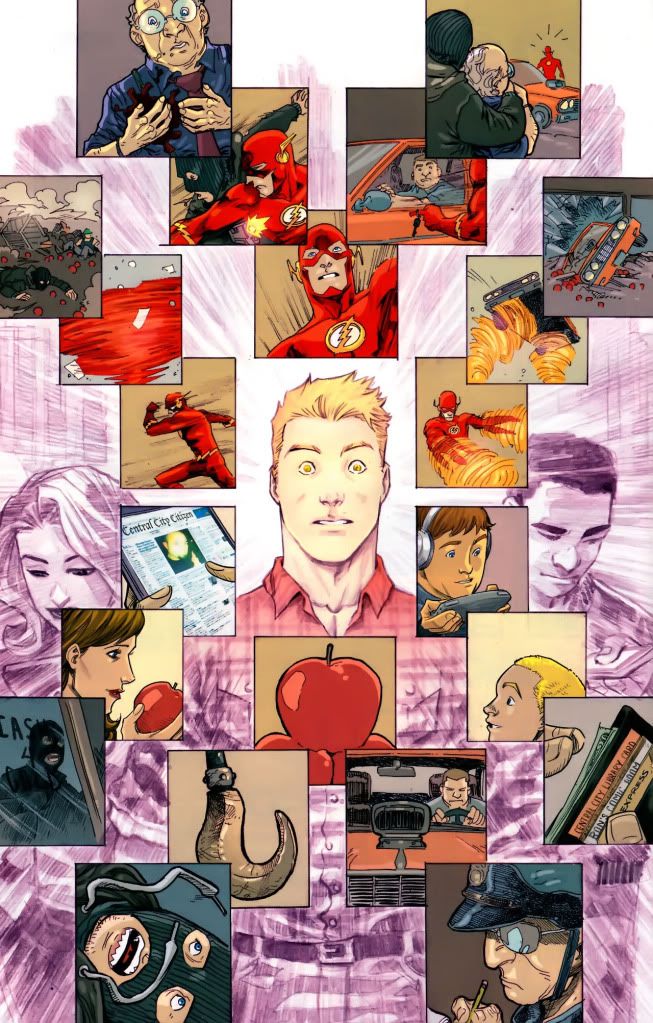
The Flash #2 (DC) - I thought the first issue of this series was really good, but this one ups the ante even more. Artist Francis Manapul and colorist Brian Buccellato also share writing duties on this series, and considering that they're not tested writers with a lot of experience, this book reads briskly and enjoyably, telling its story with more clarity and wit than many of the New 52 books guided by supposedly more seasoned writers. But the art is where this book really shines, the art and how it's used to show Barry Allen in super-fast action. This issue introduces a new wrinkle to the Flash's powers as he realizes that, while he's physically using his powers to their full potential, he hasn't really taken mental advantage of his speed. Needless to say, the pages where Manapul shows Barry flexing his new sped-up mental prowess are jaw-dropping. The pages are filled with small square panels depicting everything Barry sees as he walks around the city, as he takes in all the different aspects of a scene and then foils a robbery without anyone even realizing that he's intervened. This scene reminds me of the Marcos Martin-drawn story in Mark Waid's recent Daredevil #1, and the two books share some similarities in that both are about sensation and heightened ways of experiencing the world. It's brilliantly staged, and suggests the possibility of the Flash as a hero whose heroic acts pass unnoticed, explained away as elaborate coincidences and mishaps.

The Incredible Hulk #1 (Marvel) - I could have read quite a few issues of the shaggy, bearded Hulk hiding out underground, chilling with the Moloids and hunting great big monsters. So it's a little disappointing that this situation basically only lasts for the first half of Jason Aaron and Marc Silvestri's new first issue about the big green guy. Silvestri's densely hatched art is instantly striking, though it's puzzling why he needed three inkers as well as Michael Broussard doing "pencil assists." The issue opens with Hulk battling monsters, then brooding while his adoptive underground family feasts and celebrates his successful hunting. These pages are evocative and beautiful, depicting a haunted Hulk vainly trying to escape his past. I'm not as sold on the rest of the issue, as Aaron very quickly — too quickly, I think — breaks Hulk's isolation by bringing in a squad of chatty robots to fight him and teasing what looks to be the larger plot for subsequent issues, involving Hulk's former alter ego Bruce Banner (apparently they're separate beings now?). This was a decent enough first issue, and it's certainly cool-looking, but I'm still a little disappointed that Aaron has so quickly moved beyond what could have been a promising status quo for this book's initial arc.

Justice League Dark #2 (DC) - I didn't really expect to be saying this, but the highlight of this issue is the creepy/kinky relationship drama between Deadman and his girlfriend, Dove. Deadman attempts to get laid by possessing random strangers in the hopes of having an actual physical relationship with Dove, and it's both strangely poignant and really funny, especially when he possesses a girl and clumsily hits on Dove, causing her to storm off. Meanwhile, the main plot with Enchantress simmers a bit after the all-out chaos of the first issue. The villain mainly unleashes some random weirdness on Zatanna and Dove and delivers threatening messages via the radio. Constantine appears briefly too, very much in character, drinking and getting beat up and generally just providing a reassurance that Constantine can exist outside of Vertigo without losing his edge. I like that Milligan seems to be randomly jumping around to different characters, delivering twisted little character beats or offering up visual weirdness for Mikel Janin to draw in his hyper-real style. It's also nice that Janin subtly alters his art to suggest the different worlds of the characters: Constantine's gloomy, heavily hatched pages seem very different from the much brighter, cleaner style of the bar scenes where Deadman and Dove awkwardly banter and argue.

The Mighty Thor #7 (Marvel) - Last month, Matt Fraction wrapped up this series' first arc in a very satisfying fashion. This month, the book is given over to what amounts to a prequel to Fraction's Fear Itself crossover, the story of how Thor's father Odin ascended to become first among the Norse gods. It's just a solid, action-paced issue, an excuse for artist Pasqual Ferry to draw lots and lots of heads being lopped off and bodies torn apart as Odin does battle with the forces of his cruel, warped brother. The best part is Fraction's writing of the bold, overreaching young Odin, whose bravado and leaping into danger is very reminiscent of the child Loki who Fraction created on his last Thor series. It's a decent standalone issue, if not as boldly imaginative as the great stuff Fraction was doing with these characters prior to Fear Itself. What will be really interesting now is to see if Fraction can maintain this series' level of quality with Thor, for the moment, "dead" after the events of the crossover.

Spaceman #1 (Vertigo) - This is the debut of a new nine-issue miniseries that reunites writer Brian Azzarello and artist Eduardo Risso, the creators of the great, pulpy 100 Bullets. It's a post-apocalyptic thriller set in a future wasteland, where the title character Orson — a genetically engineered humanoid manufactured for spacefaring missions — has virtual reality sex via remote hookups and scrounges for scrap metal to feed his drug addiction. The story thus far is a mash-up of various dystopian genre conventions and little meta in-jokes, with a kidnapping plot that revolves around a vicious and transparent satire of Brangelina. There's not enough here yet to tell where this is really going, so this first issue is all about atmosphere, both in terms of Azzarello's goofy, invented future-slang and Risso's typically jaw-dropping, shadowy artwork. Though I can already feel the weird, slangy dialogue growing on me, like a nutty sci-fi twist on the purplish street patter that Azzarello slung throughout 100 Bullets, it's Risso's mostly wordless visual storytelling that provides the issue's most compelling moments. That's why the best sequences are the ones in which Orson in a spacesuit navigates across Mars, in what may be a glimpse of the past or the future or simply a druggy reflection of the main character's inner states.

Venom #8 (Marvel) - Spider Island is yet another big Marvel crossover that I haven't been reading but which is infiltrating books I like anyway. It hasn't derailed Rick Remender's Venom, though, even if the whole concept for this storyline seems spectacularly, amazingly stupid. Remender has wisely chosen not to allow the crossover to completely overwhelm the stories he was telling with this series already, so that even if the events of these issues tie into what's going on over in Amazing Spider-Man and other books, Remender keeps the focus on Flash Thompson dealing with the illness and death of his drunkard father and coping with the Venom symbiote's strengthening hold on him. Though this issue isn't as strong of a standalone issue as Remender's previous two Spider Island tie-ins — for one thing, it ends with a cliffhanger battle that's going to be resolved in Amazing Spider-Man #672, the final issue of the crossover — it's still a character piece as well as a crossover fight scene. Remender weaves the plot together with narration from a letter that Thompson's dad wrote just before he died, so that even as Thompson/Venom brawls with the Spider Queen and teams up with Steve Rogers, the book remains focused on more than the violence. That's what makes Remender's Venom so enjoyable; he does the big dumb action well but never delivers an issue that's just big dumb action. Even if these Spider Island issues haven't been as strong as the series was before the crossover started (and I'm glad it's over) Remender has managed to keep this series on track even while compromising with other writers' stories.

The Walking Dead #90 (Image) - Robert Kirkman's zombie epic has been running for so long now — holy shit, the 100th issue will be out next year! — that there's a real sense of its characters changing and growing over time. So when, as in this issue, Rick discusses the ways in which these experiences have changed him with Andrea and Carl, or when Maggie lets the pressure of life in the zombie apocalypse get to her again, these moments resonate with everything that's happened to these people in these pages. Rick's ongoing evolution, his struggle with his need to control everything, his increasing comfort with life-or-death decisions, continues to be very compelling, highlighted here by a stunning double-page spread in which he asks Andrea, and by extension the reader, to look into his eyes and really think about what he's seen and done. That expansive portrait, by Charlie Adlard — who's been with these characters nearly as long as Kirkman has — delineates Rick's exhaustion, his numbness, with lidded eyes and heavy shadow. He seems haunted, and the image itself is haunting; in an issue with no zombies, no gore, no violence, this portrait encompasses the horror of this series' premise, the horror of accepting death and violence as an everyday occurrence, just another part of what happens. This is an especially good issue for this kind of low-key character work, which is Kirkman's primary strength as a writer. He's good enough at this stuff that even the last-page romantic twist — which Adlard has been subtly hinting at with body language and visual feints for several issues now — doesn't come off as a gimmick but as a natural outgrowth of these characters and this moment.

Wolverine and the X-Men #1 (Marvel) - Jason Aaron's Schism event, which separated the X-Men into two teams focused around Cyclops and Wolverine, was lame and forced, a perfect example of a story existing solely to justify (weakly) its end point. So it's surprising that the first issue of Aaron's new book, about Wolverine setting up a new mutant school, is a blast from start to finish, totally clearing the air of all the turgid Schism/Regenesis stuff and making it clear just why Aaron was so excited to get to this point. There's just so much to love here, as Wolverine and Kitty Pryde take a breathless tour of the new school's grounds with a pair of frazzled, caricatured state education inspectors in tow, harrumphing everything they see. It's a delight from start to finish. The structure provides an opportunity for Aaron and his artistic collaborator Chris Bachalo — whose energetic manga-influenced style is a perfect fit for this issue's flippant, funny tone — to introduce the huge cast bickering, gossiping and careening through the halls committing all sorts of wackiness. It's fun to see all these underused mutant characters colliding off of one another. I got a special kick out of seeing Doop, from Peter Milligan's classic X-Statix, serving as the school's receptionist. It was also nice, and logical considering Bachalo's presence and the school setting, to see a bunch of alumni from 90s X book Generation X, which I fondly remember as a favorite of my 13-year-old self. This issue is fast and funny and packed with little character beats and visual gags, like the full page shot of mutant terrorist Quentin Quire being kept prisoner with the dragon Lockheed perched threateningly over him. If Aaron and Bachalo can keep this frantic pace and level of energy up over the long haul, they've got a real classic in the works.