Showing posts with label Journey Into Mystery. Show all posts

Tuesday, November 1, 2011

More Weekly Comics: October 26, 2011

The Fury of Firestorm: The Nuclear Men #2 (DC) - Despite its blunt dialogue and half-baked racial politics, this series' first issue was messily intriguing, a smear of weird ideas and keyed-up hysteria. Gail Simone and co-writer Ethan Van Sciver deliver more of the same for the second issue, though if anything the dialogue is even more ungainly this time around, and the seams are showing more obviously in the exposition-speak and uneven pacing. Yildiray Cinar's art continues to be the most satisfying aspect of the comic, with a distinctive marker-line style that makes things look curiously washed-out and faded. It's a great-looking comic, and there are some cool, out-there ideas bouncing around here, as the two Firestorms embody opposite personalities and can come together as part of a larger whole. It's not really a good comic, though, and I'm not sure how much longer I can wait for it to get over its trainwreck weirdness and become legitimately worth reading.

Journey Into Mystery #630 (Marvel) - Every time an issue of this Kieron Gillen series comes out, I keep thinking that it's a book with a lot of promise. There are always flashes of wit and clever writing that suggest the truly great comic it could be but never quite is. This issue has paid off my patience in a big way, though, with the best issue Gillen's written yet, the first issue to really deliver on the promise that he's shown in crafting the adventures of Loki and the other Norse gods. The focus here is on Volstagg the Voluminous, one of my favorite of the Marvel Asgardians, the jolly fat man who's a lot smarter and a lot braver than the comic relief goofball he usually seems to be. So it shouldn't be a surprise that this issue just sparkles from beginning to end; it's funny and poignant and a great showcase for the fat god. The dialogue, always Gillen's strongest attribute, is really witty and packed with puns and fast-paced exchanges, like the mocking but affectionate back-and-forth between unlikely conspirators Loki and Volstagg. And then Volstagg returns to his family, and tells his children the story of his encounters with the evil Serpent, embellishing details freely and making himself look muscular and dashing in his visualizations of these tall tales. It's funny as hell and perfectly paced, with the best moment probably being when Volstagg gets carried away in imagining Ms. Marvel gushing over him, prompting a stern scowl from his wife. There aren't as many of the often-ponderous narrated caption boxes that Gillen has sometimes leaned too heavily on in previous issues: while his omniscent narrator can be stilted and boring, his control of the characters' voices is perfectly pitched. The bulk of this issue is dominated by Volstagg, and through Gillen's writing of the character (and artist Richard Elson's expressive body language and faces) one can practically hear the big god's booming tones and jovial jesting.

The Savage Hawkman #2 (DC) - Man, this is a staggeringly bad comic. I thought, after Tony Daniel's first issue, that I could put up with Daniel's gritty Frank Miller wannabe writing for the sake of Philip Tan's lush artwork, but now I fear I was wrong. This is a comic that opens with the terribly named alien villain Morphicius telling the hero, "your nth metal is burning my blood, Hawkman! But it is a good burn!" Kinky. There's more, much more, where that came from, as Daniel seems intent on proving what a bad writer he is on every page. As for Tan, his chaotic battle scenes are certainly cool-looking, if sometimes not especially clear — the title splash page is basically just a big mess of fire in which the two combatants are totally immersed — but the non-fight scenes don't fare as well. Tan's drawings of Hawkman's co-worker Emma as an emaciated beanpole with a deformed upper body are especially comical.

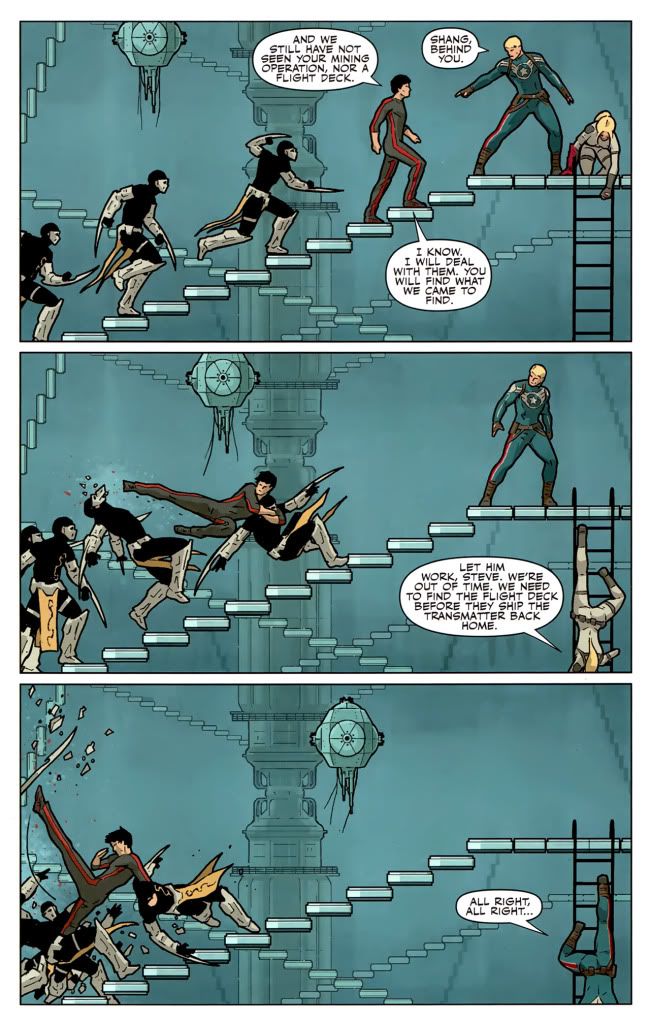
Secret Avengers #18 (Marvel) - This is Warren Ellis' third issue since taking over this series (after a solid but unfortunately abbreviated run by Ed Brubaker and a few lousy Fear Itself tie-ins by Nick Spencer) and he's turned it into just the kind of one-and-done secret mission thriller series that is one of his fortes. There's more than a hint of Planetary and Global Frequency in these issues, as Ellis makes each issue a standalone story in which Steve Rogers and a small roster of his secret agents must stop a potentially world-ending threat at the last moment. For this issue, it's just Rogers, Sharon Carter and Shang Chi infiltrating a secret base where the bad guys are smuggling out some material that could turn the Earth into a sun. For some reason, the base has warped gravity so that staircases run upside-down and up the walls, which gives David Aja an opportunity to draw mind-bending M.C. Escher layouts in which the heroes and the bad guys stalk each other at odd angles and have gravity-defying fights that start out upside-down and end with the combatants flying off-panel right-side-up. The action is brutal and efficient, and in between the fight scenes Ellis likes to pause for just a moment's breath, in which the team's resident scientist Beast often delivers elegant explanations for the multidimensional weirdness that's caused this latest threat. This is the kind of comic that Ellis could probably write in his sleep, a breezy sci-fi spy thriller with punchy dialogue and a new, inventively realized evil plot in each issue.

Superman #2 (DC) - George Pérez and Jesus Merino's Superman lacks the punchy modernism of Grant Morrison's new Action Comics, but that's obviously intentional. Just as Morrison's series chronicles the early adventures of an angry, hungry young Superman, Pérez is telling stories about a much calmer, more settled Supes who's grown into his power. While he retains the polemical, near-socialist idealism of Morrison's Superman, he's also been worn away a bit by the years. This is a very melancholy, lonely Superman who opens the issue brooding over star charts that show the location of his demolished home planet. Later, he sits in his aptly named Fortress of Solitude while Lois Lane, oblivious to his romantic pining over her, asks him to share what's bothering him. Like the first issue, this one focuses on a fight with a strange monster, though this battle is more inherently interesting and has a pretty clever conceptual hook: Superman can't see the monster while all the humans around him can. This means that he winds up relying on video feeds and televisions to fight the monster. The comic shows things from Superman's perspective, so that he seems to be fighting thin air while keeping an eye on video monitors that show what everyone else is seeing. It's nicely done, and feels like the kind of gimmick that might have provided a goofy single-issue hook for an old Silver Age issue of Superman. It also provides some visual interest that was mostly lacking in the first issue's comparatively generic fire monster. Pérez's writing is still wordy and old-school, overloaded with narration as Superman records his report about the day on his computer system. The overall effect is dense and meaty, ignoring recent trends towards minimalism and decompression.

Teen Titans #2 (DC) - Yeah, I'm done with this now. I gave this series the benefit of the doubt because I'd been pretty positive about the first issue of Scott Lobdell's Superboy, and the two books are basically telling one big story, but the first issue wasn't exactly thrilling. Now I'm ready to give up on Lobdell's New 52 work, because the second issue of Superboy wasn't anything special, and this series continues to underwhelm. Not much to say here, really. It's the kind of book that seems to think that introducing a character, giving him or her a power set and maybe one defining characteristic is the extent of characterization. The Wonder Girl/Red Robin relationship here is so one-note and simplistic: Wonder Girl just responds defensively to everything, while Red Robin makes puppy dog eyes at her. Nothing much here to make me want to read more.

The Unwritten #30 (Vertigo) - Though I'm a couple of weeks late here, this is the best issue yet of Mike Carey and Peter Gross' magical fantasy series. The most recent story arc has been delving into the rather sordid past of Tom Taylor's novelist father Wilson. This issue provides the climax of that story with an especially heartbreaking revelation about the comic book character the Tinker, a costumed hero who seems to have burst into the world from the pages of a short-lived newspaper serial. This series is, at heart, about the profound effect of fiction on those who read it and create it — as this issue makes clear, so many of this series' characters exist at a sort of junction between reality and fiction, their lives shaped by the stories that at times seem more real to them than "real life" itself. That's especially true of the Tinker, whose devastating story forms the bulk of this issue. As the comic cuts back and forth between a conversation between Tom and the Tinker and flashbacks from Wilson Taylor's journal that elucidate this strange character's past, a truly strange and powerful tragedy begins to take shape. What's especially powerful is the way Gross draws the Tinker at first in a bold, cartoony style that emphasizes his comic book origins, but as the issue goes along and the tragic truth about this character is revealed, his square-jawed heroic countenance fades into a wasted-looking old man.

Monday, October 24, 2011

Weekly Comics: October 19, 2011

Batman #2 (DC) - I love how deeply engrained Scott Snyder's Batman is in the history of Gotham City, its legends and the ancestors of the characters who define its present. The opening of this issue, with its emphasis on Wayne Tower, recalls the Snyder-overseen miniseries Gates of Gotham, which explored the secrets behind the construction of that tower. Snyder is signalling that the past is once again going to reach forward into the present. This issue also explores another of Snyder's running themes in his Batman work: the ways in which the city of Gotham shapes those who live in it, and vice versa. His Detective Comics run, with Dick Grayson as Batman, focused on Dick's fears that Gotham would transform him, would unleash the darkness that so often threatens to consume Bruce Wayne. But as in that series, Snyder's new Batman seems to be confirming that things mostly work in the other direction: each man sees his own Gotham, shaped or warped by his own experiences and how he's chosen to react to them.

Bruce's conversation with would-be politician Lincoln March underlines this theme. March is a man with a past similar to Bruce's, having lost his parents at a very young age; his story about his mother's heart pin is an eerie echo of Bruce's fixation on his own mother's pearls. March says that Gotham itself helped him past his trauma, giving him a sense of purpose, and in a strange way this is also true for Bruce, though not in the same sense as March's idealistic political fervor. Both men see themselves as shaped by the city, changed by their traumatic pasts, but they take very different trajectories and see Gotham in very different ways. It's great how Snyder is weaving these undercurrents into his story from the very beginning, slowly developing these themes as Bruce, confident in his knowledge of Gotham and of his own relationship with the city, prepares to face yet another threat from the city's past, a threat to the city that he sees as integral to his identity as Batman. Snyder's storytelling is patient, obviously working towards a bigger arc, but not at all decompressed — this issue is well-paced with action, some displays of Batman CSI tech and detective work, and the moments that develop Snyder's big picture themes.

The Boys: Butcher Baker Candlestickmaker #4 (Dynamite) - Well, I called what was going to happen in this issue. Not that it was hard to predict. The problem with this miniseries is that it was always so obvious just where it was going to be heading, the only place it possibly could be heading. It's a familiar Garth Ennis formula, especially in this series, which revels in brutality and horrible things happening to decent people. So when the future leader of the Boys, Billy Butcher, met a beautiful redhead and married her, the only question was in what horrible and grotesque way the Homelander was going to kill her so that Butcher could be pushed onto the unceasing quest for vengeance that drives him over in the main series. That question has now been answered, and the final pages of this book, as drawn by Darick Robertson, are appropriately harrowing and horrifying — suffice it to say that Ennis' warped imagination has concocted some really nasty images here, images that owe a bit to Alan Moore's Miracleman and offer up a grisly, cynical twist on one of the pivotal events of that series. But there are no surprises here, and there's no real depth to Ennis' revelation of Butcher's back story. It was always obvious from the main series that superheroes — and specifically the Homelander — had been responsible for something awful in Butcher's past, that they'd probably killed someone he loved. Now that the details have been revealed, it doesn't really change his character very much, or reveal much about him that wasn't already apparent. It's just another opportunity for Ennis to wallow in the terrible things that superpowered beings do in this series, another opportunity to show that people with real power almost invariably use it to hurt, use and screw over others. The political applications of that idea are made especially clear in this issue's discussions about Thatcherite England, but even so this whole miniseries just feels so redunant and unnecessary.

Captain Atom #2 (DC) - This is just a really cool-looking terrible comic. The linework of penciller Freddie Williams II isn't anything special; it's mostly pretty minimal and crude, and when it isn't there are some ugly, distorted faces on the pages where Williams lays down the ink thicker. Colorist Jose Villarrubia does most of the heavy lifting here, giving the series' title character a pale blue sheen that makes him stand out boldly from the world around him. It's very striking, especially on the pages where the atomic hero is overwhelmed by the electronic signals of the Internet and text messages flowing through the air around him, spectral information as ghostly and colorful as the hero himself. If only it were a good comic with this kind of distinctive style, but JT Krul's writing and plotting are just boring — when they're not outright silly, as in the volcano that abruptly popped up in the middle of New York at the end of last issue, a threat that Captain Atom seems to have neutralized between issues, leaving the volcano inert but still sticking out of a Manhattan street. I wish this comic was good, because I do like looking at it, but unfortunately it has little to offer beyond its admittedly pretty colors.

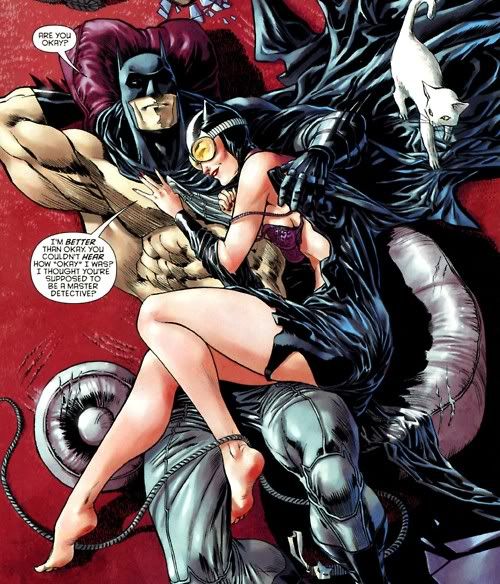
Catwoman #2 (DC) - I've gotta give it to Judd Winick: he pissed off a whole lot of people by ending the gloriously sleazy first issue of this comic with a fetishy, campy Batman/Catwoman sex scene that apparently offended everyone but me. (That's an exaggeration, but not by much.) And instead of moving on from there, he decides to open the second issue with the sex scene still in progress, giving us not only a splash page of a post-coital smiling couple but a panel of Batman adjusting his belt as he pulls his costume back into order. Never thought I'd see that. And I have to say, I'm still digging this ridiculous comic. Guillem March draws a very sexy, curvy Catwoman whose face expressively projects her playful delight in manipulating her opponents. She'll get her revenge for some dark things from her past, and she'll have a lot of fun doing it. The end of the comic goes very dark, very suddenly, but before that it's just so much fun to see Catwoman flirting with Bruce Wayne, unaware of who he is but feeling a strange attraction to him anyway, and then cleverly manipulating some rival mobsters into a shootout to get her revenge. This is pulpy stuff that very deliberately leaps across the line separating good taste from bad, and I can't help but admire it for that. It's trashy, and Winick and March undoubtedly know it, and the result is kind of a grindhouse Catwoman comic, delving into extremes of flashy sexploitation and over-the-top violence. I'm sure this comic will continue pissing people off, and I'm equally sure that it's going to be hard to look away from its garish trainwreck wildness for as long as it continues in this vein.

Green Lantern Corps #2 (DC) - After the first issue of this series, I thought I was onboard for what seemed like it was going to be some mindless cosmic action. Now I'm starting to think it's a bit too mindless after all. Not much has changed from the first issue, I admit, except that now the focus is irrevocably off characterization, so that Lanterns John Stewart, Guy Gardner and the squad of alien Lanterns they lead are all pretty generic. At least the first issue gave some character beats to the two human members of the team. The threat they're facing, which was just an unseen terror killing Lanterns last issue, has now been revealed as a bunch of generic guys in black armor, so that's a letdown too. Basically, it feels like this isn't going to be the great action series I was hoping for, and the alien Lanterns are going to continue to be mere fodder for limb-hacking and grisly deaths, and I'm not sure that there's any reason to keep reading.

Journey Into Mystery #629 (Marvel) - Since it seems like Marvel's Fear Itself event is quite simply never going to end, I guess this potentially enjoyable book is going to remain trapped in a crossover swamp for the forseeable future. Kieron Gillen's writing is a weird mix of formal prose and flippantly delivered dialogue, with the latter being much more palatable than Gillen's attempts at Asgardian portent. As usual, Loki's breezy manner is the main appeal of this comic and this character. His delivery of tossed-off battle orders — "Dark Asgard flies on engines powered by raw fear-stuff and similar... let's blow them up" — suggests his childlike enthusiasm and casual approach to prophecy and war. This is contrasted against the stiff, often awkward writing of the narrative caption boxes, which overpower the much more lively dialogue. But the real problem continues to be that Journey Into Mystery so far has just been a peripheral part of Fear Itself when it should be a fun, slightly goofy book about the adventures of kid Loki. It's a waste of this character that his showcase comic mainly summarizes events in other series (apparently Thor's dead over in Fear Itself — yeah, that'll last) and adds a little ancillary action.

Justice League #2 (DC) - Geoff Johns' flagship DC book continues to move at a deliberate pace, slowly introducing the major players and having them size each other up with pattering dialogue and the obligatory superhero-misunderstanding-fight-scenes. Last issue focused on Green Lantern and Batman, with Superman showing up at the very end, while this issue throws the Flash into the mix and moves forward with the origin of Cyborg. Johns' punchy dialogue prevents the decompressed pace from being frustrating, and it helps that it's inherently fun to see these famous heroes meeting each other for the first time, cracking jokes as they try to figure out the origin of the mother boxes that Darkseid is planting in various US cities. Jim Lee's bold art is another pleasure here, and he's at his best in depicting a fight scene between Superman and the Flash, with the speedster dancing in circles around the Kryptonian before Superman finally catches him and sends him flying with a playful flick of his finger. The layouts of fight scenes like this are simple and elegant, breaking down the action into small gestures that lead into the massive, explosive pin-up panels that are Lee's forte. When he tries for a more complex layout, as he does on a page where Green Lantern calls the Flash for help, the page starts to look crowded and cluttered, with word balloons and layered panels creating visual confusion. That's just one page, though, and the rest of the issue tends to play to Lee's strengths much more clearly, with simple, iconic depictions of fight scenes and superhero posing. The introduction of more heroes in this issue gives the impression that things are speeding up and spreading out, gathering momentum as the Justice League of the title begins to take shape. When Wonder Woman and, presumably, Aquaman show up next issue, the pacing should get even more frenetic, the action more frenzied.

Nightwing #2 (DC) - I like Dick Grayson as a character, especially since his recent stint as Batman, but I have to say, the prospect of "Nightwing solves a circus mystery" as the driving plot of this first arc is really not exciting me on any level. The same thing goes for the assassin who's stalking Dick, a generic costumed guy with claws called Saiko, which not only provides the awful pun of the cover text but allows Dick to make a similarly terrible sorta-pun inside the actual comic. This just isn't really that interesting, from the generic love interest to the weirdness of Dick inheriting a circus to the off-kilter pacing. Eddy Barrows' fight scenes are interestingly laid out — as in the first issue, he seems to be taking more than a few page design cues from JH Williams III — but his faces are really goofy looking, and the presence of two inkers suggests that this is yet another New 52 issue affected by deadline pressure.

Supergirl #2 (DC) - The very decompressed storytelling in this series is already starting to get annoying. The first issue was basically just an extended fight scene between Kara and a bunch of armored soldiers as she tries to figure out what's going on. The second issue is... basically just an extended fight between Kara and Superman as she tries to figure out what's going on. While I enjoyed the first issue well enough, Michael Green and Mike Johnson are certainly taking their time building up to anything more substantial. Here, the two Kryptonians duke it out because Kara refuses to believe that Superman is actually her cousin, mainly because in her memory he's still a baby, which raises questions about where (and when) she's actually from and how she got here. But the whole thing feels contrived because after brawling all issue, Kara abruptly decides to stop by the end, and suddenly trusts her cousin after refusing to listen to him at first. This series needs to quickly do something besides staging 20-page fight scenes, even though Mahmud Asrar is undeniably good at drawing them: his figures in motion have a nice sense of energy, and he's great at depicting the paths of destruction that the hurtling superbeings leave in their wake.

Wolverine #17 (Marvel) - Jason Aaron has been doing some fine work on Wolverine lately, quite literally sending the man with the claws to hell and bringing him back only to tear him down even further. Then, just last issue, Aaron offered up a surprisingly touching and even funny reminder that Wolverine stories can and should be about more than just suffering and killing. This issue picks up that thread and serves as a placeholder in the aftermath of Aaron's Schism miniseries, which somewhat artificially concocted an excuse for Wolverine and Cyclops to fight and split up the X-Men into two teams. Now Wolverine's preparing to restart the Xavier school, so this issue is pretty much just filler before that storyline starts in earnest over in Aaron's new Wolverine and the X-Men series. As filler, it's not bad, and Aaron's feel for humorous dialogue is especially sharp here, as Wolverine goes hunting through San Francisco's Chinatown underworld for some drug dealers who have managed to subjugate a pair of dragons. Yes, really. It's knowingly a bit goofy, especially when Wolverine's throwdown with Gorilla Man is interrupted by the meta commentary of a pair of onlookers whose banter reflects the stupidity of the superhero comic convention that every time two heroes meet, they must fight. Considering all the angst and poignancy of Aaron's recent Wolverine arcs, this kind of low-key, light-hearted issue was probably needed to provide a breather before the aftermath of Schism really starts to play out.

Wonder Woman #2 (DC) - Damn I love this comic. This issue isn't as rapidly paced as the action-packed first one, but it has the same energy and vitality. Brian Azzarello's writing is crisp and efficient: he tells Diana's origin story in just two pages and caps it off with a casually jokey exchange. He packs a lot into this issue, as Wonder Woman takes Zola — the woman carrying Zeus' latest bastard child — back to the Amazons' home. Azzarello's dialogue is crackling and sharp, very different from his usual hardboiled style but with his characteristic wit intact. Zola's conversation with Hermes is great, as she wonders which of the men she's slept with lately could have been Zeus in disguise. It's not only funny but sex-positive and non-judgmental, especially remarkable considering some of the depictions of women in other New 52 series. It helps that Cliff Chiang's cartoony, expressive faces give his characters, particularly all the women in this story, vibrant personalities. The design of the villainous Strife, Hera's daughter and apparently Diana's sister, is especially effective, appearing as a willowy, pale blue gothy figure in a shredded cocktail dress.

Monday, October 3, 2011

Weekly Comics: September 28, 2011


American Vampire #19 (Vertigo) - With the recent epic World War II storyline concluded, Scott Snyder's gritty vampire series takes a break with an arc dedicated to the early life of Skinner Sweet, before he became a vampire. Sweet and his future adversary Jim Book are in the army together, fighting Indians, and the bulk of this issue focuses on the brotherly rivalry between these two men who would eventually become worst enemies. Jordi Bernet is the guest artist for this arc, and his cartoony, slightly sketchy style is a good fit for this tale of a simpler time in these men's lives. This is especially true of the first few pages about Sweet and Book's boyhood, which features a bright, sunny look and big-eyed character drawings that immediately contrast against the much darker style usually brought to the series by Rafael Albuquerque. With the emphasis on Book and Sweet and the broadly telegraphed differences between them, this is a pretty atypical (and largely vampire-free) issue for much of its length. Of course, the ending marks a return to the pulpy lunacy that I've come to expect from Snyder's Western vampire saga, when a curvy, naked vampiress makes an appearance in the last few pages. At that point, Bernet's bold art gives the scene a splashy, campy tone that suggests that some good goofy fun is ahead for this story.

Brilliant #1 (Icon) - This is the first issue of a new creator-owned series by Brian Michael Bendis and artist Mark Bagley, which has apparently been a long-gestating idea that Bendis has been waiting to do with Bagley. The first issue is... okay. After loving a lot of Bendis' work for years, especially Alias, I've gotten burned out on his style since he started steering Marvel's Avengers and a lot of the company's big superhero crossovers. This issue does little to alleviate my exhaustion with him, because the trademark wordy, hyperactive, pattery Bendis dialogue is all over the place, with chains of word balloon exchanges winding through most of the panels. His stylized dialogue has always walked a thin line between amusing and annoying, and here it jumps back and forth between the two poles, with an unfortunate emphasis on the latter. I'm not sold on the idea (a bunch of prodigy Ivy League college kids "invent" superpowers) or the characters, and so far it basically feels like Heroes, dealing with the concept of superpowers in a mostly realistic world with young people who don't don costumes when they get their new abilities. I'm curious enough to check out some more of it, but so far it doesn't seem like Bendis has returned to the heights of Alias or Daredevil or the best parts of the sometimes-uneven Powers.

FF #9 (Marvel) - Jonathan Hickman has been doing excellent work on Fantastic Four and its successor series FF ever since his debut on the former series. The reverberations of his fantastic first arc, in which Reed Richards tried to "solve everything" with the help of a pandimensional assembly of his parallel selves, are still being felt in FF, as four dimensionally stranded Reeds stand at the center of a massive war that Hickman's been patiently setting up for some time now. This issue takes place at the climax of this war, so it's mostly all dedicated to battle and action, with visceral art and layouts by Steve Epting that make all the explosions and fist-fights pop off the page. As usual, though, Hickman is at his best when he cuts away from the action for a few pages spent with young Valeria Richards and would-be child supervillain Bentley. Hickman's expansion of the Fantastic Four cast to focus on the Richards kids and a host of other children and oddball characters is the best aspect of his run, and his dialogue for these characters — precocious but definitively childlike — is pitch-perfect. This is a short, delightful little scene, a much-needed break from the otherwise non-stop action on display here. One hopes that Hickman's FF will eventually focus even more on the Future Foundation class and other supporting characters — maybe once the main Fantastic Four series returns, also with Hickman writing, in November.

Journey Into Mystery #628 (Marvel) - I've been reading this series ever since it split off from Matt Fraction's Thor as a showcase for the young, newly resurrected Loki, and I'm not sure why. Part of it is that I love the character: Loki as a kid is just a lot of fun and his constant machinations are really charming, whether they're here or over in Fraction's Mighty Thor. The problem is that this series has been mired in the Fear Itself crossover (which I'm not reading) since it began, and a lot of these issues just read like summaries of things happening elsewhere or bits of ancillary action at the fringes of the story. Also, Kieron Gillen's wordy, text-box-heavy style is doubtless intended to give the impression of a series steeped in old world myths, but the effect is mostly just stilted and arch. This issue features nice art by Whilce Portacio, who's a little more lively than Dougie Braithwaite, whose art on previous issues of Gillen's run has always seemed overly stiff and static, not to mentioned smothered under oppressive coloring. There continue to be flashes of cleverness and fun here whenever Gillen abandons the endless narration boxes to let Loki crack wise, but he still doesn't nearly have Fraction's subtle wit or sense of scale. I'm hoping this series will be able to stand on its own well once Fear Itself finally ends, though.

The Mighty Thor #6 (Marvel) - What I love about Matt Fraction's take on Thor is that it's totally unpredictable, working at a grand epic scale, dealing with myth and belief and fate and choice, as befits a character right out of mythology. This issue concludes the war between Galactus and the inhabitants of Asgard that has run through the first six issues of Fraction's Mighty Thor. And suffice it to say that the war has been resolved in an utterly unexpected way, tying together the large-scale cosmic conflict with the ground-level struggle between the Asgardians and the humans living in a town near Asgard's current earthly location. Most notably, the local Christian pastor who had often been a subject of comic relief in earlier issues unexpectedly gets treated in a much deeper and more complex way here, and the resolution of that plot sets up a strange new status quo that should make the next arc of this series just as interesting. As usual, Olivier Coipel's art is stunning, particularly in the panels of a brooding, shadowy Galactus looming over the tiny figures of the men and gods arrayed at the feet of the world devouring being. Also as usual, much of the action is splayed across the elaborate double-page spreads that Fraction favors for his work with Marvel's Norse characters, contributing to the sense of scope that's so important to dealing with gods and aliens and creatures that dwarf mountains.

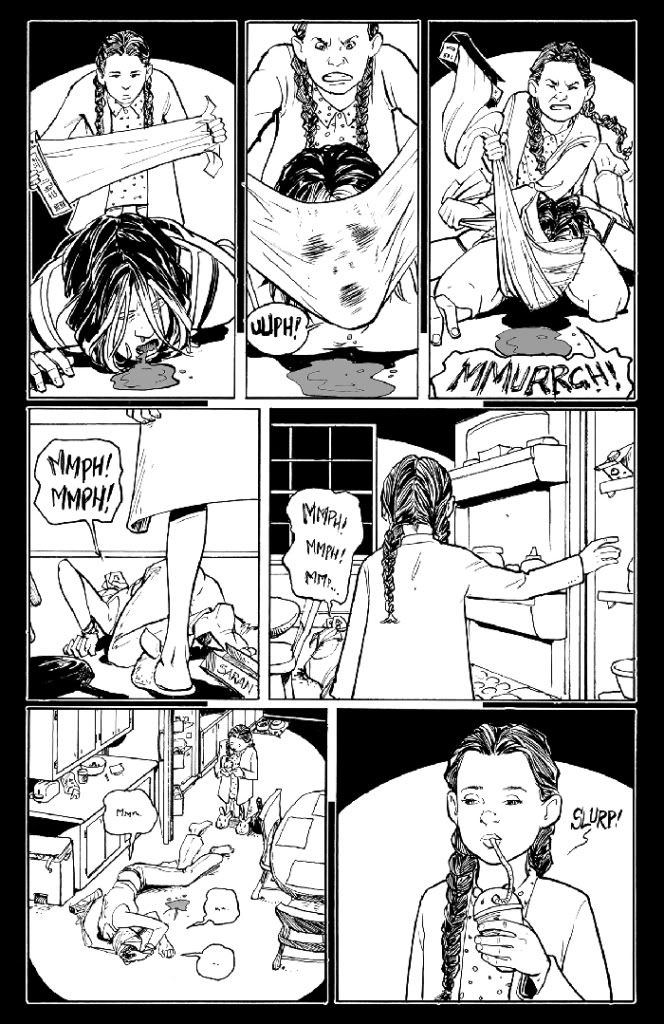
Rachel Rising #2 (Abstract Studio) - This is the second issue of a new series written and drawn by Terry Moore, of Strangers In Paradise fame. While I never liked Moore's most famous series, his clever, light sci-fi follow-up Echo was remarkable, and this new horror project promises to be equally compelling. Moore and genre fiction seems to be a really good fit. In the first issue, a young woman named Rachel woke up in a shallow grave in the woods, seemingly brought back to life with only vague memories of a shadowy figure strangling her with a length of rope. This issue is mostly about Rachel's visit to her mannish coroner aunt, who, curiously enough, takes Rachel's presence as a hallucination of sorts, reacting very strangely to her niece. These scenes have an odd rhythm, as though something is subtly off, disconnecting the reincarnated Rachel from her former life.

Moore's drawing is as beautiful as ever; his line is graceful but just a little ragged, and he makes liberal use of white space so that the overall effect is spare and ethereal. He's a sublime draftsman, and he especially has an affinity for capturing the nuances of facial expressions and body language. In one wonderful two-panel sequence, a young woman comes home from a date, her face flushed, a distant, contented smile on her lips, and in the next panel her expression falls and her body language becomes antagonistic and coiled as she sees her sister, who has been spying on her. It's slightly cartoony, and Moore doesn't flinch from manga-esque exaggeration and cartoon devices like big dramatic sound effect lettering. He blends these cartoony flourishes with whimsical dialogue and contrasts the tonally lighter moments against the darkness and violence that forms the core of the book. To that end, the issue ends with a harrowing, brilliantly rendered sequence that suggests that the series' horror component is going to remain prominent (and very satisfying).