 Batman and Robin #3 (DC) - This is becoming a slow-burning surprise favorite for me out of DC's New 52, getting better with each issue. This is especially true because Peter Tomasi is increasingly focusing on the "and Robin" part of the title, making this a book about Damien Wayne's struggles with the way he was raised versus the noble ideal offered up by his father Bruce and his mentor/peer Dick Grayson. Damien's interactions with the stolid, unshakeable Alfred are a lot of fun, and this issue opens with a chess match between the butler and the boy wonder, drolly funny and sharply written. Tomasi has a good feel for the uneasy relationship between Bruce and Damien: the boy looking up to his father but also straining against the bonds of this relationship, while Bruce, long used to being the chilly loner despite his succession of sidekicks, is a much cooler and more distant father to his troubled son than Dick Grayson was during his stint as Batman. Damien takes typical preteen rebellion and gives it a sinister twist because he's not only resisting parental guidance, he's straining against Bruce's strict no-killing code and insistence on self-control and restraint. But there's also a real joyous side to Damien when he's allowed to break free, which tempers the darker aspects of his character; it's hard to stifle a smile when he tells a crook, "I'm sure you didn't leave your hole tonight thinking you'd get your ass kicked by a ten-year-old!"
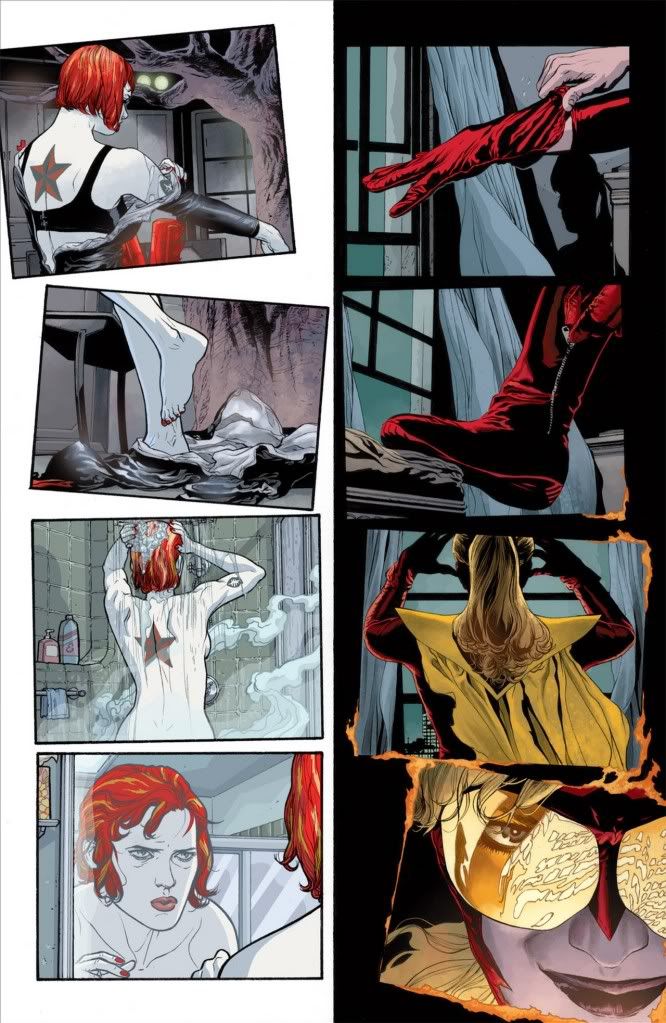
Batwoman #3 (DC) - This is the best issue of this series that J.H. Williams has done since going solo after his run on the character with Greg Rucka in Detective Comics. Williams is continuing to build on the foundation built during that earlier story, here opening with Kate Kane sucked under water by a vengeful spirit who summons the spectre of Kate's dead sister, trying to prompt the hero to let go of it all, to give in to despair. The result is a gorgeous, evocative few pages where the image of Kate as Batwoman is replaced by the image of her sister, a visual evocation of Kate's unarticulated, subconscious desire to join her sister in death. Of course she breaks free, and the next few pages are given over to a wonderful few pages where Batwoman fights with Agent Chase, who's investigating her and trying to figure out her secret identity. Williams' fight scenes, spread over the jaw-dropping double-page layouts that have come to be expected from his work, have a stuttery kinetic quality that suggest events happening in flashbulb bursts of motion, each pose frozen and cordoned off by the lines that zigzag across the page to indicate different intersections of time and space. This is also the issue where Williams' delineation of different styles for Kate's civilian life and her nocturnal adventures as Batwoman really pays off in a big way. When Kate returns to her apartment from her ordeal, dripping wet, in full costume but without her mask, her presence seems like an intrusion, a violation of the scrupulous separation between bright, colorful ordinary life and the dark, shadowed world of the costumed hero. That's the point, as Kate tells her cousin Bette, who she's been training to be a hero as well, that Bette should quit and go back to her normal life. Kate wants to keep these worlds separate, to banish her cousin from the darkness and danger of the superhero's life, to protect her from the fate of her own mad, corrupted sister. Then there's a wonderful silent page where, on the left half, Kate undresses and takes a shower, stripping back into her civilian identity, while on the other half of the page, surrounded by a deep black border, Bette puts on her costume and prepares to go out into the night. There's an acute sense in this series of identity as a costume one takes on and off, switching roles with clothing, existing in two different spheres that are represented by entirely different aesthetics.
Deathstroke #3 (DC) - Kyle Higgins has quickly proven in these three issues that he has a very limited set of ideas for this series, so he's just going to keep repeating them over and over in the hopes that it will be seen as thematic consistency instead of redundancy. This is the issue where Deathstroke's repeated insistence that he just wants respect, that he's worried that people think he's lost his touch, becomes particularly wearisome. The end of the issue throws in a few new wrinkles, tying back into the first issue and establishing that the Harmory characters in that issue weren't just a disposable punchline but were setting up something bigger. But it's not quite enough to keep me interested or make me want to continue reading what's turning out to be virtually the same book every month: Deathstroke gets a job, decapitates a bunch of people, easily dispatches everyone he encounters, and then goes all Rodney Dangerfield and complains that he gets no respect. Joe Bennett and Art Thibert give the book an attractive, unshowy art style that makes all the gore seem very matter-of-fact, but their contributions aren't reason enough to keep reading either.
Green Lantern #3 (DC) - Geoff Johns continues to do a good job of balancing the dichotomy of his central characters Sinestro and Hal Jordan: the one-time villain who's now been restored to the role of an unlikely hero, and the hero who's actually kind of a stubborn, arrogant asshole. Their interactions form the core of this book, as they define themselves against and in relation to one another, each convinced that the other is evil or idiotic or in the wrong. This is an interesting dynamic and the bitter repartee between these two old adversaries, each of them totally locked into their respective worldviews, totally drives this comic and especially this issue. The actual action, in which Sinestro and Jordan confront Sinestro's former corps for the first time, is just a quick burst at the end of the book that leads to a cliffhanger that only someone who's never read comics before could really believe is actually a cause for concern. Nevertheless, I'm definitely interested to see where this series is going, and I'm enjoying Johns' approach to these two rather unlikeable heroes/anti-heroes.
The Incredible Hulk #2 (Marvel) - I haven't been following the Hulk's comics before this new series, so I'm not sure exactly what happened to split up the Hulk and Bruce Banner, but this issue's examination of Banner's obsession with his missing other half is compelling anyway. Jason Aaron casts Banner as a deranged mad scientist in contrast to the serene, isolated Hulk, who just wants to be left alone, hidden away under the earth with his Moloid friends. This issue is all about setting up the obvious conflict between Hulk and Banner that will be coming in future issues. In the meantime, Aaron delivers the crowd-pleasing diversion of the Hulk battling some killer sharks, because hey, why not? I'm not sure how I feel about the gang of monster-hunters who are heading after Banner, though, what with the leader continually repeating that she's not related to Dr. Doom despite a shared last name, and the lame meta jokes like having a hunchbacked former mad scientist sidekick named Mr. Gor. Marc Silvestri's art is scratchy and densely hatched, and it's nice even though he seems to have an army of collaborators helping out. I don't think I've ever seen this many artistic credits on a single issue; between pencils, ink, finishes and "pencil assists," there are 11 credited artists on this comic. The result is sometimes a little inconsistent in terms of the level of detail, but not as bad as you'd think from that array of artists.
PunisherMAX #19 (Marvel) - This latest arc of Jason Aaron's PunisherMAX is at least as much about the Kingpin as it is about the Punisher himself. While this issue mostly focuses on Frank Castle's bleak internal monologue, the battle-weary drone of an old man accustomed to blood and pain, it's also about the Kingpin's gradual process of toughening himself to fill the larger-than-life role he's taken on, to really become the iconic villain he's meant to be. Interestingly, Aaron's Wilson Fisk has thus far been very passive and melancholy, a man drawn up inside of himself, having done atrocious things to achieve a position of power only to realize that he barely cares about the power. Now he's finally drawing out of that self-imposed shell, even as his adversary the Punisher cruelly antagonizes Fisk by disinterring the Kingpin's dead son. Steve Dillon's art is blunt and effective, powerfully depicting all the routine violence that surrounds these haunted, angry men, and also the ways in which all this horror has been written on their faces and in their bodies. Aaron is very much following in the footsteps of Garth Ennis on this series, and he doesn't depart too far from that model, but there's something about the combination of Aaron's writing and Dillon's art that makes this Punisher an even more tragic, sad, eerily empty character than ever.
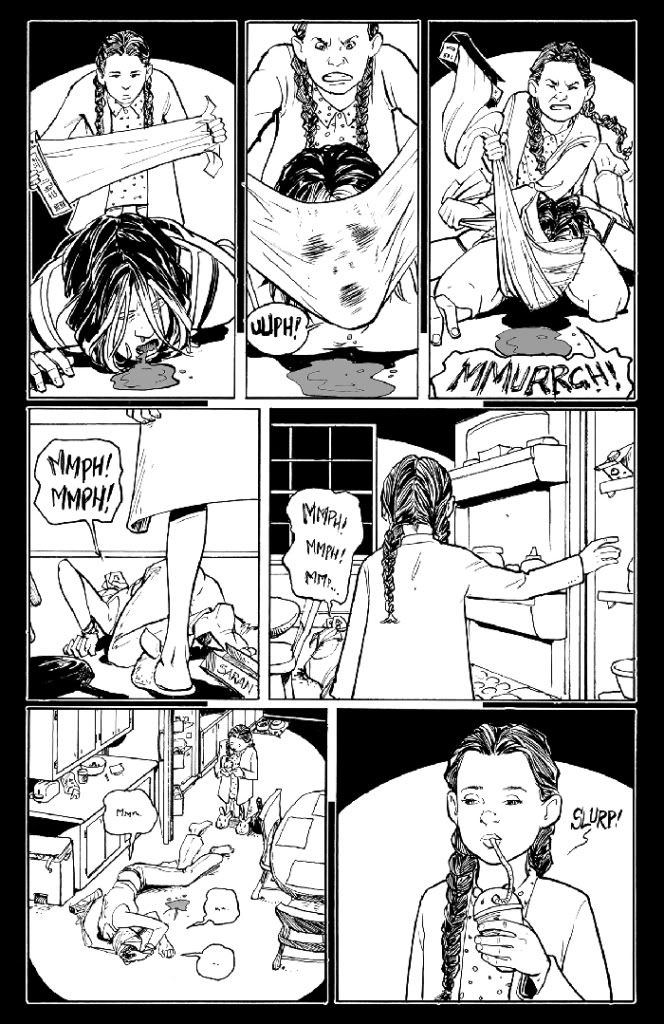
Rachel Rising #3 (Abstract Studio) - Wow, this issue really ups the ante for the freakiness of this great series. Here, the newly resurrected Rachel seems to be getting flashes of portent about the violent deaths of other women, all of which seem to be linked by the mysterious blonde woman who's wandering through town, igniting feelings of misogyny and rage that lead to murder. Violence against women is the common thread, an ancient evil that exploits latent feelings of distrust, jealousy and self-doubt. Terry Moore's clean, bold art, with its copious white space and elegantly minimal faces, is just breathtaking, and creates an especially powerful atmosphere in the silent scenes (like the opening sequence in a jazz bar). Rachel herself is depicted with strangely shaded eyes that, together with her gothy makeup and the rope burns around her neck, make her an increasingly eerie central character. The highlight is the scene where she finds herself inexplicably compelled to confront a woman in a bar bathroom, telling her, "Your wedding bed will be a shallow grave... your lungs full of mud. Something old will violate you and you will feel it... making its home in you." This is a shivery, fascinating horror story, one of my favorite new series and already a worthy successor to Moore's Echo.
Uncanny X-Force #17 (Marvel) - Rick Remender's epic "Dark Angel Saga" hurtles on towards its conclusion next month, and this penultimate issue is a great example of Remender's virtuosic control of this kind of fast-paced storytelling. This issue expertly balances visceral action with the intense psychodrama at the core of the saga, the corruption of Archangel by Apocalypse's evil influence and the struggles of Archangel's lover Psylocke to prevent the world-devastating plans of her love without destroying him in the process. Several scenes in this issue take place in memory, on the psychic plane, and here Jerome Opena's woodcut-like hash marks are especially beautiful. As Psylocke attempts to break free of her corrupted lover's control, her mind returns to the memory of their first meeting: the dialogue is witty and urbane, a verbal dance of seduction, but Opena's shaded faces and the muted color palette (by Dean White, an unsung star on this book) suggest the heartbreak to come from this blossoming romance. The action continues to be strong, too, as characters from the alternate reality Age of Apocalypse join in both on the side of X-Force and as the allies of Archangel. This is just a great series, encompassing all the epic drama and intense stakes that characterize the best superhero comics.
Wolverine #18 (Marvel) - Well this is pretty ridiculous. And writer Jason Aaron seems to know it. He's relishing telling a deliberately campy, over-the-top story here, with a villainess who leads back directly to the Dragon Lady from legendary comic strip Terry and the Pirates. This drug kingpin's lavish, outlandish daily rituals — bathing her feet in the blood of any woman who claims to be more beautiful than her, dining on delicacies like "butterfly brains," refilling her pillows nightly with the feathers of a 1000 doves — definitively establish that this is a camp movie serial villain, an exaggeratedly evil adversary who'd twirl her moustache if she had one to twirl. Equally silly is Wolverine's new ally, Fat Cobra, a big tattooed sumo type who just wants to make a meal of a dragon. This is a quirky comic that climaxes with Wolverine and his allies riding towards their enemies in the bellies of a trio of dragons, and Aaron maintains an appropriately irreverent tone as he weaves a collage of kung fu clichés with imaginative conceits like the villains' underground poppy field or the concept of using dragons as drug mules.