Showing posts with label Swamp Thing. Show all posts

Thursday, May 2, 2013

Weekly Comics: May 1, 2013

It's been a long time since I posted here so I figured I'd catch up with some weekly comics. I won't be posting these updates every week, but checking in every once in a while on what's new.

Age of Ultron #7 (Marvel) - Last issue, in which Wolverine and Sue Storm travelled to the past to kill Hank Pym, signalled a big change in this series, and this issue pays that shift off really well. The duo travel back to a present that's now been massively shaken up by the repercussions of that murder; it's great that Bendis is upping the stakes like this, pulling the rug out from under the alternate future that had dominated the first six issues, replacing it with a whole new alternate future. Lots of fun seeing two Wolverines sparring, and there are tons of tantalizing mysteries about the nature of this new reality and what happened after Pym's death to lead to this point. Carlos Pacheco draws the scenes in the past, and they're gorgeous, and then Brandon Peterson takes over for the return to the present, and that's somewhat disappointing. Peterson's faces are really inconsistent, and in particular he makes Sue Storm look really weird in quite a few panels, especially when he tries to make her show emotion and instead just makes her look deformed.

All-New X-Men #11 (Marvel) - A whole issue of people yelling at each other and getting just to the verge of fighting without actually going all the way. And it's pretty fun, actually. Bendis already revealed that the original, time-travelling Angel would join Cyclops' renegade X-Men in the last issue of Uncanny X-Men, so this issue is just an extended exploration of how exactly that happened. Lots of dialogue, most of it dramatic and shrill, but it's refreshing that Bendis doesn't really fall into his familiar rhythms too much here — in general, taking over the X-Men books seems to have freed him up to explore some new voices and to get away, at least sometimes, from his usual writing tics. Not the most exciting issue in its own right but it's another piece of the puzzle and has some nice character beats along the way, particularly between Kitty Pryde and Jean Grey. And Stuart Immonen does a good job of giving the chaos a cartoony sheen.

Animal Man #20 (DC) - Back when I evaluated the first month of DC's New 52 reboot, I predicted that I'd continue enjoying the New 52 "as long as they keep their current creative teams and level of quality." That's turned out to be a very bad joke as DC has squandered almost all the good will and potential generated by the early New 52 successes, constantly shuffling creative teams and generally allowing very few titles to remain or become great. Even Animal Man, which early on was one of the best DC titles, soon lost its distinctive artist Travel Foreman and, even worse, became mired in a boring, purposelessly elongated crossover with Scott Snyder's Swamp Thing. These two books basically took over a year and a half to tell one story, but now it's finally over, leaving Animal Man to (hopefully) recover. This issue is a good sign of that recovery, continuing the metafictional story of a movie that Buddy Baker had starred in. When the first half of this movie played out way back in Animal Man #6, it seemed like filler at best, a stall tactic to keep pace with Snyder's Swamp Thing for the impending crossover. Now, the story takes on new resonances and new meanings in the aftermath of recent events, and this story of a slacker superhero struggling to recover his fractured family weighs heavily on Buddy. There's no direct tie-in to Buddy's real life until the very end of the issue, but there doesn't need to be: every panel seems freighted with secondary meaning and emotion. Very good use of what had previously seemed a throwaway concept, and I hope Jeff Lemire continues to guide this book out of the slog of "Rotworld" with such assurance.

Copra #6 (Copra) - Michel Fiffe's Copra is one of the greatest superhero comics around, especially notable since he does it all himself: writing, art, and self-publishing. Fiffe boldly combines familiar superhero archetypes and tropes — many of them drawn from obvious reference points like Suicide Squad or The Punisher — with a hallucinatory, strangely beautiful art style that renders these action-packed comics fresh and strange. As one letter-writer notes in the back of this newest issue, it's the union of new and old that makes it so special. This issue concludes the opening arc of the series, which focused on a team of government commandos forced to go underground after a villain's destruction of a small town is blamed on the Copra team. This issue is the final showdown with that villain, Vitas, who Fiffe boldly stylizes as an interlocking set of geometric shapes, his head a triangle atop a bulky body with spindly limbs that seem to be latched onto the ovals of his hips and torso. Fiffe's character design sense is impeccable, and over the course of the series' first 5 issues he introduced a massive cast of heroes and villains, all of whom have distinctive individual looks, so that in this issue's all-out melee the characters are clearly delineated even if most readers won't have a firm grasp on names or personalities. The bold style of Fiffe's art and his gorgeous pastel coloring makes these clashes visceral and thrilling in a way that more conventionally realized superhero battles just aren't, and when he cuts loose — as he does on a few pages where Vitas' form is warped by contact with the alien artifact at the center of this conflict — the results are downright stunning. Also notable is the melancholy of this issue's ending, in which Man-Head's final battle with Vitas is overlaid with his captioned memories of the family murdered by the villain, climaxing with a simple, evocative image that the hero succinctly declares "not a stupid memory." Just a great book in every way, and this is a more than satisfying conclusion to the first arc.

Dial H #12 (DC) - This has been one of the best DC titles since its debut: really only Wonder Woman deserves to be on the same tier. China Mieville's dizzying tale of dial-a-hero shenanigans just keeps getting crazier and crazier, adding new wrinkles and new ideas with every issue, never once wasting a moment or settling into a status quo. This issue shakes things up yet again, introducing a whole new cast of dial-users who appear in a frenzied battle in the issue's second half, everything so chaotic that there's hardly a moment yet to absorb quite what is happening here. This is just such a fun book, loaded with humor, bursting with big ideas. While other New 52 titles plod along, repeating familiar stories with familiar characters, Mieville is concocting a whole new lively universe of concepts and characters, starting from the basic premise of an old, forgotten DC title but expanding it at every turn. Alberto Ponticelli seems to be settling in as the new regular penciller now that Frankenstein is gone, and he's a perfect fit, his slightly skewed figures and faces ideal for expressing this title's wild aesthetic.

Earth 2 #12 (DC) - The long lead time involved in comics makes me think that it's just a haunting coincidence that this issue opens with a fight scene staged in the sky above Boston, with the people of Boston looking on in awe and fear. Still pretty unsettling. Anyway, this is the conclusion of the Dr. Fate storyline, which has honestly slowed this book down a bit too much and detracted from its generally strong first year. Here, after all this buildup, the villain is dispatched almost offhandedly, so the story just sputters to a close, having now introduced Dr. Fate as one of the book's heroes. At least the ending signals that Steppenwolf has finally made his presence known, so things should pick up again next month; the Apokolips material in this book has been really good.

Green Arrow #20 (DC) - I'm willing to give Jeff Lemire the benefit of the doubt, but four issues in, his Green Arrow isn't really bad so much as utterly forgettable, with little of substance and little reason to care about any of these characters — the villain Komodo is arguably the most realized character so far, and even he's not too deep. Andrea Sorrentino's art is nice, all moody and shadowy, but doesn't seem especially well-suited to this story, either.

Hawkeye #10 (Marvel) - Matt Fraction's Hawkeye has had a really strong and coherent aesthetic, even when regular artist David Aja is replaced by fill-ins. Francisco Francavilla, this issue's guest artist, doesn't fit as neatly into the series' overall look, but that's appropriate since this issue is a bit of a departure, taking on the perspective of an assassin working for the "bro"-happy mobsters who have dogged Hawkeye throughout this series. It's gorgeous work. Fraction weaves together the assassin's tortured, unhappy past with the present, in which the man, undercover, exchanges some flirtatious banter at a party with the female Hawkeye Kate Bishop. The pages in the present have a warm, calm vibe, with pages laid out in neat rows of square panels, all closeups of faces and hands as these partygoers bond, Kate not realizing who this man actually is. The flashbacks are more fragmentary, with Francavilla's pages exploding into baroque designs, panels fanning out from central acts of violence, yellow and red and orange flowing across the pages to contrast against the cool midnight blue of the Kate pages. Great design, great art, and a haunting story. More proof that this is one of Marvel's very best comics.

Indestructible Hulk #7 (Marvel) - Mark Waid's new take on the Hulk as a S.H.I.E.L.D. agent has been pretty fun right along, but it's reached new levels of insanity with this current arc — drawn by Walt Simonson! — in which Hulk time travels to the past and crosses over to the Asgardian realms, teaming up with Thor against Frost Giants. There's nothing here as wild as last issue's cliffhanger pinup of the Hulk lifting Thor's hammer (though that's paid off nicely with some unexpected humor) but it's just a solid, well-crafted issue of action. And seeing Simonson tackle Thor, one of his signature characters, is always a big pleasure.

Iron Man #9 (Marvel) - Kieron Gillen's Iron Man finally seems to be ramping up in a big way, and this is a promising start to what looks like it's going to be an epic new arc. Dale Eaglesham replaces Greg Land for this issue, and the difference is obvious. Eaglesham's art is as slick and shiny as Land's during the scenes of Iron Man and Death's Head stalking the android 451, all glistening metal surfaces, but with far more personality and weight than any of Land's stiff figures. Then, when Tony's confrontation with 451 gets upended at the end of the issue, and the android makes a big deal of using outdated film reels from the past, the shift in style that Eaglesham pulls off makes the effect as jarring and potent on the reader as it must be for Tony — the lush, shaded grayscale of those movie frames is a great contrast against all the shiny metal that dominates the rest of the issue.

The Movement #1 (DC) - Like a bad punchline, DC's tone-deaf attempt to cash in on the "Occupy" movement reeks of desperation. It's just silly, obviously the result of some out-of-touch editors trying to figure out what young people want, and winding up with teens in masks holding up smart phones and tablets emblazoned with the message "I C U." Gail Simone should know better, but apparently doesn't, so she gamely introduces all these generic teen characters amidst confusing and truncated fight scenes, while Freddie Williams II seems to have settled on a new style to imitate, channeling Sean Murphy and doing OK at it — the linework is decent, though the layouts are unnecessarily cluttered. But even a genuinely amazing artist couldn't really salvage such an ill-conceived project, and there's obviously little chance of this making it past its first year.

Swamp Thing #20 (DC) - Scott Snyder ducked off Swamp Thing after slogging through "Rotworld," leaving Charles Soule to pick up the pieces, with Kano providing the art. Soule's doing a pretty good job so far, dealing very poignantly with the aftermath of "Rotworld," which whatever else it did, left the title character feeling less human than ever, more adrift from what he once was. Here, Swamp Thing is trapped in a nightmare by Scarecrow's fear toxin, facing ghosts of the happy human life he might've had with Abby, while outside in the real world his plant powers run amok and nearly destroy Metropolis. There's a nice moment at the end of the issue where Swamp Thing points out that Superman, too, isn't human and only chooses to act human, though Soule has Supes respond in a pretty lame way, urging Swamp Thing to help people. Pretty good stuff, and Kano's art is more cartoony and clean than his predecessors, though he does ape the inventive layouts of Yanick Paquette, who himself was inspired by Steve Bissette's art on the old Alan Moore run. Nice sense of continuity.

Ten Grand #1 (Image) - The debut of a new series by J. Michael Straczynski and Ben Templesmith, distributed by Image on behalf of the new Joe's Comics imprint. It's a rather unexciting debut: Templesmith's art is fabulous, of course, and well-suited to the story's dark mood and supernatural content, his scratchy lines and eerie color work perfectly capturing the sense of menace lurking within this tale. The problem is that JMS substitutes a whole bunch of clichés for real characterization. The hero was a mob hitman until a rival violently cut short his lovey-dovey relationship with a sweetly generic girlfriend whose death now haunts the hero — and it was going to be his last mission before he ran away with her to live happily ever after! Really! The blending of noir/crime aesthetics with the supernatural reminds me in a general way of Fatale, and of course John Constantine too, so maybe with Hellblazer gone this will fill a hole for someone. But there's not enough in this first issue, beyond Templesmith's art, to really set this apart or suggest that it's going to be anything special.

Winter Soldier #18 (Marvel) - The Winter Soldier is so much Ed Brubaker's creation that it's hard to imagine anyone else shepherding the further adventures of the ressurrected Bucky, but writer Jason Latour and artist Nic Klein have done as good a job as anyone could expect. This series is fast approaching its cancellation — though it will surely be back around the time of the second Captain America movie — but it's been a fine continuation of the moody spy movie vibe of Brubaker's run. This issue marks the climax of a recent arc with Bucky trying to atone for one of his past assassinations, but when he comes face to face with the girl he orphaned, now known as the Electric Ghost, she doesn't seem interested in revenge or atonement or anything else you'd expect. In a nice twist, she spends the issue narrating her gradual process of separating from conventional human emotions, through a horrible childhood in a twisted training program, her life as a spy and assassin, her eventual revenge against those who had guided her life. But for Bucky himself she has no anger, and her rhetoric of transformation and transcendence makes her an intriguing villain. Klein's is fantastic throughout, switching between the moody blue-and-gray murkiness that has usually characterized this series' dark spy adventures, and a more cartoony style to illustrate the Ghost's childhood.

Worlds' Finest #12 (DC) - I'm not entirely sure why I'm still reading this companion series to Earth 2. It's usually just mildly pleasant, and it almost always features a whole squad of artists struggling to cobble together the visuals, but there's something about it that I find charming and enjoyable. The premise of these two women, in an unfamiliar world, taking different approaches to finding their own way in their new home, it's very poignant, and Paul Levitz has done a good job of exploring these characters and their friendship, even if not much has happened on the plot front. This issue is more of the same, though the war with Darkseid's creepy henchman Desaad seems to be heating up. Notably, here Power Girl gets her old costume back, "boob window" and all, which a lot of people will be excited about but I see as a step back — and I'm one of the few who had no problems with her sleek, streamlined newer costume. There's no attempt to explain the costume change here; in flashbacks she still has the old outfit and then when she suits up in the present she's back to the classic design. Meh.

X-Factor #255 (Marvel) - The "Hell On Earth War" is almost at an end now, and none too soon — Peter David's long run on this title has been going through a fallow patch with this arc, which suffers from being way too big for the book. David's X-Factor has excelled at smaller stories and character interactions, and its strengths are lost amidst a giant saga of demons fighting on Earth, even beyond the troubling question of why nobody besides X-Factor seems to have noticed all this city-destroying chaos. There's still room here for a few nice character beats, notably the bafflement and despair of Guido when he realizes that something is very wrong with Monet during their fight. Also, the understated sadness of Layla grieving for Madrox, and Tier finally making a decision. This title is ending soon, but thankfully David is promising some character-based issues about, among others, Layla and Longshot, after this storyline wraps up next issue, so hopefully this book will go out doing what David does best.

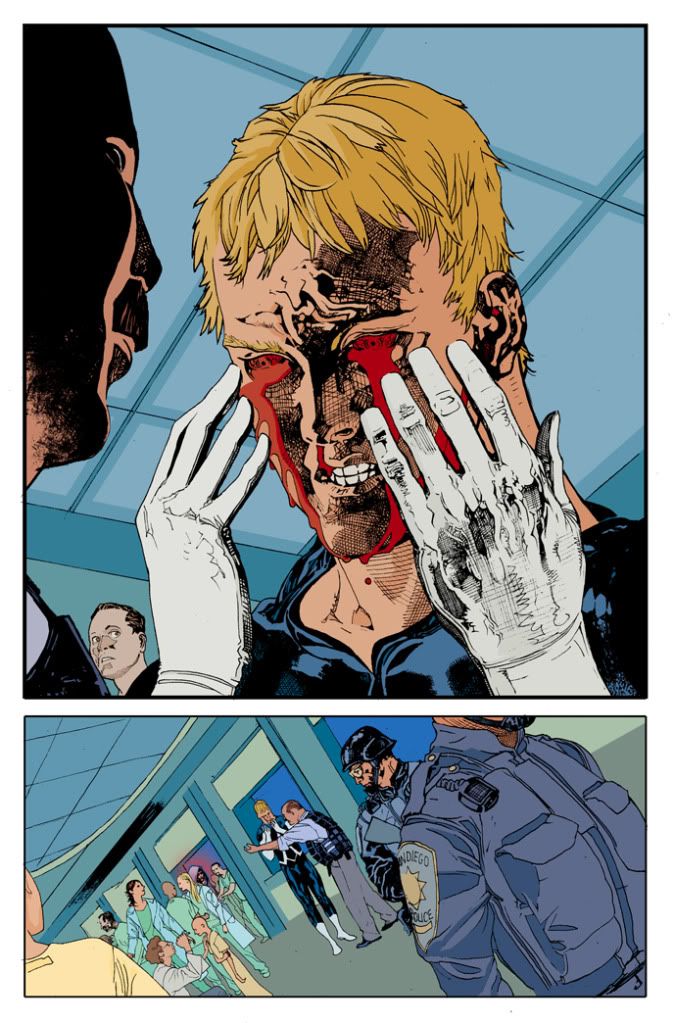
X-Men Legacy #10 (Marvel) - One of the big surprises of the Marvel Now initiative, Simon Spurrier's take on Professor X's son Legion has been thrilling and inventive and really cerebral. Literally cerebral, in fact, since much of it takes place in Legion's head, where he must contend with an unruly flock of alternate personalities, each embodying one of his many mutant powers, including a golden apparition of his father who seems to be the most sinister of the bunch. In this issue, Legion confronts another of the anti-mutant agitators who he's been tearing through of late, though this time the man — a victim of multiple mutant catastrophes, which have left him burned and confined to a wheelchair — is surprisingly sympathetic and reasonable in his anti-mutant agenda. Spurrier's been patiently building this story and it's really paying off: both Legion and his love interest/eventual antagonist Blindfold are now fully developed characters, and the sense of dread gradually accumulating like a black cloud over their heads is now really starting to thicken.

Monday, November 7, 2011

Weekly Comics: November 2, 2011

Action Comics #3 (DC) - Grant Morrison's take on Superman in this book still feels really fresh and original, and I'm loving it so far. There's a great scene here where the Metropolis PD breaks into Clark Kent's apartment and rummages through his stuff, obviously just harassing him simply because of his reporting about important businessmen in the city. This Superman is a crusader for the little guy, both in his secret identity journalism and his cape-and-jeans adventures. This issue also raises the idea that the latter is interfering with the former, because now Lex Luthor is helping to stir up distrust about Superman because of his alien heritage, which allows Clark/Superman's capitalist foes to redirect attention away from their exploitative business deals and corrupt political connections. Morrison also seems to be moving towards Superman examining his Kryptonian roots, and the issue opens with a sequence set on Krypton before its destruction. On the negative side, DC's insistence on getting issues out on time seems to be crippling artist Rags Morales, whose work here isn't quite as inconsistent as in issue #2, but still looks fairly rushed. Gene Ha guests to draw the Krypton sequence (which looks gorgeous and glossy) but apparently even this didn't give Morales enough time to polish the remaining pages. This is a great book, and as the first issue showed, if Morales has enough time it could also be a great-looking book, but it's becoming increasingly obvious that the art is suffering from deadline pressure here.

American Vampire #20 (Vertigo) - Although exposition-heavy writing is often the enemy of good comics, Scott Snyder excels at making exposition and storytelling the center of his work without often succumbing to the pitfalls associated with these devices. In this case, the bulk of this issue is structured as a flashback in which a powerful Shoshone vampiress narrates her life leading up to her conversion into a vampire and the bloody history that followed. It could be clumsy or dull, especially since Snyder is delving into the past of a character who hadn't appeared before the final pages of the last issue, but instead he economically tells a strangely moving tale of a woman who largely drifted through life, barely even realizing how unhappy she was, before the adventures that led to her becoming a vampire. Jordi Bernet, the guest artist on this arc, has a distinctive style that initially seems too cutesy/cartoony to be a good fit for such a dark tale, but he proves adept at rendering gape-mouthed grotesqueries once the vampires make their appearance.

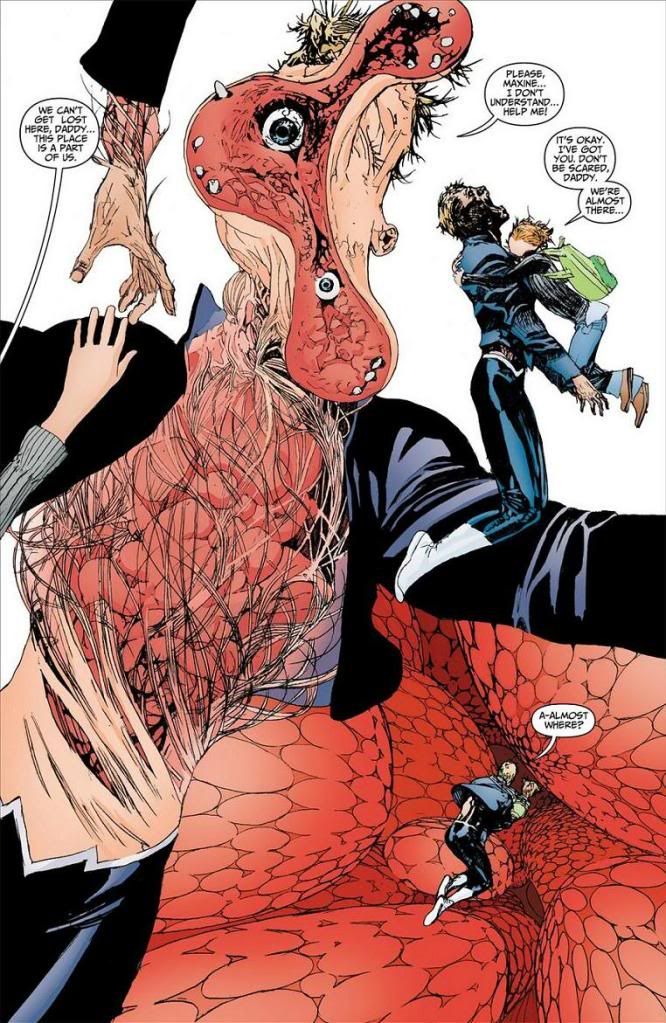
Animal Man #3 (DC) - Since it's pretty much established at this point that I think this series is the awesomest of awesome things, I'm just going to list some of the great stuff that happens in this latest issue. Right on the first page, there's the great visual of Buddy and Max falling into the Red, with Buddy getting twisted into hideous, Cronenbergian forms while Max blithely stretches her arms out with a big smile on her face, looking like she's skydiving and loving it. While the villainous Hunters Three are incredibly creepy, in many ways the benevolent forces of the Red's totems are equally terrifying, and the Red itself looks like a nightmare rather than the touchy-feely spirit-of-all-things hippie place it's described as. Although this issue is heavier on the weirdness and grotesqueries and lighter on the Baker domestic drama, I love the scenes between Ellen and Cliff: she scolds her son's gory video games but then casually joins in, and as they're fleeing from a monstrous attacker she still instinctively tells him not to curse. Travel Foreman's facial expressions are amazing, especially Ellen's pinched look of worry as she moans, "I can't believe I married a superhero." This series is just great: Jeff Lemire has established just the right delicate juggling of tones so that each issue incorporates some humor and surreal absurdity with the horror and slowly building dread. This issue also makes explicit the link between what's happening here and the equally weird goings-on in the Green over in Scott Snyder's Swamp Thing, bringing that eventual crossover closer to fruition.

The Boys #60 (Dynamite) - Not much here except the usual Ennis wallowing-in-filth. I'm not sure I get the point of the subplot with the wife and daughter of Mother's Milk doing mother/daughter porn, except as a way to display even more perversity and to drag these characters through the muck some more. Similarly, the team of superheroes who show up at the end with blatantly sexual names — Astroglide, Stopcock, Trojan — are just an even more dumbed-down than usual version of the same joke that Ennis has been telling since the beginning of this series. I continue to read this series because I want to see the inevitable confrontation between the Boys and the Seven that's been building up since the beginning, and because I'm invested to some degree in the relationship between Hughie and Annie. But issues like this basically just amount to filler, with the only moment that really stands out being the one where Butcher instinctively calls to his dog only to realize that the dog was killed last issue. Those kinds of quietly affecting, very real moments pop up every so often in this otherwise broad, over-the-top series and provide a reminder that Ennis can be much more than a self-conscious shock-purveyor when he wants to be.

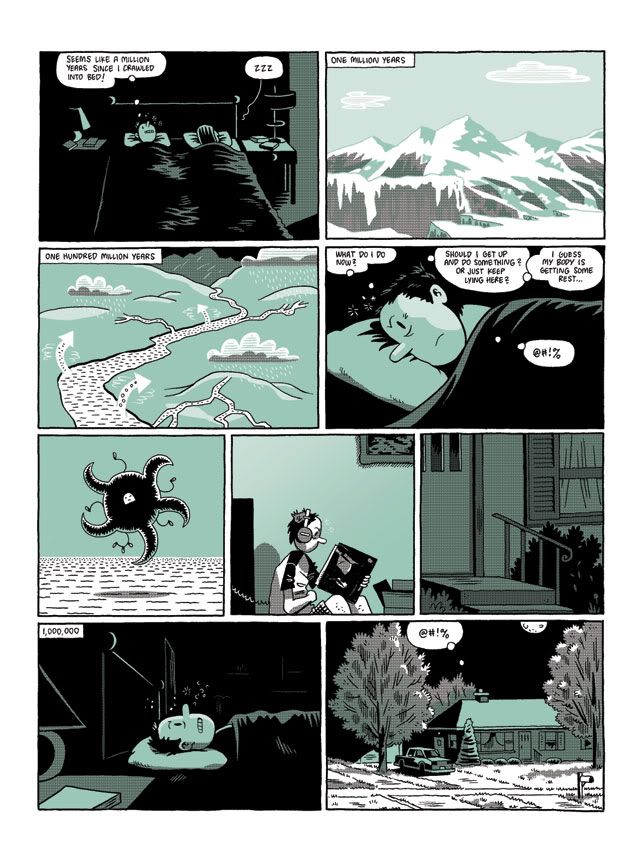
Ganges #4 (Fantagraphics) - The latest issue of Kevin Huizenga's great Ignatz-format series continues the cartoonist's introspective focus on mental states over physical action. The entire Ganges series so far has taken place over the course of a single night in which nothing much of note actually happens. In fact, Huizenga includes a few wry continuity captions of the kind that often appeared in old-school superhero comics, which here serve to remind the reader of just how uneventful this series' "plot" has been. In place of narrative drama, Huizenga delves into the thought processes and imagination of his everyman protagonist Glenn Ganges, tracing the ways in which thoughts lead one into the other, creating the chains and loops of ideas, memories and associations that constitute mental life. It's a remarkably abstract topic for a visual artist to confront, but Huizenga brilliantly makes thinking sensual and tangible, building pages that diagram out ideas and attempt to visually represent the mind's logical dissection of a situation. This issue, like the last one, can be summed up on a physical level as "Glenn Ganges tries to fall asleep and fails," but more than a story about insomnia it's a profound essay on time, mortality, and the intellect.

The most dazzling sequence of this issue comes towards the end, when Glenn begins thinking about what he plans to do with his wife tomorrow, a train of thought that leads him to think back to when he made these plans earlier in the week. From there he begins leaping back further and further in time, visualizing blocks of time as literal blocks floating in grids above his head, representing years, months within years, days within months, hours within days and so on. He's trying to come to grips with how much of his own life he can actually remember and how much has simply drifted by. This somewhat sobering idea connects back to the earlier sequence in which, while trying to pick out a book, Glenn imagines himself accompanied by the Grim Reaper, who admonishes him to choose wisely and not waste his precious time reading or doing something unimportant. In this way, Glenn's thoughts roam freely from minutiae to the biggest philosophical questions facing humanity, as his sleepless mind finds potential profundity in even the most prosaic details. In another sequence, Glenn purposefully chooses a boring theoretical book in hopes that it will help him fall asleep, but as Huizenga lovingly parodies academic-speak, Glenn's mind can't help attempting to visually diagram these confounding sentences, wrestling with the paradoxical ideas and trying to construct coherent thoughts based on what he reads.

In sequences like this, throughout this issue, Huizenga creates utterly engrossing, funny, disarmingly powerful comics from the relentlessly internal, static situation of Glenn lying in bed or wandering around his house in the dark. Huizenga's formal rigor makes each small decision — should I get out of bed or lie here some more, should I read a book, what should I think about, how often should I blink — the origin of a forking path in the protagonist's neural maze. He lays bare the internal processes of decision-making, self-analysis and thought that operate beneath the placid surface of this ordinary suburban husband as he spends a restless night next to his sleeping wife. There are repetitions and dead spaces built into the comic, and moments when the panels run off into the gutters as Glenn's thoughts detour in a whole new direction before returning to the main flow. This is totally exciting, formally ingenious cartooning, another reminder of why Huizenga is one of the very best artists working in comics today.

Moon Knight #7 (Marvel) - As much as I'm sick of Brian Michael Bendis in general, I have to admit that his take on Moon Knight is a fresh, funny, interesting approach to this character. Bendis' Moon Knight is an outright nutcase who shares his head with multiple personalities, embodied as Captain America, Wolverine and Spider-Man. It's a sly parody of the superhero team-up, as Moon Knight constantly has his own mental chorus of famous heroes giving him advice and commenting on his actions. This goofy, oddball premise is well-suited to Bendis' talky, pattering dialogue, as Moon Knight has fast-paced conversations with himself, at one point holding his head in his hands as he moans, "God, I'm hard on myself." Bendis' regular artistic collaborator Alex Maleev is as great as ever here, his gritty art a perfect complement to the urban hysteria of the title's hero. Although I've long since given up on most of Bendis' high-profile titles, this kind of obscure, off-kilter comic may be where he does his best work.

OMAC #3 (DC) - It's usually offputting when something goes out of its way to slavishly pay tribute to a predecessor, but Dan Didio and Keith Giffen are doing such a good job of aping Jack Kirby with this series that it's hard not to enjoy it as the manic homage it is. The Kirby nods go beyond the obvious way in which Giffen has tailored his art to capture Kirby's distinctively brutish, ugly faces and kinetic distortions of body language. The homage extends as well into the narration and the way each issue introduces out-there sci-fi ideas and pieces of technology, describing these innovations with the tone of an owner's manual for futuristic devices, much as Kirby did in the original OMAC series. This issue offers up yet another standalone confrontation in which Brother Eye manipulates the hapless Kevin Kho into battling a monstrous enemy. The pacing is fast and the dialogue is quirkly entertaining, so the issue just barrels by. This is just big dumb fun, a love letter to one of the iconic superhero artists. It's also a reminder that while Kirby has been and continues to be a huge influence on virtually every aspect of superhero comics, his actual style, weird and off-kilter as it is, hasn't often been imitated as completely and affectionately as this.

Stormwatch #3 (DC) - This series is still a mixed bag. Paul Cornell's writing is sometimes clever and sometimes grating, and this issue has a little of both. I loved the lurid, lunatic tone of the few pages where Harry Tanner gloats as he mentally and physically tears apart the giant eyeball at the center of the moon: Harry's a Stormwatch hero and he's fighting a monstrous alien eyeball, but the whole thing has such a sociopathic tone as the hero finds glee in utterly demolishing his adversary. On the other hand, in this issue Cornell unfortunately literalizes the powers of both Jack Hawksmoor and the Projectionist, so that the former literally talks to avatars representing various cities while the latter addresses the media as though she too is engaging in an actual conversation. Both these characters have powers that should have been left more abstract. Otherwise, this is just a big action showcase and the fight scenes are fun and chaotic, with Miguel Sepulveda's glossy art doing an especially good job of rendering the massive, tentacled alien monster that the team encounters in the second half of the issue.

Swamp Thing #3 (DC) - This is the best issue of Scott Snyder's Swamp Thing yet. It's finally all starting to come together and Snyder has now struck a good balance between the eerie horror visuals and the exposition that attempts to untangle the complex back stories of Alec Holland and Abby Arcane. As in this week's Animal Man, this is also the first issue that really makes explicit what the threat is: a young boy with a connection to the Black, the Rot, akin to Swamp Thing's status as an avatar of the Green. There are some really horrifying images here: the issue starts with more creepy/comical overtones as a sick kid hears the voices of mounted fish speaking to him, but things quickly move into more sinister territory. There are some grisly images here, most of them courtesy of guest artist Victor Ibanez, who alternates sections with regular artist Yanick Paquette and winds up drawing most of the gory hospital scenes. Paquette, for his part, continues to recall the classic work of Alan Moore, John Totleben and Steve Bissette on the series. In this case, with Abby's presence, Paquette and Snyder deliberately evoke her appearances in those old Moore issues to emphasize how she's changed in the intervening years; it's a very powerful use of earlier material to deepen the impact of a character's transformation, in ways that go way beyond her new shorter hairstyle. The pace is picking up here, and after a couple of issues that necessarily leaned heavily on explanation, this issue finally launches the horror plot into overdrive.

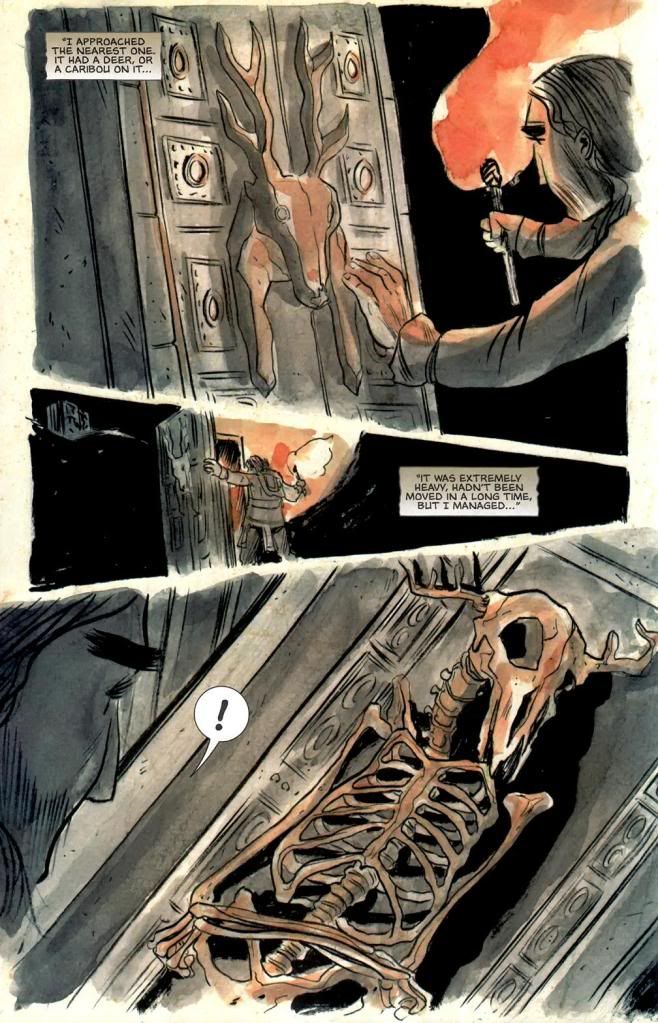
Sweet Tooth #27 (Vertigo) - As much as I love Jeff Lemire's quirky, scratchy art, this most recent arc (of which this is the second of three parts) with Matt Kindt handling the art has been really fantastic. Kindt's wispy, shaky figures and watercolors give a hazy aura to this story that appropriately suggests looking back into the past through the warped, brittle pages of a forgotten journal. Lemire is delving into the past for this arc, suggesting that the origins of the plague and the human/animal hybrids stretch back further than expected. This arc also provides a spiritual/supernatural counterpoint to the theories about the plague's origins offered elsewhere in the book, which have tended to emphasize science and genetic engineering. It's impressive that Sweet Tooth has diverted into a three-issue historical arc that doesn't feature any of the series' regular characters, and the results are absolutely engrossing and creepy and compelling.

Uncanny X-Men #1 (Marvel) - Following up on last week's Wolverine and the X-Men, this is the other half of the new post-Schism X-Men. This series, written by Kieron Gillen and drawn by Carlos Pacheco, is about the X-Men team led by Cyclops after his fall-out with Wolverine. Whereas Jason Aaron's new series focuses on massive changes to the status quo with Wolverine refounding the mutant school and gathering up a bunch of lesser-known characters, this series doesn't have any such clear change from previous X-Men stories. Wolverine's team is boldly creating something new. Cyclops' team is... continuing to hang out on Utopia. Maybe because of that, this issue just doesn't have the same breathless forward momentum and dazzling anything-can-happen spirit of fun that inflected Aaron's Wolverine and the X-Men. There's no escaping the impression that this series just doesn't have the clear sense of direction that Aaron is bringing to his title.

This is still a decent issue with some playful dialogue, explosive fight scenes, and some high-concept sci-fi threats that make me look forward to seeing where Gillen goes next. As usual, Gillen's writing goes back and forth, for me, from amusing to clunky to just downright puzzling. Case in point this issue is some dialogue with Namor and Hope, meant to be making a modest joke about stealing chairs. But it all goes awry when Namor boldly declares, "to sit in a seat so fine, Namor would take it from any man," which makes it sound like the king of Atlantis is offering to prostitute himself out for comfy chairs. It's hard to tell if Gillen is making a joke of Namor's awkward diction or if Gillen's own sometimes stilted writing is just creating unintended and unfortunate meanings.

Monday, October 10, 2011

Weekly Comics: October 5, 2011


Action Comics #2 (DC) - Grant Morrison's badass new take on Superman continues to be a ton of fun and defy expectations. In this case, the second issue opens with Superman in the custody of Lex Luthor and the US military, strapped to an electric chair and being subjected to probes and tests. Nobody knows his limits, and they're pushing his endurance, trying to figure out what hurts him. But Morrison doesn't let Superman remain defenseless for very long, so the second half of the issue is thrilling and grin-inducing, as Superman busts free of his fetters and begins tearing shit up. Morrison's having fun writing a Superman who's having fun with his powers, a young and angry Supes who at one point playfully twirls around, sending out an arc of heat vision to melt the guns of the soldiers pursuing him. Superman's escape sequence is perfectly staged by Morrison, with delightfully posed panels like the one where he calmly strides up a staircase with soldiers amassed above and below him. He strolls through the base as though he's just taking a walk, confident in the knowledge that these men can't really hurt him, simply enjoying breaking holes in walls, letting bullets bounce harmlessly off his chest and smashing any soldiers who try to stop him. When Luthor shows Superman a decaying alien goat-like creature, claiming that this is Superman's true form, Superman simply laughs, then calmly announces that the tests are over, initiating the rollicking mayhem of the book's second half. Regular artist Rags Morales is here assisted by Brent Anderson, an ominous sign that DC's pressure to keep books on time is already affecting the artists, and the art is pretty inconsistent with a few particularly awkward panels in which Lois Lane's appearance fluctuates wildly. Nevertheless, Morrison easily keeps up the energy and edge and enthusiasm of Action Comics #1, and his snotty, hot-tempered Superman continues to be a joy to watch.

Animal Man #2 (DC) - Somehow, Jeff Lemire and Travel Foreman have managed to top their stellar first issue with an even better second one, which revels in the possibilities of mingled dark humor and grisly horror offered up by this story. This issue is packed with disturbing images, but each new creepy visual is imbued with a sense of discovery and delight that makes this a dazzling, fun read in spite of its dark content. By the fourth page, when Foreman packs a kitchen scene with wonderful little details — Maxine trying to feed milk to a thirsty skeletal Mrs. Pickles, Cliff gleefully using his cell phone to record dead animals doing battle on a garbage can, and then casually heading out the door with a shovel to dig up some more nasty fun — the comic has acquired a hurtling, manic forward momentum where each page seems to top the last in nutty imagination. Foreman's art is, if anything, even better than in the first issue, as he fully embraces the strangeness and reality-warping nature of the crisis in "the Red" that's propelling Buddy and his daughter into danger. His control of facial expressions is virtuosic, ranging from the cartoony pouting of Max to the devastating panels showing Ellen's tearful, confused, angry response to the weirdness tearing her family apart. This is shaping up to be the work of true mad genius promised by Lemire and Foreman's first issue, with no signs of letting up in intensity or inspiration.

The Boys #59 (Dynamite) - This issue does not start promisingly, what with the cliffhanger from last issue — a tense showdown between the Boys and the Seven — almost immediately fizzling out. Things don't get better in the pages packed with verbose word balloons as Hughie spills his resentment of Butcher, which is starting to seem like a broken record in recent issues. But then the Boys return home to find that Butcher's beloved dog has been killed by one of the Seven's superheroes, and Garth Ennis again displays the weird mix of poignancy and brutality that makes his best comics (in which company The Boys, admittedly, usually does not belong) simultaneously so hard to take but so hard to look away from. Because there's something weirdly touching about the psychopathic Female lying down next to the dead dog, mimicking the animal's limp form and closed eyes as Butcher darkly stalks off to do what he needs to. So although the issue started as an anticlimax, by the grisly end it's obvious that the expected war is coming anyway. The final pages, with one line of dialogue repeated like a mantra over and over, are especially effective in that typical ugly Ennis way, with emotions of loss and sadness transmuted into violence and horror.

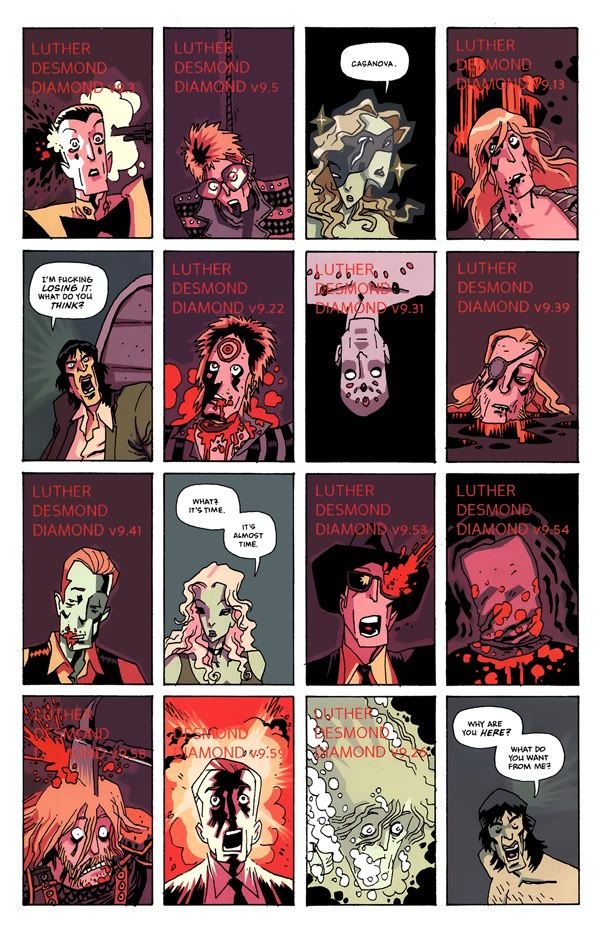
Casanova: Avaritia #2 (Icon) - With this newest Casanova miniseries, Matt Fraction is really digging deeper than ever into the heart and soul of his pandimensional spy thriller. He's using the pop culture riffing and anything-can-happen anti-logic of Casanova to explore some pretty heavy themes. It's all about patterns and repetition — specifically, about escaping from the patterns that threaten to lock Casanova Quinn into a potentially never-ending cycle of destruction and guilt. At the climax of the comic, during a bloody but beautifully visualized action sequence, Fraction replaces the dialogue with placeholders, indicators of the kind of formulaic dialogue that should go here, at this place in the story. And it's just the set-up because when Casanova begins speaking with his own words again, his voice no longer a simple vehicle for action movie clichés, he finally breaks free of the cycle, offers up an alternative to the familiar pattern. It's about free will, man! And it's damn good stuff. Gabriel Bá, more than ever, is drawing Casanova and his future nemesis Newman Xeno — who Casanova must kill, over and over, in one universe after another — as Mick Jagger and David Bowie, locked into a cycle of homoerotic attraction and deadly rivalry. Bá's art is wonderful and trippy, making it seem as though Casanova is living an acid trip, whether he's in "reality" or dreams or skating through interdimensional space, and it's appropriate that in the final sequence one important "version" of Xeno isn't quite sure if he's just really high or if he's actually talking to his would-be assassin.

I was also tickled that, in the typically rambling essay in the back of the issue, Fraction talks about crying while reading Jaime Hernandez's "The Love Bunglers." Right on.

Detective Comics #2 (DC) - The first issue of writer/artist Tony Daniel's Batman serial didn't make much of an impact other than its over-the-top final page, which showed the Joker's face sheered off and pinned to a wall. The rest of the issue was all gritty voiceover and Dark Knight clichés, but I figured I'd give Daniel a second issue to see where he was going with this. Unfortunately, this issue dives headfirst into the blunt, stupid nonsense lurking in the subtext of that first installment, and now I'm done. It's a really goofy comic, although it wants to be anything but: it's the product of someone trying way too hard to create something "dark" and violent, and instead producing unpleasant camp. The issue starts with a weirdly homoerotic scene in which Bruce Wayne is courted by a muscular businessman who strips off his shirt and climbs a rock wall with Bruce while talking business. Then, as if to prove Bruce's hetero bona fides, there's an awkward attempt at a seduction scene with a generic Wayne bimbo, and then things get really goofy. By the time a villainess shows up dressed like she bought a "sexy nurse" outfit at a Halloween costume shop, baring cleavage and wielding a hammer, there's really no redeeming this one.

iZombie #18 (Vertigo) - Since Mike Allred's iconic art is generally the main appeal of iZombie, it's surprising that guest artist Jay Stephens contributes to one of the series' best issues. Stephens has a wonderfully cartoony clear-line style, and Laura Allred's colors here also tend even more towards bold primary colors than usual. The style recalls Tintin and Dick Briefer's Frankenstein, and Chris Roberson's story also evokes the globe-trotting adventures of Hergé or Terry and the Pirates. It's old-school, and enjoyably so, in a very different way from the Universal monster movie retro affection that runs through the rest of the series. Curiously, I'm also reminded of the campy, cartoony climax of the recent American Vampire #19, drawn by Jordi Bernet. I didn't expect much without Mike Allred around (he only provides inks on a few pages) but Stephens, who seems to be mostly involved in animation and kids' comics, really impressed me.

OMAC #2 (DC) - The second issue of Dan Didio and Keith Giffen's manic Jack Kirby pastiche isn't quite as much goofy fun as the first one, but it still offers up plenty of Kirbyesque pleasures. The hapless hero, who as OMAC rampaged throughout the first issue, now reverts to human form and has a frazzled dialogue with the nigh-omniscent satellite Brother Eye, communicating through cell phones and TVs and any other handy electronics. There's something endearing about Brother Eye's motherly, solicitous conversations with Kevin, looking out for the young man's nutrition while maneuvering him into place to battle another super-powered being. It's a good mix of brisk action and light-hearted humor, a very old-school book with a tone to match Giffen's Kirby-aping artwork. This is just big dumb fun.

Severed #3 (Image) - This comic is still all about slow burn buildup rather than all-out horror, but it remains an effective tactic. In this issue, writers Scott Snyder and Scott Tuft have young Jack and Sam finally come face to face with the chilling human (?) monster who's skulked through the shadows of the previous two issues, the man with the filed, hungry teeth hidden behind a false set of normal chompers. There's no gore here, no violence, only a conversation between this predator and his latest targets in which every word subtly and not so subtly teases the absolute horror still to come. At one point, the old man asks the two children, "what's in the future for you?" and framed in the foreground between his outstretched hands is a plate full of picked-clean duck bones and uneaten skin. It's an image freighted with sinister meaning, and artist Attila Futaki continues to give everything in this story weight and hyper-real lushness that adds to the creepy vibe drifting through these pages. Shadows have real depth and the sky is a constant swirl of bright colors giving way to the midnight blue darkness of night. This is a sublimely creepy horror comic, the kind of story best told huddled around a campfire in the dark or curled up in bed with a flashlight. Best of all is the moment when the cannibalistic killer describes exactly what he's going to do to his victims, without them realizing: "he'd feed the duck beer, massage its wings, grant it its every wish... meat is muscles, boys, and muscles remember... everything. Especially the last days. If you're gonna eat an animal, make sure its last days are memorable."

Stormwatch #2 (DC) - This comic continues to be better in terms of crazy plotting and cosmic visual extravagance than in actual writing, but maybe that's okay. It's a wildly entertaining comic, moving at a frenetic pace and leaping from the literal beginning of time to the interior of the moon to Stormwatch's space station HQ to various locales around Earth. It's big and bold and aggressive, and that translates to the dialogue as well. Paul Cornell seems to think he's cleverer than he actually is, and stuff like Adam One's meta joke on the second page just comes off as clumsy and nonsensical. The dialogue is wordy and full of exposition, and there's something really unnatural about nearly every sentence. Every conflict or motivation is bolded and underlined, particularly the struggle over leadership of Stormwatch that runs all through this issue. The dialogue is also still compromised by the necessity of continually introducing characters and describing their powers. Still, Cornell's nutty concepts — lovingly, colorfully realized by Miguel Sepulveda and the rest of the art team — more than make up for the exposition-speak that seems to afflict every character. There's also a genuinely great running gag about how the team's media manipulator convinces the rest of the world's heroes that the chaos on the moon is being caused by low-rent villain the Fox. There are still plenty of seams showing in Cornell's construction, but if every issue is as much fast-moving fun as this, it'll be easy to ignore the problems even if the writing doesn't improve.

Swamp Thing #2 (DC) - It's a little disappointing that Scott Snyder is still leaning heavily on exposition and backstory in his second issue of Swamp Thing. The first issue was an intriguing set-up that teased some really eerie horror to come with a few stunning sequences of odd occurrences happening around the US. Instead of leaping deeper into that territory here, Snyder slows things down for a long infodump where the current Swamp Thing relates a whole lot of history and prophecy to Alec Holland, trying to convince Holland to take on the mantle of Swamp Thing. It's interesting exposition, at least, and Yanick Paquette's layouts — reminiscent at time of JH Williams III — help to jazz up these pages with gorgeous, sprawling guided tours through the concepts that Swamp Thing is talking about. The second half of the issue is then given over to a crisply executed action sequence, although the shock of the new has already worn off with the twisted-head zombies who attack Holland here, and his last-minute rescue by Abby Arcane borders on cheesy. This series still shows a whole lot of promise, and it's still beautiful, but it needs to start moving at a faster pace. If the next issue opens with Abby delivering her own lengthy infodump to Alec, I would not be the least bit surprised, but Snyder will be squandering the potential of a book that promises to be one of the best of the New 52. I did like the shout-outs to former Swamp Thing artists Stephen Bissette and John Totleben embedded in the artwork.

Sweet Tooth #26 (Vertigo) - Jeff Lemire's post-apocalyptic road movie adventure about a boy with antlers is starting a new arc this issue. Issue #25 left off with much of the cast preparing for a trip to Alaska, where they hope to discover the answers to mysteries like the plague that wiped out much of the world population and the animal/human hybrid children who might be connected to the disease in some way. This new arc, though set in Alaska, leaps back in time to 1911 to tell a story that's obviously going to lay some groundwork for the eventual journey of Gus and his friends to the icebound north. Lemire takes a break from the art chores as well, and his friend Matt Kindt lends a distinctive, sketchy but lush watercolor style to this issue's tale of an ill-fated Alaskan expedition. It's a gorgeous book, especially when the expedition reaches Alaska and three men wander off into an icy wasteland rendered with stripes and washes of pale grays and reds sweeping by in the background. It's an abstracted vision of the icy north that increases the sense of dread hanging over the three men. Kindt also achieves some very striking effects, as in the panel where a dog pokes its head up through the wispy, multi-colored strands of the wind and blowing snow, its green eye looking melancholy, a "whimper" enclosed in a speech balloon near its head. Several pages later, the lead character is reflected as a wavery, warped outline in the glossy black eye of a dead dog, and soon after there's a panel where a wooden church's steeple is reflected in the man's eyeglasses. Such echoes and reflections define the haunting visual storytelling going on here.

The Walking Dead #89 (Image) - And Robert Kirkman's epic zombie soap opera continues. There's not much to say about an issue like this, in which not very much happens until the end, ensconsed as it is in the middle of what's shaping up to be a very long storyline about Rick and his band of survivors settling into a more stable community, trying to build a permanent place to live. I can see this storyline stretching out for a very long time, maybe until the end of the series, and I kind of hope it does. In this issue, it seems obvious that among other things Kirkman is setting things up for a more sustained look at the long-running subtext of Rick's son Carl growing harder and colder and tougher in the zombie apocalypse, deadening his emotions in response to everything he's seen and had to do. It's something that Rick hasn't addressed quite as directly as this before, and neither has Kirkman. It's also yet another issue that ends with Rick acting like a badass, and it's interesting that the ending sequence with its series of weapon-wielding portraits of Rick and his friends more or less confirms the fear of the would-be rebels that their community is pretty much being taken over by force. I wonder if Kirkman is going to address that in subsequent issues. He's certainly never shied away from making Rick, the paranoiac control freak, a fairly unsympathetic character, and the antagonists in this plot are definitely not entirely in the wrong.

Saturday, September 10, 2011

DC's New 52, Week 1 (September 7, 2011)


Beginning this month, DC Comics is completely rebooting its entire line of comics, starting every comic over from issue #1 and re-imagining their characters, not entirely from scratch but definitely making some changes. It's a move intended to bring in new readers to the continuity-heavy world of superhero comics, and since I've only occasionally read DC superhero comics myself, I figured this was a good time for me to check out what they have to offer. This month DC is unfurling 52 new issue #1s, and I'll be reading all of them and briefly reviewing them here, week by week. This week, I review the 13 first week titles, plus Justice League #1, which came out last week as the debut of the new line. I rank them below from best to worst; by my count there were 3 very good DC comics this week, a few more that were variably enjoyable and/or promising, and then some mediocre junk. Anybody else following this initiative?


1. Animal Man #1 - This book is just fantastic. I wouldn't be surprised if this winds up being the best out of all 52 comics when this month is over. It's a mix of family drama, horror, and superheroics, balancing all these different tones without seeming all over the place. Writer Jeff Lemire packs a lot into 20 pages, economically reintroducing this character, his family, and the themes and conflicts that will drive his story. And the art, by Travel Foreman, is amazing, especially since it shifts fluidly from sketchy domesticity to punchy superhero action to surrealist, horrifying dream sequences. This looks more like an indie book than a big DC superhero title, so the aesthetic is especially striking and invigorating in this high-profile context. The art is so attuned to the nuances of the storytelling, and the style morphs to fit each new wrinkle perfectly. This is a must-read book, one that already seems poised to match the high standard of Grant Morrison's classic run on this title.

2. Swamp Thing #1 - Definitely the second-best book this week, though not remotely in the same jaw-dropping way as Animal Man. Instead, this is just a solid introduction with some very good storytelling by Scott Snyder. I'm not very clear on what exactly is going on with this character, not having followed the pre-reboot DC universe, and in that sense this book doesn't seem as new-reader-friendly as most of the others. The character's history is left pretty vague and confusing, maybe deliberately since I sense that a big part of the book's early arc is going to be figuring out just what's going on with Alec Holland. But the essence of the character and his status quo come across and there are some great sequences of horror that really make me excited to see where this is heading. The whole scene where the big threat is revealed is chilling and creepy and genuinely frightening; I won't spoil it but it's true horror brilliance, wonderfully visualized by Yanick Paquette.

3. Action Comics #1 - I really dig Grant Morrison's new take on Superman as a populist crusader with an attitude, definitely a fresh perspective on the character. It's obvious that Morrison is deliberately taking a different approach from the mythic boy scout of his fine All-Star Superman miniseries. Even Superman's costume feels more approachable and human. The first half of the issue really pops as it introduces this new Supes in action. The second half gets a little jumbled and isn't as strong, but overall this is still quite good. It's also the most straightforward comic I've read from Morrison in a while.

4. Justice League #1 - This issue is actually from last week, since it was the debut of the new DC line. It's pretty good, nothing mindblowing or anything, and I don't know why the debut of a whole new reboot wasn't made more exciting, but it's still not bad. Mostly based around some amusing banter between Batman and Green Lantern, and then the badass new Superman shows up at the end. It's more a teaser than anything else and it works in that sense, but it's not much of a story. This issue takes place five years earlier than most of the other reboot titles (with the exception of Action Comics) so it's meant to show the early days of the new status quo, when the heroes are just getting to know each other.

5. Batgirl #1 - Just a fun, basic superhero story with a lot of heart and emotional complexity. I like that in restoring Barbara Gordon to the Batgirl costume, they've kept her history from Alan Moore's The Killing Joke, so that trauma continues to haunt her even though she's regained the use of her legs. That darkness is contrasted against a refreshing enthusiasm in the dialogue and narration that's really infectious, and makes her seem like a girl who's just happy to be out kicking ass. Not exactly substantial, but pretty enjoyable nonetheless.

6. Stormwatch #1 - This is visually pretty interesting. Every few pages there's some slightly nutty cosmic concept that provides a very striking image. (Although the character drawings are a little stiff.) The problem is that the characters are all so flat and undistinguished, and writer Paul Cornell seems to know that a lot of readers will be unfamiliar with these characters, so virtually all of the dialogue is exposition and explanation. Lots of characters talking about themselves, explaining their powers, saying things to each other that they really have no reason to say except to explain something to the reader. That could get better now that the 1st issue is out of the way, but it still suggests a pretty unimaginative sensibility that jars against the visual imagination on display here. I'll check out a couple more issues of this to see which direction it heads.

7. OMAC #1 - A book that's totally in love with Jack Kirby. Not even a pinch of originality here, but it's fun enough, lots of Kirby dots everywhere, lots of superpowered enigmas pummelling each other. Entertaining and fluffy as hell. I imagine the Kirby pastiche will get old fast so I'm not sure how much longevity there is in this concept, but as a single issue it's a blast.

8. Detective Comics #1 - Pretty standard, even generic Batman stuff. There's lots of Frank Miller-style "I am the terror that flaps in the night" overwrought "gritty" writing. Not terrible, but not especially interesting either. And the Joker isn't funny, which is always a bad sign. The last page is nicely creepy, though.

9. Batwing #1 - Even more standard and generic than Detective Comics, despite this being about an African Batman, a protege of Bruce Wayne. Not exactly bad, but there's not much to it. It's one of those books where it's hard to point to what's missing except, well, anything that would differentiate it from countless other nondescript hero comics.

10. Justice League International #1 - I guess this is supposed to be the lightweight, fun, funny book where a bunch of D-listers hang out. The problem is that while it's certainly lightweight, it's not fun or funny at all, so it's pretty lame and pointless. Really bad dialogue, really bad all around.

11. Static Shock #1 - Yet another really boring one. It's trying for the light-footed teen superhero style of early Invincible, but its attempts at hip dialogue seem forced and the wisecracking tone doesn't produce any actual humor.

12. Green Arrow #1 - Not sure what to say about this other than it sucks. Totally generic, every line of dialogue is a clunkily delivered cliche, the art is static and bland, and all the Youtube references are obvious, desperate grabs for relevance that fall far short of the mark. This is somebody's laughable idea of "media criticism" I guess.

13. Men of War #1 - This. is. so. goddamn. boring. There were 2 stories in this, both straightforward war stories full of all the clichés you'd expect. I got through the first but my eyes started to glaze over just thinking about reading the second.

14. Hawk and Dove #1 - There might be 2 panels in this whole thing where someone isn't grimacing with that same damn I'm-squeezing-out-a-poop-right-now expression on their face. Actually, Hawk is the one who always looks like that. Dove, with her constantly gaping mouth, looks either perpetually surprised or like she's always ready to give a BJ. Rob Liefeld, man. This is terrible.