Showing posts with label Justice League. Show all posts

Monday, June 10, 2013

JLA Classified + more JLA

This is a round-up of a few bits and pieces read as a follow-up to my big readthrough of the whole Morrison and Waid JLA runs.

JLA Classified #1-3 (Grant Morrison & Ed McGuiness) - The first leftover from my JLA readthrough is an arc Morrison did years later for this series, which was intended as a gathering place for orphaned arcs and projects that didn't belong in the then-current JLA continuity. This belatedly picks up the characters from the earlier Ultramarine Corps. arc of JLA, putting those characters in the spotlight. Like Morrison's JLA, this is setting the stage for things to come, namely the Seven Soldiers epic and the Club of Heroes stories in Batman, driving home just how densely intertwined much of Morrison's DC work has been. This is also sheer bonkers entertainment, right up there with the high points of his earlier JLA run, another great example of his dense, elliptical action format at its best. This thing moves at a breathless pace and barely ever pauses, and every page is an invitation to marvel at Morrison's grand concepts, to laugh along with a bit of perfectly timed dialogue, to enjoy the well-calibrated sweep of McGuiness' art and the eye-popping colors that complement it. Love this, especially all the stuff with Beryl/Squire in the first two issues. This is right up there with "Rock of Ages" as the peak of Morrison's JLA work.

JLA/WildC.A.T.S. (Grant Morrison & Val Semeiks) - I skipped this cross-company crossover in reading through Morrison's run on JLA, but it's very much in the tenor of his run, like a condensed version of one of his arcs. Big world-threatening bad guy, craziness ensues, go! It's pretty fun, with the JLA dimension-hopping to team up with some Wildstorm counterparts, briefly fighting each other because that's the superhero convention, then teaming up to stop the bad guy. A lot of it reads like JLA-by-numbers, and that's fine, but the time travel element adds some additional wrinkles, like the great opening scene in which Kid Flash is rescued from the Lord of Time by... of course, Wally West, all grown up now and no longer appending "Kid" to his superhero name. There are also some wonderful scenes in which the baddie, his consciousness expanding as he conquers all of time and space, is overloaded by the sheer amount of information bombarding him. Not a bad extended issue: some typical superhero fight scenes, some nice Morrisonian chaos, a touch of sharp humor especially in the rapport between Batman and Grifter.

JLA: Paradise Lost (Mark Millar & Ariel Olivetti) - A spinoff from Morrison's JLA, centering on Zauriel, a fallen angel who Morrison introduced because at the time he couldn't use Hawkman. Zauriel, like the other Morrison/Millar new character of the time, Aztek, isn't especially memorable, and neither is this miniseries. It's totally credible action using a familiar premise — an angel gives up immortality for the love of a human, then must protect her — but it doesn't zing and careen around with the vitality of Morrison's JLA. The angel arc wasn't Morrison's strongest moment to begin with, and this continuation of that story doesn't add much to it or really do much to justify Zauriel's importance as a character. A few nice moments here, and Olivetti's art is fine, with a bit of a scratchy Vertigo vibe, but it's overall a forgettable story, and Zauriel's love interest isn't much more than a plot device.

JLA Classified #10-15 (Warren Ellis & Butch Guice) - A good basic JLA arc by a very good writer. It's the usual JLA template, the same one that Morrison and Waid followed throughout their runs: big world-ending threat appears, JLA scrambles, saves the world yet again. What makes it fun is Ellis' subtle and brainy approach to this material. Instead of the heroes defeating the villains with sheer brawn and fighting, they do it by outsmarting the enemy, by thinking through the problem and overcoming the threat with ideas. Ellis excels at this kind of conceptual stuff, and he does a great job of placing each hero into a seemingly overwhelming situation, only to have them think their way through it — rarely have braininess and lateral thinking seemed so dynamic or action-packed. Ellis also nails the character interactions, giving some witty dialogue to the various JLAers. The highlight in that respect is the relationship between Clark and Lois, whose gentle, affectionate marital sparring is razor-sharp and sexy as hell, calling to mind old-school Hollywood charmfests like The Thin Man. I'd love to see Ellis do a whole Clark/Lois reporter series based around that repartee. Guice's hyper-realistic art and mastery of facial expressions is a big draw as well, particularly in the aforementioned scenes of downtime with the characters in their ordinary lives. A nice little story, not essential but certainly a fun enough read.

JLA Classified #37-41 (Peter Milligan & Carlos D'Anda) - Originally intended to be a standalone graphic novel, it was cancelled and wound up here years later instead. It's not hard to see why it got shelved, though the idea behind this series is great and there are scenes (mostly early on) that really live up to that potential. It's Milligan's story about Kid Amazo, a cyborg "son" of the JLA enemy Amazo. This cyborg didn't know of his origin, and was going to college with false implanted memories until his father bursts into his life and reveals the truth. Milligan's conception of this burgeoning young villain as an angry, confused teenager is pretty brilliant: he wants to rebel against his father, so of course he becomes a superhero, but then he realizes that the Justice League also just want to control and discipline him, so he swings the other way. His girlfriend breaks up with him so he threatens to kill Wonder Woman. He ponders Nietzsche while trying to define his own identity, separate from his programming. There's some interesting stuff here about the nature of free will, philosophy, growing up, family, and so on. But the execution is spotty. Milligan seems disinterested in the actual JLA, who consistently act out of character, and the ending is a mess, discarding much of what made the premise so interesting to begin with. D'Anda's cartoony art is also nothing special, a little stiff and posed during what should be the big dynamic action scenes. Overall a disappointing read, mainly because the idea is great and Milligan could do so much better with this material if he was in peak form.

Monday, May 27, 2013

JLA (Grant Morrison & Mark Waid)

Here is a roundup of some comics related to Grant Morrison's run on JLA. Besides the actual Morrison run, this covers some surrounding miniseries, plus Mark Waid's Year One and Waid's own subsequent run on JLA.

Justice League: A Midsummer's Nightmare (Mark Waid/Fabian Nicieza & Jeff Johnson/Darick Robertson) - A 3-issue miniseries designed as an intro to Grant Morrison's new JLA series, bringing together the most iconic Justice League lineup to face the threat of a world that's been drastically redesigned, where all the established heroes are powerless while nearly everyone else on Earth has been given powers. This kind of stuff would be a recurring throughline in Morrison's subsequent series, which often had the JLA facing threats that remade the world in various ways or submerged the JLA in dreams or visions or alternate realities. It would all be handled much more interestingly by Morrison, of course.

This series, with its dual creators on both the writing and art side, is a bit of a jumble, and the villain, when he's finally revealed, is a typically silly 90s-style character who, tellingly, has never appeared again outside this mini, though Morrison does make a few references to this story in his own run. Still, there are nice moments along the way, most notably a great little scene where Superman gently, almost romantically, wakes Wonder Woman out of her dream state by inviting her to fly with him. Waid would go on to do some really fun JLA stuff himself, and there are frequent flashes of his humor and heart in this story, but it's pretty slight and not even close to being as good as the Morrison and Waid JLA material that would follow it.

JLA v1 #1-41 (Grant Morrison & various artists) - I read Morrison's JLA many years ago, when I was first getting into comics, but I'm glad I decided to revisit it now. At the time, I thought it was fun but not up there with Morrison's best work. It's more straightforward, in some ways, and more conventional: Morrison was set loose to do his thing on fringe characters like Animal Man or Doom Patrol, but the JLA, especially this configuration, are the big guns of the DC universe, and Morrison can't get quite as out there as he did on the smaller books he'd previously tackled. This was his big step-up at DC, certainly the biggest property he'd yet handled for DC, and here he proved that he could tell big stories with Superman, Batman and the rest of the icons, that he could be trusted to steward more than minor, forgotten C-listers. In retrospect, though, this is still very much stamped with Morrison's vision and personality, and the seeds are planted here, already, for a lot of the stories he'd be telling in the next decade as he ascended to be one of DC's top creative minds. Particularly in the epic "Rock of Ages" arc, with its mind-bending time travel narrative and its focus on Darkseid, the stage is set for Seven Soldiers and Final Crisis. Moreover, far more than his previous Arkham Asylum graphic novel, this run establishes the personality of Morrison's Batman and foreshadows his eventual and still-running Batman saga.

It's not all top-level work — the Prometheus and Ultramarine Corps arcs stand out as rather uninspired — but at its best it's some great comics. "Rock of Ages" especially is just jaw-dropping, an utterly unpredictable narrative that, in 6 densely packed issues, shifts from a typical heroes vs. villains set-up into a crazed, reality-warping cosmic epic with the heroes hurtling across time and space, plunging into alternate realities and then leaping back into the present for a final battle that's as much slapstick as fisticuffs (thanks in large part to Plastic Man, who Morrison uses really well throughout his run). It's one of Morrison's very best stories, and worth reading this run for those 6 issues alone.

My one big complaint is Howard Porter, who drew most of Morrison's issues, and whose style is way too conventional and boring to really do justice to the writer's work. Porter's Wonder Woman, especially, is a distorted Barbie-esque piece of cheesecake, while his muscled supermen bear a lot of unfortunate influence from the 90s Image aesthetic. Still, the boring art doesn't ruin an otherwise very fun series, and the best stuff here, like "Rock of Ages" and the equally bonkers final story, "World War III," has all the energy and propulsion that always characterizes Morrison's best superhero work.

DC One Million (Grant Morrison & Val Semeiks) - A big crossover event that impacted most of DC's titles, which all had issues numbered 1,000,000 to celebrate the occasion. But the core of it all is Morrison's 4-issue miniseries plus the issue of his JLA that tied in to it — it's basically a JLA story at heart, an extension of his run on that book. And it's really good, a time-bending narrative on the level of "Rock of Ages." Morrison's great at stirring up a feeling of chaos and impending doom, then solving it all at the last moment with a combination of cosmic feats and good old human wit. The Justice Legion of the 853rd Century travels back in time, sending the JLA to the future to celebrate Superman's emergence from the sun after 15,000 years spent hibernating in its flames. And it all goes crazy from there, as an evil mechanical sun unleashes a virus on the past while multiple versions of Vandal Savage assemble evil plots. The fourth and final issue of the miniseries builds to a crescendo of insanity and then Morrison unleashes one thrill after another, leaving the reader tingly and happy — Morrison's action climaxes tend to be as emotional as they are visceral, and that's especially true here.

He'd revisit a lot of this stuff in All-Star Superman, to even more heartwarming effect, but the seeds are already planted here, and multiple images from this issue's climax will stick with me for some time, like a sun overlaid with a Green Lantern symbol or a silver woman being assembled from a strand of DNA to be reunited with her golden man. It's a blast, a typically convoluted and frenzied Morrisonian event comic, with an intentionally fragmentary feeling that, I suspect, would not be entirely erased by picking up all the tie-ins not written by Morrison. It's also beautifully illustrated by Val Semeiks, who's a major step up from Howard Porter's work on JLA — he's got a great grasp for the cosmic, explosive beauty of Morrison's imagery, and his style melds well with the computer graphics of the issue design and the constant barrage of text (from multiple viewpoints) through which Morrison tells this story.

JLA: Year One (Mark Waid, Brian Augustyn & Barry Kitson) - Published during Morrison's run on the main JLA title, this 12-issue series looks at the group's origins and early years, with a different, somewhat less iconic version of the team — no Superman, Batman or Wonder Woman, with Black Canary subbed in instead. It's a total blast, just fantastic superhero comics with a real Silver Age vibe. Waid and Augustyn pack each issue with plenty of humor, and place the emphasis squarely on the characters and their interactions, developing each one in relation to the others, giving each a distinct voice and personality. It's a model for what basic, fun superhero comics should be — nothing flashy, nothing deconstructionist or "grim and gritty," just a series of colorful threats providing an action context for these characters to crack wise and spar and air their personal troubles. Kitson's art is excellent, as well, detailed and realistic but with enough flair to sell the more ridiculous moments, particularly during the Doom Patrol arc, with its outlandish villains and their sinister plan to steal the JLA's limbs.

JLA: Earth 2 (Grant Morrison & Frank Quitely) - A final capstone to Morrison's JLA, a graphic novel that reintroduces, with surprisingly little fuss or fanfare, the concept of alternate realities that had been eliminated back in Crisis on Infinite Earths. Indeed, the book focuses on the Crime Syndicate, who had been killed off in the opening pages of Crisis — an alternate version of the Justice League from a universe where everything is the opposite of the heroes' universe, where good is bad and bad is good. In this world, Lex Luthor is the only hero, bravely opposing the evil of the Crime Syndicate's twisted analogues for Superman, Batman, Wonder Woman, the Flash and Green Lantern. It's a fun little story, brisk and relatively straightforward compared to Morrison's super-dense JLA epics.

The appeal here is mainly in seeing Quitely's crisp, iconic depictions of the Justice League and their opposites, and in Morrison's graceful examination of the idea behind these opposing worlds. It's a neat twist that the Justice League can't win in a world where good is bad, while the Crime Syndicate equally can't function in the "real" DC universe, where their evil doesn't function or fit in nearly as well as it did in their own world. It's obvious that Morrison misses the multiverse and its unique alternate realities, and the message of this book is a rebuttal to Crisis, which collapsed the multiverse and brought characters from different universes together into a shared reality. Morrison seems to be saying that this shouldn't happen, that these characters only make sense in their own realities, their own spaces, and that trying to force all these different characters together into a single world only robs them of some of what made them unique in the first place.

JLA v1 #43-60 (Mark Waid & various artists) - It couldn't have been easy to follow Morrison's run on this title, but Waid does a fine job, expanding on both the weirdness of Morrison's run and the bright, bold tone of Waid's own earlier JLA stories. Not only had Waid done the Year One series, but he'd filled in for Morrison a few times and done a pretty good job — most notably in a great issue that brought back the White Martians, teasing his own eventual work with them, and which contains probably the best naughty use of Plastic Man ever. The opening story of Waid's own run is a particular highlight, the "Tower of Babel" arc in which Ra's Al Ghul steals Batman's files on the rest of the Justice League, including detailed plans for taking down every member of the team. This is the start of a theme that runs all through these issues — the seeds for which were first planted in one of Waid's fill-ins during Morrison's run — with the JLA constantly being divided and split apart. At times this division is literal, as one arc finds most of the League members split into two, with their secret identities and their superhero selves both taking on separate physical forms. Despite the paranoid themes, this is fun and freaky superhero action, all about body transformation and warped realities, like a lot of the Silver Age stories that inform both Morrison's and Waid's work on this series. It's good stuff, and a substantial portion of Waid's run is illustrated by Bryan Hitch, which is an added pleasure, his richly textured art and realistic figures providing some heft to the craziness going on in these stories.

Monday, May 13, 2013

DC 2000

This unjustly forgotten comic seems to have fallen through the cracks. A spiritual successor to Grant Morrison's DC One Million crossover event, Tom Peyer's two-part DC 2000 never got the attention or the acclaim of its predecessor, and it's slipped into near-complete obscurity in the years since. It's a sad fate for a fantastic book, and a baffling one as well: how could comics this bizarre and funny and smart be so obscure?

Peyer conceives of the book as a clash between two times, 1941 and 2000, and two teams, the JSA and the JLA. It's a dazzlingly intricate time-travel story in which the villainous scientist T.O. Morrow, trying to bring about a future in which he rules everything, mucks about in the past by introducing year 2000 technology to earlier eras, thus accelerating the development of technology and science in various ways. The book's primary theme is the double-edged sword of modern notions of progress, the ways in which rapid advances in science and societal norms have been massive boons in some ways and chilling threats in others. The JSA of 1941 encounter the technology of the future and they are both awed and terrified by it: impressed by the potential of an artificial heart, horrified by the rapid killing potential of an automatic weapon, baffled and overwhelmed by the nearly limitless possibilities of a computer. The group's encounters with these technological marvels allows Peyer the opportunity for some sharp humor about the kinds of things we now take for granted in our technology-dominated era, as well as some subtle critique — about the easy availability of ridiculously powerful guns, especially, with a strong gun control message popping up in the book's subtext several times.

It's also a book about shifts in morality and belief over time, contrasting the relative innocence of the JSA's times — and, implicitly, the kid-oriented comics they appeared in — against the far more complex morality of the JLA's modern age. At one point, the JSA get a glimpse of the JLA's future and they are horrified: World War II waits in the future for them, as does the A-bomb, the '60s counterculture, Nixon's disgrace, rampant drug use, more violent crime, the dismantling of FDR's New Deal. Peyer has artist Val Semeiks — also the artist of One Million — render this panorama of future horrors across a hallucinatory double-page spread, with a long thin panel running across the bottom of the page showing the stunned faces of the JSA. It drives home how much the world has changed, how much comics and heroes have changed.

Moreover, the book's action is continually driven by the morality of the protagonists, by their desire to change the world. It's a parable about how easy it is to be seduced by the lure of power: even the noble icons of the JSA, often held up as holdovers from an earlier, more innocent era, are not immune to it, and when they are given access to modern technology, they run amok with it, meaning well but causing all sorts of havok throughout time in their attempts to make a better world. It's the same impulse that drives the villain himself, trying to remake the world in his own image, to bring about a world suited to his own desire for a bright, shining future. The JSA's motives are more altruistic but their hubris is no less damaging. Only Jay Garrick, the original Flash, resists the impulse, preferring progress to come at its own pace rather than trying to force the world forward too soon — ironically it's the man who moves at inhuman speeds who wants to slow down, to resist the lure of the future and live in the present he already has.

Peyer also engages with morality through his treatment of Dr. Fate and the Spectre, who he views as opposing icons of spirituality, with Dr. Fate representing inclusivity and openness while the Spectre is an avatar of blind faith, tenaciously clinging to a rigid religiously dictated morality rather than embracing the relativism and inquisitiveness of Dr. Fate. The Spectre is in many ways the book's real villain, more than Morrow, because the Spectre's simplistic view of faith leads him to see the JLA as sinners, the time they come from corrupt and evil. For Peyer, the Spectre becomes an embodiment of religious fundamentalism and intolerance, so locked into his own perspective, so assured of the correctness of his own beliefs, that he calls down eternal punishment on those whose views contradict his own.

This is a book with some very big, very serious ideas at its core, but it is not, it should be said, an entirely serious or straight-faced comic. This is no treatise, and a big part of what makes DC 2000 so great is Peyer's ability to balance multiple tones, to approach his ideas with seriousness without sacrificing humor or emotion, without getting overbearingly preachy or grim. This commentary on religion, morality, progress, and technology is all housed within a framework that leaves plenty of room for wit and good old-fashioned superhero action. Semeiks' art is vibrant and energetic, his layouts bursting with vitality and a keen sense of pacing. And at times the book is outright funny, particularly in the sequences where the JSA puzzle over the technology of the future; the group's encounter with a laptop computer is especially hilarious. At other times, Peyer mines genuine, and surprising, emotion from this premise, particularly in a startling sequence towards the end of the second issue where T.O. Morrow must tearfully face a heartbreaking decision, poised to progress from a powerful but somewhat old-fashioned supervillain into a genuinely terrifying monster.

This last-act focus on the villain's humanity and psychology is just one example of this comic's unpredictability and depth. Peyer and Semeiks crafted a fun, smart, tonally varied epic in just two oversized issues, and in many ways these comics are the equal of Grant Morrison's JLA and One Million, from which this miniseries was spun off.

Friday, October 28, 2011

Weekly Comics: October 26, 2011

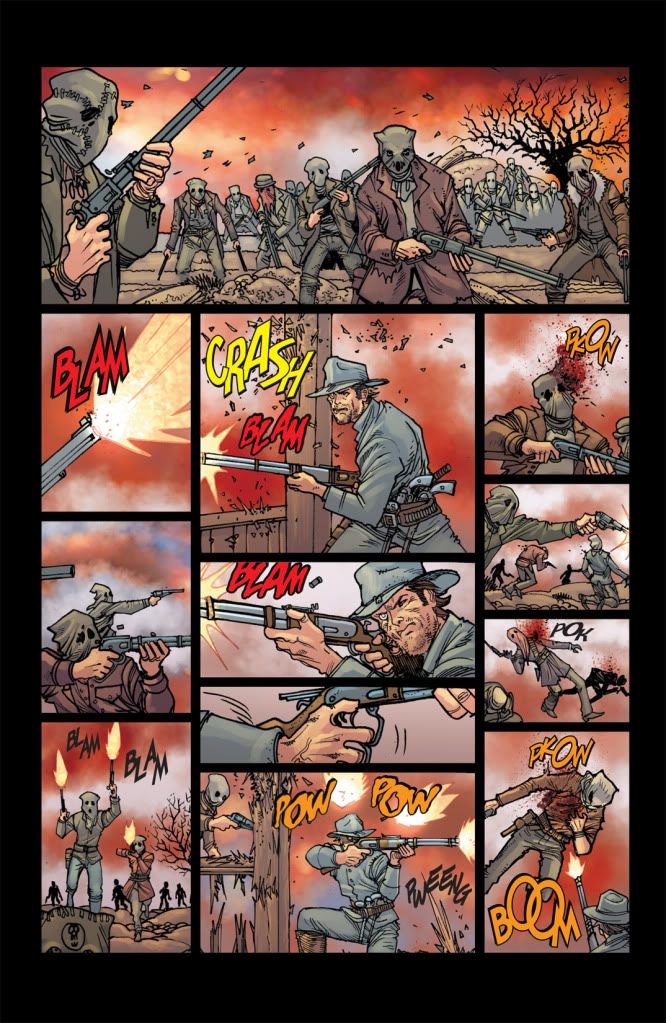
All Star Western #2 (DC) - Some people complained that the first issue of this series was too heavy on text box narration from Amadeus Arkham. Though the text-heavy first issue didn't bother me — it was a good way of delving into the characters of Arkham and bounty hunter Jonah Hex — it is nice to see that the second issue is much lighter on text and moves at a much brisker pace. The secret society that Hex and Arkham stumbled across last issue is now revealed as the same "religion of crime" that's been featured in Grant Morrison's Batman and the Greg Rucka/JH Williams III Batwoman. Between Morrison and Scott Snyder's work with Batman of late, there have been a lot of comics that have delved into the history of Gotham City, and this series now promises to tie in with that work in interesting ways. Justin Gray and Jimmy Palmiotti vary the pace here nicely, with a great shootout composed on a few busy pages full of frantic action panels. There are some occasional awkward moments in the writing (the very first page refers to "a more bloody destination") and even Moritat's generally fantastic artwork isn't always in top form. The staging of a fight scene between Hex and a hulking brute makes it pretty unclear where exactly the characters are in relation to one another, for instance. This issue also introduces a back-up feature about El Diablo, also written by Gray and Palmiotti, and drawn by the great Jordi Bernet, which justifies the book's title as something other than a Jonah Hex solo series. This short piece, in which El Diablo prepares to face down some zombies, is slight (like many backup features) but nicely drawn.

Aquaman #2 (DC) - Well at least this issue goes much lighter on the relentless Aquaman-is-a-joke punchlines from Geoff Johns' first issue. There are still traces of that annoyingly defensive tone, but for the most part integrated much more seamlessly, so this issue's gags — like the way Mera keeps getting called Aquawoman, or the scene where a cop doesn't quite recognize Aquaman without his orange shirt — are funny without being as blunt and obvious. I'm still not totally sold on this series but this is a decent issue, and the deep-sea monsters with their huge razor-sharp teeth are really creepy. Ivan Reis' art is mostly nice, too, especially during the gory battle scenes with the gilled monsters. Reis' youthful, square-jawed Aquaman is a pleasure to watch in action, but his facial expressions vary from awkward to just plain inscrutable. There are too many panels where Aquaman stares blankly straight ahead, his feelings or thoughts unclear. The tonal uncertainty in those moments is emblematic of this series as a whole.

Captain America & Bucky #623 (Marvel) - I've been really enjoying the World War II era stories in this comic of late, more than pretty much anything in Ed Brubaker's Captain America stories since around the time Steve Rogers came back from the dead. The basic gimmick here is that Brubaker, along with co-writer Marc Andreyko, is retelling the stories of this era from the point-of-view of the sidekick rather than the larger-than-life hero, and all of it is informed with an extra level of poignancy by the knowledge of Bucky's ultimate fate as developed during Brubaker's Captain America run. In this issue, Bucky comes face to face for the first time with the horrors of the concentration camps, probably an inevitability considering that this is an attempt to do a gritty war movie version of Bucky's life story. It's appropriately horrifying, the kind of story that never would have appeared in the original World War II Cap and Bucky comics. Chris Samnee's moody, wintery artwork — evoking the feel of David Mazzucchelli's Batman: Year One — makes the images of skeletal, silent prisoners especially heartbreaking. These World War II stories have been so generally good that it's a little disappointing that this series is now moving on, though the promise of checking in on Bucky's years as Soviet assassin the Winter Soldier is equally enticing.

Daredevil #5 (Marvel) - It's really wonderful to see the methodical way that artist Marcos Martin breaks down a fight scene into a flurry of small panels. Martin's art, together with Mark Waid's writing, puts the emphasis on Daredevil's senses: this book continually captures the way that Matt Murdock compensates for his lack of sight by analyzing his surroundings through the input of his other senses, turning each move, each action, into an elaborate but super-fast calculation. On one page, Martin pulls back from a closeup of the interior of an ear as Murdock winnows away all the extraneous sound threatening to overload his senses, honing in on the few important sounds he needs to hear clearly. Waid's writing has a clever, breezy feel to it that emphasizes just how much fun Daredevil is having doing what he does. "Oh, no! Six armed mercs wearing night vision goggles! Whatever will I do?" Murdock thinks, before Martin inserts a perfectly timed panel of a finger flicking a light switch to blind the bad guys. It's whimsical and light-hearted, despite the high-stakes danger and intrigue, although Waid does keep hinting that Murdock's new happy-go-lucky attitude is a defense mechanism to deal with all the trauma inflicted on the character by previous Daredevil writers.

FF #11 (Marvel) - Jonathan Hickman consistently packs an awful lot into 20 pages. This comic features another typically charming scene with Val and Franklin Richards and their assortment of oddball friends, multiple world-ending plots churning into motion, and Reed Richards assembling a huge group of heroes to face the threats closing in from every direction. It's briskly paced, funny and thrilling by turns, and every page has some fun bit of business or a startling twist or some visual stunner. This is dense and exciting, the total opposite of the trend towards decompression that dominates so many other superhero comics these days. What happens in this issue might have been stretched out over a few months in other series — or a few years if Bendis was writing it — but Hickman continues to hurtle forward with so much going on in different corners of the universe. Probably the best sci-fi moment is the revelation of the fate of the two alternate universe Reeds held captive by the Inhumans: a totally unexpected twist that Hickman and artist Barry Kitson brilliantly depict in a few gorgeously outrageous pages. Other writers would have made that the last-page cliffhanger, but Hickman just confidently tosses it out there in the middle of the issue and then moves on, ending with an even bigger cliffhanger. This is an especially strong issue for Hickman's crackling dialogue, too, after a few issues that focused more on epic fight scenes and plot machinations. The banter centering around the Future Foundation kids is crisp as ever, and so is a great scene where She-Hulk and Sue Richards gently, affectionately mock a grumpy Ben Grimm. It's yet another reminder that Hickman's Fantastic Four (which returns for its 600th issue next month) and the spinoff FF are so strong not only for their wild high-concept sci-fi but for their low-key humor and keen grasp of family dynamics.

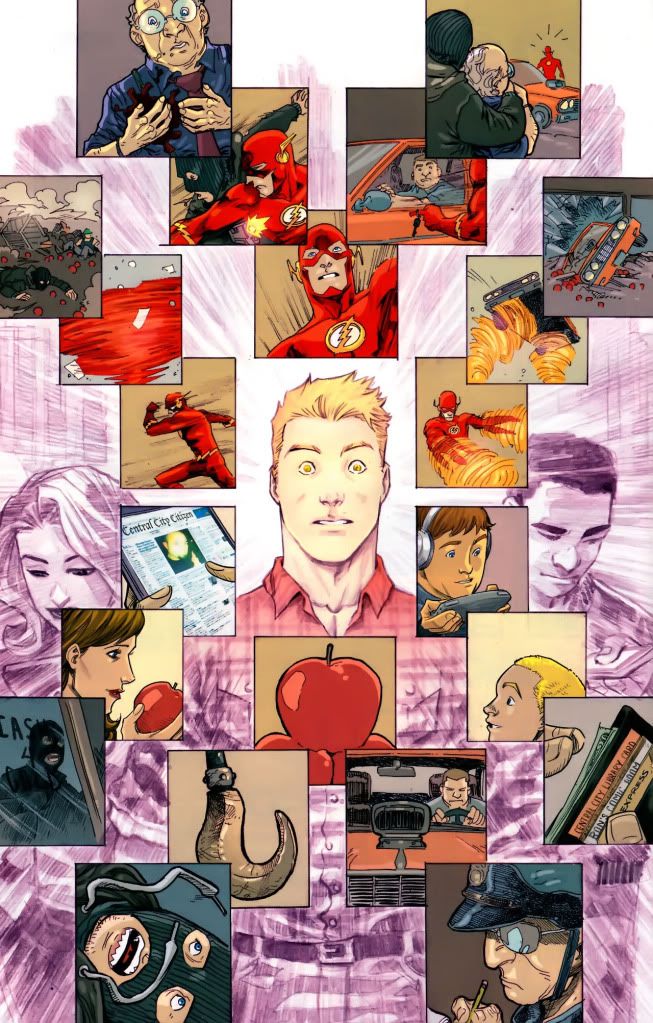
The Flash #2 (DC) - I thought the first issue of this series was really good, but this one ups the ante even more. Artist Francis Manapul and colorist Brian Buccellato also share writing duties on this series, and considering that they're not tested writers with a lot of experience, this book reads briskly and enjoyably, telling its story with more clarity and wit than many of the New 52 books guided by supposedly more seasoned writers. But the art is where this book really shines, the art and how it's used to show Barry Allen in super-fast action. This issue introduces a new wrinkle to the Flash's powers as he realizes that, while he's physically using his powers to their full potential, he hasn't really taken mental advantage of his speed. Needless to say, the pages where Manapul shows Barry flexing his new sped-up mental prowess are jaw-dropping. The pages are filled with small square panels depicting everything Barry sees as he walks around the city, as he takes in all the different aspects of a scene and then foils a robbery without anyone even realizing that he's intervened. This scene reminds me of the Marcos Martin-drawn story in Mark Waid's recent Daredevil #1, and the two books share some similarities in that both are about sensation and heightened ways of experiencing the world. It's brilliantly staged, and suggests the possibility of the Flash as a hero whose heroic acts pass unnoticed, explained away as elaborate coincidences and mishaps.

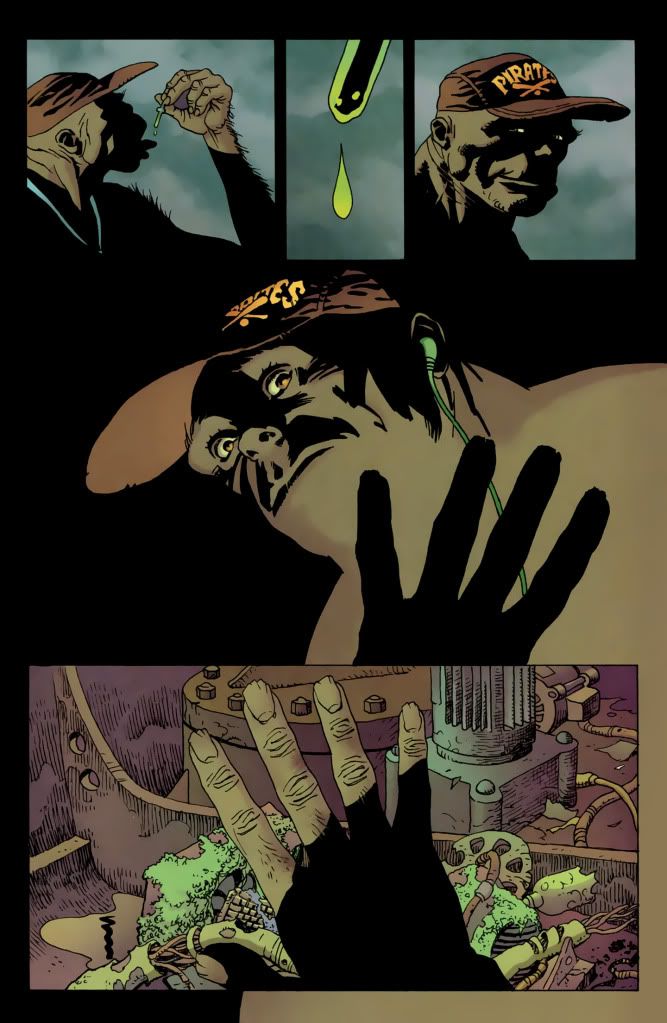
The Incredible Hulk #1 (Marvel) - I could have read quite a few issues of the shaggy, bearded Hulk hiding out underground, chilling with the Moloids and hunting great big monsters. So it's a little disappointing that this situation basically only lasts for the first half of Jason Aaron and Marc Silvestri's new first issue about the big green guy. Silvestri's densely hatched art is instantly striking, though it's puzzling why he needed three inkers as well as Michael Broussard doing "pencil assists." The issue opens with Hulk battling monsters, then brooding while his adoptive underground family feasts and celebrates his successful hunting. These pages are evocative and beautiful, depicting a haunted Hulk vainly trying to escape his past. I'm not as sold on the rest of the issue, as Aaron very quickly — too quickly, I think — breaks Hulk's isolation by bringing in a squad of chatty robots to fight him and teasing what looks to be the larger plot for subsequent issues, involving Hulk's former alter ego Bruce Banner (apparently they're separate beings now?). This was a decent enough first issue, and it's certainly cool-looking, but I'm still a little disappointed that Aaron has so quickly moved beyond what could have been a promising status quo for this book's initial arc.

Justice League Dark #2 (DC) - I didn't really expect to be saying this, but the highlight of this issue is the creepy/kinky relationship drama between Deadman and his girlfriend, Dove. Deadman attempts to get laid by possessing random strangers in the hopes of having an actual physical relationship with Dove, and it's both strangely poignant and really funny, especially when he possesses a girl and clumsily hits on Dove, causing her to storm off. Meanwhile, the main plot with Enchantress simmers a bit after the all-out chaos of the first issue. The villain mainly unleashes some random weirdness on Zatanna and Dove and delivers threatening messages via the radio. Constantine appears briefly too, very much in character, drinking and getting beat up and generally just providing a reassurance that Constantine can exist outside of Vertigo without losing his edge. I like that Milligan seems to be randomly jumping around to different characters, delivering twisted little character beats or offering up visual weirdness for Mikel Janin to draw in his hyper-real style. It's also nice that Janin subtly alters his art to suggest the different worlds of the characters: Constantine's gloomy, heavily hatched pages seem very different from the much brighter, cleaner style of the bar scenes where Deadman and Dove awkwardly banter and argue.

The Mighty Thor #7 (Marvel) - Last month, Matt Fraction wrapped up this series' first arc in a very satisfying fashion. This month, the book is given over to what amounts to a prequel to Fraction's Fear Itself crossover, the story of how Thor's father Odin ascended to become first among the Norse gods. It's just a solid, action-paced issue, an excuse for artist Pasqual Ferry to draw lots and lots of heads being lopped off and bodies torn apart as Odin does battle with the forces of his cruel, warped brother. The best part is Fraction's writing of the bold, overreaching young Odin, whose bravado and leaping into danger is very reminiscent of the child Loki who Fraction created on his last Thor series. It's a decent standalone issue, if not as boldly imaginative as the great stuff Fraction was doing with these characters prior to Fear Itself. What will be really interesting now is to see if Fraction can maintain this series' level of quality with Thor, for the moment, "dead" after the events of the crossover.

Spaceman #1 (Vertigo) - This is the debut of a new nine-issue miniseries that reunites writer Brian Azzarello and artist Eduardo Risso, the creators of the great, pulpy 100 Bullets. It's a post-apocalyptic thriller set in a future wasteland, where the title character Orson — a genetically engineered humanoid manufactured for spacefaring missions — has virtual reality sex via remote hookups and scrounges for scrap metal to feed his drug addiction. The story thus far is a mash-up of various dystopian genre conventions and little meta in-jokes, with a kidnapping plot that revolves around a vicious and transparent satire of Brangelina. There's not enough here yet to tell where this is really going, so this first issue is all about atmosphere, both in terms of Azzarello's goofy, invented future-slang and Risso's typically jaw-dropping, shadowy artwork. Though I can already feel the weird, slangy dialogue growing on me, like a nutty sci-fi twist on the purplish street patter that Azzarello slung throughout 100 Bullets, it's Risso's mostly wordless visual storytelling that provides the issue's most compelling moments. That's why the best sequences are the ones in which Orson in a spacesuit navigates across Mars, in what may be a glimpse of the past or the future or simply a druggy reflection of the main character's inner states.

Venom #8 (Marvel) - Spider Island is yet another big Marvel crossover that I haven't been reading but which is infiltrating books I like anyway. It hasn't derailed Rick Remender's Venom, though, even if the whole concept for this storyline seems spectacularly, amazingly stupid. Remender has wisely chosen not to allow the crossover to completely overwhelm the stories he was telling with this series already, so that even if the events of these issues tie into what's going on over in Amazing Spider-Man and other books, Remender keeps the focus on Flash Thompson dealing with the illness and death of his drunkard father and coping with the Venom symbiote's strengthening hold on him. Though this issue isn't as strong of a standalone issue as Remender's previous two Spider Island tie-ins — for one thing, it ends with a cliffhanger battle that's going to be resolved in Amazing Spider-Man #672, the final issue of the crossover — it's still a character piece as well as a crossover fight scene. Remender weaves the plot together with narration from a letter that Thompson's dad wrote just before he died, so that even as Thompson/Venom brawls with the Spider Queen and teams up with Steve Rogers, the book remains focused on more than the violence. That's what makes Remender's Venom so enjoyable; he does the big dumb action well but never delivers an issue that's just big dumb action. Even if these Spider Island issues haven't been as strong as the series was before the crossover started (and I'm glad it's over) Remender has managed to keep this series on track even while compromising with other writers' stories.

The Walking Dead #90 (Image) - Robert Kirkman's zombie epic has been running for so long now — holy shit, the 100th issue will be out next year! — that there's a real sense of its characters changing and growing over time. So when, as in this issue, Rick discusses the ways in which these experiences have changed him with Andrea and Carl, or when Maggie lets the pressure of life in the zombie apocalypse get to her again, these moments resonate with everything that's happened to these people in these pages. Rick's ongoing evolution, his struggle with his need to control everything, his increasing comfort with life-or-death decisions, continues to be very compelling, highlighted here by a stunning double-page spread in which he asks Andrea, and by extension the reader, to look into his eyes and really think about what he's seen and done. That expansive portrait, by Charlie Adlard — who's been with these characters nearly as long as Kirkman has — delineates Rick's exhaustion, his numbness, with lidded eyes and heavy shadow. He seems haunted, and the image itself is haunting; in an issue with no zombies, no gore, no violence, this portrait encompasses the horror of this series' premise, the horror of accepting death and violence as an everyday occurrence, just another part of what happens. This is an especially good issue for this kind of low-key character work, which is Kirkman's primary strength as a writer. He's good enough at this stuff that even the last-page romantic twist — which Adlard has been subtly hinting at with body language and visual feints for several issues now — doesn't come off as a gimmick but as a natural outgrowth of these characters and this moment.

Wolverine and the X-Men #1 (Marvel) - Jason Aaron's Schism event, which separated the X-Men into two teams focused around Cyclops and Wolverine, was lame and forced, a perfect example of a story existing solely to justify (weakly) its end point. So it's surprising that the first issue of Aaron's new book, about Wolverine setting up a new mutant school, is a blast from start to finish, totally clearing the air of all the turgid Schism/Regenesis stuff and making it clear just why Aaron was so excited to get to this point. There's just so much to love here, as Wolverine and Kitty Pryde take a breathless tour of the new school's grounds with a pair of frazzled, caricatured state education inspectors in tow, harrumphing everything they see. It's a delight from start to finish. The structure provides an opportunity for Aaron and his artistic collaborator Chris Bachalo — whose energetic manga-influenced style is a perfect fit for this issue's flippant, funny tone — to introduce the huge cast bickering, gossiping and careening through the halls committing all sorts of wackiness. It's fun to see all these underused mutant characters colliding off of one another. I got a special kick out of seeing Doop, from Peter Milligan's classic X-Statix, serving as the school's receptionist. It was also nice, and logical considering Bachalo's presence and the school setting, to see a bunch of alumni from 90s X book Generation X, which I fondly remember as a favorite of my 13-year-old self. This issue is fast and funny and packed with little character beats and visual gags, like the full page shot of mutant terrorist Quentin Quire being kept prisoner with the dragon Lockheed perched threateningly over him. If Aaron and Bachalo can keep this frantic pace and level of energy up over the long haul, they've got a real classic in the works.

Monday, October 24, 2011

Weekly Comics: October 19, 2011

Batman #2 (DC) - I love how deeply engrained Scott Snyder's Batman is in the history of Gotham City, its legends and the ancestors of the characters who define its present. The opening of this issue, with its emphasis on Wayne Tower, recalls the Snyder-overseen miniseries Gates of Gotham, which explored the secrets behind the construction of that tower. Snyder is signalling that the past is once again going to reach forward into the present. This issue also explores another of Snyder's running themes in his Batman work: the ways in which the city of Gotham shapes those who live in it, and vice versa. His Detective Comics run, with Dick Grayson as Batman, focused on Dick's fears that Gotham would transform him, would unleash the darkness that so often threatens to consume Bruce Wayne. But as in that series, Snyder's new Batman seems to be confirming that things mostly work in the other direction: each man sees his own Gotham, shaped or warped by his own experiences and how he's chosen to react to them.

Bruce's conversation with would-be politician Lincoln March underlines this theme. March is a man with a past similar to Bruce's, having lost his parents at a very young age; his story about his mother's heart pin is an eerie echo of Bruce's fixation on his own mother's pearls. March says that Gotham itself helped him past his trauma, giving him a sense of purpose, and in a strange way this is also true for Bruce, though not in the same sense as March's idealistic political fervor. Both men see themselves as shaped by the city, changed by their traumatic pasts, but they take very different trajectories and see Gotham in very different ways. It's great how Snyder is weaving these undercurrents into his story from the very beginning, slowly developing these themes as Bruce, confident in his knowledge of Gotham and of his own relationship with the city, prepares to face yet another threat from the city's past, a threat to the city that he sees as integral to his identity as Batman. Snyder's storytelling is patient, obviously working towards a bigger arc, but not at all decompressed — this issue is well-paced with action, some displays of Batman CSI tech and detective work, and the moments that develop Snyder's big picture themes.

The Boys: Butcher Baker Candlestickmaker #4 (Dynamite) - Well, I called what was going to happen in this issue. Not that it was hard to predict. The problem with this miniseries is that it was always so obvious just where it was going to be heading, the only place it possibly could be heading. It's a familiar Garth Ennis formula, especially in this series, which revels in brutality and horrible things happening to decent people. So when the future leader of the Boys, Billy Butcher, met a beautiful redhead and married her, the only question was in what horrible and grotesque way the Homelander was going to kill her so that Butcher could be pushed onto the unceasing quest for vengeance that drives him over in the main series. That question has now been answered, and the final pages of this book, as drawn by Darick Robertson, are appropriately harrowing and horrifying — suffice it to say that Ennis' warped imagination has concocted some really nasty images here, images that owe a bit to Alan Moore's Miracleman and offer up a grisly, cynical twist on one of the pivotal events of that series. But there are no surprises here, and there's no real depth to Ennis' revelation of Butcher's back story. It was always obvious from the main series that superheroes — and specifically the Homelander — had been responsible for something awful in Butcher's past, that they'd probably killed someone he loved. Now that the details have been revealed, it doesn't really change his character very much, or reveal much about him that wasn't already apparent. It's just another opportunity for Ennis to wallow in the terrible things that superpowered beings do in this series, another opportunity to show that people with real power almost invariably use it to hurt, use and screw over others. The political applications of that idea are made especially clear in this issue's discussions about Thatcherite England, but even so this whole miniseries just feels so redunant and unnecessary.

Captain Atom #2 (DC) - This is just a really cool-looking terrible comic. The linework of penciller Freddie Williams II isn't anything special; it's mostly pretty minimal and crude, and when it isn't there are some ugly, distorted faces on the pages where Williams lays down the ink thicker. Colorist Jose Villarrubia does most of the heavy lifting here, giving the series' title character a pale blue sheen that makes him stand out boldly from the world around him. It's very striking, especially on the pages where the atomic hero is overwhelmed by the electronic signals of the Internet and text messages flowing through the air around him, spectral information as ghostly and colorful as the hero himself. If only it were a good comic with this kind of distinctive style, but JT Krul's writing and plotting are just boring — when they're not outright silly, as in the volcano that abruptly popped up in the middle of New York at the end of last issue, a threat that Captain Atom seems to have neutralized between issues, leaving the volcano inert but still sticking out of a Manhattan street. I wish this comic was good, because I do like looking at it, but unfortunately it has little to offer beyond its admittedly pretty colors.

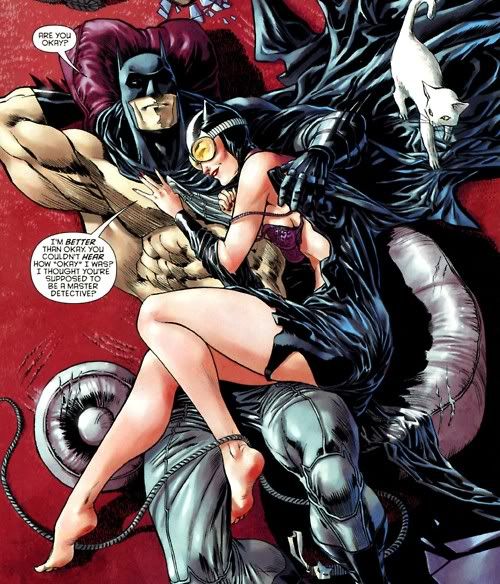
Catwoman #2 (DC) - I've gotta give it to Judd Winick: he pissed off a whole lot of people by ending the gloriously sleazy first issue of this comic with a fetishy, campy Batman/Catwoman sex scene that apparently offended everyone but me. (That's an exaggeration, but not by much.) And instead of moving on from there, he decides to open the second issue with the sex scene still in progress, giving us not only a splash page of a post-coital smiling couple but a panel of Batman adjusting his belt as he pulls his costume back into order. Never thought I'd see that. And I have to say, I'm still digging this ridiculous comic. Guillem March draws a very sexy, curvy Catwoman whose face expressively projects her playful delight in manipulating her opponents. She'll get her revenge for some dark things from her past, and she'll have a lot of fun doing it. The end of the comic goes very dark, very suddenly, but before that it's just so much fun to see Catwoman flirting with Bruce Wayne, unaware of who he is but feeling a strange attraction to him anyway, and then cleverly manipulating some rival mobsters into a shootout to get her revenge. This is pulpy stuff that very deliberately leaps across the line separating good taste from bad, and I can't help but admire it for that. It's trashy, and Winick and March undoubtedly know it, and the result is kind of a grindhouse Catwoman comic, delving into extremes of flashy sexploitation and over-the-top violence. I'm sure this comic will continue pissing people off, and I'm equally sure that it's going to be hard to look away from its garish trainwreck wildness for as long as it continues in this vein.

Green Lantern Corps #2 (DC) - After the first issue of this series, I thought I was onboard for what seemed like it was going to be some mindless cosmic action. Now I'm starting to think it's a bit too mindless after all. Not much has changed from the first issue, I admit, except that now the focus is irrevocably off characterization, so that Lanterns John Stewart, Guy Gardner and the squad of alien Lanterns they lead are all pretty generic. At least the first issue gave some character beats to the two human members of the team. The threat they're facing, which was just an unseen terror killing Lanterns last issue, has now been revealed as a bunch of generic guys in black armor, so that's a letdown too. Basically, it feels like this isn't going to be the great action series I was hoping for, and the alien Lanterns are going to continue to be mere fodder for limb-hacking and grisly deaths, and I'm not sure that there's any reason to keep reading.

Journey Into Mystery #629 (Marvel) - Since it seems like Marvel's Fear Itself event is quite simply never going to end, I guess this potentially enjoyable book is going to remain trapped in a crossover swamp for the forseeable future. Kieron Gillen's writing is a weird mix of formal prose and flippantly delivered dialogue, with the latter being much more palatable than Gillen's attempts at Asgardian portent. As usual, Loki's breezy manner is the main appeal of this comic and this character. His delivery of tossed-off battle orders — "Dark Asgard flies on engines powered by raw fear-stuff and similar... let's blow them up" — suggests his childlike enthusiasm and casual approach to prophecy and war. This is contrasted against the stiff, often awkward writing of the narrative caption boxes, which overpower the much more lively dialogue. But the real problem continues to be that Journey Into Mystery so far has just been a peripheral part of Fear Itself when it should be a fun, slightly goofy book about the adventures of kid Loki. It's a waste of this character that his showcase comic mainly summarizes events in other series (apparently Thor's dead over in Fear Itself — yeah, that'll last) and adds a little ancillary action.

Justice League #2 (DC) - Geoff Johns' flagship DC book continues to move at a deliberate pace, slowly introducing the major players and having them size each other up with pattering dialogue and the obligatory superhero-misunderstanding-fight-scenes. Last issue focused on Green Lantern and Batman, with Superman showing up at the very end, while this issue throws the Flash into the mix and moves forward with the origin of Cyborg. Johns' punchy dialogue prevents the decompressed pace from being frustrating, and it helps that it's inherently fun to see these famous heroes meeting each other for the first time, cracking jokes as they try to figure out the origin of the mother boxes that Darkseid is planting in various US cities. Jim Lee's bold art is another pleasure here, and he's at his best in depicting a fight scene between Superman and the Flash, with the speedster dancing in circles around the Kryptonian before Superman finally catches him and sends him flying with a playful flick of his finger. The layouts of fight scenes like this are simple and elegant, breaking down the action into small gestures that lead into the massive, explosive pin-up panels that are Lee's forte. When he tries for a more complex layout, as he does on a page where Green Lantern calls the Flash for help, the page starts to look crowded and cluttered, with word balloons and layered panels creating visual confusion. That's just one page, though, and the rest of the issue tends to play to Lee's strengths much more clearly, with simple, iconic depictions of fight scenes and superhero posing. The introduction of more heroes in this issue gives the impression that things are speeding up and spreading out, gathering momentum as the Justice League of the title begins to take shape. When Wonder Woman and, presumably, Aquaman show up next issue, the pacing should get even more frenetic, the action more frenzied.

Nightwing #2 (DC) - I like Dick Grayson as a character, especially since his recent stint as Batman, but I have to say, the prospect of "Nightwing solves a circus mystery" as the driving plot of this first arc is really not exciting me on any level. The same thing goes for the assassin who's stalking Dick, a generic costumed guy with claws called Saiko, which not only provides the awful pun of the cover text but allows Dick to make a similarly terrible sorta-pun inside the actual comic. This just isn't really that interesting, from the generic love interest to the weirdness of Dick inheriting a circus to the off-kilter pacing. Eddy Barrows' fight scenes are interestingly laid out — as in the first issue, he seems to be taking more than a few page design cues from JH Williams III — but his faces are really goofy looking, and the presence of two inkers suggests that this is yet another New 52 issue affected by deadline pressure.

Supergirl #2 (DC) - The very decompressed storytelling in this series is already starting to get annoying. The first issue was basically just an extended fight scene between Kara and a bunch of armored soldiers as she tries to figure out what's going on. The second issue is... basically just an extended fight between Kara and Superman as she tries to figure out what's going on. While I enjoyed the first issue well enough, Michael Green and Mike Johnson are certainly taking their time building up to anything more substantial. Here, the two Kryptonians duke it out because Kara refuses to believe that Superman is actually her cousin, mainly because in her memory he's still a baby, which raises questions about where (and when) she's actually from and how she got here. But the whole thing feels contrived because after brawling all issue, Kara abruptly decides to stop by the end, and suddenly trusts her cousin after refusing to listen to him at first. This series needs to quickly do something besides staging 20-page fight scenes, even though Mahmud Asrar is undeniably good at drawing them: his figures in motion have a nice sense of energy, and he's great at depicting the paths of destruction that the hurtling superbeings leave in their wake.

Wolverine #17 (Marvel) - Jason Aaron has been doing some fine work on Wolverine lately, quite literally sending the man with the claws to hell and bringing him back only to tear him down even further. Then, just last issue, Aaron offered up a surprisingly touching and even funny reminder that Wolverine stories can and should be about more than just suffering and killing. This issue picks up that thread and serves as a placeholder in the aftermath of Aaron's Schism miniseries, which somewhat artificially concocted an excuse for Wolverine and Cyclops to fight and split up the X-Men into two teams. Now Wolverine's preparing to restart the Xavier school, so this issue is pretty much just filler before that storyline starts in earnest over in Aaron's new Wolverine and the X-Men series. As filler, it's not bad, and Aaron's feel for humorous dialogue is especially sharp here, as Wolverine goes hunting through San Francisco's Chinatown underworld for some drug dealers who have managed to subjugate a pair of dragons. Yes, really. It's knowingly a bit goofy, especially when Wolverine's throwdown with Gorilla Man is interrupted by the meta commentary of a pair of onlookers whose banter reflects the stupidity of the superhero comic convention that every time two heroes meet, they must fight. Considering all the angst and poignancy of Aaron's recent Wolverine arcs, this kind of low-key, light-hearted issue was probably needed to provide a breather before the aftermath of Schism really starts to play out.

Wonder Woman #2 (DC) - Damn I love this comic. This issue isn't as rapidly paced as the action-packed first one, but it has the same energy and vitality. Brian Azzarello's writing is crisp and efficient: he tells Diana's origin story in just two pages and caps it off with a casually jokey exchange. He packs a lot into this issue, as Wonder Woman takes Zola — the woman carrying Zeus' latest bastard child — back to the Amazons' home. Azzarello's dialogue is crackling and sharp, very different from his usual hardboiled style but with his characteristic wit intact. Zola's conversation with Hermes is great, as she wonders which of the men she's slept with lately could have been Zeus in disguise. It's not only funny but sex-positive and non-judgmental, especially remarkable considering some of the depictions of women in other New 52 series. It helps that Cliff Chiang's cartoony, expressive faces give his characters, particularly all the women in this story, vibrant personalities. The design of the villainous Strife, Hera's daughter and apparently Diana's sister, is especially effective, appearing as a willowy, pale blue gothy figure in a shredded cocktail dress.

Thursday, September 29, 2011

DC's New 52, Week 4 (September 28, 2011)


This is the final week of DC's New 52 initiative. As with the other weeks, it's a bit of a grab bag. There are no books here as strong as the best titles from previous weeks, but there's still some good stuff, a few surprises (I never expected Firestorm to be any good) and some stuff that I'm not sure why it's even being published.

1. Justice League Dark #1 - Now this is the kind of comic Peter Milligan is meant to be writing. Despite the title, this series is DC's attempt to fold a whole bunch of its Vertigo magical/supernatural characters into the mainstream DC universe, with a catch-all title dedicated to what's bound to be a pretty loose grouping of unconventional heroes. This is Milligan's forte, and that's immediately obvious as he spits out page after page of crazy reality-warping concepts and purplish prose. It reads like a pastiche of some of Milligan's peak work — particularly Shade the Changing Man, the title character of which is one of the main heroes here, and his short stint on Animal Man — but that's OK when he's coming up with something this entertaining and strange. Identical women hurl themselves into bloody traffic accidents, cows given birth to machinery, and a storm of razor sharp teeth slice Superman to bits while he muses that the teeth smell insane, which in turns prompts a narration box to counter, "but what is the smell of sanity?" The inclusion of the Justice League deliberately makes another old favorite Milligan point, that sometimes the world is just too strange to be understood or confronted by solid, noble heroes like Superman and Wonder Woman — sometimes the most damaged, wacky people are precisely the ones who can best cope with the world's lunatic shifts. The comic moves at a frantic pace and avoids the exposition trap by interspersing the obligatory character introductions with all the insane goings-on caused by the Enchantress. Mikel Janin's art is excellent, particularly in the epic sequence where the Justice League attempts to face the Enchantress. There's also a sly sense of humor here that manifests itself in things like Superman sensing that Cyborg is anxious by monitoring his oil levels.

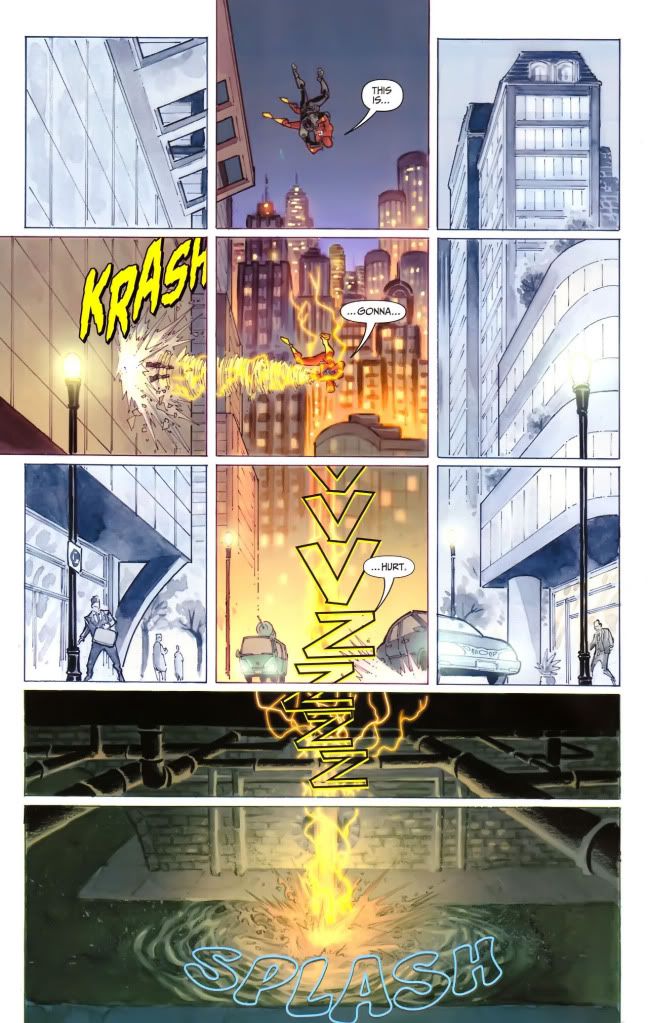
2. The Flash #1 - This is just a joyous, spirited superhero comic, as quick on its feet as the Flash himself. Writer/artist Francis Manapul (who gets some writing help from colorist Brian Buccellato) has delivered an energetic and fun first issue that gets everything just right as far as straightforward superhero antics go. Manapul's art is crisp and clean, with some inventive page layouts that communicate the constant sense of rapid motion that constitutes the heart of Barry Allen's power. Best of all is the page where the Flash, falling from a plane full of bad guys, tumbles down a series of panels in the center of the page, with the rest of the city rendered in the grid around him, so that the page as a whole looks like a segmented diagram of the city, with Barry's freefall ending below the street in the sewer that sprawls across the bottom of the page. It's all bright and beautifully colored, moving at a brisk pace without sacrificing the necessary character beats that establish the hero as an earnest, deliberate, serious young man in contrast to his hyper-kinetic powers. The pace is frantic enough and the art gorgeous enough that the initially generic-seeming villains aren't too much of a concern, and the issue ends with a series of quirky twists that suggests that even those stock, faceless baddies are pointing towards a much more interesting sci-fi plot ahead.

3. All Star Western #1 - It's great to see DC stretching into the past of its universe with this book, which focuses on Jonah Hex and Amadeus Arkham trying to solve a series of murders that are reminiscent of Jack the Ripper. This issue is especially fascinating in relation to Grant Morrison's travels into the history of Gotham City in The Return of Bruce Wayne and the rest of his Batman epic, and there are some obvious connections here in the characters of Hex, Arkham, the Wayne ancestors, and a secret society of wealthy Gothamites with some sinister secrets. More importantly, this is very well-done. It's wordy but well-written by Jimmy Palmiotti and Justin Gray, and Arkham's narration, with its attempts at analyzing his reluctant partner Hex, is engrossing and fits perfectly with the period setting. And then there's the art by Moritat, whose bold, thick lines often make each page look like gritty stained glass compositions.

4. Superman #1 - While Grant Morrison's Action Comics chronicles the early years of Superman's career as a feisty urban crusader, the hero's name title (written by George Perez and drawn by Jesus Merino) takes place in the present day of the new DC universe. This is an older, more established Superman, who still shows signs of the moralist hero of the common people established in Morrison's title, but without the same fiery anger and playful sensibility. The result is a solid superhero yarn that lacks the leaping, bounding excitement of Action Comics #1 but nevertheless seems to be setting up a fine superhero saga. The bulk of the issue concerns the first day of a new Daily Planet that's been taken over by a rival that the muckraking Clark Kent sees as a lousy gossip factory. As the merger goes into effect and Lois Lane takes charge of the new enterprise, Superman does battle with a mysterious alien fire monster. The action is fairly rote, and there's a random connection to Stormwatch #1 that suggests an eventual crossover but doesn't do much else. Still, it's interesting to see a Superman who seems so remote and lonely, and in that respect the last page, on which a dejected Clark slumps into an elevator while using his super-hearing to listen in on Lois chatting with her boyfriend, is especially effective and affecting.

5. The Fury of Firestorm: The Nuclear Men #1 - This is a weird one, and one where I didn't really know what to expect beforehand. Co-written by Ethan van Sciver and Gail Simone, and drawn by Yildray Cinar, it turns out to be an unlikely combination of high school melodrama, violent mercenary action, and explosive sci-fi craziness. Surprisingly, it winds up being a pretty entertaining issue that sets up a rivalry between two high school students: one black, one white; one a jock, the other a reporter for the school paper. The differences between these two are drawn pretty broadly, especially in the rather heavy-handed dialogue about race, but in formal terms the parallel editing and alternating narration streams keep the comic interesting. Cinar's art is very nice-looking, too, with lots of heavy blacks and strongly defined lines. The book's tone alternates, for much of its length, between action and high school drama before suddenly erupting, literally, with the transformation of the two leads into the superpowered fire creatures of the title. This is a fairly strong first issue with an interesting premise.

6. Aquaman #1 - This is a very self-aware Aquaman comic that knows that the titular hero is, for most people, kind of a joke, so writer Geoff Johns inserts plenty of nods to the jokes while trying to establish his hero as a badass with no sense of humor about his reputation. It's not great, and some of the dialogue in the later half of the book, when Aquaman visits a diner, is especially forced. An interview with a pushy blogger provides an opportunity for some clumsy faux-casual exposition, and Aquaman's humorless stoicism doesn't make him a very endearing hero. Just about all he does here is silently glower while everyone he meets wisecracks about fish and mermaids. More promising is the framing story involving some creepy-looking deep-sea Creature From the Black Lagoon outcasts, who provide a horror frame for Aquaman's on-land adventures.

7. The Savage Hawkman #1 - This is written by Tony Daniel, so of course it has a gritty, wordy tough guy voiceover running all through the issue. It's a style that's pretty common in these New 52 books, actually, though Daniel seems to be the worst offender. At one point, Hawkman calls himself "bud" while looking in the mirror; it's that kind of hard-boiled or maybe just overcooked narration. And the issue opens with Carter Hall taking his Hawkman costume, burying it in the ground, and shooting it with a gun as a symbolic gesture. That said, despite Daniel's tough guy posing, this is a decent first issue, especially when a sinister — and very Venom-like — alien threat is revealed in the later pages of the book. Most of the credit has to go to artist Philip Tan, whose detailed, textured work is gorgeous whether he's portraying ordinary scenes of archeologists at work or the increasing alien weirdness of the final few pages.

8. Teen Titans #1 - Well this just whizzes by; when I got to the last page and saw that it was over I was pretty shocked because it barely felt like I'd read anything. Which is both good and bad — it's certainly not plodding like Men of War or the Legion books, but it's also pretty fluffy. It's an assembling-the-team kind of issue with Tim Drake monitoring some other superhero teens so he can get a team together before a mysterious organization can get to the kids first. There's a very Speedball-during-Civil War moment involving Kid Flash, but other than that it's mostly about Tim and Wonder Girl, with a final page that ties back into Scott Lobdell's other book, Superboy. (I guess it's just fortunate that he doesn't seem to be tying the execrable Red Hood into these two titles as well.) It's a fast-moving book with a lot of attitude, even if some of it seems more than a little misplaced (like Tim Drake blowing up his penthouse).

9. Voodoo #1 - Considering that this is pretty much exclusively known as "that series about the stripper," everyone should know what to expect here. This makes Catwoman #1 look positively demure in comparison. Ron Marz sets this whole first issue in a strip club where the title character is one of the dancers, so naturally there are plenty of women posing in lingerie or with arms draped across their chests. It's basically a whole book of cutesy cheesecake drawings by Sami Basri, whose style is undoubtedly well-suited to drawing pretty ladies in their underwear. There's not much else here, of course, and since the issue ends with a grisly bloodbath that signals where the series is headed next, it seems like the creative team wanted to get all the sexy stuff out of the way up front before leaving the strip club setting behind. At this point, you might as well as just read a bona fide softcore porn comic, since this amounts to more or less the same thing. It doesn't have the playfulness and goofy fun of Catwoman, and though Basri's art is attractive he's no Guillem March, but neither is this as hateful as Red Hood and the Outlaws #1, still the low point in DC's treatment of its female characters. This just doesn't have much to offer besides pretty pictures and recycled clichés about strippers.

10. Green Lantern: New Guardians #1 - I'll give this issue credit for trying to approach the reboot in a slightly different way than most of the other New 52 — it rushes through an origin story in a couple of pages and then tries to introduce a whole bunch of other characters and a big cosmic plot by the end — but it just doesn't work. It reads like a condensed summary of a few issues at least, especially since central character Kyle Rayner is introduced, steps outside to go to the bathroom, gets a power ring, quickly adjusts to it and is then shown cruising around as a Green Lantern saving people. There's hardly any time to pause in order to establish him as a character or show his reactions to what should be a shocking event. Tony Bedard's trying to cram way too much into one issue here, and the result is that everything rushes by without having any impact; the main character's still a cipher, let alone the swarm of multi-colored alien Lanterns who show up to fight him by the end of the issue. The art, by Tyler Kirkham, is pretty good, and especially shows an affinity for creative visualizations of the Lantern powers: upon receiving his power ring, Rayner instantly turns the alien who gives it to him into a manga-styled imp, and later constructs a group of glowing green construction workers to catch a collapsing crane. This is pretty forgettable otherwise, though.

11. Blackhawks #1 - This is one of those issues where I'm really not sure what to say. It's not bad, exactly, just boring and undistinguished. It's about a team of UN paramilitary commandos, and they have clever nicknames like the Irishman (he has red hair!) and two of them have a secret romance that they have to keep from their superiors. And I'm getting a little sleepy just thinking about it, frankly. The art by Graham Nolan and Ken Lashley is sketchy and finicky but kind of stylish at times, but overall there's just nothing too interesting here besides some rehashed Bond movie action scenes and lots of technobabble.

12. I, Vampire #1 - Some editor at DC obviously realized, a few years after the rest of the world, that vampires are pretty hot these days, and that's clearly the only reason that this is a relaunch title. Whatever. It's boring as hell, and the structure is a mess with stilted dialogue between the two lead vampires running throughout the whole thing in caption boxes. All the usual vampire clichés are present and accounted for, of course, including the tortured vampire romance angle that's all the rage with the teens. Joshua Hale Fialkov's dialogue is mostly the kind of high melodrama that's supposed to suggest, for some reason, beings who have lived a very long time, with occasional diversions into cutesy vernacular that are all the more jarring for the general self-seriousness of everything else. The last thing anybody needs is this half-assed vampire book.

13. Batman: The Dark Knight #1 - What is the point of this book? Out of the 52 titles in DC's current relaunch, there are 11 titles about Batman or characters associated with Batman, including 4 titles that actually star Batman. I get it, DC wants as much Batman on the shelves as possible, but this seems like more than overkill. Particularly since this issue is just total junk with absolutely nothing to offer, treading over very similar ground to the other Batman first issues released during this month. Things do not start promisingly since the very first line of the issue is a caption box that reads, "fear is a cannibal that feeds upon itself." All of Paul Jenkins' writing is of a similar caliber: awkwardly phrased narration and stiff dialogue. David Finch, who co-wrote the book with Jenkins in addition to drawing it, contributes equally stiff poses, including a gratuitous pinup of a generic Bruce Wayne love interest in a super-short dress, lending more fuel to the fire of those decrying DC's unfailing sexualization of female characters. More than that this is just dumb, and utterly redundant when measured against the other Batman titles coming out now. Bruce Wayne goes to a party and gives a speech about Gotham's future, then faces a mob of escaped Arkham inmates, then squares off against the final page reveal of a buffed-up Two Face worthy of Rob Liefeld. It's like Jenkins has shuffled up the contents of Scott Snyder's far superior Batman #1 and filtered out anything smart or subtle or fun. This has some of the worst writing out of the whole New 52, and it absolutely has the worst last page out of any of these comics.

Saturday, September 10, 2011

DC's New 52, Week 1 (September 7, 2011)


Beginning this month, DC Comics is completely rebooting its entire line of comics, starting every comic over from issue #1 and re-imagining their characters, not entirely from scratch but definitely making some changes. It's a move intended to bring in new readers to the continuity-heavy world of superhero comics, and since I've only occasionally read DC superhero comics myself, I figured this was a good time for me to check out what they have to offer. This month DC is unfurling 52 new issue #1s, and I'll be reading all of them and briefly reviewing them here, week by week. This week, I review the 13 first week titles, plus Justice League #1, which came out last week as the debut of the new line. I rank them below from best to worst; by my count there were 3 very good DC comics this week, a few more that were variably enjoyable and/or promising, and then some mediocre junk. Anybody else following this initiative?


1. Animal Man #1 - This book is just fantastic. I wouldn't be surprised if this winds up being the best out of all 52 comics when this month is over. It's a mix of family drama, horror, and superheroics, balancing all these different tones without seeming all over the place. Writer Jeff Lemire packs a lot into 20 pages, economically reintroducing this character, his family, and the themes and conflicts that will drive his story. And the art, by Travel Foreman, is amazing, especially since it shifts fluidly from sketchy domesticity to punchy superhero action to surrealist, horrifying dream sequences. This looks more like an indie book than a big DC superhero title, so the aesthetic is especially striking and invigorating in this high-profile context. The art is so attuned to the nuances of the storytelling, and the style morphs to fit each new wrinkle perfectly. This is a must-read book, one that already seems poised to match the high standard of Grant Morrison's classic run on this title.

2. Swamp Thing #1 - Definitely the second-best book this week, though not remotely in the same jaw-dropping way as Animal Man. Instead, this is just a solid introduction with some very good storytelling by Scott Snyder. I'm not very clear on what exactly is going on with this character, not having followed the pre-reboot DC universe, and in that sense this book doesn't seem as new-reader-friendly as most of the others. The character's history is left pretty vague and confusing, maybe deliberately since I sense that a big part of the book's early arc is going to be figuring out just what's going on with Alec Holland. But the essence of the character and his status quo come across and there are some great sequences of horror that really make me excited to see where this is heading. The whole scene where the big threat is revealed is chilling and creepy and genuinely frightening; I won't spoil it but it's true horror brilliance, wonderfully visualized by Yanick Paquette.

3. Action Comics #1 - I really dig Grant Morrison's new take on Superman as a populist crusader with an attitude, definitely a fresh perspective on the character. It's obvious that Morrison is deliberately taking a different approach from the mythic boy scout of his fine All-Star Superman miniseries. Even Superman's costume feels more approachable and human. The first half of the issue really pops as it introduces this new Supes in action. The second half gets a little jumbled and isn't as strong, but overall this is still quite good. It's also the most straightforward comic I've read from Morrison in a while.

4. Justice League #1 - This issue is actually from last week, since it was the debut of the new DC line. It's pretty good, nothing mindblowing or anything, and I don't know why the debut of a whole new reboot wasn't made more exciting, but it's still not bad. Mostly based around some amusing banter between Batman and Green Lantern, and then the badass new Superman shows up at the end. It's more a teaser than anything else and it works in that sense, but it's not much of a story. This issue takes place five years earlier than most of the other reboot titles (with the exception of Action Comics) so it's meant to show the early days of the new status quo, when the heroes are just getting to know each other.

5. Batgirl #1 - Just a fun, basic superhero story with a lot of heart and emotional complexity. I like that in restoring Barbara Gordon to the Batgirl costume, they've kept her history from Alan Moore's The Killing Joke, so that trauma continues to haunt her even though she's regained the use of her legs. That darkness is contrasted against a refreshing enthusiasm in the dialogue and narration that's really infectious, and makes her seem like a girl who's just happy to be out kicking ass. Not exactly substantial, but pretty enjoyable nonetheless.

6. Stormwatch #1 - This is visually pretty interesting. Every few pages there's some slightly nutty cosmic concept that provides a very striking image. (Although the character drawings are a little stiff.) The problem is that the characters are all so flat and undistinguished, and writer Paul Cornell seems to know that a lot of readers will be unfamiliar with these characters, so virtually all of the dialogue is exposition and explanation. Lots of characters talking about themselves, explaining their powers, saying things to each other that they really have no reason to say except to explain something to the reader. That could get better now that the 1st issue is out of the way, but it still suggests a pretty unimaginative sensibility that jars against the visual imagination on display here. I'll check out a couple more issues of this to see which direction it heads.

7. OMAC #1 - A book that's totally in love with Jack Kirby. Not even a pinch of originality here, but it's fun enough, lots of Kirby dots everywhere, lots of superpowered enigmas pummelling each other. Entertaining and fluffy as hell. I imagine the Kirby pastiche will get old fast so I'm not sure how much longevity there is in this concept, but as a single issue it's a blast.

8. Detective Comics #1 - Pretty standard, even generic Batman stuff. There's lots of Frank Miller-style "I am the terror that flaps in the night" overwrought "gritty" writing. Not terrible, but not especially interesting either. And the Joker isn't funny, which is always a bad sign. The last page is nicely creepy, though.

9. Batwing #1 - Even more standard and generic than Detective Comics, despite this being about an African Batman, a protege of Bruce Wayne. Not exactly bad, but there's not much to it. It's one of those books where it's hard to point to what's missing except, well, anything that would differentiate it from countless other nondescript hero comics.

10. Justice League International #1 - I guess this is supposed to be the lightweight, fun, funny book where a bunch of D-listers hang out. The problem is that while it's certainly lightweight, it's not fun or funny at all, so it's pretty lame and pointless. Really bad dialogue, really bad all around.

11. Static Shock #1 - Yet another really boring one. It's trying for the light-footed teen superhero style of early Invincible, but its attempts at hip dialogue seem forced and the wisecracking tone doesn't produce any actual humor.

12. Green Arrow #1 - Not sure what to say about this other than it sucks. Totally generic, every line of dialogue is a clunkily delivered cliche, the art is static and bland, and all the Youtube references are obvious, desperate grabs for relevance that fall far short of the mark. This is somebody's laughable idea of "media criticism" I guess.

13. Men of War #1 - This. is. so. goddamn. boring. There were 2 stories in this, both straightforward war stories full of all the clichés you'd expect. I got through the first but my eyes started to glaze over just thinking about reading the second.

14. Hawk and Dove #1 - There might be 2 panels in this whole thing where someone isn't grimacing with that same damn I'm-squeezing-out-a-poop-right-now expression on their face. Actually, Hawk is the one who always looks like that. Dove, with her constantly gaping mouth, looks either perpetually surprised or like she's always ready to give a BJ. Rob Liefeld, man. This is terrible.