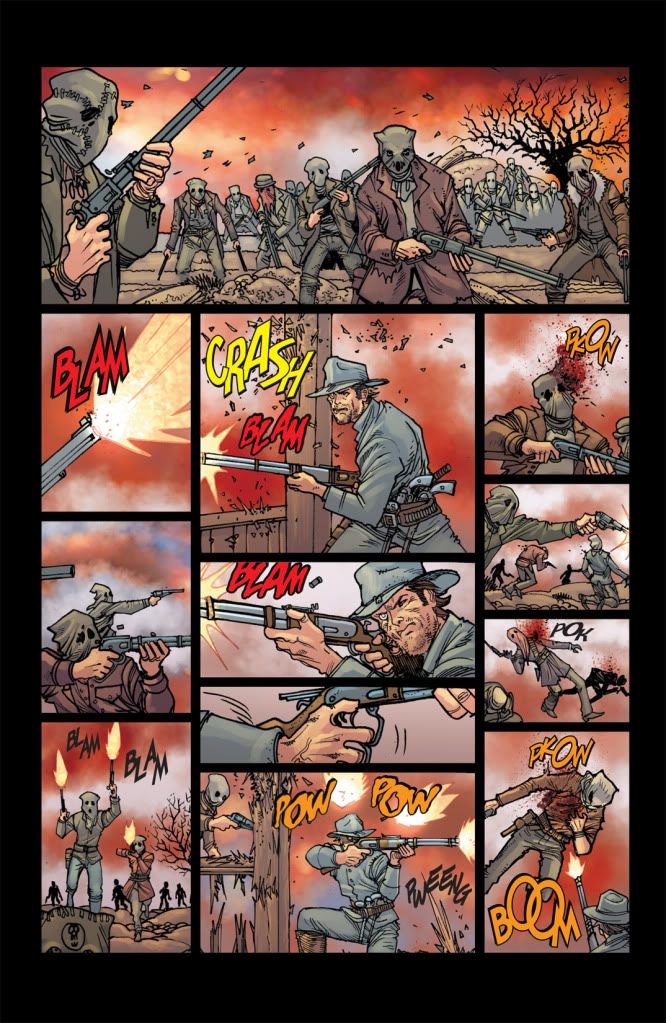
 All Star Western #2 (DC) - Some people complained that the first issue of this series was too heavy on text box narration from Amadeus Arkham. Though the text-heavy first issue didn't bother me — it was a good way of delving into the characters of Arkham and bounty hunter Jonah Hex — it is nice to see that the second issue is much lighter on text and moves at a much brisker pace. The secret society that Hex and Arkham stumbled across last issue is now revealed as the same "religion of crime" that's been featured in Grant Morrison's Batman and the Greg Rucka/JH Williams III Batwoman. Between Morrison and Scott Snyder's work with Batman of late, there have been a lot of comics that have delved into the history of Gotham City, and this series now promises to tie in with that work in interesting ways. Justin Gray and Jimmy Palmiotti vary the pace here nicely, with a great shootout composed on a few busy pages full of frantic action panels. There are some occasional awkward moments in the writing (the very first page refers to "a more bloody destination") and even Moritat's generally fantastic artwork isn't always in top form. The staging of a fight scene between Hex and a hulking brute makes it pretty unclear where exactly the characters are in relation to one another, for instance. This issue also introduces a back-up feature about El Diablo, also written by Gray and Palmiotti, and drawn by the great Jordi Bernet, which justifies the book's title as something other than a Jonah Hex solo series. This short piece, in which El Diablo prepares to face down some zombies, is slight (like many backup features) but nicely drawn.
Aquaman #2 (DC) - Well at least this issue goes much lighter on the relentless Aquaman-is-a-joke punchlines from Geoff Johns' first issue. There are still traces of that annoyingly defensive tone, but for the most part integrated much more seamlessly, so this issue's gags — like the way Mera keeps getting called Aquawoman, or the scene where a cop doesn't quite recognize Aquaman without his orange shirt — are funny without being as blunt and obvious. I'm still not totally sold on this series but this is a decent issue, and the deep-sea monsters with their huge razor-sharp teeth are really creepy. Ivan Reis' art is mostly nice, too, especially during the gory battle scenes with the gilled monsters. Reis' youthful, square-jawed Aquaman is a pleasure to watch in action, but his facial expressions vary from awkward to just plain inscrutable. There are too many panels where Aquaman stares blankly straight ahead, his feelings or thoughts unclear. The tonal uncertainty in those moments is emblematic of this series as a whole.
Captain America & Bucky #623 (Marvel) - I've been really enjoying the World War II era stories in this comic of late, more than pretty much anything in Ed Brubaker's Captain America stories since around the time Steve Rogers came back from the dead. The basic gimmick here is that Brubaker, along with co-writer Marc Andreyko, is retelling the stories of this era from the point-of-view of the sidekick rather than the larger-than-life hero, and all of it is informed with an extra level of poignancy by the knowledge of Bucky's ultimate fate as developed during Brubaker's Captain America run. In this issue, Bucky comes face to face for the first time with the horrors of the concentration camps, probably an inevitability considering that this is an attempt to do a gritty war movie version of Bucky's life story. It's appropriately horrifying, the kind of story that never would have appeared in the original World War II Cap and Bucky comics. Chris Samnee's moody, wintery artwork — evoking the feel of David Mazzucchelli's Batman: Year One — makes the images of skeletal, silent prisoners especially heartbreaking. These World War II stories have been so generally good that it's a little disappointing that this series is now moving on, though the promise of checking in on Bucky's years as Soviet assassin the Winter Soldier is equally enticing.
Daredevil #5 (Marvel) - It's really wonderful to see the methodical way that artist Marcos Martin breaks down a fight scene into a flurry of small panels. Martin's art, together with Mark Waid's writing, puts the emphasis on Daredevil's senses: this book continually captures the way that Matt Murdock compensates for his lack of sight by analyzing his surroundings through the input of his other senses, turning each move, each action, into an elaborate but super-fast calculation. On one page, Martin pulls back from a closeup of the interior of an ear as Murdock winnows away all the extraneous sound threatening to overload his senses, honing in on the few important sounds he needs to hear clearly. Waid's writing has a clever, breezy feel to it that emphasizes just how much fun Daredevil is having doing what he does. "Oh, no! Six armed mercs wearing night vision goggles! Whatever will I do?" Murdock thinks, before Martin inserts a perfectly timed panel of a finger flicking a light switch to blind the bad guys. It's whimsical and light-hearted, despite the high-stakes danger and intrigue, although Waid does keep hinting that Murdock's new happy-go-lucky attitude is a defense mechanism to deal with all the trauma inflicted on the character by previous Daredevil writers.
FF #11 (Marvel) - Jonathan Hickman consistently packs an awful lot into 20 pages. This comic features another typically charming scene with Val and Franklin Richards and their assortment of oddball friends, multiple world-ending plots churning into motion, and Reed Richards assembling a huge group of heroes to face the threats closing in from every direction. It's briskly paced, funny and thrilling by turns, and every page has some fun bit of business or a startling twist or some visual stunner. This is dense and exciting, the total opposite of the trend towards decompression that dominates so many other superhero comics these days. What happens in this issue might have been stretched out over a few months in other series — or a few years if Bendis was writing it — but Hickman continues to hurtle forward with so much going on in different corners of the universe. Probably the best sci-fi moment is the revelation of the fate of the two alternate universe Reeds held captive by the Inhumans: a totally unexpected twist that Hickman and artist Barry Kitson brilliantly depict in a few gorgeously outrageous pages. Other writers would have made that the last-page cliffhanger, but Hickman just confidently tosses it out there in the middle of the issue and then moves on, ending with an even bigger cliffhanger. This is an especially strong issue for Hickman's crackling dialogue, too, after a few issues that focused more on epic fight scenes and plot machinations. The banter centering around the Future Foundation kids is crisp as ever, and so is a great scene where She-Hulk and Sue Richards gently, affectionately mock a grumpy Ben Grimm. It's yet another reminder that Hickman's Fantastic Four (which returns for its 600th issue next month) and the spinoff FF are so strong not only for their wild high-concept sci-fi but for their low-key humor and keen grasp of family dynamics.
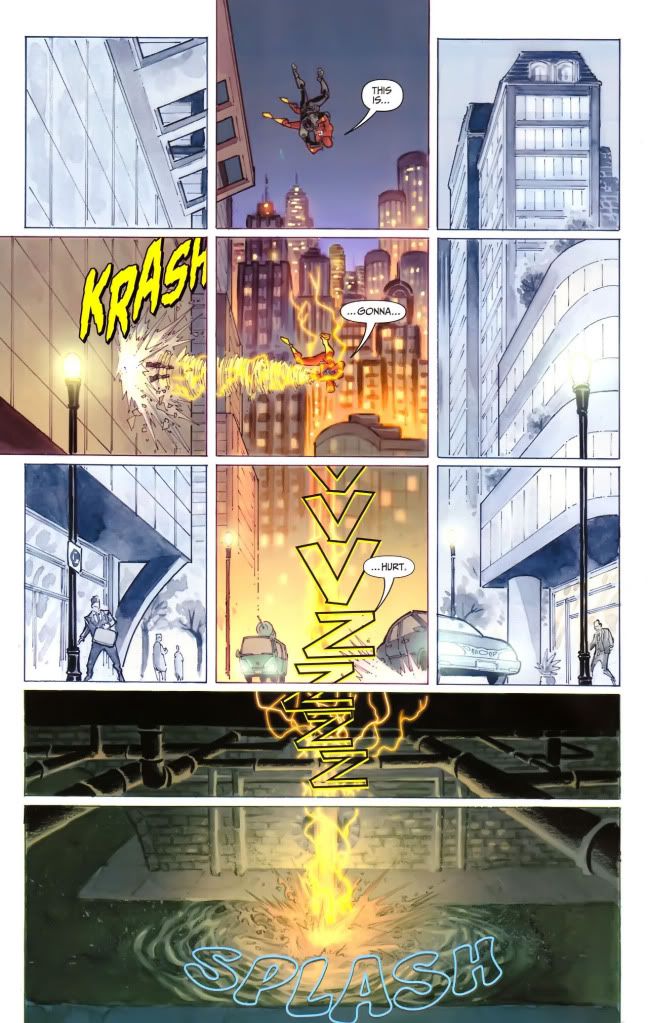
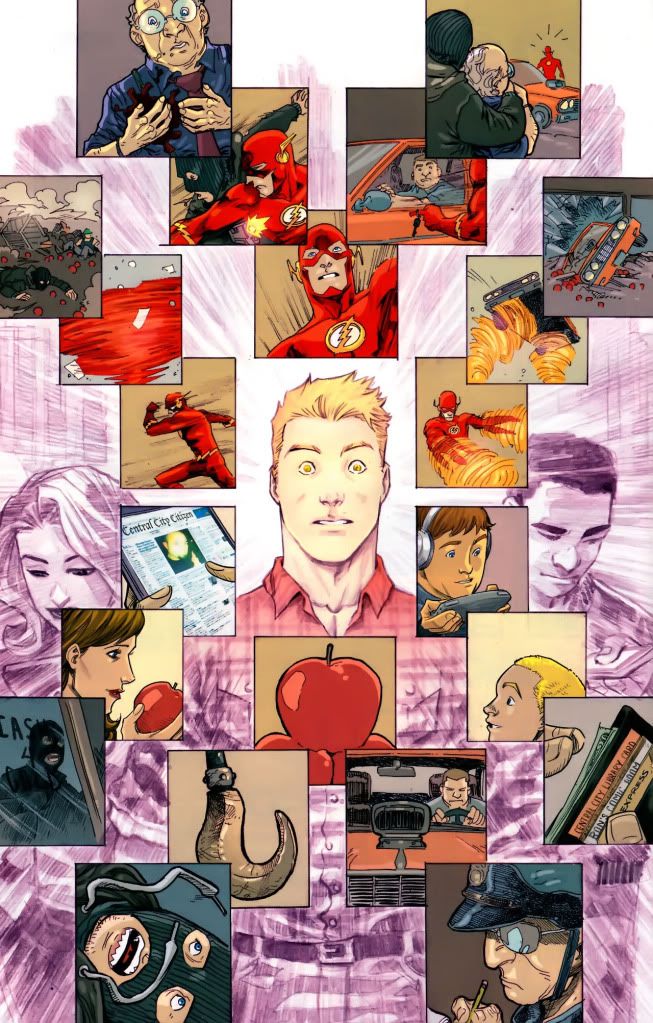 The Flash #2 (DC) - I thought the first issue of this series was really good, but this one ups the ante even more. Artist Francis Manapul and colorist Brian Buccellato also share writing duties on this series, and considering that they're not tested writers with a lot of experience, this book reads briskly and enjoyably, telling its story with more clarity and wit than many of the New 52 books guided by supposedly more seasoned writers. But the art is where this book really shines, the art and how it's used to show Barry Allen in super-fast action. This issue introduces a new wrinkle to the Flash's powers as he realizes that, while he's physically using his powers to their full potential, he hasn't really taken mental advantage of his speed. Needless to say, the pages where Manapul shows Barry flexing his new sped-up mental prowess are jaw-dropping. The pages are filled with small square panels depicting everything Barry sees as he walks around the city, as he takes in all the different aspects of a scene and then foils a robbery without anyone even realizing that he's intervened. This scene reminds me of the Marcos Martin-drawn story in Mark Waid's recent Daredevil #1, and the two books share some similarities in that both are about sensation and heightened ways of experiencing the world. It's brilliantly staged, and suggests the possibility of the Flash as a hero whose heroic acts pass unnoticed, explained away as elaborate coincidences and mishaps.
The Incredible Hulk #1 (Marvel) - I could have read quite a few issues of the shaggy, bearded Hulk hiding out underground, chilling with the Moloids and hunting great big monsters. So it's a little disappointing that this situation basically only lasts for the first half of Jason Aaron and Marc Silvestri's new first issue about the big green guy. Silvestri's densely hatched art is instantly striking, though it's puzzling why he needed three inkers as well as Michael Broussard doing "pencil assists." The issue opens with Hulk battling monsters, then brooding while his adoptive underground family feasts and celebrates his successful hunting. These pages are evocative and beautiful, depicting a haunted Hulk vainly trying to escape his past. I'm not as sold on the rest of the issue, as Aaron very quickly — too quickly, I think — breaks Hulk's isolation by bringing in a squad of chatty robots to fight him and teasing what looks to be the larger plot for subsequent issues, involving Hulk's former alter ego Bruce Banner (apparently they're separate beings now?). This was a decent enough first issue, and it's certainly cool-looking, but I'm still a little disappointed that Aaron has so quickly moved beyond what could have been a promising status quo for this book's initial arc.
Justice League Dark #2 (DC) - I didn't really expect to be saying this, but the highlight of this issue is the creepy/kinky relationship drama between Deadman and his girlfriend, Dove. Deadman attempts to get laid by possessing random strangers in the hopes of having an actual physical relationship with Dove, and it's both strangely poignant and really funny, especially when he possesses a girl and clumsily hits on Dove, causing her to storm off. Meanwhile, the main plot with Enchantress simmers a bit after the all-out chaos of the first issue. The villain mainly unleashes some random weirdness on Zatanna and Dove and delivers threatening messages via the radio. Constantine appears briefly too, very much in character, drinking and getting beat up and generally just providing a reassurance that Constantine can exist outside of Vertigo without losing his edge. I like that Milligan seems to be randomly jumping around to different characters, delivering twisted little character beats or offering up visual weirdness for Mikel Janin to draw in his hyper-real style. It's also nice that Janin subtly alters his art to suggest the different worlds of the characters: Constantine's gloomy, heavily hatched pages seem very different from the much brighter, cleaner style of the bar scenes where Deadman and Dove awkwardly banter and argue.
The Mighty Thor #7 (Marvel) - Last month, Matt Fraction wrapped up this series' first arc in a very satisfying fashion. This month, the book is given over to what amounts to a prequel to Fraction's Fear Itself crossover, the story of how Thor's father Odin ascended to become first among the Norse gods. It's just a solid, action-paced issue, an excuse for artist Pasqual Ferry to draw lots and lots of heads being lopped off and bodies torn apart as Odin does battle with the forces of his cruel, warped brother. The best part is Fraction's writing of the bold, overreaching young Odin, whose bravado and leaping into danger is very reminiscent of the child Loki who Fraction created on his last Thor series. It's a decent standalone issue, if not as boldly imaginative as the great stuff Fraction was doing with these characters prior to Fear Itself. What will be really interesting now is to see if Fraction can maintain this series' level of quality with Thor, for the moment, "dead" after the events of the crossover.
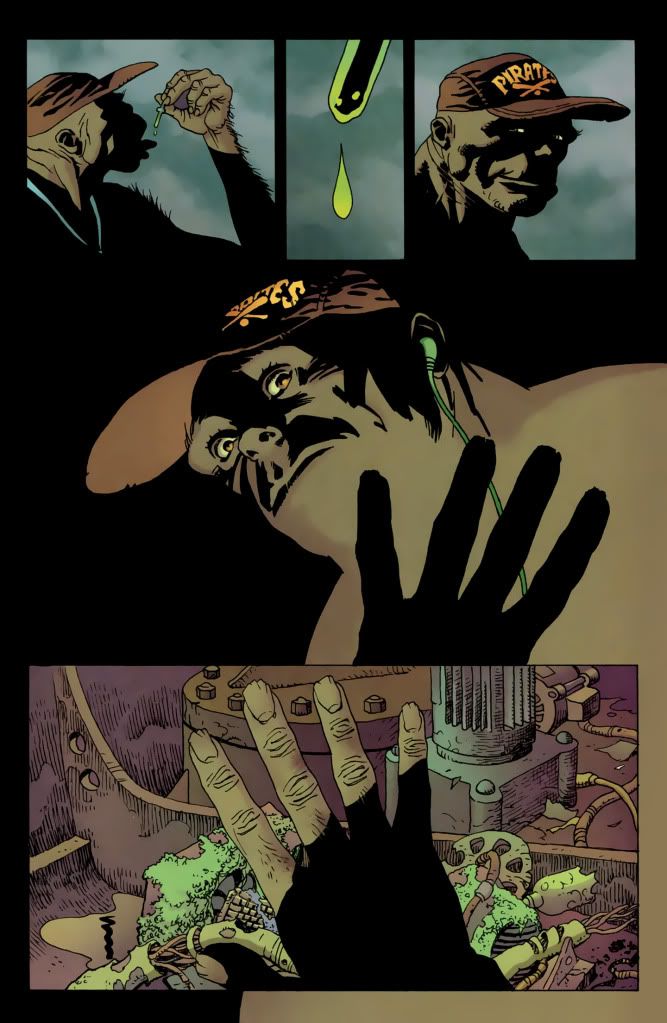 Spaceman #1 (Vertigo) - This is the debut of a new nine-issue miniseries that reunites writer Brian Azzarello and artist Eduardo Risso, the creators of the great, pulpy 100 Bullets. It's a post-apocalyptic thriller set in a future wasteland, where the title character Orson — a genetically engineered humanoid manufactured for spacefaring missions — has virtual reality sex via remote hookups and scrounges for scrap metal to feed his drug addiction. The story thus far is a mash-up of various dystopian genre conventions and little meta in-jokes, with a kidnapping plot that revolves around a vicious and transparent satire of Brangelina. There's not enough here yet to tell where this is really going, so this first issue is all about atmosphere, both in terms of Azzarello's goofy, invented future-slang and Risso's typically jaw-dropping, shadowy artwork. Though I can already feel the weird, slangy dialogue growing on me, like a nutty sci-fi twist on the purplish street patter that Azzarello slung throughout 100 Bullets, it's Risso's mostly wordless visual storytelling that provides the issue's most compelling moments. That's why the best sequences are the ones in which Orson in a spacesuit navigates across Mars, in what may be a glimpse of the past or the future or simply a druggy reflection of the main character's inner states.
Venom #8 (Marvel) - Spider Island is yet another big Marvel crossover that I haven't been reading but which is infiltrating books I like anyway. It hasn't derailed Rick Remender's Venom, though, even if the whole concept for this storyline seems spectacularly, amazingly stupid. Remender has wisely chosen not to allow the crossover to completely overwhelm the stories he was telling with this series already, so that even if the events of these issues tie into what's going on over in Amazing Spider-Man and other books, Remender keeps the focus on Flash Thompson dealing with the illness and death of his drunkard father and coping with the Venom symbiote's strengthening hold on him. Though this issue isn't as strong of a standalone issue as Remender's previous two Spider Island tie-ins — for one thing, it ends with a cliffhanger battle that's going to be resolved in Amazing Spider-Man #672, the final issue of the crossover — it's still a character piece as well as a crossover fight scene. Remender weaves the plot together with narration from a letter that Thompson's dad wrote just before he died, so that even as Thompson/Venom brawls with the Spider Queen and teams up with Steve Rogers, the book remains focused on more than the violence. That's what makes Remender's Venom so enjoyable; he does the big dumb action well but never delivers an issue that's just big dumb action. Even if these Spider Island issues haven't been as strong as the series was before the crossover started (and I'm glad it's over) Remender has managed to keep this series on track even while compromising with other writers' stories.
The Walking Dead #90 (Image) - Robert Kirkman's zombie epic has been running for so long now — holy shit, the 100th issue will be out next year! — that there's a real sense of its characters changing and growing over time. So when, as in this issue, Rick discusses the ways in which these experiences have changed him with Andrea and Carl, or when Maggie lets the pressure of life in the zombie apocalypse get to her again, these moments resonate with everything that's happened to these people in these pages. Rick's ongoing evolution, his struggle with his need to control everything, his increasing comfort with life-or-death decisions, continues to be very compelling, highlighted here by a stunning double-page spread in which he asks Andrea, and by extension the reader, to look into his eyes and really think about what he's seen and done. That expansive portrait, by Charlie Adlard — who's been with these characters nearly as long as Kirkman has — delineates Rick's exhaustion, his numbness, with lidded eyes and heavy shadow. He seems haunted, and the image itself is haunting; in an issue with no zombies, no gore, no violence, this portrait encompasses the horror of this series' premise, the horror of accepting death and violence as an everyday occurrence, just another part of what happens. This is an especially good issue for this kind of low-key character work, which is Kirkman's primary strength as a writer. He's good enough at this stuff that even the last-page romantic twist — which Adlard has been subtly hinting at with body language and visual feints for several issues now — doesn't come off as a gimmick but as a natural outgrowth of these characters and this moment.
Wolverine and the X-Men #1 (Marvel) - Jason Aaron's Schism event, which separated the X-Men into two teams focused around Cyclops and Wolverine, was lame and forced, a perfect example of a story existing solely to justify (weakly) its end point. So it's surprising that the first issue of Aaron's new book, about Wolverine setting up a new mutant school, is a blast from start to finish, totally clearing the air of all the turgid Schism/Regenesis stuff and making it clear just why Aaron was so excited to get to this point. There's just so much to love here, as Wolverine and Kitty Pryde take a breathless tour of the new school's grounds with a pair of frazzled, caricatured state education inspectors in tow, harrumphing everything they see. It's a delight from start to finish. The structure provides an opportunity for Aaron and his artistic collaborator Chris Bachalo — whose energetic manga-influenced style is a perfect fit for this issue's flippant, funny tone — to introduce the huge cast bickering, gossiping and careening through the halls committing all sorts of wackiness. It's fun to see all these underused mutant characters colliding off of one another. I got a special kick out of seeing Doop, from Peter Milligan's classic X-Statix, serving as the school's receptionist. It was also nice, and logical considering Bachalo's presence and the school setting, to see a bunch of alumni from 90s X book Generation X, which I fondly remember as a favorite of my 13-year-old self. This issue is fast and funny and packed with little character beats and visual gags, like the full page shot of mutant terrorist Quentin Quire being kept prisoner with the dragon Lockheed perched threateningly over him. If Aaron and Bachalo can keep this frantic pace and level of energy up over the long haul, they've got a real classic in the works.