Showing posts with label American Vampire. Show all posts

Monday, November 7, 2011

Weekly Comics: November 2, 2011

Action Comics #3 (DC) - Grant Morrison's take on Superman in this book still feels really fresh and original, and I'm loving it so far. There's a great scene here where the Metropolis PD breaks into Clark Kent's apartment and rummages through his stuff, obviously just harassing him simply because of his reporting about important businessmen in the city. This Superman is a crusader for the little guy, both in his secret identity journalism and his cape-and-jeans adventures. This issue also raises the idea that the latter is interfering with the former, because now Lex Luthor is helping to stir up distrust about Superman because of his alien heritage, which allows Clark/Superman's capitalist foes to redirect attention away from their exploitative business deals and corrupt political connections. Morrison also seems to be moving towards Superman examining his Kryptonian roots, and the issue opens with a sequence set on Krypton before its destruction. On the negative side, DC's insistence on getting issues out on time seems to be crippling artist Rags Morales, whose work here isn't quite as inconsistent as in issue #2, but still looks fairly rushed. Gene Ha guests to draw the Krypton sequence (which looks gorgeous and glossy) but apparently even this didn't give Morales enough time to polish the remaining pages. This is a great book, and as the first issue showed, if Morales has enough time it could also be a great-looking book, but it's becoming increasingly obvious that the art is suffering from deadline pressure here.

American Vampire #20 (Vertigo) - Although exposition-heavy writing is often the enemy of good comics, Scott Snyder excels at making exposition and storytelling the center of his work without often succumbing to the pitfalls associated with these devices. In this case, the bulk of this issue is structured as a flashback in which a powerful Shoshone vampiress narrates her life leading up to her conversion into a vampire and the bloody history that followed. It could be clumsy or dull, especially since Snyder is delving into the past of a character who hadn't appeared before the final pages of the last issue, but instead he economically tells a strangely moving tale of a woman who largely drifted through life, barely even realizing how unhappy she was, before the adventures that led to her becoming a vampire. Jordi Bernet, the guest artist on this arc, has a distinctive style that initially seems too cutesy/cartoony to be a good fit for such a dark tale, but he proves adept at rendering gape-mouthed grotesqueries once the vampires make their appearance.

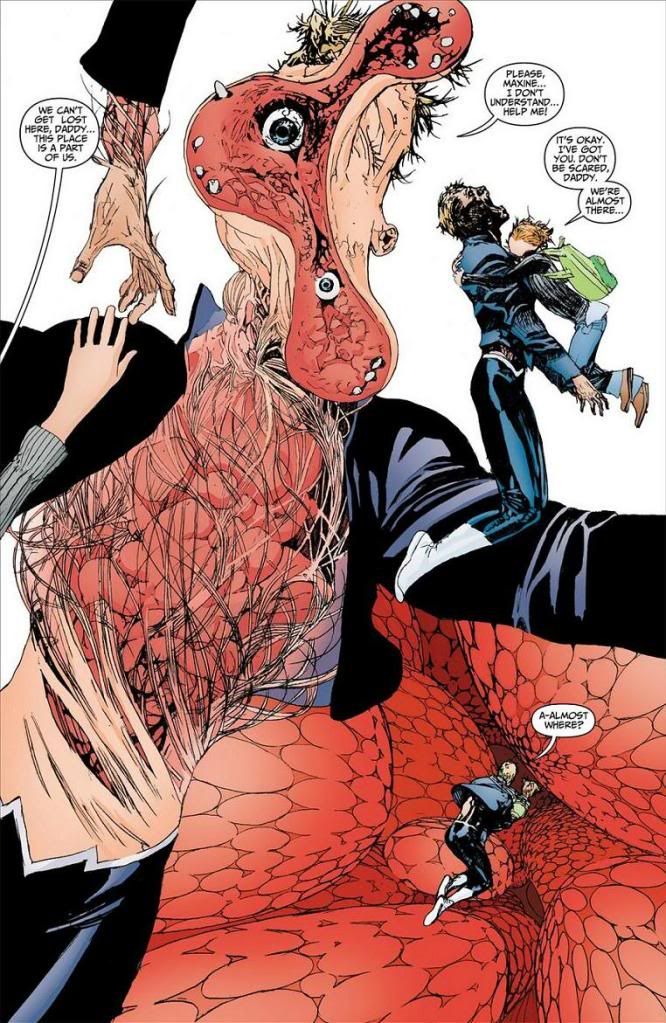
Animal Man #3 (DC) - Since it's pretty much established at this point that I think this series is the awesomest of awesome things, I'm just going to list some of the great stuff that happens in this latest issue. Right on the first page, there's the great visual of Buddy and Max falling into the Red, with Buddy getting twisted into hideous, Cronenbergian forms while Max blithely stretches her arms out with a big smile on her face, looking like she's skydiving and loving it. While the villainous Hunters Three are incredibly creepy, in many ways the benevolent forces of the Red's totems are equally terrifying, and the Red itself looks like a nightmare rather than the touchy-feely spirit-of-all-things hippie place it's described as. Although this issue is heavier on the weirdness and grotesqueries and lighter on the Baker domestic drama, I love the scenes between Ellen and Cliff: she scolds her son's gory video games but then casually joins in, and as they're fleeing from a monstrous attacker she still instinctively tells him not to curse. Travel Foreman's facial expressions are amazing, especially Ellen's pinched look of worry as she moans, "I can't believe I married a superhero." This series is just great: Jeff Lemire has established just the right delicate juggling of tones so that each issue incorporates some humor and surreal absurdity with the horror and slowly building dread. This issue also makes explicit the link between what's happening here and the equally weird goings-on in the Green over in Scott Snyder's Swamp Thing, bringing that eventual crossover closer to fruition.

The Boys #60 (Dynamite) - Not much here except the usual Ennis wallowing-in-filth. I'm not sure I get the point of the subplot with the wife and daughter of Mother's Milk doing mother/daughter porn, except as a way to display even more perversity and to drag these characters through the muck some more. Similarly, the team of superheroes who show up at the end with blatantly sexual names — Astroglide, Stopcock, Trojan — are just an even more dumbed-down than usual version of the same joke that Ennis has been telling since the beginning of this series. I continue to read this series because I want to see the inevitable confrontation between the Boys and the Seven that's been building up since the beginning, and because I'm invested to some degree in the relationship between Hughie and Annie. But issues like this basically just amount to filler, with the only moment that really stands out being the one where Butcher instinctively calls to his dog only to realize that the dog was killed last issue. Those kinds of quietly affecting, very real moments pop up every so often in this otherwise broad, over-the-top series and provide a reminder that Ennis can be much more than a self-conscious shock-purveyor when he wants to be.
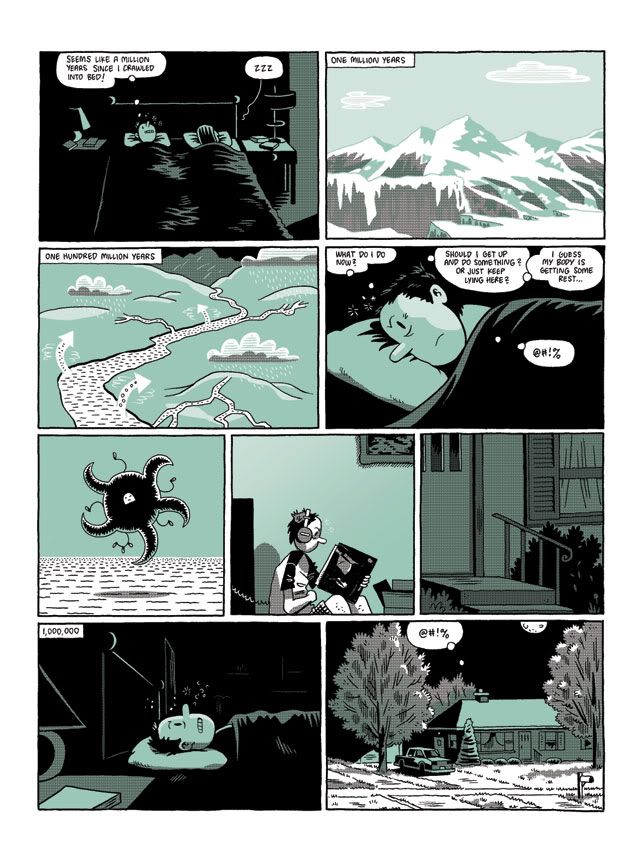
Ganges #4 (Fantagraphics) - The latest issue of Kevin Huizenga's great Ignatz-format series continues the cartoonist's introspective focus on mental states over physical action. The entire Ganges series so far has taken place over the course of a single night in which nothing much of note actually happens. In fact, Huizenga includes a few wry continuity captions of the kind that often appeared in old-school superhero comics, which here serve to remind the reader of just how uneventful this series' "plot" has been. In place of narrative drama, Huizenga delves into the thought processes and imagination of his everyman protagonist Glenn Ganges, tracing the ways in which thoughts lead one into the other, creating the chains and loops of ideas, memories and associations that constitute mental life. It's a remarkably abstract topic for a visual artist to confront, but Huizenga brilliantly makes thinking sensual and tangible, building pages that diagram out ideas and attempt to visually represent the mind's logical dissection of a situation. This issue, like the last one, can be summed up on a physical level as "Glenn Ganges tries to fall asleep and fails," but more than a story about insomnia it's a profound essay on time, mortality, and the intellect.

The most dazzling sequence of this issue comes towards the end, when Glenn begins thinking about what he plans to do with his wife tomorrow, a train of thought that leads him to think back to when he made these plans earlier in the week. From there he begins leaping back further and further in time, visualizing blocks of time as literal blocks floating in grids above his head, representing years, months within years, days within months, hours within days and so on. He's trying to come to grips with how much of his own life he can actually remember and how much has simply drifted by. This somewhat sobering idea connects back to the earlier sequence in which, while trying to pick out a book, Glenn imagines himself accompanied by the Grim Reaper, who admonishes him to choose wisely and not waste his precious time reading or doing something unimportant. In this way, Glenn's thoughts roam freely from minutiae to the biggest philosophical questions facing humanity, as his sleepless mind finds potential profundity in even the most prosaic details. In another sequence, Glenn purposefully chooses a boring theoretical book in hopes that it will help him fall asleep, but as Huizenga lovingly parodies academic-speak, Glenn's mind can't help attempting to visually diagram these confounding sentences, wrestling with the paradoxical ideas and trying to construct coherent thoughts based on what he reads.

In sequences like this, throughout this issue, Huizenga creates utterly engrossing, funny, disarmingly powerful comics from the relentlessly internal, static situation of Glenn lying in bed or wandering around his house in the dark. Huizenga's formal rigor makes each small decision — should I get out of bed or lie here some more, should I read a book, what should I think about, how often should I blink — the origin of a forking path in the protagonist's neural maze. He lays bare the internal processes of decision-making, self-analysis and thought that operate beneath the placid surface of this ordinary suburban husband as he spends a restless night next to his sleeping wife. There are repetitions and dead spaces built into the comic, and moments when the panels run off into the gutters as Glenn's thoughts detour in a whole new direction before returning to the main flow. This is totally exciting, formally ingenious cartooning, another reminder of why Huizenga is one of the very best artists working in comics today.

Moon Knight #7 (Marvel) - As much as I'm sick of Brian Michael Bendis in general, I have to admit that his take on Moon Knight is a fresh, funny, interesting approach to this character. Bendis' Moon Knight is an outright nutcase who shares his head with multiple personalities, embodied as Captain America, Wolverine and Spider-Man. It's a sly parody of the superhero team-up, as Moon Knight constantly has his own mental chorus of famous heroes giving him advice and commenting on his actions. This goofy, oddball premise is well-suited to Bendis' talky, pattering dialogue, as Moon Knight has fast-paced conversations with himself, at one point holding his head in his hands as he moans, "God, I'm hard on myself." Bendis' regular artistic collaborator Alex Maleev is as great as ever here, his gritty art a perfect complement to the urban hysteria of the title's hero. Although I've long since given up on most of Bendis' high-profile titles, this kind of obscure, off-kilter comic may be where he does his best work.

OMAC #3 (DC) - It's usually offputting when something goes out of its way to slavishly pay tribute to a predecessor, but Dan Didio and Keith Giffen are doing such a good job of aping Jack Kirby with this series that it's hard not to enjoy it as the manic homage it is. The Kirby nods go beyond the obvious way in which Giffen has tailored his art to capture Kirby's distinctively brutish, ugly faces and kinetic distortions of body language. The homage extends as well into the narration and the way each issue introduces out-there sci-fi ideas and pieces of technology, describing these innovations with the tone of an owner's manual for futuristic devices, much as Kirby did in the original OMAC series. This issue offers up yet another standalone confrontation in which Brother Eye manipulates the hapless Kevin Kho into battling a monstrous enemy. The pacing is fast and the dialogue is quirkly entertaining, so the issue just barrels by. This is just big dumb fun, a love letter to one of the iconic superhero artists. It's also a reminder that while Kirby has been and continues to be a huge influence on virtually every aspect of superhero comics, his actual style, weird and off-kilter as it is, hasn't often been imitated as completely and affectionately as this.

Stormwatch #3 (DC) - This series is still a mixed bag. Paul Cornell's writing is sometimes clever and sometimes grating, and this issue has a little of both. I loved the lurid, lunatic tone of the few pages where Harry Tanner gloats as he mentally and physically tears apart the giant eyeball at the center of the moon: Harry's a Stormwatch hero and he's fighting a monstrous alien eyeball, but the whole thing has such a sociopathic tone as the hero finds glee in utterly demolishing his adversary. On the other hand, in this issue Cornell unfortunately literalizes the powers of both Jack Hawksmoor and the Projectionist, so that the former literally talks to avatars representing various cities while the latter addresses the media as though she too is engaging in an actual conversation. Both these characters have powers that should have been left more abstract. Otherwise, this is just a big action showcase and the fight scenes are fun and chaotic, with Miguel Sepulveda's glossy art doing an especially good job of rendering the massive, tentacled alien monster that the team encounters in the second half of the issue.

Swamp Thing #3 (DC) - This is the best issue of Scott Snyder's Swamp Thing yet. It's finally all starting to come together and Snyder has now struck a good balance between the eerie horror visuals and the exposition that attempts to untangle the complex back stories of Alec Holland and Abby Arcane. As in this week's Animal Man, this is also the first issue that really makes explicit what the threat is: a young boy with a connection to the Black, the Rot, akin to Swamp Thing's status as an avatar of the Green. There are some really horrifying images here: the issue starts with more creepy/comical overtones as a sick kid hears the voices of mounted fish speaking to him, but things quickly move into more sinister territory. There are some grisly images here, most of them courtesy of guest artist Victor Ibanez, who alternates sections with regular artist Yanick Paquette and winds up drawing most of the gory hospital scenes. Paquette, for his part, continues to recall the classic work of Alan Moore, John Totleben and Steve Bissette on the series. In this case, with Abby's presence, Paquette and Snyder deliberately evoke her appearances in those old Moore issues to emphasize how she's changed in the intervening years; it's a very powerful use of earlier material to deepen the impact of a character's transformation, in ways that go way beyond her new shorter hairstyle. The pace is picking up here, and after a couple of issues that necessarily leaned heavily on explanation, this issue finally launches the horror plot into overdrive.
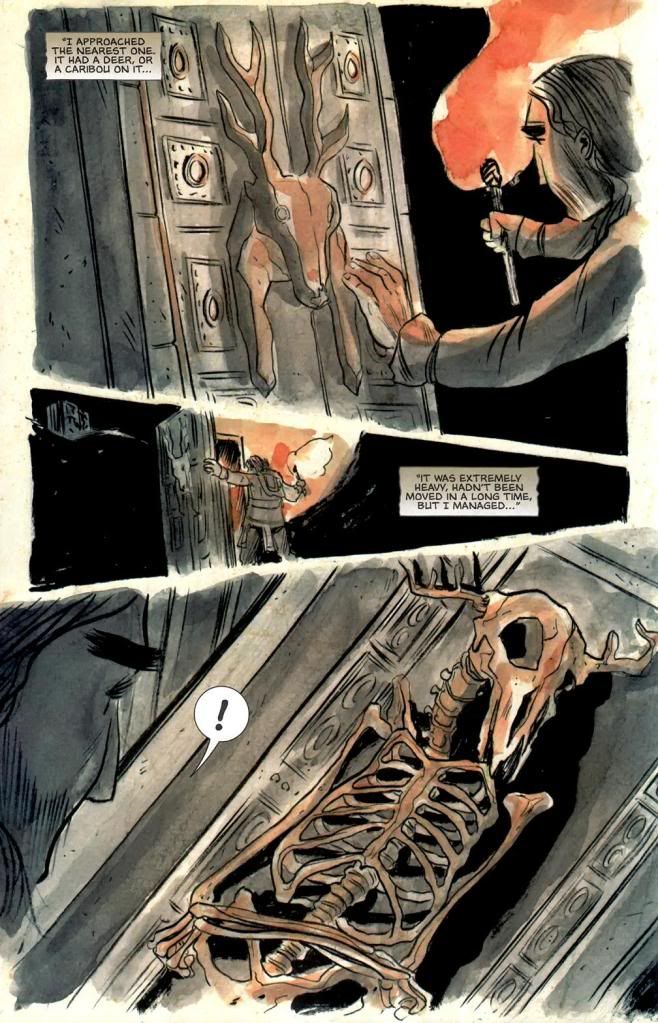
Sweet Tooth #27 (Vertigo) - As much as I love Jeff Lemire's quirky, scratchy art, this most recent arc (of which this is the second of three parts) with Matt Kindt handling the art has been really fantastic. Kindt's wispy, shaky figures and watercolors give a hazy aura to this story that appropriately suggests looking back into the past through the warped, brittle pages of a forgotten journal. Lemire is delving into the past for this arc, suggesting that the origins of the plague and the human/animal hybrids stretch back further than expected. This arc also provides a spiritual/supernatural counterpoint to the theories about the plague's origins offered elsewhere in the book, which have tended to emphasize science and genetic engineering. It's impressive that Sweet Tooth has diverted into a three-issue historical arc that doesn't feature any of the series' regular characters, and the results are absolutely engrossing and creepy and compelling.

Uncanny X-Men #1 (Marvel) - Following up on last week's Wolverine and the X-Men, this is the other half of the new post-Schism X-Men. This series, written by Kieron Gillen and drawn by Carlos Pacheco, is about the X-Men team led by Cyclops after his fall-out with Wolverine. Whereas Jason Aaron's new series focuses on massive changes to the status quo with Wolverine refounding the mutant school and gathering up a bunch of lesser-known characters, this series doesn't have any such clear change from previous X-Men stories. Wolverine's team is boldly creating something new. Cyclops' team is... continuing to hang out on Utopia. Maybe because of that, this issue just doesn't have the same breathless forward momentum and dazzling anything-can-happen spirit of fun that inflected Aaron's Wolverine and the X-Men. There's no escaping the impression that this series just doesn't have the clear sense of direction that Aaron is bringing to his title.

This is still a decent issue with some playful dialogue, explosive fight scenes, and some high-concept sci-fi threats that make me look forward to seeing where Gillen goes next. As usual, Gillen's writing goes back and forth, for me, from amusing to clunky to just downright puzzling. Case in point this issue is some dialogue with Namor and Hope, meant to be making a modest joke about stealing chairs. But it all goes awry when Namor boldly declares, "to sit in a seat so fine, Namor would take it from any man," which makes it sound like the king of Atlantis is offering to prostitute himself out for comfy chairs. It's hard to tell if Gillen is making a joke of Namor's awkward diction or if Gillen's own sometimes stilted writing is just creating unintended and unfortunate meanings.

Thursday, October 13, 2011

Weekly Comics: October 12, 2011

American Vampire: Survival of the Fittest #5 (Vertigo) - The final installment of this Nazi vampire spinoff miniseries plays out like a full-on action movie climax. Scott Snyder knowingly and lovingly hits all the expected beats, with the hero sacrificing himself to save the girl, giving her a final kiss as a sendoff before he storms into the center of the Nazi tanks, literally giving the finger to the enemy as he sings the Star-Spangled Banner. It's just that kind of over-the-top pulp craziness. It's also the kind of story where the heroes escape the Nazi vampires by leaping across a seemingly unpassable gap on a motorcycle as, behind them, the towering and recently unearthed godlike ancient vampires demolish the newer, uniformed monsters. Sean Murphy's manic hatching and exaggerated facial expressions are perfect for this explosive material, but he's equally excellent in the comparatively understated and moving coda in the final pages of the book. At that point, when the insanity has abated and the clamor of war faded away, Snyder and Murphy offer up a simple, moving epilogue and a surprisingly sweet last page.

Batgirl #2 (DC) - This series seems to have stirred up a lot of controversy just for giving Barbara Gordon back the use of her legs and making her Batgirl again after decades as the wheelchair-bound Oracle. I can't say I feel too strongly about that decision one way or the other, though the circumstances of Barbara's recovery continue to be pretty vague here. So, putting aside whether or not the basic idea is a good one, Gail Simone's new Batgirl is just a pretty good book about a very likable character whose internal narration wavers between anxiety over her return to superheroics and girlish euphoria at once again being able to swing through the air and fight bad guys. I could do with a little more of the enthusiasm and a little less of the hand-wringing, honestly. It makes sense, though, that this first arc's villain, the Mirror, is basically a personification of survivor's guilt, a perfect foil for a hesitantly recovering Barbara who isn't quite sure why she's experienced this "miracle." Barbara's new roommate is just a bundle of annoying quirks, and her boyfriend is bland, but this issue has some kinetic, intense fight sequences (fluidly rendered by Ardian Syaf) and the writing has a breezy quality even when it's mired in Barbara's self-doubt and uncertainty.

Batman and Robin #2 (DC) - Maybe it's just because I like Bruce Wayne's son Damien as a character, but I'm really digging the way this series seems to be focusing on Bruce's ongoing attempts to channel his son's killer nature and angry temperament into constructive pursuits. Peter Tomasi writes this father/son relationship well, especially in the scene where Bruce awkwardly questions Damien about homework before transitioning into the set-up for a Batman and Robin mission. It's an interesting relationship unlike the dynamic between Batman and any of his previous Robins, and it seems to be what's really driving this book so far. Although, it could just be that the actual villains here are pretty uninteresting, as Batman and Robin take on some generic weapons dealers. Then, at the end of the issue another nemesis shows up, and I'm unsure if I'm supposed to know who this is or not, but I don't, except that he was the guy killing the Russian Batman in the previous issue. I'm not too invested in the actual menace that Tomasi is haphazardly setting up here, whatever it is, but I'll keep coming back to see more of the central father/son relationship.

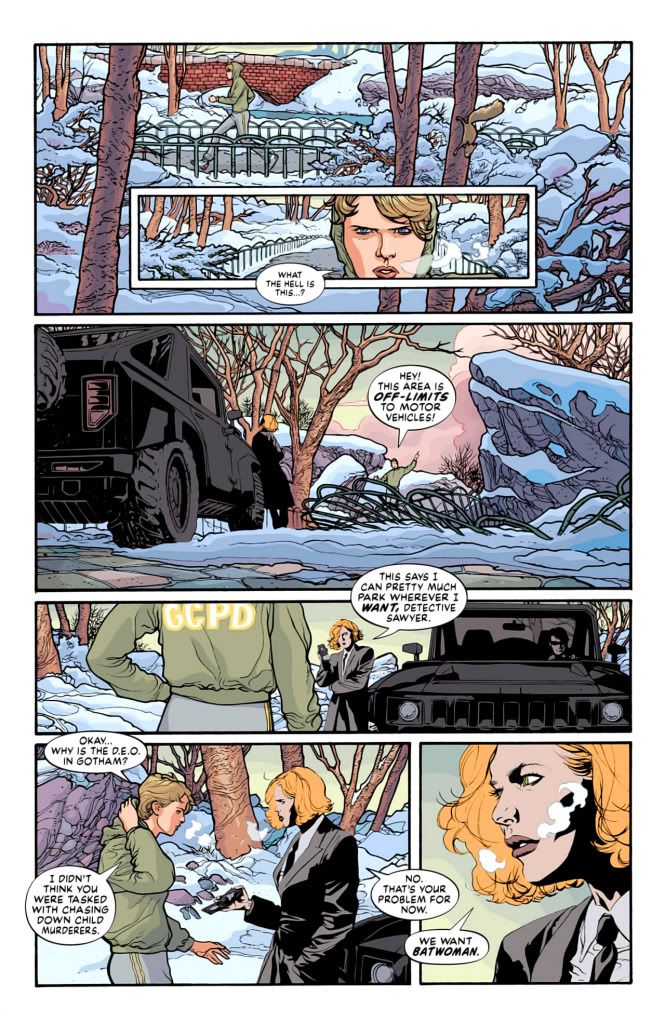
Batwoman #2 (DC) - At this point, it's almost easy to take JH Williams' interpretation of Batwoman for granted, even just two issues into the character's first solo title. His brilliant, sprawling double-page layouts and mastery of different styles is fully in place by this point. His action scenes are spiky and kinetic, full of pointed edges and panels-within-panels that call attention to points of impact or reveal the X-rayed anatomical contortions behind each well-placed kick. The panels become wavery and watery whenever the ghostly "weeping woman" makes an appearance, and the scenes in the ordinary civilian life of Kate Kane have a comparatively rigid panel structure and soft, brightly lit feminine colors to suggest the disparity between this woman's secret identity and her nightly crimefighting activities. This is an amazing comic in every way, guaranteed to be mindblowing month after month. The best scene in this issue is one in which Kate's detective girlfriend Maggie Sawyer walks around a supernatural crime scene, using the evidence to concoct a coherent story of what went down, and as she speaks the battle springs into life in the air around her, shaped by her conclusions and conjectures. Williams excels at this kind of diagrammatic layout. He excels, too, at jamming together contrasting styles, as he does when Maggie meets Cameron Chase, who's rendered in a shadowy noir style even in daytime, recalling her appearance in the short-lived Chase series that Williams illustrated back in 1998. The issue ends on an abrupt cliffhanger that suggests that the comic simply ran out of pages — Williams' plotting may be a little shakier than his jaw-dropping artwork — but otherwise this is yet another remarkable, unmissable installment in one of comics' most consistent visual treats.

Deathstroke #2 (DC) - I'm not sure what to say about this one, because even more than in the first issue, Kyle Higgins and Joe Bennett have just delivered a 20-page fight scene that takes all of two minutes to read, if even. It's got explosions, decapitations, and Deathstroke's rather quick destruction of a goofy, armored-up, roller-blading guy called Road Rage. There's not much at stake here, and barely a hint that the title character has even worked up a sweat after easily dispatching everyone who comes at him. It's lightweight and utterly disposable, with less of the quirky touches of personality and humor that spiced up the first issue. This comic is bound to just be the bloodbath-of-the-month and it does that just fine.

Demon Knights #2 (DC) - The first issue of this series was one of the bigger surprises of the New 52, since I didn't really have any expectations for it and it wound up being a whole lot of fun. This second issue lives up to the promise of throwing a whole bunch of DC's olden-times magic/immortal characters together to fight dragons and an evil queen. It's fast-paced and action-packed, inflected with the fun-loving spirit of warriors who love nothing more than digging into a tough fight and feasting on dragon meat when it's all over. Paul Cornell's dialogue has a peppy zing that mostly compensates for his characters' tendency to narrate their every move. This light-hearted style only occasionally gets tiresome, as when Cornell takes a cue from manga's jokey meta asides, which results in some very out-of-place dialogue. Other than such small dialogue issues, though, this remains a rollicking good time, gorgeously illustrated by Diogenes Neves and Oclair Albert, whose lush, European-influenced style is perfectly suited to this old-school wizards-and-demons adventure.

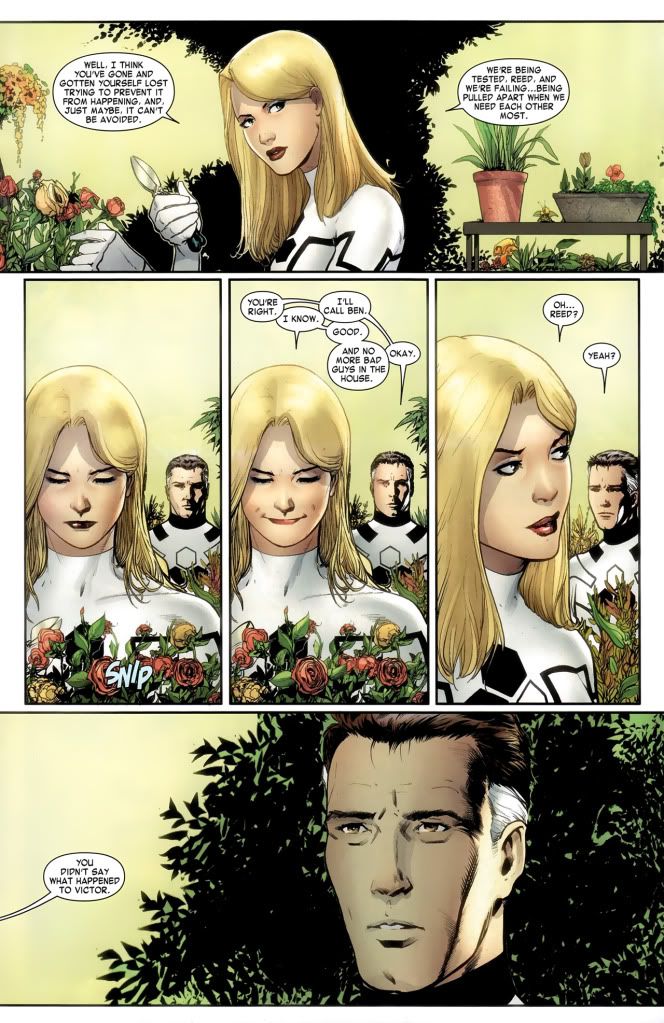
FF #10 (Marvel) - This is a pretty low-key set-up issue, a breather after last issue's climactic extended battle, which didn't so much conclude as take a momentary break. Jonathan Hickman continues to excel at hitting just the right emotional beats. The prime example here is a quiet scene between Sue and Reed Richards, staged so that Sue is looking away from her husband, facing the "camera," her expression mostly guarded but betraying a little smile, knowing and satisfied, when Reed tells her she's right. The scene plays out entirely in small shifts of facial expressions as husband and wife reconcile without laying it all out in so many words. Barry Kitson, filling in for regular artist Steve Epting, does an excellent job in moments like this, with a glossy, economical style that defines faces in a few graceful lines. Thanks to Hickman's facility for one-on-one dialogue scenes and Kitson's unshowy feel for the emotional nuance of Hickman's writing, what could have played out as a mere lead-up to bigger plots instead feels like a series of emotional climaxes for Reed and Sue, Ben Grimm, even the peripheral Inhuman Crystal and her Kree husband.

Frankenstein: Agent of S.H.A.D.E. #2 (DC) - This is stronger than the already good first issue of Jeff Lemire's Hellboy-ish paranormal series, because with most of the exposition out of the way Frankenstein and his troupe of monster soldiers just leap into action here. The best line comes early on, when Frankenstein slaps an old woman (she had it coming) and deadpans, "Frankenstein's vengeance does not discriminate on the basis of age." After that, there's more frenzied action sequences with massive monsters, rendered in scratchy scribbles of dark lines by Albert Ponticelli. Lemire takes a break in the middle of the issue to provide a backstory for one of his newly introduced monster characters, a female Creature from the Black Lagoon lookalike, which suggests that maybe each of these early issues will fill in the pasts of these new characters one by one. It's perhaps an inelegant way of shoehorning in exposition, but it works in this case because the flashback is packed with little bits of weird science fun, and because it ties in thematically with this issue's revelations about child sacrifice in the small town where this interdimensional infestation has broken loose.

Green Lantern #2 (DC) - It's not too surprising that Geoff Johns has wasted little time in getting Hal Jordan back in a Green Lantern costume after spending the first issue of this title powerless. It's not a total return to the status quo given that Jordan's power is now tied to his one-time nemesis Sinestro, but Jordan once again has a costume and a ring, even if it's not a "true" Green Lantern ring. Considering how clumsy and hackneyed the plotting of Hal's human misaventures were in that first issue, this is probably a good thing, and this issue establishes the terms of the unlikely Jordan/Sinestro team-up with some solid action. Sinestro's lesson to Hal has a hint of meta about it, an acknowledgment that for all the power of the Lantern rings, most of those who have wielded them have not changed worlds but simply constructed big green weapons to fight other superpowered beings. It's a distant echo of the end of Alan Moore's Miracleman, which questioned why superheroes with awe-inspiring power always thought so small. The point is perhaps erased when the very next scene involves Sinestro and Hal constructing big green weapons to kill a marauding alien, but it's nice to think that maybe Johns will work his way up to something more ambitious over time. This series isn't blowing me away so far, but it's offering up interesting, dynamic characters and some good old spacefaring action, and so far at least that's been enough.

The Punisher #4 (Marvel) - Though Greg Rucka's new series bears the name of antihero Frank Castle, the Punisher, what makes it worth reading is that, this time around, Castle isn't quite the center of his own book. In Rucka's first issue, the Punisher was a ghostly presence glimpsed out of the corner of one's eye, little more than a blurry flash of that white skull logo and the bloody evidence left behind in his wake. He's become a bit more of a physical presence in subsequent issues, and in this fourth issue he speaks more — 25 whole words — than he has in the previous three issues combined. But this is still a comic about the effect of the Punisher, the idea of the Punisher, more than it is about the man. That makes sense; the Punisher has starred in a lot of comics and has had a lot of writers define and redefine him. His psychology is pretty well established at this point. Rucka has decided to take the Punisher himself as a given, a powerful force tearing through New York's criminal underground, and his Punisher is more about the cops, journalists, and crime victims who would be glimpsed at the fringes of a more traditionally centered Punisher story. That street-level grit is affecting, especially when it comes to the continued emphasis on Rachel Alves, the survivor of a wedding day shootout that killed her new husband and most of her family. The Punisher is all about revenge, but Rucka seems interested in exploring crime and vengeance in ways that go far beyond the Punisher's simple, predictable, bloody retribution. In this, he's ably assisted by Marco Checchetto, whose art is gritty but somehow also soft-focused, as though there's a shadowy fog hanging over everything, blurring the black-and-white moral clarity of the Punisher's world. This issue is much more conventional in form than the brutal, near-wordless bloodletting of issue #3 or the destabilizing ambiguity of issue #1, but it continues Rucka's examination of the grimy nighttime world that revolves around Marvel's most ferocious antihero.

PunisherMAX #18 (Marvel) - If Rucka's Punisher stays fresh and interesting by taking a new approach to the character, Jason Aaron and Steve Dillon's MAX series is much more traditionalist. Aaron's Punisher is very much recognizable as the hardboiled killer of Garth Ennis' justly praised MAX run, an alternate take on the Punisher, free of mainstream Marvel continuity and also free to be much more explicit in terms of sex, language and especially all the inevitable blood and guts. Aaron doesn't do anything too daring here, just offers up more of the same for those who loved Ennis' Punisher. The book has been structured elementally, with each arc examining a character: Kingpin, Bullseye, then Castle himself. In the current "Homeless" arc, there's no such clear character focus, but Castle has been reduced to zero, having to rebuild his store of weapons, re-establishing himself as a force on the streets after a stint in jail. This is a Punisher book where Elektra can dispatch a room full of mob flunkies in memorably gruesome ways, tearing out eyeballs and sticking knives up men's noses, then screw the Kingpin on a bloody table for some reason. A few pages later, she goes to bed with Vanessa Fisk instead, a puzzling development that suggests the gleefully juvenile sensibility of this material. Dillon, with long experience drawing similarly trashy stories for Ennis, brings his characteristic physical heft to each disfigurement and death, each gory action sequence. But what he's best at, it turns out, is drawing Frank Castle himself, as an old and grizzled man with hard lines cut into his face as if out of granite, scowl lines etched so deeply into his skin that they're like wartime trenches. Castle's mask-like face is the real star of this series, the craggy visage of a man who's fought and killed his way to the brink of old age without exhausting his appetite for blood.

Resurrection Man #2 (DC) - Oddly enough, I still don't have much of a handle on whether this series is actually any good or not. It's an engaging concept — a guy who dies and is reborn every issue with a new power — written in a fast-paced, jagged style. In this issue, Mitch Shelley goes looking for answers about his own murky past, trying to figure out who he was while various supernatural entities and killer glam girls track him for their own mysterious purposes. Dan Abnett and Andy Lanning mostly go for a light, casual writing style that allows the issue to glide by quickly, though there are a few clunkers ("wow, pretty mad surfing skills there, Darryl") to serve as speed bumps. Similarly, Fernando Dagnino's art is not bad, but tends too much towards awkward pin-up poses, especially for the hitwoman villains, who seemingly lounge around in their underwear reading porno mags while waiting for their next mission. (They don't wear a whole lot more while on a mission, for that matter.) This second issue does little to improve upon the problems I had with the first, but there's still something goofily entertaining and intriguing about this off-kilter book. Its odd cast of characters includes the resurrecting man himself, glamorous hitwomen, angels, shape-shifting monsters, and it ends with Shelley plunked down into a weird netherworld with chalk-outlined bodies drawn on the ground and shadowy demons in the sky. If Abnett and Lanning simply mean to keep readers guessing and coming back for more off-kilter, uneven weirdness, so far they're succeeding.

The Shade #1 (DC) - James Robinson returns to one of the characters from his beloved Starman series for a 12-issue miniseries. Thankfully, he definitely does justice to the always-intriguing character of the Shade, capturing the witty, urbane tone of this character perfectly, as well as the emotional openness that characterized Robinson's best work. I haven't followed Robinson or the Starman characters after the end of the great original series, but this already seems like a worthy follow-up. This first issue establishes the scope and the tone of this material, opening with a philosophically inclined conversation between the Shade and Mikaal, one of several characters to bear the mantle of Starman. The dialogue is florid and romantic, as befits an ancient, gentlemanly character like the Shade, but it never gets weighted down by the stylized language. Instead, the dialogue zips and darts around with wit and insight, both in this conversation and a later scene between the Shade and his girlfriend. The action scenes are equally adept, particularly the showdown between Shade and Deathstroke that ends the issue. Cully Hamner's art is great and is especially strong when the Shade begins drawing shadows around himself, his red eyes shining from beneath the brim of his hat, his face becoming a maze of black patterns layered over his skin. Like Robinson's Starman, this is just great comics, with a relentless forward momentum and a real feel for the characters that perfectly balances the action. I'm really looking forward to more of this.

The Simpsons' Treehouse of Horror #17 (Bongo) - Traditionally, the "Treehouse of Horror" series has been the annual opportunity for The Simpsons, whether on TV or in print, to mess with the formula, to tell outrageous, surreal, gory stories where the usual rules of the characters don't apply. In the comic, this has often meant that this annual institution has been an opportunity for comic creators from outside the mainstream to tackle the iconic inhabitants of Springfield. This year, the real draw here is a story by Jim Woodring that closes the anthology. But first, Zander Cannon and Gene Ha turn in a loving homage to Nosferatu, with Mr. Burns as the vampire, Homer as Renfield, and Bart as the hapless visitor to the vampire's lair. Cannon and Ha have a lot of fun translating silent film aesthetics to print, including a line of musical notation that runs beneath the panels until Bart decides to turn the record off. It's a fun, quirky read with some clever nods to the story's cinematic source, and several panels recreate iconic compositions from the film, with the most effective being a few silent panels in which Burnsferatu creeps towards the "camera" through a stone archway. The second story in this issue, written by Jane Wiedlin of the Go-Go's with art by Tom Hodges, is much less successful. It starts as a lame and haphazardly plotted Star Wars pastiche (Hodges is an artist for Star Wars webcomics), tosses in some zombies, and it's just an unfunny tonal mess. Even the lettering is ugly.

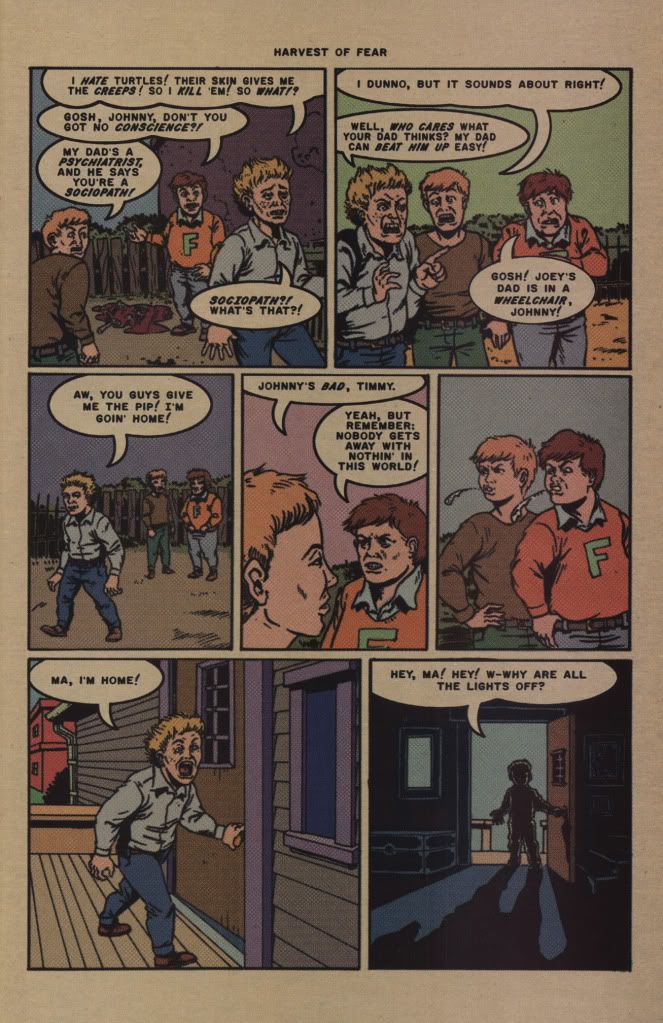
Unsurprisingly, Woodring's final story is the issue's primary treat, and it's great indeed. It's a tribute to the classic EC horror comics in which Bart discovers a third-rate EC knockoff comic that terrifies him. Woodring draws the comics within the comic in a throwback style and packs the story with meta gags and weird, unsettling imagery. The first story Bart reads starts with a boy brutally killing a turtle, which leads to a wonderfully awkward panel of his two friends spitting as they deliver the kind of unsubtle moral message that always acted as a counterbalance to the gore in EC-style comics. Woodring's slightly off-model drawings of the Simpsons characters go well with his subtly off-kilter humor. He ends the story with a fantastic meta flourish in which his comic mirrors the comic within the comic, merely implying the gory and gruesome ending. This issue is well worth a look for Woodring's story alone, and moments such as these make one wish that the Treehouse of Horror was more than a yearly event.

Superboy #2 (DC) - At some point, probably soon, I know I'm going to get tired of the new DC titles that offer up dependable, solid superhero entertainment but don't really rise above the pack. When that happens, I think Scott Lobdell's connected Superboy and Teen Titans are pretty sure to fall by the wayside. This is a decent second issue and not much more. There's still a lot of internal narration from Superboy here, infusing the book with the title character's continued quest for self-discovery. And there's a nice balance of governmental conspiracy plotting with, in the latter half of the issue, some all-out action. The rationale behind said action is weak enough that it transparently comes across as the writer deciding, "OK, now we need some action," but it's still pretty fun to watch Superboy and Rose Wilson thrash it out with some shark-like aliens. R.B. Silva's art is attractive and clean, slightly cartoony in a way that makes everyone look like teenagers, which is great for Superboy and slightly problematic for his handlers. All around, this is a good read but I just can't see this ever becoming a must every month.

Monday, October 3, 2011

Weekly Comics: September 28, 2011


American Vampire #19 (Vertigo) - With the recent epic World War II storyline concluded, Scott Snyder's gritty vampire series takes a break with an arc dedicated to the early life of Skinner Sweet, before he became a vampire. Sweet and his future adversary Jim Book are in the army together, fighting Indians, and the bulk of this issue focuses on the brotherly rivalry between these two men who would eventually become worst enemies. Jordi Bernet is the guest artist for this arc, and his cartoony, slightly sketchy style is a good fit for this tale of a simpler time in these men's lives. This is especially true of the first few pages about Sweet and Book's boyhood, which features a bright, sunny look and big-eyed character drawings that immediately contrast against the much darker style usually brought to the series by Rafael Albuquerque. With the emphasis on Book and Sweet and the broadly telegraphed differences between them, this is a pretty atypical (and largely vampire-free) issue for much of its length. Of course, the ending marks a return to the pulpy lunacy that I've come to expect from Snyder's Western vampire saga, when a curvy, naked vampiress makes an appearance in the last few pages. At that point, Bernet's bold art gives the scene a splashy, campy tone that suggests that some good goofy fun is ahead for this story.

Brilliant #1 (Icon) - This is the first issue of a new creator-owned series by Brian Michael Bendis and artist Mark Bagley, which has apparently been a long-gestating idea that Bendis has been waiting to do with Bagley. The first issue is... okay. After loving a lot of Bendis' work for years, especially Alias, I've gotten burned out on his style since he started steering Marvel's Avengers and a lot of the company's big superhero crossovers. This issue does little to alleviate my exhaustion with him, because the trademark wordy, hyperactive, pattery Bendis dialogue is all over the place, with chains of word balloon exchanges winding through most of the panels. His stylized dialogue has always walked a thin line between amusing and annoying, and here it jumps back and forth between the two poles, with an unfortunate emphasis on the latter. I'm not sold on the idea (a bunch of prodigy Ivy League college kids "invent" superpowers) or the characters, and so far it basically feels like Heroes, dealing with the concept of superpowers in a mostly realistic world with young people who don't don costumes when they get their new abilities. I'm curious enough to check out some more of it, but so far it doesn't seem like Bendis has returned to the heights of Alias or Daredevil or the best parts of the sometimes-uneven Powers.

FF #9 (Marvel) - Jonathan Hickman has been doing excellent work on Fantastic Four and its successor series FF ever since his debut on the former series. The reverberations of his fantastic first arc, in which Reed Richards tried to "solve everything" with the help of a pandimensional assembly of his parallel selves, are still being felt in FF, as four dimensionally stranded Reeds stand at the center of a massive war that Hickman's been patiently setting up for some time now. This issue takes place at the climax of this war, so it's mostly all dedicated to battle and action, with visceral art and layouts by Steve Epting that make all the explosions and fist-fights pop off the page. As usual, though, Hickman is at his best when he cuts away from the action for a few pages spent with young Valeria Richards and would-be child supervillain Bentley. Hickman's expansion of the Fantastic Four cast to focus on the Richards kids and a host of other children and oddball characters is the best aspect of his run, and his dialogue for these characters — precocious but definitively childlike — is pitch-perfect. This is a short, delightful little scene, a much-needed break from the otherwise non-stop action on display here. One hopes that Hickman's FF will eventually focus even more on the Future Foundation class and other supporting characters — maybe once the main Fantastic Four series returns, also with Hickman writing, in November.

Journey Into Mystery #628 (Marvel) - I've been reading this series ever since it split off from Matt Fraction's Thor as a showcase for the young, newly resurrected Loki, and I'm not sure why. Part of it is that I love the character: Loki as a kid is just a lot of fun and his constant machinations are really charming, whether they're here or over in Fraction's Mighty Thor. The problem is that this series has been mired in the Fear Itself crossover (which I'm not reading) since it began, and a lot of these issues just read like summaries of things happening elsewhere or bits of ancillary action at the fringes of the story. Also, Kieron Gillen's wordy, text-box-heavy style is doubtless intended to give the impression of a series steeped in old world myths, but the effect is mostly just stilted and arch. This issue features nice art by Whilce Portacio, who's a little more lively than Dougie Braithwaite, whose art on previous issues of Gillen's run has always seemed overly stiff and static, not to mentioned smothered under oppressive coloring. There continue to be flashes of cleverness and fun here whenever Gillen abandons the endless narration boxes to let Loki crack wise, but he still doesn't nearly have Fraction's subtle wit or sense of scale. I'm hoping this series will be able to stand on its own well once Fear Itself finally ends, though.

The Mighty Thor #6 (Marvel) - What I love about Matt Fraction's take on Thor is that it's totally unpredictable, working at a grand epic scale, dealing with myth and belief and fate and choice, as befits a character right out of mythology. This issue concludes the war between Galactus and the inhabitants of Asgard that has run through the first six issues of Fraction's Mighty Thor. And suffice it to say that the war has been resolved in an utterly unexpected way, tying together the large-scale cosmic conflict with the ground-level struggle between the Asgardians and the humans living in a town near Asgard's current earthly location. Most notably, the local Christian pastor who had often been a subject of comic relief in earlier issues unexpectedly gets treated in a much deeper and more complex way here, and the resolution of that plot sets up a strange new status quo that should make the next arc of this series just as interesting. As usual, Olivier Coipel's art is stunning, particularly in the panels of a brooding, shadowy Galactus looming over the tiny figures of the men and gods arrayed at the feet of the world devouring being. Also as usual, much of the action is splayed across the elaborate double-page spreads that Fraction favors for his work with Marvel's Norse characters, contributing to the sense of scope that's so important to dealing with gods and aliens and creatures that dwarf mountains.

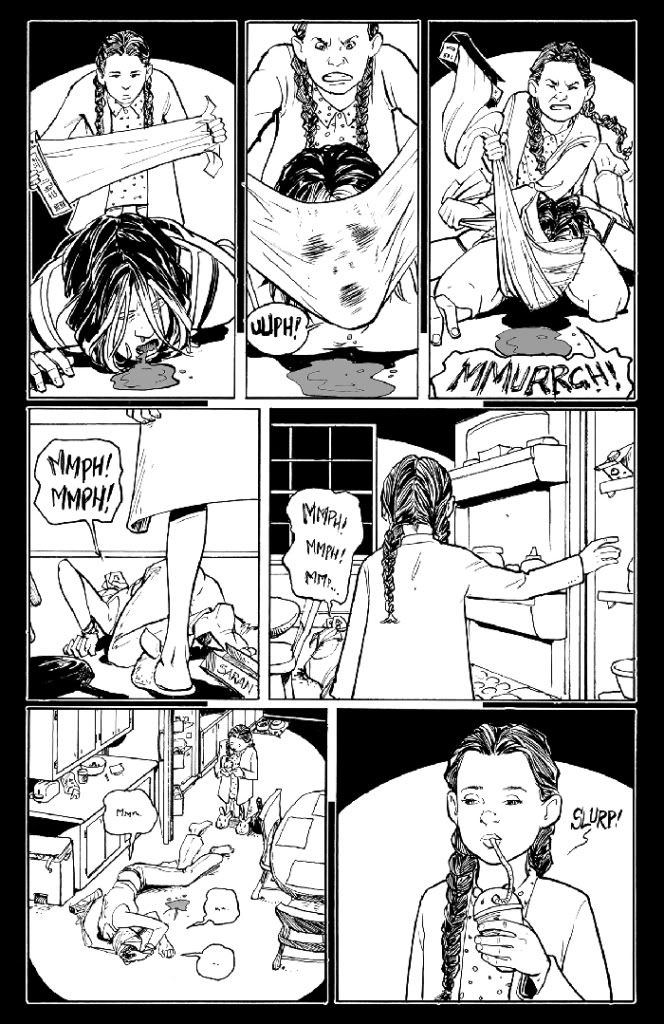
Rachel Rising #2 (Abstract Studio) - This is the second issue of a new series written and drawn by Terry Moore, of Strangers In Paradise fame. While I never liked Moore's most famous series, his clever, light sci-fi follow-up Echo was remarkable, and this new horror project promises to be equally compelling. Moore and genre fiction seems to be a really good fit. In the first issue, a young woman named Rachel woke up in a shallow grave in the woods, seemingly brought back to life with only vague memories of a shadowy figure strangling her with a length of rope. This issue is mostly about Rachel's visit to her mannish coroner aunt, who, curiously enough, takes Rachel's presence as a hallucination of sorts, reacting very strangely to her niece. These scenes have an odd rhythm, as though something is subtly off, disconnecting the reincarnated Rachel from her former life.

Moore's drawing is as beautiful as ever; his line is graceful but just a little ragged, and he makes liberal use of white space so that the overall effect is spare and ethereal. He's a sublime draftsman, and he especially has an affinity for capturing the nuances of facial expressions and body language. In one wonderful two-panel sequence, a young woman comes home from a date, her face flushed, a distant, contented smile on her lips, and in the next panel her expression falls and her body language becomes antagonistic and coiled as she sees her sister, who has been spying on her. It's slightly cartoony, and Moore doesn't flinch from manga-esque exaggeration and cartoon devices like big dramatic sound effect lettering. He blends these cartoony flourishes with whimsical dialogue and contrasts the tonally lighter moments against the darkness and violence that forms the core of the book. To that end, the issue ends with a harrowing, brilliantly rendered sequence that suggests that the series' horror component is going to remain prominent (and very satisfying).

Monday, September 19, 2011

Weekly Comics: September 14, 2011


Here are some thoughts on the comics I've read this week other than DC's New 52 titles.

American Vampire: Survival of the Fittest #4 (Vertigo) - This is a spinoff from Scott Snyder's gleefully bloody vampire series American Vampire. It's not so different from the main series, which tends to leap around in time for each arc, telling connected but distinct stories set in various eras of vampire history, from turn-of-the-century America to World War II in the Pacific. This miniseries (which will conclude next month with its fifth issue) is also set during World War II, with a couple of anti-vampire operatives infiltrating a German castle filled with squads of Nazi vampire commandos. It's pulpy as hell, and Snyder has a lot of fun delivering on the grindhouse promise of Nazi vampires. The plotting's sometimes a bit lazy — a double agent abruptly reveals himself for a last minute rescue, while time spent in a cell provides an opportunity for confessional bonding — but the propulsive action sequences and the appearance of an imaginative new type of ancient vampire provide enough thrills to excuse the issue's flaws. There's also the pleasure of seeing artist Sean Murphy (who did such brilliant work on Grant Morrison's Joe the Barbarian) take on Snyder's dark horror world. Murphy's angular figures and subtle cartoony flourishes provide a unique, idiosyncratic slant on Snyder's characters and the darkly hatched, shadowy world they inhabit. His art, along with the last-page promise of a mayhem-filled final issue, makes this miniseries, if not the best or the most substantial American Vampire arc, then at least one well worth reading.

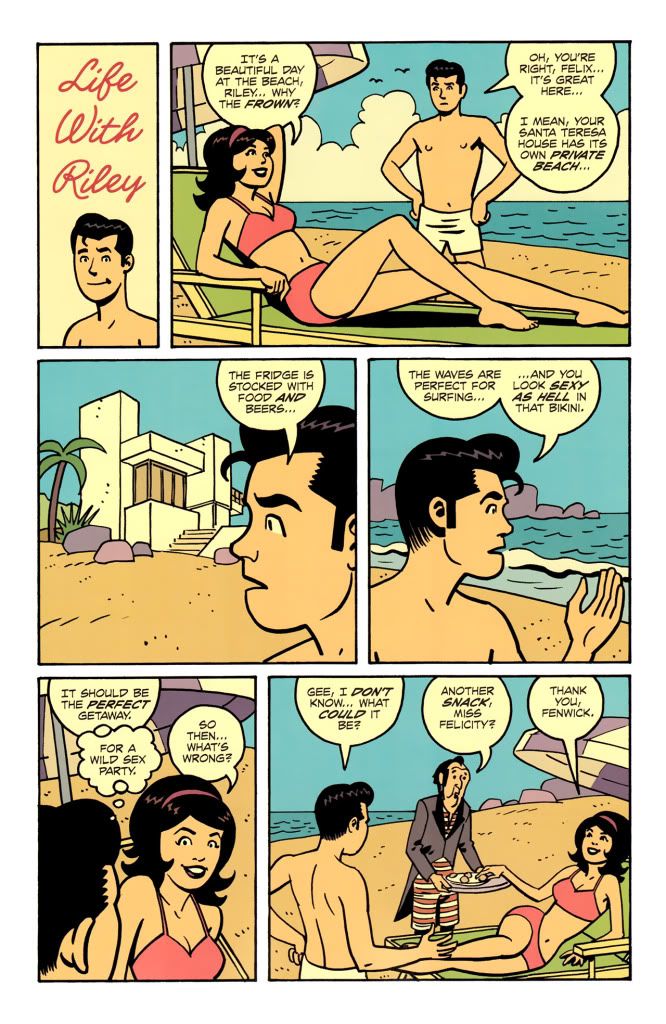
Criminal: The Last of the Innocent #4 (Marvel) - This latest Criminal miniseries by the team of writer Ed Brubaker and artist Sean Phillips has been some of their very best work yet. The unusual premise of this series is that it's a noir take on the characters of the Archie comics. Archie stand-in Riley returns to his hometown for the death of his father, and finds that his best friend Freakout is a messed-up recovering drug addict. Riley also comes to believe that he made the wrong choice when marrying one of his high school sweethearts: he chose the dark-haired bad girl and now regrets opting for her over the good-natured redhead next door. The series so far has been an examination of nostalgia and memory, with the memories of Riley rendered in the bright, clean tones of Archie's Riverdale, a perfect youth, at least as he chooses to remember it.

In this final installment, Brubaker and Phillips continue to explore the nature of memory and the rosy nostalgia that always makes the past seem so much brighter and happier than the present. The series has been structured in an interesting way, with most of the action happening in the first three issues, so that this fourth issue is a coda in which Riley's life is definitively split between appearances and reality. He's building a new life for himself, one modeled on the dreams and fantasies of his youth, but the reality upon which this artifice is constructed just gets seedier and seedier. Brubaker for once doesn't delve into a classically tragic noir ending, but the end of the issue is all the more devastating for its restraint, hinting at the darkness and ugliness that lurk just below the sunny, smiling figures of Riley's Archie-like teen years. Phillips' cartoony renderings of the past are the key to the series' poignancy, because implicit in these bold, brightly colored scenes of teenage bliss is the knowledge that these memories, filtered through the cleansing lens of nostalgia, are actually the foundation for all the squalid events of the present. What could have been a mere gimmick — the striking contrast between the shadowy noir present and the cartoon perfection of the past — becomes a very profound examination of how we remember (and misremember).

Optic Nerve #12 (Drawn & Quarterly) - I've never been much of a fan of Adrian Tomine. His clean, unobtrusive drawing style is attractive but kind of bland, and in many ways his writing can be described the same way. There's something so unassuming about his work; it's readable and occasionally offers up some minor pleasures or a flash of insight, but never cuts deeply or really bowls me over. This latest issue of his infrequently published series is mostly taken up by two short stories that do little to change my essential impression of him. "Hortisculpture" is formatted like a daily newspaper comic, with a series of 4-panel strips (plus full-pagers in color for the Sundays) about a middle-aged gardener struggling with seemingly universal indifference to the sculptures he makes out of clay and foliage. The newspaper format means that each strip ends with a gentle gag line, usually showing the protagonist suffering some defeat or moaning about his failures. It's hard not to think that this is Tomine's way of weeping about the difficulty of making art with an uncertain audience — especially when coupled with the 2-page autobiographical strip at the back of this issue, in which Tomine gripes about the obsolescence of pamphlet comics in a market dominated by "graphic novels." This kind of self-deprecating schtick has long been a tic of far too many indie cartoonists, and it's more than gotten old, so Tomine's stooped-shoulder irony, either in "Hortisculpture" or the autobio strip, is simply tiring.

The other long strip here is "Amber Sweet," and it's better but still pretty slight. The story concerns a young woman who looks almost identical to a porn star, and whose life is made difficult as a result. It's an intriguing idea, but executed clumsily and broadly, so the questions about identity, sexuality and the Internet raised by this story simply glide along the surface. Tomine's ideas — that real-life women often have to compete with porn stars in bed, that the Internet creates some pretty unusual connections — are basic and not particularly original. His main character's plight is moving (if not always especially believable) and the art is typically nice, with cool colors and elegant linework. But as usual it's the definition of tasteful and pleasant, without really tapping into the roiling emotions or fully exploring the ideas at the heart of this story. Tomine is too content to stay at the surface level.

Severed #2 (Image) - This series is definitely off to a great start with its first two issues. It's a slow-burn horror piece set in 1916, which presents the large, scary world through the eyes of kids who live on the road, prey for all the terrifying predators, human or supernatural, who dwell in the urban shadows. Writers Scott Snyder and Scott Tuft have paced the series patiently, spacing out the moments of horror and gore in between passages of careful scene-setting. Attila Futaki's moody art and sensuous colors provide the perfect sophisticated style for what Snyder and Tuft are attempting here, giving the impression that there's danger lurking beneath every ominous night sky, in every shadowy back alley. There's nothing here as brilliant as the way the first issue achieved a shivery thrill from a few methodical panels of a disguised monster taking out his false teeth, but the few real scares are still chilling.