Here are some thoughts on the comics I've read this week other than DC's New 52 titles.
American Vampire: Survival of the Fittest #4 (Vertigo) - This is a spinoff from Scott Snyder's gleefully bloody vampire series American Vampire. It's not so different from the main series, which tends to leap around in time for each arc, telling connected but distinct stories set in various eras of vampire history, from turn-of-the-century America to World War II in the Pacific. This miniseries (which will conclude next month with its fifth issue) is also set during World War II, with a couple of anti-vampire operatives infiltrating a German castle filled with squads of Nazi vampire commandos. It's pulpy as hell, and Snyder has a lot of fun delivering on the grindhouse promise of Nazi vampires. The plotting's sometimes a bit lazy — a double agent abruptly reveals himself for a last minute rescue, while time spent in a cell provides an opportunity for confessional bonding — but the propulsive action sequences and the appearance of an imaginative new type of ancient vampire provide enough thrills to excuse the issue's flaws. There's also the pleasure of seeing artist Sean Murphy (who did such brilliant work on Grant Morrison's Joe the Barbarian) take on Snyder's dark horror world. Murphy's angular figures and subtle cartoony flourishes provide a unique, idiosyncratic slant on Snyder's characters and the darkly hatched, shadowy world they inhabit. His art, along with the last-page promise of a mayhem-filled final issue, makes this miniseries, if not the best or the most substantial American Vampire arc, then at least one well worth reading.
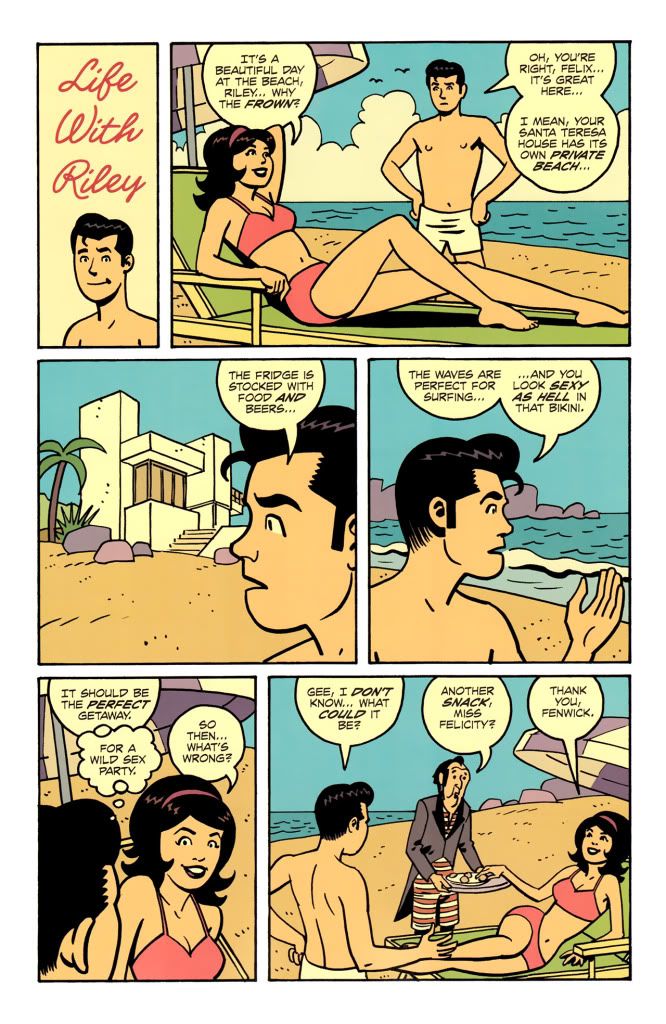
Criminal: The Last of the Innocent #4 (Marvel) - This latest Criminal miniseries by the team of writer Ed Brubaker and artist Sean Phillips has been some of their very best work yet. The unusual premise of this series is that it's a noir take on the characters of the Archie comics. Archie stand-in Riley returns to his hometown for the death of his father, and finds that his best friend Freakout is a messed-up recovering drug addict. Riley also comes to believe that he made the wrong choice when marrying one of his high school sweethearts: he chose the dark-haired bad girl and now regrets opting for her over the good-natured redhead next door. The series so far has been an examination of nostalgia and memory, with the memories of Riley rendered in the bright, clean tones of Archie's Riverdale, a perfect youth, at least as he chooses to remember it.
In this final installment, Brubaker and Phillips continue to explore the nature of memory and the rosy nostalgia that always makes the past seem so much brighter and happier than the present. The series has been structured in an interesting way, with most of the action happening in the first three issues, so that this fourth issue is a coda in which Riley's life is definitively split between appearances and reality. He's building a new life for himself, one modeled on the dreams and fantasies of his youth, but the reality upon which this artifice is constructed just gets seedier and seedier. Brubaker for once doesn't delve into a classically tragic noir ending, but the end of the issue is all the more devastating for its restraint, hinting at the darkness and ugliness that lurk just below the sunny, smiling figures of Riley's Archie-like teen years. Phillips' cartoony renderings of the past are the key to the series' poignancy, because implicit in these bold, brightly colored scenes of teenage bliss is the knowledge that these memories, filtered through the cleansing lens of nostalgia, are actually the foundation for all the squalid events of the present. What could have been a mere gimmick — the striking contrast between the shadowy noir present and the cartoon perfection of the past — becomes a very profound examination of how we remember (and misremember).
Optic Nerve #12 (Drawn & Quarterly) - I've never been much of a fan of Adrian Tomine. His clean, unobtrusive drawing style is attractive but kind of bland, and in many ways his writing can be described the same way. There's something so unassuming about his work; it's readable and occasionally offers up some minor pleasures or a flash of insight, but never cuts deeply or really bowls me over. This latest issue of his infrequently published series is mostly taken up by two short stories that do little to change my essential impression of him. "Hortisculpture" is formatted like a daily newspaper comic, with a series of 4-panel strips (plus full-pagers in color for the Sundays) about a middle-aged gardener struggling with seemingly universal indifference to the sculptures he makes out of clay and foliage. The newspaper format means that each strip ends with a gentle gag line, usually showing the protagonist suffering some defeat or moaning about his failures. It's hard not to think that this is Tomine's way of weeping about the difficulty of making art with an uncertain audience — especially when coupled with the 2-page autobiographical strip at the back of this issue, in which Tomine gripes about the obsolescence of pamphlet comics in a market dominated by "graphic novels." This kind of self-deprecating schtick has long been a tic of far too many indie cartoonists, and it's more than gotten old, so Tomine's stooped-shoulder irony, either in "Hortisculpture" or the autobio strip, is simply tiring.
The other long strip here is "Amber Sweet," and it's better but still pretty slight. The story concerns a young woman who looks almost identical to a porn star, and whose life is made difficult as a result. It's an intriguing idea, but executed clumsily and broadly, so the questions about identity, sexuality and the Internet raised by this story simply glide along the surface. Tomine's ideas — that real-life women often have to compete with porn stars in bed, that the Internet creates some pretty unusual connections — are basic and not particularly original. His main character's plight is moving (if not always especially believable) and the art is typically nice, with cool colors and elegant linework. But as usual it's the definition of tasteful and pleasant, without really tapping into the roiling emotions or fully exploring the ideas at the heart of this story. Tomine is too content to stay at the surface level.
Severed #2 (Image) - This series is definitely off to a great start with its first two issues. It's a slow-burn horror piece set in 1916, which presents the large, scary world through the eyes of kids who live on the road, prey for all the terrifying predators, human or supernatural, who dwell in the urban shadows. Writers Scott Snyder and Scott Tuft have paced the series patiently, spacing out the moments of horror and gore in between passages of careful scene-setting. Attila Futaki's moody art and sensuous colors provide the perfect sophisticated style for what Snyder and Tuft are attempting here, giving the impression that there's danger lurking beneath every ominous night sky, in every shadowy back alley. There's nothing here as brilliant as the way the first issue achieved a shivery thrill from a few methodical panels of a disguised monster taking out his false teeth, but the few real scares are still chilling.
