Showing posts with label Batman. Show all posts

Thursday, May 9, 2013

Weekly Comics: May 8, 2013

3 New Stories (Fantagraphics) - Pamphlet-format comics from indie publishers are pretty rare these days, with most smaller publishers having migrated towards the bookstore market and "graphic novels." So it's nice when something like this comes along, an actual floppy comic with three stories by Dash Shaw. I suspect the demise of Fantagraphics' anthology MOME may have something to do with this release, as these little experiments are exactly the kind of thing that Shaw would've published in those pages. With no regular outlet for these kinds of short stories, which have always formed a significant portion of his artistic output, he's assembled a few of them here. The middle story is a very short "adaptation" of a Girls Gone Wild segment, similar in form to the dating-show adaptations Shaw did in MOME, though not as substantial — he doesn't manage to burrow into the emotional core of this shallow video product the way he had with his earlier TV/video adaptations. "Object Lesson" is a pointed surrealist piece about the current economic situation, a barbed satire in which an out-of-work detective is sent back to high school due to a clerical error, while his family starves and resorts to eating the dog, his wife encouraging him to, "Lower your standards. Abolish your goals. Cower. Give up. Please." Throughout the comic, Shaw's drawings are overlaid on collages of paintings and photographs, full of symbols — Spider-Man, gold coins, a desert vista — that comment on the action and also serve as backgrounds and coloring. It's a potent, ambiguous portrait of a society where standards, goals, and morality have been rendered obsolete, where education is a bad joke, where making money means resigning oneself to serving a ridiculous system. Similarly, the final story depicts a children's prison where kids have been jailed for petty offenses, prevented from deviating in even the smallest ways from a restrictive series of laws and orders. On the chillingly nonchalant final page, the relentlessly upbeat heroine shrugs off the violence she's seen, a sign of how this kind of system encourages detachment and dehumanization. This is undoubtedly a bleak little comic, but as usual with Shaw, it's also formally inventive and unforgettably potent, communicating some very strong emotional and political truths through its blunt symbolism.

Astonishing X-Men #62 (Marvel) - I wasn't reading this title before its recent involvement in the conclusion of David Lapham's Age of Apocalypse, but I figured I'd check in on this follow-up issue in the hopes that some surviving AOA characters might still be hanging around. No such luck, but this issue is a decent enough, low-key character piece. I'm not sure if the book is always like this, but Marjorie Liu does a good job, in the complete absence of action, of providing quiet character beats and relationship dramas. Very simple stuff, as basic as Kitty Pryde leaning her head on Wolverine's shoulder, after getting shuffled to the side by her boyfriend Iceman during an earlier awkward moment. Artist Gabriel Hernandez Walta's elegant, expressive art is perfectly suited to this kind of understated drama; it's all in the body language, the subtle facial expressions, the careful staging of the characters within the frame. I have a feeling things are bound to head into more conventional mutant action soon enough, but I would happily read a quiet little book like this on a regular basis.

Avengers #11 (Marvel) - Jonathan Hickman's dual run on this title and New Avengers continues to sprawl; while New Avengers has been almost unrelentingly dark and grim and single-minded, the adjectiveless title is looser, epic in scope, leaping around from one thing to the next like a careening pinball, crashing from one shard of plot to another. Here, a group of Avengers attempt to infiltrate an A.I.M.-sponsored weapons deal, posing as gambling fun-seekers while they try to suss out clues. With Mike Deodato's glossy art giving the whole thing an Ocean's Eleven heist movie glow, this issue has a lighter tone than most of Hickman's work on these titles so far. It doesn't always work, and some stabs at humor over Black Widow's plan to take violent shortcuts feel very forced, but most of the issue is quite fun. The highlight is Cannonball and Sunspot convincing a couple of A.I.M. agents to skip the obligatory fight scene and have a fun weekend of boozing and partying instead, a sequence that wouldn't be tonally out of place in Matt Fraction's Hawkeye. Meanwhile, to satisfy those seeking some action, a Shang Chi fight scene is threaded through the whole issue. This is a pretty minor piece of the overall puzzle, probably the weakest single issue of Hickman's Avengers yet, and only at the end is an important piece of information delivered. This will be a mere blip in the eventual omnibus (which is the perfect format for these epic Hickman runs) but as a single issue it's just on a slightly lower level than the rest of the series has been.

Avengers Assemble #15AU (Marvel) - Big surprise, but while Age of Ultron itself has been very good, most of these AU tie-in issues are very unnecessary. This one's set in the early hours of Ultron's takeover, and has Captains Marvel and Britain going up against Ultron with the help of some very whimsical British heroes who, if I'm not mistaken, were invented especially for the occasion. Al Ewing guests for regular writer Kelly Sue DeConnick, and Butch Guice is excellent as ever, but it's all pretty much pointless, because what can any of these tie-ins show besides variations on heroes failing to beat Ultron? Ewing indulges in some fun-enough Britophilia, and there are some nice but all-too-brief sequences when the video-game-infiltrating hero Computer Graham matches pixels with Ultron, but otherwise this is pretty forgettable.

Batman #20 (DC) - The conclusion of Scott Snyder and Greg Capullo's Clayface two-parter is just OK, which compared to some of what's gone on in this title, is a minor triumph. Compared to the ridiculous revelations that capped the Owls storyline or the sputtering non-event of the Joker story, a straightforward Clayface battle that ends with the villain viciously imitating the recently dead Damien Wayne is definitely a step up. There are still some rather head-scratching moments, like Batman pretending to wear a DNA mask taken from Bruce Wayne, but for the most part this is decent if unexciting. It's also odd how out-of-step the relatively well-balanced Bruce seen here is with the grief-stricken lunatic Peter Tomasi is depicting in Batman and Robin, one of the problems with there being something like ten Batman-related titles coming out every month. Unfortunately, there's still no sign of Snyder getting back to the tight noirish detective stories of his pre-New 52 Batman work, and since he's now gearing up for what promises to be a full year's worth of excruciatingly boring origin stories, this ship probably isn't going to be righted anytime soon.

Batman & Red Hood #20 (DC) - In the wake of Damien Wayne's death in Grant Morrison's Batman Incorporated, Peter Tomasi's Batman and Robin is being retitled a few times to co-star first Red Robin and now Red Hood, with other Batman sidekicks and friends set to appear in the title in coming months. Other than Morrison himself, Tomasi seems to be the main Bat-writer dealing with the fallout of Damien's death, and specifically its effect on Bruce, as seen most memorably so far in #18, a silent issue in which Patrick Gleason's brooding art captured the grieving father's rage and despair over the loss of his son and crimefighting partner. Now Tomasi and Gleason have Batman working through the five stages of grief with help from his friends, and it's been heartbreaking and really well-done, a very powerful companion piece to Morrison's work — while Morrison barrels forward towards the likely epic conclusion of his years-long run, Tomasi pauses in the shadows, dealing with the emotional meltdown that follows Bruce's personal tragedy. In this issue, Batman is especially brutal, both with the assassins who he and Red Hood bust up (Batman purposefully deadens the nerves in their hands so they'll never be able to shoot a gun, or feed themselves, again) and in his dealings with Jason Todd, the man under the Red Hood mask and once a Robin himself. The issue's climax is really powerful, both in what it says about Batman's grief over Damien, and in the hurt reaction of Jason, who feels like he deserves better than this cruel manipulation. As in the last issue, where Batman tried to recruit Frankenstein to help him bring Damien back to life, Tomasi is dealing with the messy, ugly, awkward reality of grief, and the raw, ferocious emotions spilling across these pages are really compelling.

Chin Music #1 (Image) - A new horror/supernatural series from Steve Niles (of 30 Days of Night fame) and artist Tony Harris. I was anticipating some good gritty horror, but I didn't think much of this virtually impenetrable first issue, which doles out very little text or dialogue or actual plot — for an introductory issue, there's surprisingly little to hold onto here. Some kind of supernaturally powered guy (a google search tells me he's named Shaw, though the issue isn't so informative) is attacked in what seems to be pre-Twentieth Century Egypt. He's burned and stripped down to a skeleton, which somehow still lives, and flees (or is sent) through time to Prohibition-era Chicago, where he quickly comes into contact with Elliot Ness (who barely reacts to the spectacle of an Arabic-speaking living skeleton) and Al Capone. There's just not much here, and the time travel stuff seems very cutesy, the kind of time travel story where a fight between supernatural beings is used as an explanation for the Sphinx losing its nose, and where the main character will immediately meet any famous historical figures who happen to be in his time. The history-changing ending isn't enough of a hook to bring me back for more, nor is Tony Harris' art, which is nice and moody but can't distract from the essential slightness of this issue.

Constantine #3 (DC) - Yeah, so Peter Milligan's run on Hellblazer wasn't the most exciting or greatest in the title's history, but it was good, and I can't stop thinking about it when reading the new tales of Constantine in the mainstream DC universe. Everything Milligan (and many other writers in Hellblazer's storied history) did well has been jettisoned. The supporting cast is anemic and poorly developed, with characters showing up out of nowhere and heading back there as soon as their plot function has been fulfilled. The book is relentlessly plot-driven, with none of the downtime or weird diversions that always made Hellblazer so fun. And most importantly, Constatine's essential aimlessness has been sacrificed. One of the best things about Constantine was always that he wasn't a hero, that he almost never set out to do big quests for their own sake, but now not only does he have a mission, it's a mission that's explicitly spelled out in the intro box that appears on each issue's title page. It's just totally the wrong approach: Jeff Lemire and Ray Fawkes throw in all the superficial signifiers, the cigarettes and British lingo, but the soul, the attitude, the warped and wild aesthetic, is lost in translation.

Fearless Defenders #4 (Marvel) - Cullen Bunn's had a pretty disappointing career at Marvel so far, and this is the first book he's done for them that really has something to recommend it. It's a goofy, pulpy B-movie kind of book, with an all-female cast, and it has a breezy quality to its action and its banter. Will Sliney's art is slick and his women are undoubtedly sexy, but the book thankfully doesn't resort to outright cheesecake. It's pretty much the definition of a fun, lightweight action comic that's easy to read but not necessarily essential.

Infinity - Free Comic Book Day (Marvel) - Despite not going to a comic shop on Saturday, I did snag a couple of FCBD books at my local shop, including this one. This is a teaser for Jonathan Hickman's upcoming Infinity miniseries, a summer event involving Thanos coming to Earth. As expected, it's all set-up to establish a sense of encroaching doom, but it's beautifully illustrated by Jim Cheung, who turns in some of the best work I've ever seen from him. The alien creatures who serve Thanos are just seething with menace. I'm looking forward to this event, which will probably play like a brief, violent outgrowth from Hickman's larger Avengers run. Also included here is a brief and not bad Thanos/Destroyer fight story from 1977, written by Scott Edelman and drawn by Mike Zeck. Plus a very short excerpt of Warren Ellis' upcoming Avengers graphic novel, way too brief to get any idea of what it'll be like, though the back-and-forth patter between Captain America and a few other Avengers has some nice spark to it.

The Private Eye #2 (Panel Syndicate) - This is Brian K. Vaughan and Marcos Martin's new self-published, digital-only, pay-what-you-want comic, which so far is great for reasons well beyond its attention-getting distribution method. It's set in a future where the era of Internet over-sharing backfired in such a spectacular fashion that now everyone is obsessed with privacy, with most people hiding their names and identities behind masks and role-playing constructs of various degrees of complexity, shedding skins whenever they feel like it. It's a fascinating idea and a wonderfully realized world: one of Vaughan's strengths has always been taking fantasy or sci-fi concepts and building very real-feeling worlds around them, and this one is no exception. Martin's gorgeous art (with a big help from colorist Muntsa Vicente) renders this world vibrant and exciting, stuffed with people hiding behind all sorts of masks, as the underground private eye Patrick Immelmann finds that his client has been murdered. Martin lends a noirish neon-lit vibe to the many night scenes here, particularly a haunting trip to a fringe area where abandoned trains and sewer tunnels have been converted into makeshift homes for masked drug users and dealers.

Prophet #35 (Image) - Brandon Graham's revival of Rob Liefeld's Prophet is one of the most ambitious mainstream comics out, a wild and at times barely coherent sci-fi epic that has taken its time showing its hand with regards to what the hell is going on. The picture is a bit clearer now, with an ancient empire starting to re-emerge while rebels gather their forces to resist, and this issue alternates between the two stories, while also alternating between artists, since Graham has gathered a small staple of artists and associated each one with a different set of characters. Simon Roy handles the perspective of the "New-Father" Prophet who serves the empire, while Giannis Milonogiannis draws the "Old Man" Prophet and his group of anti-empire rebels. Graham exploits the contrast between Roy's thick lines and lumpy forms and Milonogiannis' comparatively thin, minimalist work (which is much closer aesthetically to Graham's own art) to delineate the two groups and their stories, which at this point are still very separate but seem fated to unite eventually. As always, there's lots to love here on a sheer conceptual level, from the way Graham treats a battle scene like a video game or a diagram, with little icons representing the gradually depleting forces on each side, to the Old Man's poignant confrontation with an artifact from his past. Also, the previous issue's backup story by Matt Sheean and Malachi Ward continues here, more evidence of Graham's great taste in showcasing indie auteurs doing great sci-fi work. This serial is nicely creepy and ambiguous, concerning a man sacrificed to a giant monster and methodically going to work in the creature's insides.

Suicide Squad #20 (DC) - The first issue of a new run on this title by Image writer Ales Kot. I haven't checked in on this book since its brainless first issue (by Adam Glass), and Kot is certainly a big improvement over that inauspicious debut. It's all setup, but so far it seems like Kot is planning on introducing some interesting plots, and he's got a good handle on the kind of damaged psychologies that made John Ostrander and Kim Yale's Suicide Squad one of the best series of the '80s. I'm still thrown off by the new skinny, sexy Amanda Waller, which remains a bizarre character design choice, but otherwise this is setting up exactly the kinds of frayed minds and bitter tension that should drive this book. Telling a confirmed death-wish case like Deadshot that he now essentially will not be allowed to die is a great start, and Waller, together with her shadowy associate, seems to be pushing all of her inmates to the breaking point in similar ways. Of course, the revelation of Waller's partner in this at the end of the issue is just icing on the bloody cake, since this particular character has been begging for someone to pick up his story since before the New 52 started. A good start, and it's nice for once to be adding a New 52 title back onto my list rather than dropping one.

Thor: God of Thunder #8 (Marvel) - This is great comics. Jason Aaron hasn't exactly been rushing this introductory God Butcher storyline, but the deliberate pacing has allowed Esad Ribic to deliver countless great images along the way, and it's been great fun to watch the story's three versions of Thor struggling against the implacable Gorr. This issue is where it all starts to come to a head, with the young Viking Thor's story finally intersecting with that of the modern Thor and the old Odin-esque one-eyed Thor. Aaron introduces Thor's granddaughters, the future goddesses of thunder — one of whom confesses to "impure thoughts" about her hunky young grandfather — and delivers a kick-ass final page that promises much more adrenaline-fueled action to come.

Ultimate Comics: Ultimates #24 (Marvel) - The President Cap storyline comes to a rather inauspicious end, with Sam Humphries basically shrugging away the one cool idea of his run so far, not that he did too much to really explore Cap as President in the past few issues. Making Captain America the President for the long run would have been bold and provided plenty of potential stories, so it's a shame that Humphries doesn't seem interested in following through on that possibility. Other than that, there's not much here, though it's funny that between this issue and Uncanny Avengers, this week has two separate comics where Thor must destroy falling space debris before it lays waste to a city.

Uncanny Avengers #8 (Marvel) - When Rick Remender brought his epic Uncanny X-Force to a close, I thought that was it, that he'd said all he had to say, but instead the current arc of his new series seems to be just picking up where he left off. It's a credit to Remender that he's been able to tell this many stories about various versions of Apocalypse without it getting a stale, but somehow it's still thrilling to see these threads being picked up yet again, the contagious evil of Apocalypse passed on to yet more new avatars, here with Kang and Red Skull thrown into the mix. Most of the characters from Remender's X-Force aren't here, and the Avengers have been added to the mix, but this still feels like Uncanny X-Force, a sustained study of evil, nature and nurture, the moral implications of violence, and guilt and responsibility.

The Walking Dead #110 (Image) - One of those talky issues where nothing much happens, besides Robert Kirkman backing away a bit from his introduction of a black self-styled "king" who kept a pet tiger, a character who verged on racist caricature when first introduced. Making him a zookeeper who basically feeds off of other people's legends about him redeems the character somewhat, as does acknowledging that he's kind of a male version of fan-favorite Michonne, who self-styled herself as a badass urban samurai with a sword that she's apparently not as well-trained with as she pretends to be (not that that's stopped her from being an actual badass with it all through the series). Anyway, this plot is still crawling towards the eventual big confrontation with the villainous Negan, perhaps a little too slowly even by Kirkman's usual patient standards.

Wolverine #3 (Marvel) - After the frenzied one-two punch of this series' first two issues, Paul Cornell slows things down a bit for this one, as Wolverine teams up with Nick Fury Jr. (yep, still a ridiculous character) to track down some aliens. The slower pace reveals that this maybe isn't as good or fun as it initially seemed to be. Wolverine's new supporting cast seems to be made up of pub-crawling cast-offs from Hellblazer, and their introduction is really awkward, and then there's lots of fighting for very unclear reasons, and by the end it seems as though the only reason to stick around at all is Alan Davis' still-brilliant cartoony art.

Monday, November 14, 2011

Weekly Comics: November 9, 2011

Batman and Robin #3 (DC) - This is becoming a slow-burning surprise favorite for me out of DC's New 52, getting better with each issue. This is especially true because Peter Tomasi is increasingly focusing on the "and Robin" part of the title, making this a book about Damien Wayne's struggles with the way he was raised versus the noble ideal offered up by his father Bruce and his mentor/peer Dick Grayson. Damien's interactions with the stolid, unshakeable Alfred are a lot of fun, and this issue opens with a chess match between the butler and the boy wonder, drolly funny and sharply written. Tomasi has a good feel for the uneasy relationship between Bruce and Damien: the boy looking up to his father but also straining against the bonds of this relationship, while Bruce, long used to being the chilly loner despite his succession of sidekicks, is a much cooler and more distant father to his troubled son than Dick Grayson was during his stint as Batman. Damien takes typical preteen rebellion and gives it a sinister twist because he's not only resisting parental guidance, he's straining against Bruce's strict no-killing code and insistence on self-control and restraint. But there's also a real joyous side to Damien when he's allowed to break free, which tempers the darker aspects of his character; it's hard to stifle a smile when he tells a crook, "I'm sure you didn't leave your hole tonight thinking you'd get your ass kicked by a ten-year-old!"

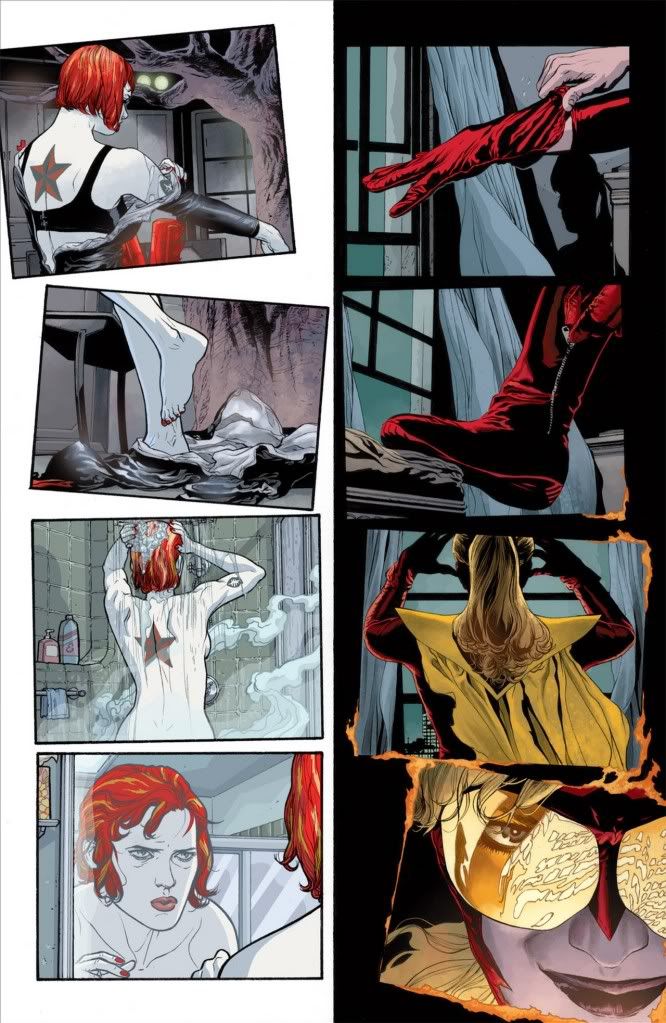
Batwoman #3 (DC) - This is the best issue of this series that J.H. Williams has done since going solo after his run on the character with Greg Rucka in Detective Comics. Williams is continuing to build on the foundation built during that earlier story, here opening with Kate Kane sucked under water by a vengeful spirit who summons the spectre of Kate's dead sister, trying to prompt the hero to let go of it all, to give in to despair. The result is a gorgeous, evocative few pages where the image of Kate as Batwoman is replaced by the image of her sister, a visual evocation of Kate's unarticulated, subconscious desire to join her sister in death. Of course she breaks free, and the next few pages are given over to a wonderful few pages where Batwoman fights with Agent Chase, who's investigating her and trying to figure out her secret identity. Williams' fight scenes, spread over the jaw-dropping double-page layouts that have come to be expected from his work, have a stuttery kinetic quality that suggest events happening in flashbulb bursts of motion, each pose frozen and cordoned off by the lines that zigzag across the page to indicate different intersections of time and space. This is also the issue where Williams' delineation of different styles for Kate's civilian life and her nocturnal adventures as Batwoman really pays off in a big way. When Kate returns to her apartment from her ordeal, dripping wet, in full costume but without her mask, her presence seems like an intrusion, a violation of the scrupulous separation between bright, colorful ordinary life and the dark, shadowed world of the costumed hero. That's the point, as Kate tells her cousin Bette, who she's been training to be a hero as well, that Bette should quit and go back to her normal life. Kate wants to keep these worlds separate, to banish her cousin from the darkness and danger of the superhero's life, to protect her from the fate of her own mad, corrupted sister. Then there's a wonderful silent page where, on the left half, Kate undresses and takes a shower, stripping back into her civilian identity, while on the other half of the page, surrounded by a deep black border, Bette puts on her costume and prepares to go out into the night. There's an acute sense in this series of identity as a costume one takes on and off, switching roles with clothing, existing in two different spheres that are represented by entirely different aesthetics.

Deathstroke #3 (DC) - Kyle Higgins has quickly proven in these three issues that he has a very limited set of ideas for this series, so he's just going to keep repeating them over and over in the hopes that it will be seen as thematic consistency instead of redundancy. This is the issue where Deathstroke's repeated insistence that he just wants respect, that he's worried that people think he's lost his touch, becomes particularly wearisome. The end of the issue throws in a few new wrinkles, tying back into the first issue and establishing that the Harmory characters in that issue weren't just a disposable punchline but were setting up something bigger. But it's not quite enough to keep me interested or make me want to continue reading what's turning out to be virtually the same book every month: Deathstroke gets a job, decapitates a bunch of people, easily dispatches everyone he encounters, and then goes all Rodney Dangerfield and complains that he gets no respect. Joe Bennett and Art Thibert give the book an attractive, unshowy art style that makes all the gore seem very matter-of-fact, but their contributions aren't reason enough to keep reading either.

Green Lantern #3 (DC) - Geoff Johns continues to do a good job of balancing the dichotomy of his central characters Sinestro and Hal Jordan: the one-time villain who's now been restored to the role of an unlikely hero, and the hero who's actually kind of a stubborn, arrogant asshole. Their interactions form the core of this book, as they define themselves against and in relation to one another, each convinced that the other is evil or idiotic or in the wrong. This is an interesting dynamic and the bitter repartee between these two old adversaries, each of them totally locked into their respective worldviews, totally drives this comic and especially this issue. The actual action, in which Sinestro and Jordan confront Sinestro's former corps for the first time, is just a quick burst at the end of the book that leads to a cliffhanger that only someone who's never read comics before could really believe is actually a cause for concern. Nevertheless, I'm definitely interested to see where this series is going, and I'm enjoying Johns' approach to these two rather unlikeable heroes/anti-heroes.

The Incredible Hulk #2 (Marvel) - I haven't been following the Hulk's comics before this new series, so I'm not sure exactly what happened to split up the Hulk and Bruce Banner, but this issue's examination of Banner's obsession with his missing other half is compelling anyway. Jason Aaron casts Banner as a deranged mad scientist in contrast to the serene, isolated Hulk, who just wants to be left alone, hidden away under the earth with his Moloid friends. This issue is all about setting up the obvious conflict between Hulk and Banner that will be coming in future issues. In the meantime, Aaron delivers the crowd-pleasing diversion of the Hulk battling some killer sharks, because hey, why not? I'm not sure how I feel about the gang of monster-hunters who are heading after Banner, though, what with the leader continually repeating that she's not related to Dr. Doom despite a shared last name, and the lame meta jokes like having a hunchbacked former mad scientist sidekick named Mr. Gor. Marc Silvestri's art is scratchy and densely hatched, and it's nice even though he seems to have an army of collaborators helping out. I don't think I've ever seen this many artistic credits on a single issue; between pencils, ink, finishes and "pencil assists," there are 11 credited artists on this comic. The result is sometimes a little inconsistent in terms of the level of detail, but not as bad as you'd think from that array of artists.

PunisherMAX #19 (Marvel) - This latest arc of Jason Aaron's PunisherMAX is at least as much about the Kingpin as it is about the Punisher himself. While this issue mostly focuses on Frank Castle's bleak internal monologue, the battle-weary drone of an old man accustomed to blood and pain, it's also about the Kingpin's gradual process of toughening himself to fill the larger-than-life role he's taken on, to really become the iconic villain he's meant to be. Interestingly, Aaron's Wilson Fisk has thus far been very passive and melancholy, a man drawn up inside of himself, having done atrocious things to achieve a position of power only to realize that he barely cares about the power. Now he's finally drawing out of that self-imposed shell, even as his adversary the Punisher cruelly antagonizes Fisk by disinterring the Kingpin's dead son. Steve Dillon's art is blunt and effective, powerfully depicting all the routine violence that surrounds these haunted, angry men, and also the ways in which all this horror has been written on their faces and in their bodies. Aaron is very much following in the footsteps of Garth Ennis on this series, and he doesn't depart too far from that model, but there's something about the combination of Aaron's writing and Dillon's art that makes this Punisher an even more tragic, sad, eerily empty character than ever.

Rachel Rising #3 (Abstract Studio) - Wow, this issue really ups the ante for the freakiness of this great series. Here, the newly resurrected Rachel seems to be getting flashes of portent about the violent deaths of other women, all of which seem to be linked by the mysterious blonde woman who's wandering through town, igniting feelings of misogyny and rage that lead to murder. Violence against women is the common thread, an ancient evil that exploits latent feelings of distrust, jealousy and self-doubt. Terry Moore's clean, bold art, with its copious white space and elegantly minimal faces, is just breathtaking, and creates an especially powerful atmosphere in the silent scenes (like the opening sequence in a jazz bar). Rachel herself is depicted with strangely shaded eyes that, together with her gothy makeup and the rope burns around her neck, make her an increasingly eerie central character. The highlight is the scene where she finds herself inexplicably compelled to confront a woman in a bar bathroom, telling her, "Your wedding bed will be a shallow grave... your lungs full of mud. Something old will violate you and you will feel it... making its home in you." This is a shivery, fascinating horror story, one of my favorite new series and already a worthy successor to Moore's Echo.

Uncanny X-Force #17 (Marvel) - Rick Remender's epic "Dark Angel Saga" hurtles on towards its conclusion next month, and this penultimate issue is a great example of Remender's virtuosic control of this kind of fast-paced storytelling. This issue expertly balances visceral action with the intense psychodrama at the core of the saga, the corruption of Archangel by Apocalypse's evil influence and the struggles of Archangel's lover Psylocke to prevent the world-devastating plans of her love without destroying him in the process. Several scenes in this issue take place in memory, on the psychic plane, and here Jerome Opena's woodcut-like hash marks are especially beautiful. As Psylocke attempts to break free of her corrupted lover's control, her mind returns to the memory of their first meeting: the dialogue is witty and urbane, a verbal dance of seduction, but Opena's shaded faces and the muted color palette (by Dean White, an unsung star on this book) suggest the heartbreak to come from this blossoming romance. The action continues to be strong, too, as characters from the alternate reality Age of Apocalypse join in both on the side of X-Force and as the allies of Archangel. This is just a great series, encompassing all the epic drama and intense stakes that characterize the best superhero comics.

Wolverine #18 (Marvel) - Well this is pretty ridiculous. And writer Jason Aaron seems to know it. He's relishing telling a deliberately campy, over-the-top story here, with a villainess who leads back directly to the Dragon Lady from legendary comic strip Terry and the Pirates. This drug kingpin's lavish, outlandish daily rituals — bathing her feet in the blood of any woman who claims to be more beautiful than her, dining on delicacies like "butterfly brains," refilling her pillows nightly with the feathers of a 1000 doves — definitively establish that this is a camp movie serial villain, an exaggeratedly evil adversary who'd twirl her moustache if she had one to twirl. Equally silly is Wolverine's new ally, Fat Cobra, a big tattooed sumo type who just wants to make a meal of a dragon. This is a quirky comic that climaxes with Wolverine and his allies riding towards their enemies in the bellies of a trio of dragons, and Aaron maintains an appropriately irreverent tone as he weaves a collage of kung fu clichés with imaginative conceits like the villains' underground poppy field or the concept of using dragons as drug mules.

Monday, October 24, 2011

Weekly Comics: October 19, 2011

Batman #2 (DC) - I love how deeply engrained Scott Snyder's Batman is in the history of Gotham City, its legends and the ancestors of the characters who define its present. The opening of this issue, with its emphasis on Wayne Tower, recalls the Snyder-overseen miniseries Gates of Gotham, which explored the secrets behind the construction of that tower. Snyder is signalling that the past is once again going to reach forward into the present. This issue also explores another of Snyder's running themes in his Batman work: the ways in which the city of Gotham shapes those who live in it, and vice versa. His Detective Comics run, with Dick Grayson as Batman, focused on Dick's fears that Gotham would transform him, would unleash the darkness that so often threatens to consume Bruce Wayne. But as in that series, Snyder's new Batman seems to be confirming that things mostly work in the other direction: each man sees his own Gotham, shaped or warped by his own experiences and how he's chosen to react to them.

Bruce's conversation with would-be politician Lincoln March underlines this theme. March is a man with a past similar to Bruce's, having lost his parents at a very young age; his story about his mother's heart pin is an eerie echo of Bruce's fixation on his own mother's pearls. March says that Gotham itself helped him past his trauma, giving him a sense of purpose, and in a strange way this is also true for Bruce, though not in the same sense as March's idealistic political fervor. Both men see themselves as shaped by the city, changed by their traumatic pasts, but they take very different trajectories and see Gotham in very different ways. It's great how Snyder is weaving these undercurrents into his story from the very beginning, slowly developing these themes as Bruce, confident in his knowledge of Gotham and of his own relationship with the city, prepares to face yet another threat from the city's past, a threat to the city that he sees as integral to his identity as Batman. Snyder's storytelling is patient, obviously working towards a bigger arc, but not at all decompressed — this issue is well-paced with action, some displays of Batman CSI tech and detective work, and the moments that develop Snyder's big picture themes.

The Boys: Butcher Baker Candlestickmaker #4 (Dynamite) - Well, I called what was going to happen in this issue. Not that it was hard to predict. The problem with this miniseries is that it was always so obvious just where it was going to be heading, the only place it possibly could be heading. It's a familiar Garth Ennis formula, especially in this series, which revels in brutality and horrible things happening to decent people. So when the future leader of the Boys, Billy Butcher, met a beautiful redhead and married her, the only question was in what horrible and grotesque way the Homelander was going to kill her so that Butcher could be pushed onto the unceasing quest for vengeance that drives him over in the main series. That question has now been answered, and the final pages of this book, as drawn by Darick Robertson, are appropriately harrowing and horrifying — suffice it to say that Ennis' warped imagination has concocted some really nasty images here, images that owe a bit to Alan Moore's Miracleman and offer up a grisly, cynical twist on one of the pivotal events of that series. But there are no surprises here, and there's no real depth to Ennis' revelation of Butcher's back story. It was always obvious from the main series that superheroes — and specifically the Homelander — had been responsible for something awful in Butcher's past, that they'd probably killed someone he loved. Now that the details have been revealed, it doesn't really change his character very much, or reveal much about him that wasn't already apparent. It's just another opportunity for Ennis to wallow in the terrible things that superpowered beings do in this series, another opportunity to show that people with real power almost invariably use it to hurt, use and screw over others. The political applications of that idea are made especially clear in this issue's discussions about Thatcherite England, but even so this whole miniseries just feels so redunant and unnecessary.

Captain Atom #2 (DC) - This is just a really cool-looking terrible comic. The linework of penciller Freddie Williams II isn't anything special; it's mostly pretty minimal and crude, and when it isn't there are some ugly, distorted faces on the pages where Williams lays down the ink thicker. Colorist Jose Villarrubia does most of the heavy lifting here, giving the series' title character a pale blue sheen that makes him stand out boldly from the world around him. It's very striking, especially on the pages where the atomic hero is overwhelmed by the electronic signals of the Internet and text messages flowing through the air around him, spectral information as ghostly and colorful as the hero himself. If only it were a good comic with this kind of distinctive style, but JT Krul's writing and plotting are just boring — when they're not outright silly, as in the volcano that abruptly popped up in the middle of New York at the end of last issue, a threat that Captain Atom seems to have neutralized between issues, leaving the volcano inert but still sticking out of a Manhattan street. I wish this comic was good, because I do like looking at it, but unfortunately it has little to offer beyond its admittedly pretty colors.

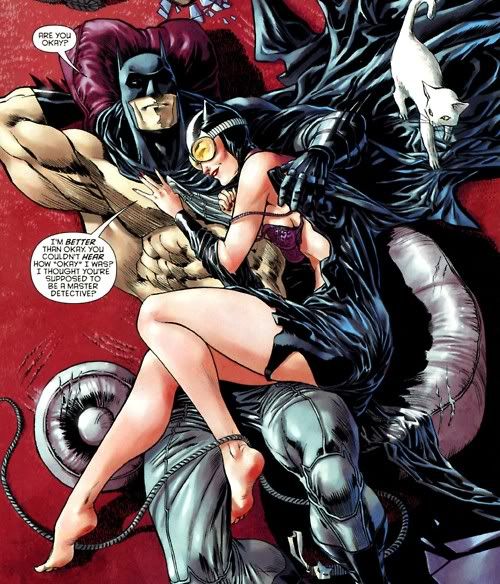
Catwoman #2 (DC) - I've gotta give it to Judd Winick: he pissed off a whole lot of people by ending the gloriously sleazy first issue of this comic with a fetishy, campy Batman/Catwoman sex scene that apparently offended everyone but me. (That's an exaggeration, but not by much.) And instead of moving on from there, he decides to open the second issue with the sex scene still in progress, giving us not only a splash page of a post-coital smiling couple but a panel of Batman adjusting his belt as he pulls his costume back into order. Never thought I'd see that. And I have to say, I'm still digging this ridiculous comic. Guillem March draws a very sexy, curvy Catwoman whose face expressively projects her playful delight in manipulating her opponents. She'll get her revenge for some dark things from her past, and she'll have a lot of fun doing it. The end of the comic goes very dark, very suddenly, but before that it's just so much fun to see Catwoman flirting with Bruce Wayne, unaware of who he is but feeling a strange attraction to him anyway, and then cleverly manipulating some rival mobsters into a shootout to get her revenge. This is pulpy stuff that very deliberately leaps across the line separating good taste from bad, and I can't help but admire it for that. It's trashy, and Winick and March undoubtedly know it, and the result is kind of a grindhouse Catwoman comic, delving into extremes of flashy sexploitation and over-the-top violence. I'm sure this comic will continue pissing people off, and I'm equally sure that it's going to be hard to look away from its garish trainwreck wildness for as long as it continues in this vein.

Green Lantern Corps #2 (DC) - After the first issue of this series, I thought I was onboard for what seemed like it was going to be some mindless cosmic action. Now I'm starting to think it's a bit too mindless after all. Not much has changed from the first issue, I admit, except that now the focus is irrevocably off characterization, so that Lanterns John Stewart, Guy Gardner and the squad of alien Lanterns they lead are all pretty generic. At least the first issue gave some character beats to the two human members of the team. The threat they're facing, which was just an unseen terror killing Lanterns last issue, has now been revealed as a bunch of generic guys in black armor, so that's a letdown too. Basically, it feels like this isn't going to be the great action series I was hoping for, and the alien Lanterns are going to continue to be mere fodder for limb-hacking and grisly deaths, and I'm not sure that there's any reason to keep reading.

Journey Into Mystery #629 (Marvel) - Since it seems like Marvel's Fear Itself event is quite simply never going to end, I guess this potentially enjoyable book is going to remain trapped in a crossover swamp for the forseeable future. Kieron Gillen's writing is a weird mix of formal prose and flippantly delivered dialogue, with the latter being much more palatable than Gillen's attempts at Asgardian portent. As usual, Loki's breezy manner is the main appeal of this comic and this character. His delivery of tossed-off battle orders — "Dark Asgard flies on engines powered by raw fear-stuff and similar... let's blow them up" — suggests his childlike enthusiasm and casual approach to prophecy and war. This is contrasted against the stiff, often awkward writing of the narrative caption boxes, which overpower the much more lively dialogue. But the real problem continues to be that Journey Into Mystery so far has just been a peripheral part of Fear Itself when it should be a fun, slightly goofy book about the adventures of kid Loki. It's a waste of this character that his showcase comic mainly summarizes events in other series (apparently Thor's dead over in Fear Itself — yeah, that'll last) and adds a little ancillary action.

Justice League #2 (DC) - Geoff Johns' flagship DC book continues to move at a deliberate pace, slowly introducing the major players and having them size each other up with pattering dialogue and the obligatory superhero-misunderstanding-fight-scenes. Last issue focused on Green Lantern and Batman, with Superman showing up at the very end, while this issue throws the Flash into the mix and moves forward with the origin of Cyborg. Johns' punchy dialogue prevents the decompressed pace from being frustrating, and it helps that it's inherently fun to see these famous heroes meeting each other for the first time, cracking jokes as they try to figure out the origin of the mother boxes that Darkseid is planting in various US cities. Jim Lee's bold art is another pleasure here, and he's at his best in depicting a fight scene between Superman and the Flash, with the speedster dancing in circles around the Kryptonian before Superman finally catches him and sends him flying with a playful flick of his finger. The layouts of fight scenes like this are simple and elegant, breaking down the action into small gestures that lead into the massive, explosive pin-up panels that are Lee's forte. When he tries for a more complex layout, as he does on a page where Green Lantern calls the Flash for help, the page starts to look crowded and cluttered, with word balloons and layered panels creating visual confusion. That's just one page, though, and the rest of the issue tends to play to Lee's strengths much more clearly, with simple, iconic depictions of fight scenes and superhero posing. The introduction of more heroes in this issue gives the impression that things are speeding up and spreading out, gathering momentum as the Justice League of the title begins to take shape. When Wonder Woman and, presumably, Aquaman show up next issue, the pacing should get even more frenetic, the action more frenzied.

Nightwing #2 (DC) - I like Dick Grayson as a character, especially since his recent stint as Batman, but I have to say, the prospect of "Nightwing solves a circus mystery" as the driving plot of this first arc is really not exciting me on any level. The same thing goes for the assassin who's stalking Dick, a generic costumed guy with claws called Saiko, which not only provides the awful pun of the cover text but allows Dick to make a similarly terrible sorta-pun inside the actual comic. This just isn't really that interesting, from the generic love interest to the weirdness of Dick inheriting a circus to the off-kilter pacing. Eddy Barrows' fight scenes are interestingly laid out — as in the first issue, he seems to be taking more than a few page design cues from JH Williams III — but his faces are really goofy looking, and the presence of two inkers suggests that this is yet another New 52 issue affected by deadline pressure.

Supergirl #2 (DC) - The very decompressed storytelling in this series is already starting to get annoying. The first issue was basically just an extended fight scene between Kara and a bunch of armored soldiers as she tries to figure out what's going on. The second issue is... basically just an extended fight between Kara and Superman as she tries to figure out what's going on. While I enjoyed the first issue well enough, Michael Green and Mike Johnson are certainly taking their time building up to anything more substantial. Here, the two Kryptonians duke it out because Kara refuses to believe that Superman is actually her cousin, mainly because in her memory he's still a baby, which raises questions about where (and when) she's actually from and how she got here. But the whole thing feels contrived because after brawling all issue, Kara abruptly decides to stop by the end, and suddenly trusts her cousin after refusing to listen to him at first. This series needs to quickly do something besides staging 20-page fight scenes, even though Mahmud Asrar is undeniably good at drawing them: his figures in motion have a nice sense of energy, and he's great at depicting the paths of destruction that the hurtling superbeings leave in their wake.

Wolverine #17 (Marvel) - Jason Aaron has been doing some fine work on Wolverine lately, quite literally sending the man with the claws to hell and bringing him back only to tear him down even further. Then, just last issue, Aaron offered up a surprisingly touching and even funny reminder that Wolverine stories can and should be about more than just suffering and killing. This issue picks up that thread and serves as a placeholder in the aftermath of Aaron's Schism miniseries, which somewhat artificially concocted an excuse for Wolverine and Cyclops to fight and split up the X-Men into two teams. Now Wolverine's preparing to restart the Xavier school, so this issue is pretty much just filler before that storyline starts in earnest over in Aaron's new Wolverine and the X-Men series. As filler, it's not bad, and Aaron's feel for humorous dialogue is especially sharp here, as Wolverine goes hunting through San Francisco's Chinatown underworld for some drug dealers who have managed to subjugate a pair of dragons. Yes, really. It's knowingly a bit goofy, especially when Wolverine's throwdown with Gorilla Man is interrupted by the meta commentary of a pair of onlookers whose banter reflects the stupidity of the superhero comic convention that every time two heroes meet, they must fight. Considering all the angst and poignancy of Aaron's recent Wolverine arcs, this kind of low-key, light-hearted issue was probably needed to provide a breather before the aftermath of Schism really starts to play out.

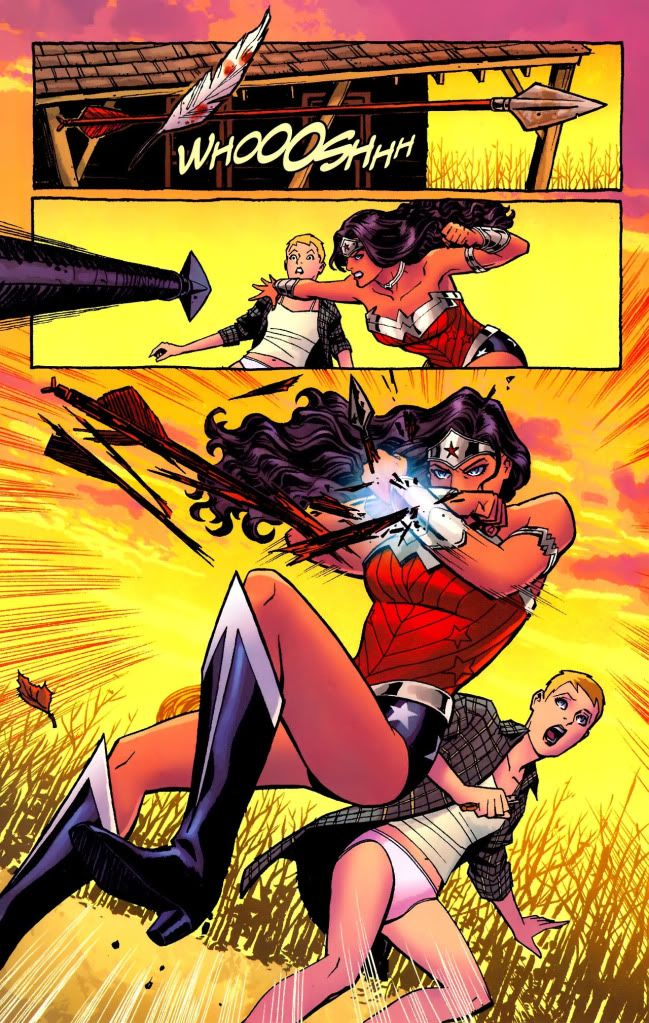
Wonder Woman #2 (DC) - Damn I love this comic. This issue isn't as rapidly paced as the action-packed first one, but it has the same energy and vitality. Brian Azzarello's writing is crisp and efficient: he tells Diana's origin story in just two pages and caps it off with a casually jokey exchange. He packs a lot into this issue, as Wonder Woman takes Zola — the woman carrying Zeus' latest bastard child — back to the Amazons' home. Azzarello's dialogue is crackling and sharp, very different from his usual hardboiled style but with his characteristic wit intact. Zola's conversation with Hermes is great, as she wonders which of the men she's slept with lately could have been Zeus in disguise. It's not only funny but sex-positive and non-judgmental, especially remarkable considering some of the depictions of women in other New 52 series. It helps that Cliff Chiang's cartoony, expressive faces give his characters, particularly all the women in this story, vibrant personalities. The design of the villainous Strife, Hera's daughter and apparently Diana's sister, is especially effective, appearing as a willowy, pale blue gothy figure in a shredded cocktail dress.

Thursday, October 13, 2011

Weekly Comics: October 12, 2011

American Vampire: Survival of the Fittest #5 (Vertigo) - The final installment of this Nazi vampire spinoff miniseries plays out like a full-on action movie climax. Scott Snyder knowingly and lovingly hits all the expected beats, with the hero sacrificing himself to save the girl, giving her a final kiss as a sendoff before he storms into the center of the Nazi tanks, literally giving the finger to the enemy as he sings the Star-Spangled Banner. It's just that kind of over-the-top pulp craziness. It's also the kind of story where the heroes escape the Nazi vampires by leaping across a seemingly unpassable gap on a motorcycle as, behind them, the towering and recently unearthed godlike ancient vampires demolish the newer, uniformed monsters. Sean Murphy's manic hatching and exaggerated facial expressions are perfect for this explosive material, but he's equally excellent in the comparatively understated and moving coda in the final pages of the book. At that point, when the insanity has abated and the clamor of war faded away, Snyder and Murphy offer up a simple, moving epilogue and a surprisingly sweet last page.

Batgirl #2 (DC) - This series seems to have stirred up a lot of controversy just for giving Barbara Gordon back the use of her legs and making her Batgirl again after decades as the wheelchair-bound Oracle. I can't say I feel too strongly about that decision one way or the other, though the circumstances of Barbara's recovery continue to be pretty vague here. So, putting aside whether or not the basic idea is a good one, Gail Simone's new Batgirl is just a pretty good book about a very likable character whose internal narration wavers between anxiety over her return to superheroics and girlish euphoria at once again being able to swing through the air and fight bad guys. I could do with a little more of the enthusiasm and a little less of the hand-wringing, honestly. It makes sense, though, that this first arc's villain, the Mirror, is basically a personification of survivor's guilt, a perfect foil for a hesitantly recovering Barbara who isn't quite sure why she's experienced this "miracle." Barbara's new roommate is just a bundle of annoying quirks, and her boyfriend is bland, but this issue has some kinetic, intense fight sequences (fluidly rendered by Ardian Syaf) and the writing has a breezy quality even when it's mired in Barbara's self-doubt and uncertainty.

Batman and Robin #2 (DC) - Maybe it's just because I like Bruce Wayne's son Damien as a character, but I'm really digging the way this series seems to be focusing on Bruce's ongoing attempts to channel his son's killer nature and angry temperament into constructive pursuits. Peter Tomasi writes this father/son relationship well, especially in the scene where Bruce awkwardly questions Damien about homework before transitioning into the set-up for a Batman and Robin mission. It's an interesting relationship unlike the dynamic between Batman and any of his previous Robins, and it seems to be what's really driving this book so far. Although, it could just be that the actual villains here are pretty uninteresting, as Batman and Robin take on some generic weapons dealers. Then, at the end of the issue another nemesis shows up, and I'm unsure if I'm supposed to know who this is or not, but I don't, except that he was the guy killing the Russian Batman in the previous issue. I'm not too invested in the actual menace that Tomasi is haphazardly setting up here, whatever it is, but I'll keep coming back to see more of the central father/son relationship.

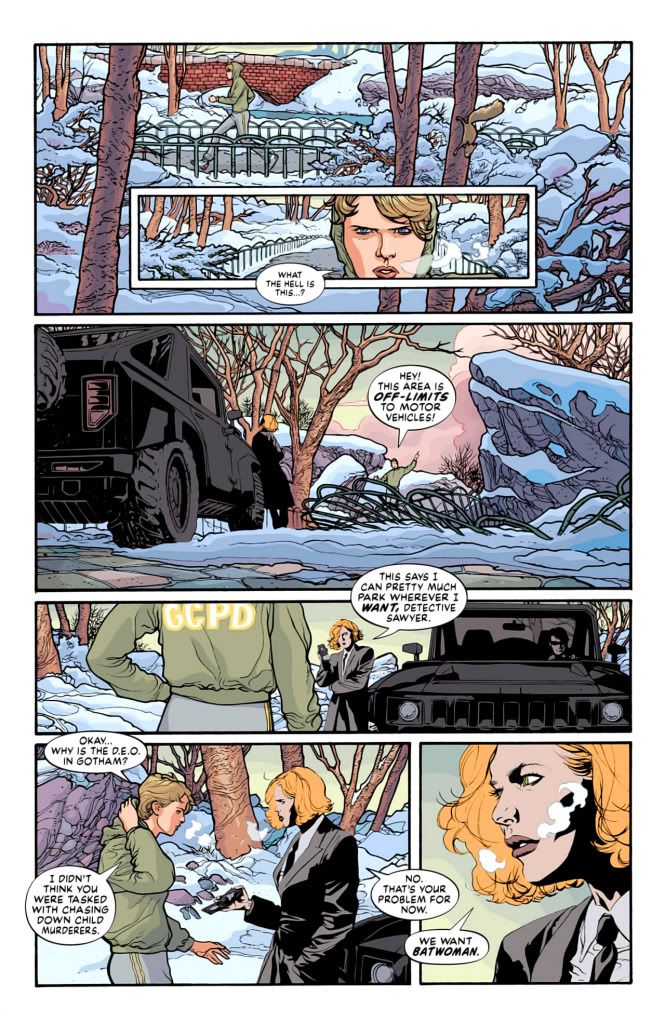
Batwoman #2 (DC) - At this point, it's almost easy to take JH Williams' interpretation of Batwoman for granted, even just two issues into the character's first solo title. His brilliant, sprawling double-page layouts and mastery of different styles is fully in place by this point. His action scenes are spiky and kinetic, full of pointed edges and panels-within-panels that call attention to points of impact or reveal the X-rayed anatomical contortions behind each well-placed kick. The panels become wavery and watery whenever the ghostly "weeping woman" makes an appearance, and the scenes in the ordinary civilian life of Kate Kane have a comparatively rigid panel structure and soft, brightly lit feminine colors to suggest the disparity between this woman's secret identity and her nightly crimefighting activities. This is an amazing comic in every way, guaranteed to be mindblowing month after month. The best scene in this issue is one in which Kate's detective girlfriend Maggie Sawyer walks around a supernatural crime scene, using the evidence to concoct a coherent story of what went down, and as she speaks the battle springs into life in the air around her, shaped by her conclusions and conjectures. Williams excels at this kind of diagrammatic layout. He excels, too, at jamming together contrasting styles, as he does when Maggie meets Cameron Chase, who's rendered in a shadowy noir style even in daytime, recalling her appearance in the short-lived Chase series that Williams illustrated back in 1998. The issue ends on an abrupt cliffhanger that suggests that the comic simply ran out of pages — Williams' plotting may be a little shakier than his jaw-dropping artwork — but otherwise this is yet another remarkable, unmissable installment in one of comics' most consistent visual treats.

Deathstroke #2 (DC) - I'm not sure what to say about this one, because even more than in the first issue, Kyle Higgins and Joe Bennett have just delivered a 20-page fight scene that takes all of two minutes to read, if even. It's got explosions, decapitations, and Deathstroke's rather quick destruction of a goofy, armored-up, roller-blading guy called Road Rage. There's not much at stake here, and barely a hint that the title character has even worked up a sweat after easily dispatching everyone who comes at him. It's lightweight and utterly disposable, with less of the quirky touches of personality and humor that spiced up the first issue. This comic is bound to just be the bloodbath-of-the-month and it does that just fine.

Demon Knights #2 (DC) - The first issue of this series was one of the bigger surprises of the New 52, since I didn't really have any expectations for it and it wound up being a whole lot of fun. This second issue lives up to the promise of throwing a whole bunch of DC's olden-times magic/immortal characters together to fight dragons and an evil queen. It's fast-paced and action-packed, inflected with the fun-loving spirit of warriors who love nothing more than digging into a tough fight and feasting on dragon meat when it's all over. Paul Cornell's dialogue has a peppy zing that mostly compensates for his characters' tendency to narrate their every move. This light-hearted style only occasionally gets tiresome, as when Cornell takes a cue from manga's jokey meta asides, which results in some very out-of-place dialogue. Other than such small dialogue issues, though, this remains a rollicking good time, gorgeously illustrated by Diogenes Neves and Oclair Albert, whose lush, European-influenced style is perfectly suited to this old-school wizards-and-demons adventure.

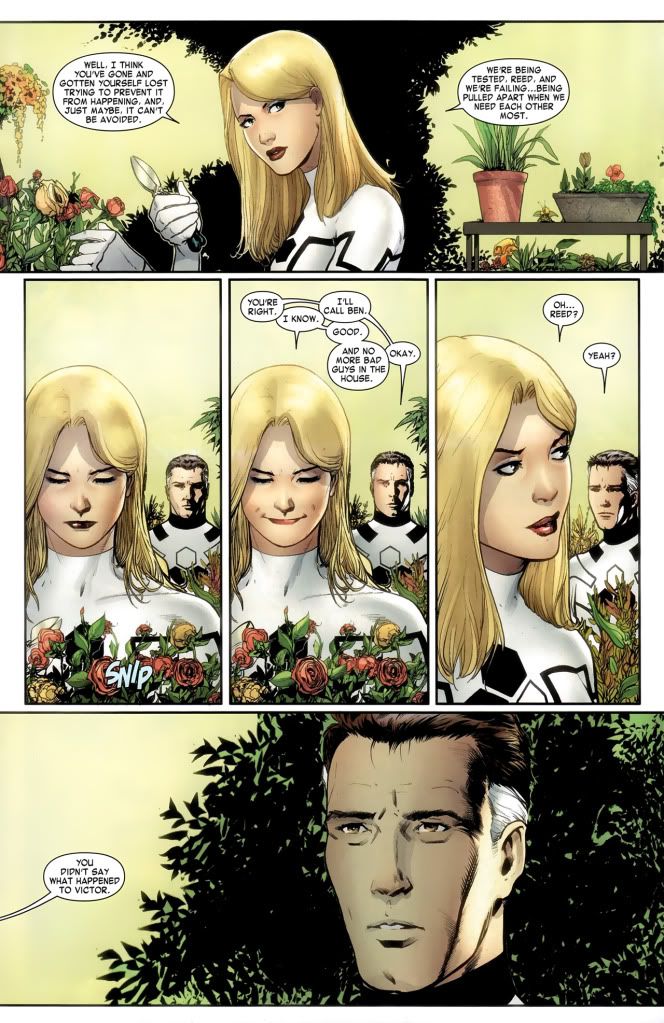
FF #10 (Marvel) - This is a pretty low-key set-up issue, a breather after last issue's climactic extended battle, which didn't so much conclude as take a momentary break. Jonathan Hickman continues to excel at hitting just the right emotional beats. The prime example here is a quiet scene between Sue and Reed Richards, staged so that Sue is looking away from her husband, facing the "camera," her expression mostly guarded but betraying a little smile, knowing and satisfied, when Reed tells her she's right. The scene plays out entirely in small shifts of facial expressions as husband and wife reconcile without laying it all out in so many words. Barry Kitson, filling in for regular artist Steve Epting, does an excellent job in moments like this, with a glossy, economical style that defines faces in a few graceful lines. Thanks to Hickman's facility for one-on-one dialogue scenes and Kitson's unshowy feel for the emotional nuance of Hickman's writing, what could have played out as a mere lead-up to bigger plots instead feels like a series of emotional climaxes for Reed and Sue, Ben Grimm, even the peripheral Inhuman Crystal and her Kree husband.

Frankenstein: Agent of S.H.A.D.E. #2 (DC) - This is stronger than the already good first issue of Jeff Lemire's Hellboy-ish paranormal series, because with most of the exposition out of the way Frankenstein and his troupe of monster soldiers just leap into action here. The best line comes early on, when Frankenstein slaps an old woman (she had it coming) and deadpans, "Frankenstein's vengeance does not discriminate on the basis of age." After that, there's more frenzied action sequences with massive monsters, rendered in scratchy scribbles of dark lines by Albert Ponticelli. Lemire takes a break in the middle of the issue to provide a backstory for one of his newly introduced monster characters, a female Creature from the Black Lagoon lookalike, which suggests that maybe each of these early issues will fill in the pasts of these new characters one by one. It's perhaps an inelegant way of shoehorning in exposition, but it works in this case because the flashback is packed with little bits of weird science fun, and because it ties in thematically with this issue's revelations about child sacrifice in the small town where this interdimensional infestation has broken loose.

Green Lantern #2 (DC) - It's not too surprising that Geoff Johns has wasted little time in getting Hal Jordan back in a Green Lantern costume after spending the first issue of this title powerless. It's not a total return to the status quo given that Jordan's power is now tied to his one-time nemesis Sinestro, but Jordan once again has a costume and a ring, even if it's not a "true" Green Lantern ring. Considering how clumsy and hackneyed the plotting of Hal's human misaventures were in that first issue, this is probably a good thing, and this issue establishes the terms of the unlikely Jordan/Sinestro team-up with some solid action. Sinestro's lesson to Hal has a hint of meta about it, an acknowledgment that for all the power of the Lantern rings, most of those who have wielded them have not changed worlds but simply constructed big green weapons to fight other superpowered beings. It's a distant echo of the end of Alan Moore's Miracleman, which questioned why superheroes with awe-inspiring power always thought so small. The point is perhaps erased when the very next scene involves Sinestro and Hal constructing big green weapons to kill a marauding alien, but it's nice to think that maybe Johns will work his way up to something more ambitious over time. This series isn't blowing me away so far, but it's offering up interesting, dynamic characters and some good old spacefaring action, and so far at least that's been enough.

The Punisher #4 (Marvel) - Though Greg Rucka's new series bears the name of antihero Frank Castle, the Punisher, what makes it worth reading is that, this time around, Castle isn't quite the center of his own book. In Rucka's first issue, the Punisher was a ghostly presence glimpsed out of the corner of one's eye, little more than a blurry flash of that white skull logo and the bloody evidence left behind in his wake. He's become a bit more of a physical presence in subsequent issues, and in this fourth issue he speaks more — 25 whole words — than he has in the previous three issues combined. But this is still a comic about the effect of the Punisher, the idea of the Punisher, more than it is about the man. That makes sense; the Punisher has starred in a lot of comics and has had a lot of writers define and redefine him. His psychology is pretty well established at this point. Rucka has decided to take the Punisher himself as a given, a powerful force tearing through New York's criminal underground, and his Punisher is more about the cops, journalists, and crime victims who would be glimpsed at the fringes of a more traditionally centered Punisher story. That street-level grit is affecting, especially when it comes to the continued emphasis on Rachel Alves, the survivor of a wedding day shootout that killed her new husband and most of her family. The Punisher is all about revenge, but Rucka seems interested in exploring crime and vengeance in ways that go far beyond the Punisher's simple, predictable, bloody retribution. In this, he's ably assisted by Marco Checchetto, whose art is gritty but somehow also soft-focused, as though there's a shadowy fog hanging over everything, blurring the black-and-white moral clarity of the Punisher's world. This issue is much more conventional in form than the brutal, near-wordless bloodletting of issue #3 or the destabilizing ambiguity of issue #1, but it continues Rucka's examination of the grimy nighttime world that revolves around Marvel's most ferocious antihero.

PunisherMAX #18 (Marvel) - If Rucka's Punisher stays fresh and interesting by taking a new approach to the character, Jason Aaron and Steve Dillon's MAX series is much more traditionalist. Aaron's Punisher is very much recognizable as the hardboiled killer of Garth Ennis' justly praised MAX run, an alternate take on the Punisher, free of mainstream Marvel continuity and also free to be much more explicit in terms of sex, language and especially all the inevitable blood and guts. Aaron doesn't do anything too daring here, just offers up more of the same for those who loved Ennis' Punisher. The book has been structured elementally, with each arc examining a character: Kingpin, Bullseye, then Castle himself. In the current "Homeless" arc, there's no such clear character focus, but Castle has been reduced to zero, having to rebuild his store of weapons, re-establishing himself as a force on the streets after a stint in jail. This is a Punisher book where Elektra can dispatch a room full of mob flunkies in memorably gruesome ways, tearing out eyeballs and sticking knives up men's noses, then screw the Kingpin on a bloody table for some reason. A few pages later, she goes to bed with Vanessa Fisk instead, a puzzling development that suggests the gleefully juvenile sensibility of this material. Dillon, with long experience drawing similarly trashy stories for Ennis, brings his characteristic physical heft to each disfigurement and death, each gory action sequence. But what he's best at, it turns out, is drawing Frank Castle himself, as an old and grizzled man with hard lines cut into his face as if out of granite, scowl lines etched so deeply into his skin that they're like wartime trenches. Castle's mask-like face is the real star of this series, the craggy visage of a man who's fought and killed his way to the brink of old age without exhausting his appetite for blood.

Resurrection Man #2 (DC) - Oddly enough, I still don't have much of a handle on whether this series is actually any good or not. It's an engaging concept — a guy who dies and is reborn every issue with a new power — written in a fast-paced, jagged style. In this issue, Mitch Shelley goes looking for answers about his own murky past, trying to figure out who he was while various supernatural entities and killer glam girls track him for their own mysterious purposes. Dan Abnett and Andy Lanning mostly go for a light, casual writing style that allows the issue to glide by quickly, though there are a few clunkers ("wow, pretty mad surfing skills there, Darryl") to serve as speed bumps. Similarly, Fernando Dagnino's art is not bad, but tends too much towards awkward pin-up poses, especially for the hitwoman villains, who seemingly lounge around in their underwear reading porno mags while waiting for their next mission. (They don't wear a whole lot more while on a mission, for that matter.) This second issue does little to improve upon the problems I had with the first, but there's still something goofily entertaining and intriguing about this off-kilter book. Its odd cast of characters includes the resurrecting man himself, glamorous hitwomen, angels, shape-shifting monsters, and it ends with Shelley plunked down into a weird netherworld with chalk-outlined bodies drawn on the ground and shadowy demons in the sky. If Abnett and Lanning simply mean to keep readers guessing and coming back for more off-kilter, uneven weirdness, so far they're succeeding.

The Shade #1 (DC) - James Robinson returns to one of the characters from his beloved Starman series for a 12-issue miniseries. Thankfully, he definitely does justice to the always-intriguing character of the Shade, capturing the witty, urbane tone of this character perfectly, as well as the emotional openness that characterized Robinson's best work. I haven't followed Robinson or the Starman characters after the end of the great original series, but this already seems like a worthy follow-up. This first issue establishes the scope and the tone of this material, opening with a philosophically inclined conversation between the Shade and Mikaal, one of several characters to bear the mantle of Starman. The dialogue is florid and romantic, as befits an ancient, gentlemanly character like the Shade, but it never gets weighted down by the stylized language. Instead, the dialogue zips and darts around with wit and insight, both in this conversation and a later scene between the Shade and his girlfriend. The action scenes are equally adept, particularly the showdown between Shade and Deathstroke that ends the issue. Cully Hamner's art is great and is especially strong when the Shade begins drawing shadows around himself, his red eyes shining from beneath the brim of his hat, his face becoming a maze of black patterns layered over his skin. Like Robinson's Starman, this is just great comics, with a relentless forward momentum and a real feel for the characters that perfectly balances the action. I'm really looking forward to more of this.

The Simpsons' Treehouse of Horror #17 (Bongo) - Traditionally, the "Treehouse of Horror" series has been the annual opportunity for The Simpsons, whether on TV or in print, to mess with the formula, to tell outrageous, surreal, gory stories where the usual rules of the characters don't apply. In the comic, this has often meant that this annual institution has been an opportunity for comic creators from outside the mainstream to tackle the iconic inhabitants of Springfield. This year, the real draw here is a story by Jim Woodring that closes the anthology. But first, Zander Cannon and Gene Ha turn in a loving homage to Nosferatu, with Mr. Burns as the vampire, Homer as Renfield, and Bart as the hapless visitor to the vampire's lair. Cannon and Ha have a lot of fun translating silent film aesthetics to print, including a line of musical notation that runs beneath the panels until Bart decides to turn the record off. It's a fun, quirky read with some clever nods to the story's cinematic source, and several panels recreate iconic compositions from the film, with the most effective being a few silent panels in which Burnsferatu creeps towards the "camera" through a stone archway. The second story in this issue, written by Jane Wiedlin of the Go-Go's with art by Tom Hodges, is much less successful. It starts as a lame and haphazardly plotted Star Wars pastiche (Hodges is an artist for Star Wars webcomics), tosses in some zombies, and it's just an unfunny tonal mess. Even the lettering is ugly.

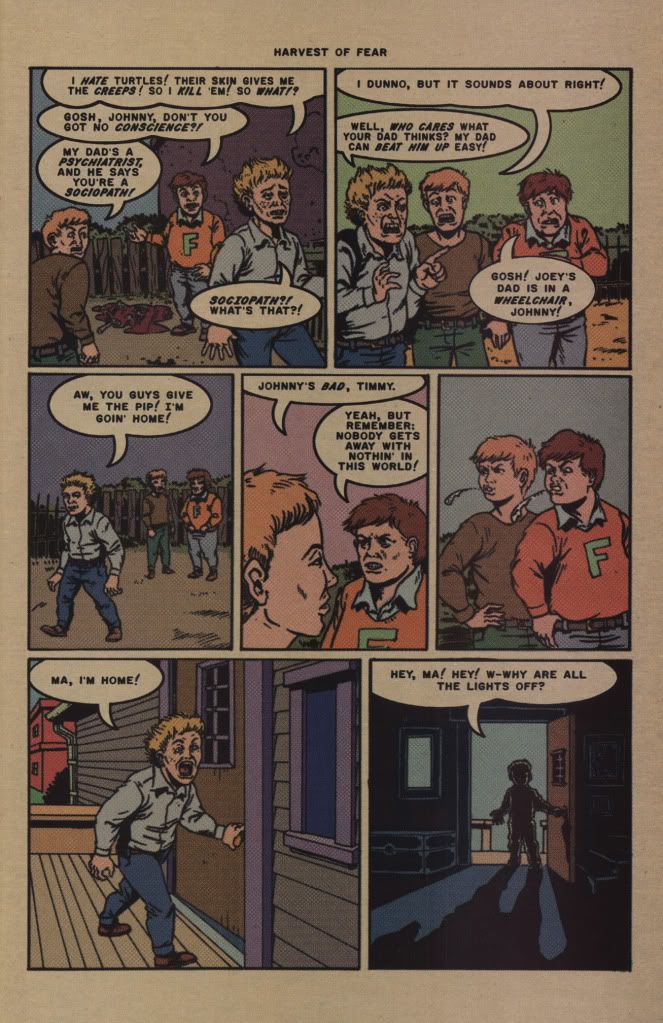
Unsurprisingly, Woodring's final story is the issue's primary treat, and it's great indeed. It's a tribute to the classic EC horror comics in which Bart discovers a third-rate EC knockoff comic that terrifies him. Woodring draws the comics within the comic in a throwback style and packs the story with meta gags and weird, unsettling imagery. The first story Bart reads starts with a boy brutally killing a turtle, which leads to a wonderfully awkward panel of his two friends spitting as they deliver the kind of unsubtle moral message that always acted as a counterbalance to the gore in EC-style comics. Woodring's slightly off-model drawings of the Simpsons characters go well with his subtly off-kilter humor. He ends the story with a fantastic meta flourish in which his comic mirrors the comic within the comic, merely implying the gory and gruesome ending. This issue is well worth a look for Woodring's story alone, and moments such as these make one wish that the Treehouse of Horror was more than a yearly event.

Superboy #2 (DC) - At some point, probably soon, I know I'm going to get tired of the new DC titles that offer up dependable, solid superhero entertainment but don't really rise above the pack. When that happens, I think Scott Lobdell's connected Superboy and Teen Titans are pretty sure to fall by the wayside. This is a decent second issue and not much more. There's still a lot of internal narration from Superboy here, infusing the book with the title character's continued quest for self-discovery. And there's a nice balance of governmental conspiracy plotting with, in the latter half of the issue, some all-out action. The rationale behind said action is weak enough that it transparently comes across as the writer deciding, "OK, now we need some action," but it's still pretty fun to watch Superboy and Rose Wilson thrash it out with some shark-like aliens. R.B. Silva's art is attractive and clean, slightly cartoony in a way that makes everyone look like teenagers, which is great for Superboy and slightly problematic for his handlers. All around, this is a good read but I just can't see this ever becoming a must every month.

Thursday, September 29, 2011

DC's New 52, Week 4 (September 28, 2011)


This is the final week of DC's New 52 initiative. As with the other weeks, it's a bit of a grab bag. There are no books here as strong as the best titles from previous weeks, but there's still some good stuff, a few surprises (I never expected Firestorm to be any good) and some stuff that I'm not sure why it's even being published.

1. Justice League Dark #1 - Now this is the kind of comic Peter Milligan is meant to be writing. Despite the title, this series is DC's attempt to fold a whole bunch of its Vertigo magical/supernatural characters into the mainstream DC universe, with a catch-all title dedicated to what's bound to be a pretty loose grouping of unconventional heroes. This is Milligan's forte, and that's immediately obvious as he spits out page after page of crazy reality-warping concepts and purplish prose. It reads like a pastiche of some of Milligan's peak work — particularly Shade the Changing Man, the title character of which is one of the main heroes here, and his short stint on Animal Man — but that's OK when he's coming up with something this entertaining and strange. Identical women hurl themselves into bloody traffic accidents, cows given birth to machinery, and a storm of razor sharp teeth slice Superman to bits while he muses that the teeth smell insane, which in turns prompts a narration box to counter, "but what is the smell of sanity?" The inclusion of the Justice League deliberately makes another old favorite Milligan point, that sometimes the world is just too strange to be understood or confronted by solid, noble heroes like Superman and Wonder Woman — sometimes the most damaged, wacky people are precisely the ones who can best cope with the world's lunatic shifts. The comic moves at a frantic pace and avoids the exposition trap by interspersing the obligatory character introductions with all the insane goings-on caused by the Enchantress. Mikel Janin's art is excellent, particularly in the epic sequence where the Justice League attempts to face the Enchantress. There's also a sly sense of humor here that manifests itself in things like Superman sensing that Cyborg is anxious by monitoring his oil levels.

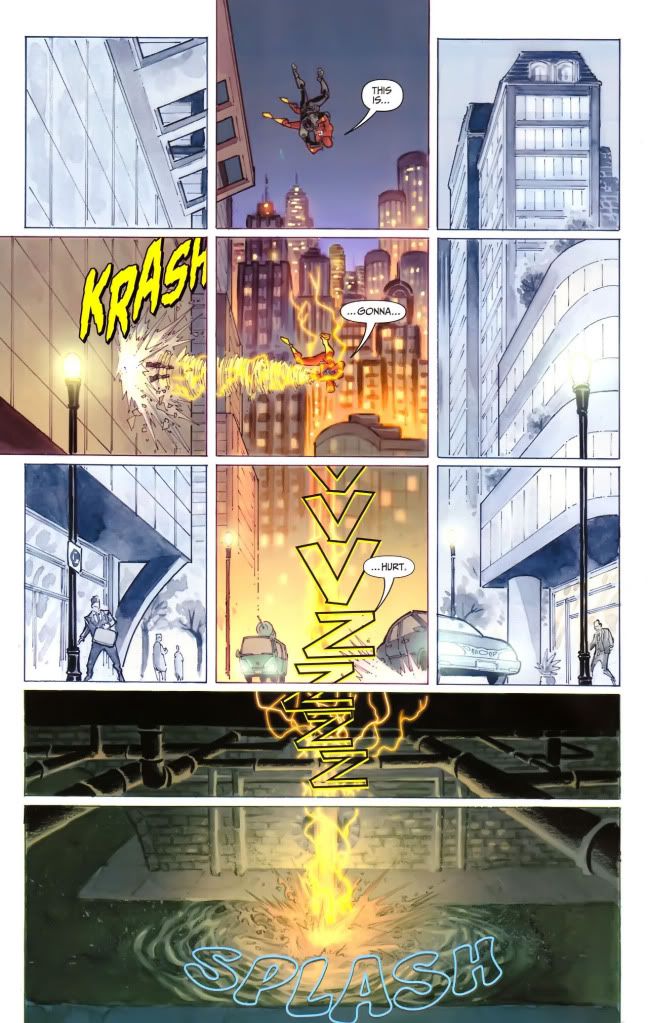
2. The Flash #1 - This is just a joyous, spirited superhero comic, as quick on its feet as the Flash himself. Writer/artist Francis Manapul (who gets some writing help from colorist Brian Buccellato) has delivered an energetic and fun first issue that gets everything just right as far as straightforward superhero antics go. Manapul's art is crisp and clean, with some inventive page layouts that communicate the constant sense of rapid motion that constitutes the heart of Barry Allen's power. Best of all is the page where the Flash, falling from a plane full of bad guys, tumbles down a series of panels in the center of the page, with the rest of the city rendered in the grid around him, so that the page as a whole looks like a segmented diagram of the city, with Barry's freefall ending below the street in the sewer that sprawls across the bottom of the page. It's all bright and beautifully colored, moving at a brisk pace without sacrificing the necessary character beats that establish the hero as an earnest, deliberate, serious young man in contrast to his hyper-kinetic powers. The pace is frantic enough and the art gorgeous enough that the initially generic-seeming villains aren't too much of a concern, and the issue ends with a series of quirky twists that suggests that even those stock, faceless baddies are pointing towards a much more interesting sci-fi plot ahead.

3. All Star Western #1 - It's great to see DC stretching into the past of its universe with this book, which focuses on Jonah Hex and Amadeus Arkham trying to solve a series of murders that are reminiscent of Jack the Ripper. This issue is especially fascinating in relation to Grant Morrison's travels into the history of Gotham City in The Return of Bruce Wayne and the rest of his Batman epic, and there are some obvious connections here in the characters of Hex, Arkham, the Wayne ancestors, and a secret society of wealthy Gothamites with some sinister secrets. More importantly, this is very well-done. It's wordy but well-written by Jimmy Palmiotti and Justin Gray, and Arkham's narration, with its attempts at analyzing his reluctant partner Hex, is engrossing and fits perfectly with the period setting. And then there's the art by Moritat, whose bold, thick lines often make each page look like gritty stained glass compositions.

4. Superman #1 - While Grant Morrison's Action Comics chronicles the early years of Superman's career as a feisty urban crusader, the hero's name title (written by George Perez and drawn by Jesus Merino) takes place in the present day of the new DC universe. This is an older, more established Superman, who still shows signs of the moralist hero of the common people established in Morrison's title, but without the same fiery anger and playful sensibility. The result is a solid superhero yarn that lacks the leaping, bounding excitement of Action Comics #1 but nevertheless seems to be setting up a fine superhero saga. The bulk of the issue concerns the first day of a new Daily Planet that's been taken over by a rival that the muckraking Clark Kent sees as a lousy gossip factory. As the merger goes into effect and Lois Lane takes charge of the new enterprise, Superman does battle with a mysterious alien fire monster. The action is fairly rote, and there's a random connection to Stormwatch #1 that suggests an eventual crossover but doesn't do much else. Still, it's interesting to see a Superman who seems so remote and lonely, and in that respect the last page, on which a dejected Clark slumps into an elevator while using his super-hearing to listen in on Lois chatting with her boyfriend, is especially effective and affecting.

5. The Fury of Firestorm: The Nuclear Men #1 - This is a weird one, and one where I didn't really know what to expect beforehand. Co-written by Ethan van Sciver and Gail Simone, and drawn by Yildray Cinar, it turns out to be an unlikely combination of high school melodrama, violent mercenary action, and explosive sci-fi craziness. Surprisingly, it winds up being a pretty entertaining issue that sets up a rivalry between two high school students: one black, one white; one a jock, the other a reporter for the school paper. The differences between these two are drawn pretty broadly, especially in the rather heavy-handed dialogue about race, but in formal terms the parallel editing and alternating narration streams keep the comic interesting. Cinar's art is very nice-looking, too, with lots of heavy blacks and strongly defined lines. The book's tone alternates, for much of its length, between action and high school drama before suddenly erupting, literally, with the transformation of the two leads into the superpowered fire creatures of the title. This is a fairly strong first issue with an interesting premise.

6. Aquaman #1 - This is a very self-aware Aquaman comic that knows that the titular hero is, for most people, kind of a joke, so writer Geoff Johns inserts plenty of nods to the jokes while trying to establish his hero as a badass with no sense of humor about his reputation. It's not great, and some of the dialogue in the later half of the book, when Aquaman visits a diner, is especially forced. An interview with a pushy blogger provides an opportunity for some clumsy faux-casual exposition, and Aquaman's humorless stoicism doesn't make him a very endearing hero. Just about all he does here is silently glower while everyone he meets wisecracks about fish and mermaids. More promising is the framing story involving some creepy-looking deep-sea Creature From the Black Lagoon outcasts, who provide a horror frame for Aquaman's on-land adventures.

7. The Savage Hawkman #1 - This is written by Tony Daniel, so of course it has a gritty, wordy tough guy voiceover running all through the issue. It's a style that's pretty common in these New 52 books, actually, though Daniel seems to be the worst offender. At one point, Hawkman calls himself "bud" while looking in the mirror; it's that kind of hard-boiled or maybe just overcooked narration. And the issue opens with Carter Hall taking his Hawkman costume, burying it in the ground, and shooting it with a gun as a symbolic gesture. That said, despite Daniel's tough guy posing, this is a decent first issue, especially when a sinister — and very Venom-like — alien threat is revealed in the later pages of the book. Most of the credit has to go to artist Philip Tan, whose detailed, textured work is gorgeous whether he's portraying ordinary scenes of archeologists at work or the increasing alien weirdness of the final few pages.

8. Teen Titans #1 - Well this just whizzes by; when I got to the last page and saw that it was over I was pretty shocked because it barely felt like I'd read anything. Which is both good and bad — it's certainly not plodding like Men of War or the Legion books, but it's also pretty fluffy. It's an assembling-the-team kind of issue with Tim Drake monitoring some other superhero teens so he can get a team together before a mysterious organization can get to the kids first. There's a very Speedball-during-Civil War moment involving Kid Flash, but other than that it's mostly about Tim and Wonder Girl, with a final page that ties back into Scott Lobdell's other book, Superboy. (I guess it's just fortunate that he doesn't seem to be tying the execrable Red Hood into these two titles as well.) It's a fast-moving book with a lot of attitude, even if some of it seems more than a little misplaced (like Tim Drake blowing up his penthouse).

9. Voodoo #1 - Considering that this is pretty much exclusively known as "that series about the stripper," everyone should know what to expect here. This makes Catwoman #1 look positively demure in comparison. Ron Marz sets this whole first issue in a strip club where the title character is one of the dancers, so naturally there are plenty of women posing in lingerie or with arms draped across their chests. It's basically a whole book of cutesy cheesecake drawings by Sami Basri, whose style is undoubtedly well-suited to drawing pretty ladies in their underwear. There's not much else here, of course, and since the issue ends with a grisly bloodbath that signals where the series is headed next, it seems like the creative team wanted to get all the sexy stuff out of the way up front before leaving the strip club setting behind. At this point, you might as well as just read a bona fide softcore porn comic, since this amounts to more or less the same thing. It doesn't have the playfulness and goofy fun of Catwoman, and though Basri's art is attractive he's no Guillem March, but neither is this as hateful as Red Hood and the Outlaws #1, still the low point in DC's treatment of its female characters. This just doesn't have much to offer besides pretty pictures and recycled clichés about strippers.

10. Green Lantern: New Guardians #1 - I'll give this issue credit for trying to approach the reboot in a slightly different way than most of the other New 52 — it rushes through an origin story in a couple of pages and then tries to introduce a whole bunch of other characters and a big cosmic plot by the end — but it just doesn't work. It reads like a condensed summary of a few issues at least, especially since central character Kyle Rayner is introduced, steps outside to go to the bathroom, gets a power ring, quickly adjusts to it and is then shown cruising around as a Green Lantern saving people. There's hardly any time to pause in order to establish him as a character or show his reactions to what should be a shocking event. Tony Bedard's trying to cram way too much into one issue here, and the result is that everything rushes by without having any impact; the main character's still a cipher, let alone the swarm of multi-colored alien Lanterns who show up to fight him by the end of the issue. The art, by Tyler Kirkham, is pretty good, and especially shows an affinity for creative visualizations of the Lantern powers: upon receiving his power ring, Rayner instantly turns the alien who gives it to him into a manga-styled imp, and later constructs a group of glowing green construction workers to catch a collapsing crane. This is pretty forgettable otherwise, though.

11. Blackhawks #1 - This is one of those issues where I'm really not sure what to say. It's not bad, exactly, just boring and undistinguished. It's about a team of UN paramilitary commandos, and they have clever nicknames like the Irishman (he has red hair!) and two of them have a secret romance that they have to keep from their superiors. And I'm getting a little sleepy just thinking about it, frankly. The art by Graham Nolan and Ken Lashley is sketchy and finicky but kind of stylish at times, but overall there's just nothing too interesting here besides some rehashed Bond movie action scenes and lots of technobabble.

12. I, Vampire #1 - Some editor at DC obviously realized, a few years after the rest of the world, that vampires are pretty hot these days, and that's clearly the only reason that this is a relaunch title. Whatever. It's boring as hell, and the structure is a mess with stilted dialogue between the two lead vampires running throughout the whole thing in caption boxes. All the usual vampire clichés are present and accounted for, of course, including the tortured vampire romance angle that's all the rage with the teens. Joshua Hale Fialkov's dialogue is mostly the kind of high melodrama that's supposed to suggest, for some reason, beings who have lived a very long time, with occasional diversions into cutesy vernacular that are all the more jarring for the general self-seriousness of everything else. The last thing anybody needs is this half-assed vampire book.

13. Batman: The Dark Knight #1 - What is the point of this book? Out of the 52 titles in DC's current relaunch, there are 11 titles about Batman or characters associated with Batman, including 4 titles that actually star Batman. I get it, DC wants as much Batman on the shelves as possible, but this seems like more than overkill. Particularly since this issue is just total junk with absolutely nothing to offer, treading over very similar ground to the other Batman first issues released during this month. Things do not start promisingly since the very first line of the issue is a caption box that reads, "fear is a cannibal that feeds upon itself." All of Paul Jenkins' writing is of a similar caliber: awkwardly phrased narration and stiff dialogue. David Finch, who co-wrote the book with Jenkins in addition to drawing it, contributes equally stiff poses, including a gratuitous pinup of a generic Bruce Wayne love interest in a super-short dress, lending more fuel to the fire of those decrying DC's unfailing sexualization of female characters. More than that this is just dumb, and utterly redundant when measured against the other Batman titles coming out now. Bruce Wayne goes to a party and gives a speech about Gotham's future, then faces a mob of escaped Arkham inmates, then squares off against the final page reveal of a buffed-up Two Face worthy of Rob Liefeld. It's like Jenkins has shuffled up the contents of Scott Snyder's far superior Batman #1 and filtered out anything smart or subtle or fun. This has some of the worst writing out of the whole New 52, and it absolutely has the worst last page out of any of these comics.

Wednesday, September 21, 2011

DC's New 52, Week 3 (September 21, 2011)


The third week of DC's New 52 is here now, with 12 first issues released this week. This was a pretty fun week, with a couple of titles I had low expectations for that actually surprised me. The first two weeks were largely predictable in terms of what I figured I'd like and what I guessed I wouldn't, so it was nice to get a few fun curveballs this time around.

1. Wonder Woman #1 - This was the book I was most looking forward to this week, and it does not disappoint in the least. In fact, if anything it still managed to surprise me with just how great it is. Brian Azzarello brings a gritty, horrific sensibility to this title that at first seems jarring against the bright, bold colors of Wonder Woman but actually makes perfect sense considering all the blood, betrayal and gore involved in the Greek myths that form the foundation for these characters. This first issue dispenses with the exposition-heavy approach of a lot of the other New 52 debuts, and just hurtles into the middle of what looks to be a satisfyingly bloody, imaginative epic. Artist Cliff Chiang has a cartoony, thick-lined style that makes the bloodier moments pop off the page, and there are some really great images and ideas here: best of all the mysterious figure who chops the heads off a pair of horses so that human torsos can grow out of the severed necks, creating a bloodthirsty centaur warriors. Chiang's Diana radiates red-cheeked beauty and purity, a shining icon of strength and goodness, coolly slicing through any obstacles in her way. This is exciting, energetic comics storytelling. Azzarello's writing isn't as pun-filled and pulpy as it can sometimes be, as his excesses wouldn't be a good fit here, but there's still some clever, punchy writing. In particular, there's a thread of clever caption boxes that epitomize the mix of creepy and whimsical that makes this issue so great. One of the most fun and vibrant of the new DC books so far.

2. Batman #1 - Scott Snyder is tackling Batman's name title coming off of a very strong run on the other big Batman book, Detective Comics, just before the reboot. This issue doesn't immediately hit the heights of creepy, suspenseful greatness that that 11-issue run had, but that's because like most of the other New 52 first issues, Snyder is starting slow here, taking his time to introduce the characters. To that end, the issue starts with a brawl that introduces a few heavies from the rogues' gallery, and then has Bruce Wayne attending a party with three generations of Robins in tow, where he meets a few more of Gotham's regular residents. The device that Snyder uses to introduce these characters through captions is a bit clumsy, but probably is necessary considering that the new readers that DC is aiming for here presumably aren't familiar with the fact that there has been more than one Robin, for instance. In any event, Snyder seems to be setting up another grisly mystery, and there's a lot of pleasure to be found in the details — like the fact that the Riddler, glimpsed in the middle of the introductory Arkham Asylum battle, has his hair shaved into a question mark, or the red sneakers that Bruce's son Damien wears with his tuxedo. Greg Capullo's art is quite nice, too, just gritty enough to be a good fit for Snyder's Gotham.

3. Catwoman #1 - If there was any doubt as to what this comic was going to be about from the glossy pin-up cover, the very first panel of the very first page erases that doubt: it's a closeup of Catwoman in a bra, or more accurately a closeup of her chest, since her face is mostly out of frame. And more or less remains that way during the subsequent rushed chase sequence as she puts her costume on halfway, escaping a few steps ahead of some murderous thugs coming to kill her. The pacing and framing is frenetic and suggests the chaotic movement of this ace thief gathering up her few possessions — including a carrier full of entertainingly startled-looking cats — and leaping away from danger. This is a fast-paced, garish, sexy-silly comic propelled by the bold, sexualized art of Guillem March, which has the smutty European vibe of a Milo Manara, with lots of curvy female bodies and cartoony, expressive faces. There's sex, action, blood, and only the briefest interludes for some shreds of character development before a fetishy sex scene between Catwoman and Batman that, amusingly enough, provides the issue's title: "And Most of the Costumes Stay On." It's dumb and regressive as hell, but writer Judd Winick seems to know it and wallow in it, so it winds up being weirdly charming and entertaining and self-aware.

4. Green Lantern Corps #1 - This is some good cosmic fun courtesy of writer Peter Tomasi and the art team of Fernando Pasarin and Scott Hanna. This book is built around two of Earth's Green Lanterns, Guy Gardner and John Stewart, who seem to be having as much of a problem fitting in on Earth as Hal Jordan over in Geoff Johns' main Green Lantern title. Seems to be a theme: it's tough being a Lantern when you're not in space beating up alien bad guys. This first issue establishes a mysterious and apparently very deadly threat — there's some well-done, methodically drawn gore that has a creepy horror-in-space vibe — and then sends Guy and John off to confront it, accompanied by a bunch of generic alien Lanterns. The art is better at cosmic weirdness than humanity or Earthbound drama, but that's fine since the series seems to have quickly left Earth behind anyway. This seems like a solid set-up for some bloody, enthusiastically mindless alien action.

5. Supergirl #1 - As an origin issue where Supergirl crashes to Earth and fights off some armored-up government storm troopers, this issue does a decent job of establishing the character in the midst of an extended fight scene. She's confused by her surroundings and reacts believably to what she only slowly realizes is not a dream, which gives a charge of energy and emotion to what could've been a by-the-numbers origin story. One neat meta touch: when Supergirl's super hearing kicks in, flooding her senses with random snippets of sound, she hears bits of dialogue from some of this week's other DC issues. It helps that it's all attractively drawn by Mahmud Asrar, whose art is kinetic and distinctive, with thick, strong linework. Superman shows up at the very end to tease the next issue, dressed, unfortunately, in his ridiculous-looking, unnecessarily elaborate new costume — if this is the alternative, it's too bad he's not sticking with his jeans-and-t-shirt look from Grant Morrison's Action Comics. This is a basic superhero first issue but it has some promise.

6. Captain Atom #1 - Wow. This comic has a really big disconnect between the quality of the artwork and the quality of everything else. This is one gorgeous-looking book, courtesy of artist Freddie Williams II, though in fact as much if not more credit in this case has to go to colorist Jose Villarrubia, whose bright tones and colored-pencil-like shading define the art style of this issue on equal terms with Williams' linework. This is very striking work: the titular Doc Manhattan-like hero seems to glow and radiate energy, and the high-contrast world around him is shadowy and bold, delineated by huge blocky areas of black that make the glowing blue Captain Atom stand out even more. The problem is that the writing doesn't come anywhere near this level; this isn't as bad as JT Krul's abysmal Green Arrow, but it's still really pedestrian, packed with clunky, overly wordy dialogue and awkward internal monologues. The only thing sillier than the disaster movie conceit of a volcano in Manhattan is the way that Doc, oh sorry Captain Atom actually addresses the volcano like it's a supervillain: "Okay, what do you say, hot magma? How about we cool you off — big time." Not to mention the fact that the book's best aspects, like the identity-blurring nature of the hero's powers, are largely cribbed from Alan Moore's Watchmen. This is certainly a good-looking book. It's just a shame it's not actually a good one.

7. Nightwing #1 - A lot of these New 52 first issues aren't bad so much as standard, and this one is pretty much the definition of that tendency. Dick Grayson's always a decent character, and he's got some new wrinkles now after playing Batman during Grant Morrison's Batman and Robin, but this first issue doesn't add a whole lot to that foundation. Dick fights a couple of boring supervillains and visits the circus he used to belong to before his parents were murdered. There's a bit of a hook in the late-issue line about "the fiercest killer in all of Gotham," which presumably ties in to the revelation on the last page of Scott Snyder's Batman #1, but I'm not sure it's enough to come back. The workmanlike art by Eddy Barrows and JP Mayer is OK, and some of the fight scene splash pages towards the beginning aspire to second-rate JH Williams III, but all in all this issue is just average and uninspiring.

8. Birds of Prey #1 - This one's disposable and almost instantly forgettable, as rather generic heroines Black Canary and Starling square off against a bunch of literally faceless foot soldiers. Writer Duane Swierczynski tries to spice things up by shuffling the narrative chronology, flashing back to earlier scenes to break up what would otherwise be an issue-long fight scene, but there's nothing to these characters and it's all very dull and rote. Likewise, Jesus Saiz's art is competent enough but not exactly exciting, and the colors are alternately washed-out and glossy so that things don't seem to quite fit together as part of a coherent visual world.

9. Blue Beetle #1 - This is another of those undistinguished titles about which there really isn't much to say. It's kind of the Spider-Man template, the high-schooler who suddenly gets great power, but there's not much to make this take on that familiar concept stand out. Other than all the Spanish dialects, I guess, since the characters are mostly Hispanic — which means, of course, that there has to be a gang member with a red headband. Whatever, it's all silly and slight.

10. DC Universe Presents #1 - This title is intended to be a catch-all for various characters who can't sustain their own titles — although considering some of the dodgy, pointless characters that DC did give books to, it's hard to imagine who would meet those requirements. As a matter of fact, at least for this first arc, the book will be about Deadman, who is actually a pretty interesting and unique character. Or he should be, anyway, but this is mostly just dull, despite one nice sequence in which the body-hopping Deadman leaps from one host body to the next trying to speak to an old acquaintance. The upshot of this series is that, with the right characters and the right creative teams, this could be a good vehicle for short stories and standalone arcs that wouldn't sustain an ongoing title. This first arc doesn't look like anything special, though.

11. Legion of Super-Heroes #1 - Oof, this is just lousy. This group of futuristic heroes is connected to the ones unmoored in time in the similarly bad Legion Lost, and this issue suffers the same failings as that one, only magnified. This is a HUGE cast of characters, none of whom I've ever heard of before, and it seems like there's three new characters introduced (with caption boxes listing their names and powers) on every page. It's exhausting, and it makes my eyes just glide off the page when all that seems to be happening is handing out sound bites for twenty or thirty interchangeable aliens. This would be bad no matter what, but it's especially galling since the stated mission of the New 52 is to streamline things and bring in new readers, and I can't think of any other book in this whole relaunch that's less friendly to new readers. Maybe that's unavoidable — it's hard to imagine this nonsense ever being readable, let alone good — but it's still a big failing.

12. Red Hood and the Outlaws #1 - I didn't think it was possible, but this is pretty much as dumb as Hawk and Dove. I don't know much about former Robin Jason Todd's return to life in recent years, but if the character's always been this bad he should've stayed dead. Here he seems to be a low-rent DC version of Deadpool, a mercenary who's constantly cracking wise, making jokes of a staggering level of badness. (I was actually stunned by the corniness of a certain "tanks" pun.) A whole bunch of pages are totally given over to ogling yellow-skinned alien Starfire in a bikini, making much of the fact that she has sex with pretty much anyone who comes into her orbit, which is about the extent of her characterization. And when she's not center-stage, the rest of the issue is spent ignoring the fact that there's been a reboot, choosing instead to refer extensively to the continuity and pasts of these characters in the most ambiguous and confusing way possible. Seriously, the issue ends not with the conventional "to be continued" but "to be explained," which is really not a good sign.