Showing posts with label Malcy Duff. Show all posts

Sunday, May 10, 2015

Eleven Favorites of 2014

Of course it's kind of too late for this, but as I'm unpacking my comics from crates after renovations here and happily remember reading them, I do feel like a Best of 2014. Please excuse the snapshots, the scanner is still wrapped up somewhere. Here goes:

Eleven.
World's Finest Comics 196 by Bob Haney, Curt Swan, and George Roussos (DC). Featuring the Kryptonite Express! Well, dunno, somehow I couldn't find me a proper superhero series to love this year. Some very ok ones, but nothing really exciting. So I started buying old stuff to keep me happy, and one that I discovered was this issue, which is the only superhero comic I ever read as a child! I was kept on a strict diet of Asterix and Lucky Luke when I borrowed this issue from a culturally less protected playground acquaintance and it fried itself into my budding superbrain forever. Here's a scene I especially remembered, a description of which allowed me to find the issue through the web:


Now what's so amazing about this comic is that despite the haphazard mixture of elements (e.g. a top-hatted antique train collector cum mad genius crook more or less out of Jules Verne sleep-gassing train passengers with the help of trained flocks of bats), every element of the plot has the uncanny inevitability of the only story ever told.

Ten.
Safari Honeymoon by Jesse Jacobs (Koyama).


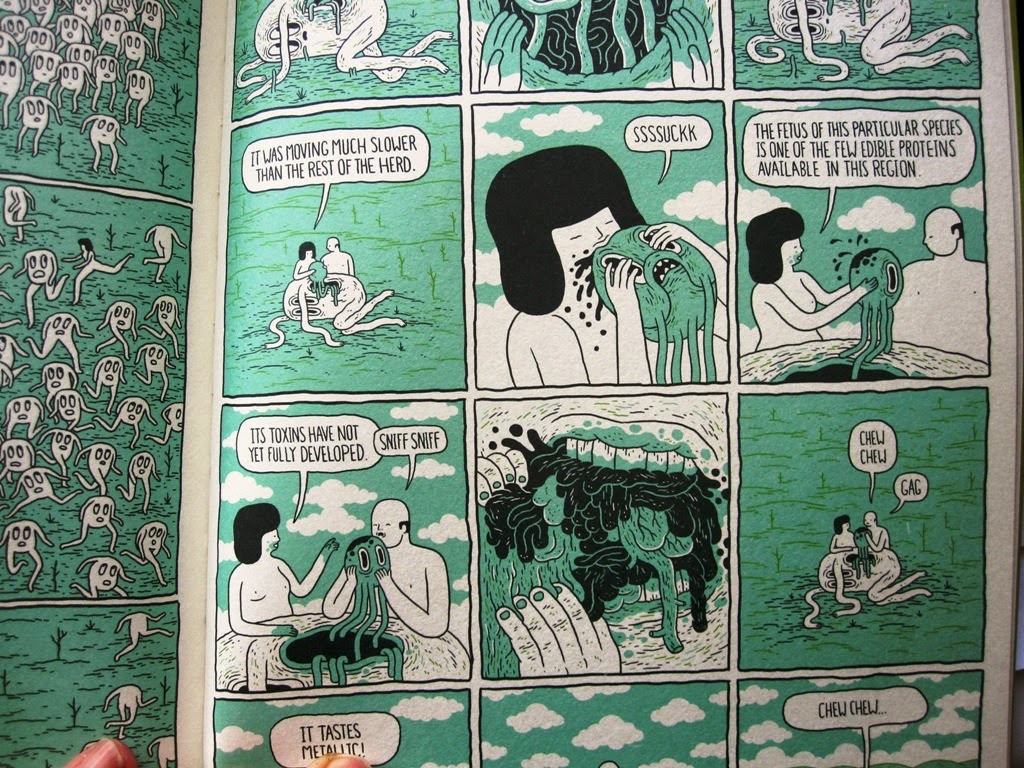
A newly married couple hunt gross insects and other creatures which in turn fight back by occupying them as host bodies. The book also works as the portrayal of a sick Garden of Eden with the guide as snake, or maybe everybody as snakes, and the author very much as God, unveiling to us the abstract geometry of all matter that makes up the fabric of life. Jacobs has also published a mini in 2014 titled Mathematical Solutions for a Global Crisis, which is in even mightier God mode. I'm not sure how much further in that direction I'd want to follow him, but for now he has some excellent survival tips.


Nine.
Juvenitive 3 by Jason Murphy (Subferior). This is about poses that can be struck with the help of a sort of rubberband figure, or sometimes a subcontrabass sax tubing figure, or a limp cushion figure with a bulb on top; poses that seem to reference classic cartoon slapstick situations without really playing them out. I've seen minis by Murphy where that didn't quite gel for me, but this issue has an extra looseness that makes it perfect. It also helps that some of the tableaux ...


seem to remind me of mid-60s Valerio Adami ...


(which is very much a good thing)


... and so on eight we have:
Pictures with connexions by Valerio Adami (Galleria Schwarz, Studio Marconi). "This catalog attempts to record a creative mechanism," the zine-like catalog itself informs us. It features a selection of 1966 paintings after found photos from magazines etc. An example will best show you the mechanism at play. On the cover, there's Matisse doing his best Freud impersonation:


On the first page there's Adami's mechanical translation of that:


Which shows, as the artist explains: "Me substituted for Matisse--while I am working in a pair of sky-blue [this we have to take on trust, most of the catalog is in b/w] Stirling Moss type overalls, associating the penis-pencil with Matisse's phrase, 'I have colors and brushes, and I must express myself with purity.'"

Seven.
Pyramid Scheme by Josh Burggraf and Victor Kerlow (Yeah Dude). One late night last year I watched an hour of Tex Avery cartoons to recapture the sense of anarchy they had offered me as a child (classic cartoons on tv was something I was allowed). They were still great but now they appeared almost mechanical in their excessive build-up toward one expectation after another to be stunted with a no-surprise surprise. The awesomeness now seemed to lie in the humorless precision of those variations on a long drawn-out punchline. (Very Germanic, no?)


That has nothing at all to do with the effortless absurdity of Pyramid Scheme, which feeds from completely different sources, except it fulfills my desire for no method at all. There's a bit of good-natured splatter that is maybe borderline anarchic, but it hides its mean temper behind tender lilac tones. Then there's real jokes or at least real silliness of the don't-touch-that kind with immediate payoffs. There are tons of references from, I guess, Donald Duck spacetrip adventures, to tripping in general, to Keith Richards snorting his father's ashes, and many more, none of which I get.


We must read panel for panel, because each panel drops the accents on a different beat, and on each page the characters completely change complexion anyway, as Burggraf has some serious chops and tugs stuff toward surreal battle scenes, while Kerlow favors a natural goofiness so during his pages objectives tend to be forgotten. Fun! (Isn't it sad, though, the small child protected only by his socialist gnome hat, alone in big space?)

Six.
Theth by Josh Bayer (Retrofit). I am sure this is the most proper comic I've read from Bayer so far, no scratching out or tipp-exing things, no sudden switches of pens, no careless stapling through the edges of pages ... but then this is serious, a classic coming of age story, or maybe a classic coming to terms with your comics addiction story.


The boy Theth (Seth with a lisp, I gather) also featured in Bayer's retellings of vintage ROM Spaceknight issues, which added depth by subtracting all that was not awesome from the original narratives. Now we get Theth's own viewpoint (somewhat cataracted by the edges of his spacesuit helmet's visor), and while to him comics are a vague proof that something must exist beyond his drab everyday existence (and beyond the limits established by his own personality flaws), comics are not at all a tool for escapism. Comics are a medium that allow you to imagine things and ask philosophical questions when you don't have the words for them. Quite clearly they will lead the discriminate reader, who struggles to analyze his own awestruckness, to a higher understanding of the world (though not to an understanding of comics themselves).

(The only reason this is not my favorite book of the year is that it's so very American and I had to grow up all by myself with just the one World's Finest issue that I had for only a week. You don't know how lucky you are.)

Anyway, you would have to call this a graphic novel. You can read the hell out of this book.


Five.
The Incredible Hulk 268 by Bill Mantlo and Sal Buscema (Marvel). I actually got this because Theth reads it in Bayer's first ROM from 2011. There Theth's mother picks up the issue and laments: "Everything you read is angry and weird. Life isn't some twilight zone where everything ends up with a scary twist." Theth in return thinks: "It's that stupid Hulk comic [in] which nothing even happens--it's supposed to be all eerie and dreamlike but it just doesn't feel as strong as they maybe wanted it to ... It's not fair that I should have to defend it, I'm not done judging it." ... But no, it is as strong as maybe they wanted it!


There's a benefit to reading this stuff from such a distance (locally and in time). Especially Marvel comics (much more than DC) from the 80s are so faded already (well, what I get from ebay) that they appear positively antique, or maybe timeless (which works because I as a German, while 14 in 1982 and so within the right age group, have never seen most products from the ads before). So the act of reading feels like excavating relics of a remote culture. It has become eerie, this mad, urgent energy, over the top emotionalism, the scream Buscema grafts onto many of the faces, at once unspeakably angry and limp with despair, pure creatureliness, and at the same time of course a mere ornament of the face, an author's trademark. And yet the comic for me exists beyond authorial intent, because I have no idea how to take it. Were they serious? If they were, the story ends on the most soul-crushing of notes, Hulk making short shrift of the Pariah: "Hulk will crush stone! Then let spirits find somewhere else to live!" (They do survive between the lines, happily.)

Four.
Eel Mansions by Derek van Gieson (Uncivilized Books). I would recognize few rules on which comics I like and which I don't, but one hard and fast rule would be that I hate comics in which faces illustrate or amplify what's being said in the speech bubble. Luckily, in Eel Mansions most of the characters are shooting sideway glances to check if the character on the other side of the page appreciates how they themselves will fully treasure their own wit. And they come up with wisecracks objectively out of step with proceedings around them, yet are safely contained inside their own circle of references. I guess it's the resigned self-delight of the characters which holds the whole thing firmly together despite all the willful switches (and appropriations, there's even a Moomin riff-off called Doomin) of styles.


I read the six minis (the last two in 2014); right now the book is out as a trade at twice the page size (the cramped lettering can be quite hard to decipher in spots, so more size will help, grrr ... but then again the squint you need for this equals the squint you need for a fading, dissolving old Marvel page, except you get tons more ink). I did not follow the plot, if plot there was, so I can't tell you what happens. Even when I try to pay close attention, ten pages later I can't remember anything as this seems constructed in a classic Russian novel kind of multiplying cast of character treatment. (This should have its own wiki page, also for spotting the references and links to the songs etc.) But then I'm not into plotlines anyway, so I read it for the vibrant tone, that of the blackest ever ink and of the conversation and the sly expressions on faces that always impress the observing reader by force of pose and personality.


Three.
The Invincible Iron Man 169 by Denny O'Neil, Luke McDonnell, and Steve Mitchell (Marvel).


Is it relevant that three years later Jeff Koons brought those same booze signs into the gallery space?


That was for his series Luxury and Degradation, and most comments on this Iron Man phase, during which Tony Stark boozes out completely (I'd count roughly 166 to 170 as the absolute classics before a SHIELD story, which includes strange aquamarine creatures, cuts in and starts undermining things), seem to remark on how the portrayal of alcoholism and abjection here is too simple or too corny or whatever, but I find Iron Man's drinking absolutely befitting a superhero and his mad actions highly deserving of a reward. The art is sometimes a bit wooden but always on the nose. The stakes are high, the battles senseless. 


Two.
My School Sunk into the Ground, So I Had to Dig to Get to My School Reunion and How to Make a Puppet by Malcy Duff (self-released). It's Year Two of my ongoing Malcy Duff addiction. So how do I rate him now I've got all the older minis I could possibly get and am reduced to following the current output? I still compulsively grab them from the shelves whenever I find myself with a free minute. Still let's say I'll place him on two, because I can't have the same number one every year. Also of course I can take it or leave it.

I'm not sure I can pinpoint how the new output varies from the previous. Maybe the rhythm is less quantized? You have heavily superimposed drawings followed by especially blockheaded blank pages ...

My School Sunk into the Ground also has electric dowsing (do you call it that?):


How to Make a Puppet comes in one of my favorite Duff covers (a sock performing a headstand on top of a chest of drawers, google it) and is sort of a reverie on the noble sport of table tennis (I seem to remember that an earlier mini by the author was mostly about tennis, so it might be enlightening to compare the two, but I have yet to unpack the crate that one's in).


It appears table tennis is a very lonely sport whose limited formal repertory can be reduced to the letter H. That formal repertory, though, can be found even beneath the self-estranged nature that we call a park, which we cross when on weekends we go and watch the library from afar. Loads to chew on! Incomparable linework, idiosyncratic timing.

I still cannot make a puppet.

One.
Isaac by Nathaniel Walpole (self-released). This is probably another coming-of-age story, like Theth, and also one about finding one's place within natural surroundings in a mutual truce, which relates it to Jacobs' Safari Honeymoon. Isaac is some sort of man creature with a phallic neckhead and a phallic tail and a not quite as but still phallic phallus, who has to learn to govern his typically male urges and not to fuck with nature and its creatures (including man) quite as willfully.


The drawings look much more awkward on the page than they do in these snapshots (it's not a mini but a school pad-like A4). They seem executed in no longer quite fresh fine-liner on sandwich paper, and the more naturalistic elements, like the members of a bronze age family Isaac does battle with, are rendered with schoolboy studiousness rather than freely inspired lines. (Or like an autobio comic. The denser textures are nice and deep, though.) This awkwardness seems very necessary somehow, in that the page is not mastered just like the narrative remains open. The whole thing has just the right degree of openness for me, a very selective viewpoint which never seems to transcend the given situation (or maybe Isaac is just a slow learner?) ... much richer than God perspective in the end.


Usually I'm all for mad skills, though, so I am very excited by the promise of some more recent drawings Walpole has posted on his tumblr, which show him experimenting with different speeds of line etc. Now a comic of these ...

P.S. On a historical note, Wassily Kandinsky was the first to try and develop an Isaac out of a horse during an improvisation in 1911:


He failed and chose abstraction instead. Probably he would have been more successful starting from a human figure, but these were never his forte. Still, see how close he got:


Friday, April 11, 2014

Village in a Panel


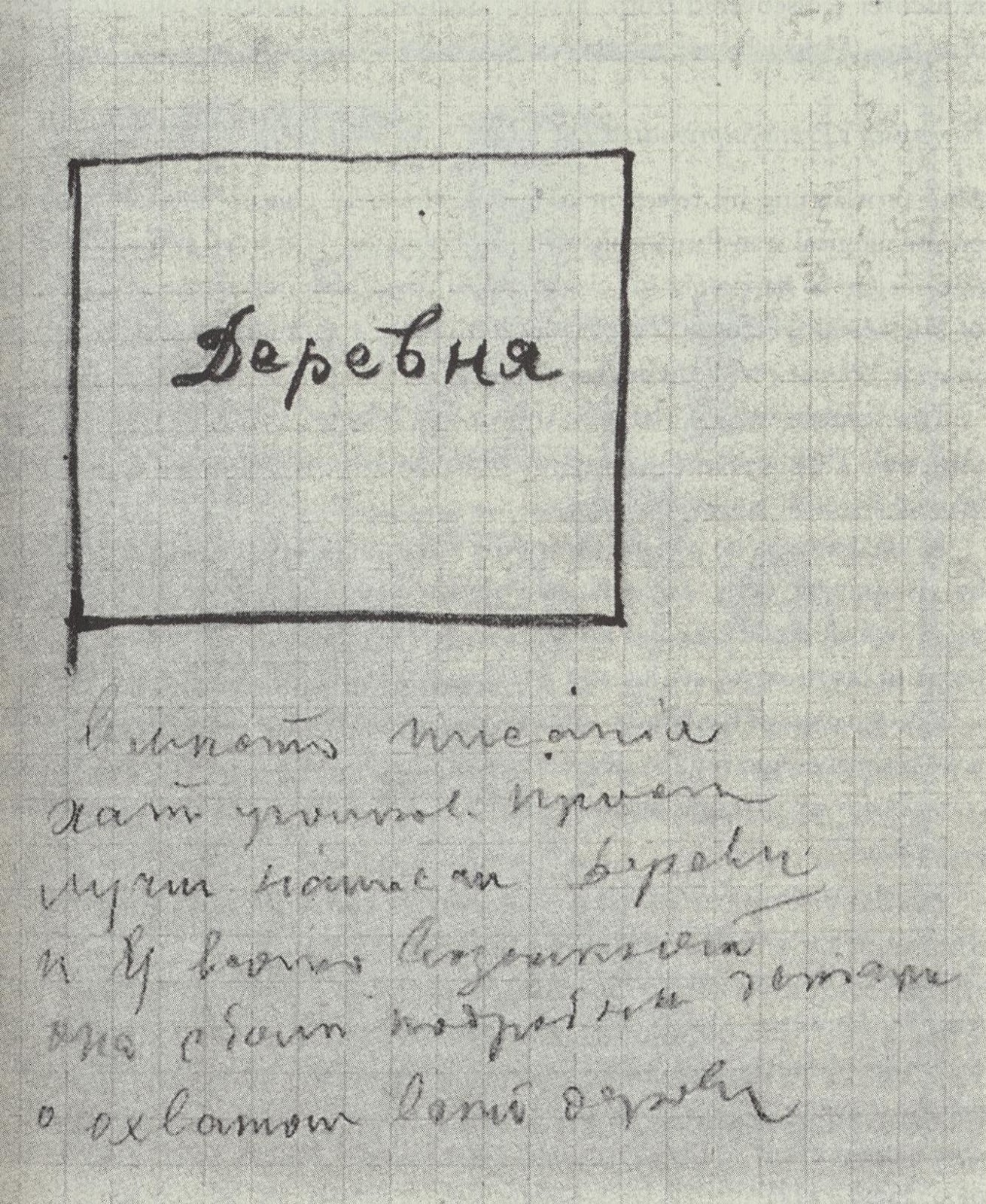
This is a village in a panel by Kasimir Malevich. There's a small post about that and Malcy Duff's comics (see previous entry) over at my pod.

Sunday, January 19, 2014

Five Favorites of 2013

This is more fun if you have a hunch of my questionable tastes, so first let me think what my top five of 2012 would have been. Best for me was definitely Blacklung by Chris Wright. I should write a post about that sometime. Second place I'd give to Hellblazer, trusty old bastard, third maybe the Lilli Carré collection, fourth would go to the first Animal Man trade (oh did I have hopes in that), and then either Jesse Jacobs or the first trade of Waid's Daredevil (which also immediately afterward dropped in quality). I'm sure I'm forgetting something but this sounds about right, Fantagraphics-type books and superheroes who were in much better shape then. My list for 2013 doesn't have much left of those, but feels similarly unrounded. This is not on any perceived order of objective merit, but simply what I loved best:

Five.
Theremin 1 by Curt Pires and Dalton Rose (Monkeybrain). I was actually reading a proper Theremin biography, subtitled Ether Music and Espionage, and while the subject was completely fascinating...science prodigy, instrument inventor, spy, working in post-revolution Russia under the urgent expectation to come up with something good for state prestige, living in the US as sort of a socialite (is there a pun in that?), still the book was tough going and I didn't get very far. Probably because it stuck with the sources and had most to tell where details were richly documented, and not where we'd want to imagine stuff. And that is where Theremin the comic came in and delivered all the fantasy hoped for, keeping it much more true to the character potential. Because when you hit the right frequency on the Theremin:


It's actually The Red. Ouch. I have no idea what it's doing here, I thought it was busy turning the DC universe into a shapeless mire. Still you can maybe see here what I like about the art: sparse lines with a somehow oldschool stiffness that leave lots of space to be creatively filled with anything from flat computer patterns to ornamental brushstrokes of analog paint... But what mainly made the issue so brilliant for me was what usually would annoy me, that it was pure exposition, tackled not in a careful manner, but instead everything thrown at the reader at once (as befits a character successfully performing a double assassination of Lenin on two different timelines). Of course, this opening move could not be followed in the same vein. The second issue started "one year later," and then the storyline kicked in and came with lots of wondrous incidents that made the book not so amazing anymore.

Four.
Hellblazer: Death and Cigarettes by Peter Milligan and Giuseppe Camuncoli or Simon Bisley (Vertigo). The news of course being that here was the end of the line...


I'm rating this higher than most people do, I think? Milligan's run is my second favorite of the longer Hellblazer runs after the first two Delano trades or so, and it's my favorite Milligan run on anything (his surrealism in e.g. Shade or Animal Man is a bit too forced for my tastes, there's nothing more easy than organizing meetings between sewing machines and umbrellas, so it's shorter stuff like Face or Flowers to Rhino that I really love). Also, the series had Camuncoli at his best (and it looks like he'll be completely eaten up by the really big mainstream projects now, getting inkers to soften the biting of lips and crumbling of eye sockets, so who knows if he'll ever do anything worthwhile again). Anyway, the book goes out in style, offering plenty of looking back without getting too sentimental, and does a good job killing off Constantine in senseless fashion, except he saw a chance to go which might look better on the tab sheet in hell than what he rightfully would have coming. I thought Milligan was about done with the character anyway, so it was a good moment to go for him too. By the later parts of this collection the plot felt noticeably reined in, and the pacing became heavier on actual development, but the incidents continued to entertain (Constantine smoking his own dead ashes to top Keith Richards) and the ending's not the feared cop-out. Constantine is dead alright and properly shellshocked by the fact he no longer has a scheme in the game (see above). (That guy Constantine still running around the DC universe is of course an impostor who must be ignored.)

Three.
Copra 6 by Michel Fiffe (self-released). Now I know from the many favorable reviews that the series is altogether a feat as a whole, and I'm sorry for being so perverse, still I vote for only this single issue as a standalone without knowing or wanting to know much of the rest. The issue comes at the end of the first story arc, and team Copra and a few presumably more evil characters are battling it out after all plot duties have been performed. Since everybody also gets a little descriptive box at first entrance, stating their name and prime motivation ("Gracie: likes to punch and kick"), there's no context really lacking and nothing to prevent us from the pure appreciation of inventive draughtsmanship which the carnage provokes here...


It comes down to a battle between one Man-Head ("street fighter, widower") and Vitas ("main bad guy drunk on power"), with other staff jumping out from the works and landing a blow or two only to abstract themselves and vanish again. I suspect a strong meta layer both in homage to classic comic book fights and there is reflection of broader conventions of depicting violence e.g. in a very impressive two-page sequence where Man-Head recites his life story while battering away on an already beaten opponent, the life flashing through the mind of the aggressor instead of the one who's about to die. By the way, the issue is perfectly safe for somebody squeamish like me, especially since without the five previous and six to-come issues I'm not invested in the well-being of any of the characters. It would be no use to read the other issues, I'm never into team books at all. Not into Suicide Squad, which is the main inspiration here. (My rules for the rest of this list are I cannot nominate a single spread only if I haven't read the rest of the book.)

Two.
Miniature Jesus by Ted McKeever (Image). McKeever can be too much for me, an auteur with a vengeance, each page a broadside, and it's probably telling that my favorite of his books so far was Meta4, his most controlled effort, which came in a subdued format and in a rather grayish black and white (I'm not sure if that's on purpose or just a bad printing? anyway it worked great to make it feel more, well, meta). Miniature Jesus is full blast mode again, and even if you read it on the most immediate level as the story of an alcoholic with a little angel (miniature J-boy) and some rather big devils on his shoulders shouting into his ears, the energy level is amazing. But actually despite this thing being built on rather common dichotomies in noir black and white, the story is actually quite slippery, and every cliché might immediately cave in on itself. The tone is informal, there are lots of off-notes even if all that happens might just be spontaneous externalizations of one loser's internal debate. The figures are eternal posers, but their grandstanding might immediately be followed by an apologetic grin. All the conflict seems overcooked, and nobody falls for anybody's worldly wisdom except for selfish reasons...


Possibly the whole drama takes place while the main character walks only a block, and we follow just a single, tired train of thought, him amping up his profane conflicts into a war of the heavens. Not much is resolved by the end, except he won his soliloquy. So that's relatively upbeat. But anyway, even if you choose a straighter reading, it should still work for the art, which is more consistently realist than usual, coming out of a thick chiaroscuro, with sudden clashes of style, as morals can quickly deteriorate the figures into caricaturesque distortion. The images sit blackly on the page with only a narrow frame, sometimes looming there so heavily that there's no room for the page to be composed...each panel is onto itself. It's a complete trip, and the narrowness of theme heightens the punch.

One.
Don't Name Your Hands "Hands" and really a good dozen of other mini-comics from the last decade by Malcy Duff (self-released). So yes I'm cheating here, all of Duff's works were completely new to me and I'm rating their collective impact. Actually his 2013 output is rather on the more reduced side, so it helps to come with lots of expectations on what will happen when you turn the page and have those disappointed. If I had to tell you what the comics are about, I'd say: lovingly rendered awkwardnesses of form. Also: things developing into situations from which there is no escape except changing the topic...


...and they're about an empathy with these things and beings for their awkwardnesses, an empathy not of feeling but of bodily sensation, holding an expectant posture over several panels, feeling my few hairs fluttering in the wind, before we finally make eye contact: what now?


Instead of a storyline, the work  is driven by modes of presentation. Frames present a few choice lines hovering between the edge of a pool in a public swimming bath and the springboard. Some objects present themselves like conjurors performing their little tricks, some forms are exposed by the hand of the author in more autocratic manner... Presentation is about the single moment, so this mode frees up time, and it's amazing how many panels can be fruitfully wasted in the pursuit of the rhythm of not much happening. For example here we have something like a misshapen board creeping out through an opened door until our undevided attention gets too much for it and it slides back again. It's like the abstracted storyboard for a Tex Avery sight gag, say, the endless stretch limo driving through the picture, stretching, stretching, but then just before the big bad wolf at the wheel is waving his sign, "that's long, isn't it?"...proceedings are reversed, and you will never know that there was a wolf, and you can't even be sure it was a stretch limo, and that's it, folks.


Runner-up of the two Duff titles from 2013 is called I Have Never Seen Anyone Hold Their Nose and it has a story written on the cover which begins: "We can see ... A woman putting shards of glass all over the outside of her house." From there we go through eight pages of not very interesting loosely pasted pattern fragments (maybe readable as memories floating like ghosts like double glazed broken glass, if we're searching the story for clues) until we finally arrive at just what the story said we would see, the woman standing before a rectangle inscribed as a house with little jagged fragments that read "glass." So if that doesn't prove the story then I don't know what will. When we turn the zine around there's the exact same story on the cover again, and we go through the exact similar pattern debris, but then we get distracted and end up with somebody maybe holding their nose. But it isn't proven that they do. Then I always flip back a page to stare at the earthworm. I never knew he bore such straight tunnels into the earth, stiffening up half his body with rigorous muscle tension. I must admit that more than once I accidentally chopped worms apart with the blade of a spade digging up earth, and I spent a sorry thought on them wondering if indeed one half would live on like it's said it will. But never have I been so in tune with the plight of the common earthworm.


(Excuse the awful scans. Oh and if you've accidentally found this post because you want to get rid of a Malcy Duff comic I don't have, please make contact.)