 The Fury of Firestorm: The Nuclear Men #2 (DC) - Despite its blunt dialogue and half-baked racial politics, this series' first issue was messily intriguing, a smear of weird ideas and keyed-up hysteria. Gail Simone and co-writer Ethan Van Sciver deliver more of the same for the second issue, though if anything the dialogue is even more ungainly this time around, and the seams are showing more obviously in the exposition-speak and uneven pacing. Yildiray Cinar's art continues to be the most satisfying aspect of the comic, with a distinctive marker-line style that makes things look curiously washed-out and faded. It's a great-looking comic, and there are some cool, out-there ideas bouncing around here, as the two Firestorms embody opposite personalities and can come together as part of a larger whole. It's not really a good comic, though, and I'm not sure how much longer I can wait for it to get over its trainwreck weirdness and become legitimately worth reading.
Journey Into Mystery #630 (Marvel) - Every time an issue of this Kieron Gillen series comes out, I keep thinking that it's a book with a lot of promise. There are always flashes of wit and clever writing that suggest the truly great comic it could be but never quite is. This issue has paid off my patience in a big way, though, with the best issue Gillen's written yet, the first issue to really deliver on the promise that he's shown in crafting the adventures of Loki and the other Norse gods. The focus here is on Volstagg the Voluminous, one of my favorite of the Marvel Asgardians, the jolly fat man who's a lot smarter and a lot braver than the comic relief goofball he usually seems to be. So it shouldn't be a surprise that this issue just sparkles from beginning to end; it's funny and poignant and a great showcase for the fat god. The dialogue, always Gillen's strongest attribute, is really witty and packed with puns and fast-paced exchanges, like the mocking but affectionate back-and-forth between unlikely conspirators Loki and Volstagg. And then Volstagg returns to his family, and tells his children the story of his encounters with the evil Serpent, embellishing details freely and making himself look muscular and dashing in his visualizations of these tall tales. It's funny as hell and perfectly paced, with the best moment probably being when Volstagg gets carried away in imagining Ms. Marvel gushing over him, prompting a stern scowl from his wife. There aren't as many of the often-ponderous narrated caption boxes that Gillen has sometimes leaned too heavily on in previous issues: while his omniscent narrator can be stilted and boring, his control of the characters' voices is perfectly pitched. The bulk of this issue is dominated by Volstagg, and through Gillen's writing of the character (and artist Richard Elson's expressive body language and faces) one can practically hear the big god's booming tones and jovial jesting.
The Savage Hawkman #2 (DC) - Man, this is a staggeringly bad comic. I thought, after Tony Daniel's first issue, that I could put up with Daniel's gritty Frank Miller wannabe writing for the sake of Philip Tan's lush artwork, but now I fear I was wrong. This is a comic that opens with the terribly named alien villain Morphicius telling the hero, "your nth metal is burning my blood, Hawkman! But it is a good burn!" Kinky. There's more, much more, where that came from, as Daniel seems intent on proving what a bad writer he is on every page. As for Tan, his chaotic battle scenes are certainly cool-looking, if sometimes not especially clear — the title splash page is basically just a big mess of fire in which the two combatants are totally immersed — but the non-fight scenes don't fare as well. Tan's drawings of Hawkman's co-worker Emma as an emaciated beanpole with a deformed upper body are especially comical.
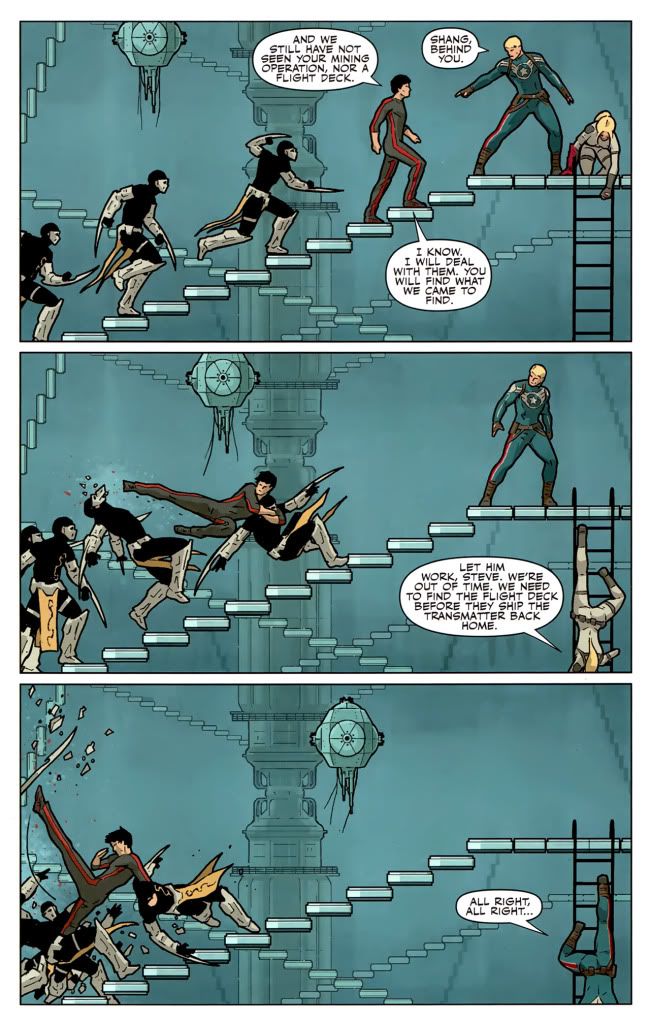
Secret Avengers #18 (Marvel) - This is Warren Ellis' third issue since taking over this series (after a solid but unfortunately abbreviated run by Ed Brubaker and a few lousy Fear Itself tie-ins by Nick Spencer) and he's turned it into just the kind of one-and-done secret mission thriller series that is one of his fortes. There's more than a hint of Planetary and Global Frequency in these issues, as Ellis makes each issue a standalone story in which Steve Rogers and a small roster of his secret agents must stop a potentially world-ending threat at the last moment. For this issue, it's just Rogers, Sharon Carter and Shang Chi infiltrating a secret base where the bad guys are smuggling out some material that could turn the Earth into a sun. For some reason, the base has warped gravity so that staircases run upside-down and up the walls, which gives David Aja an opportunity to draw mind-bending M.C. Escher layouts in which the heroes and the bad guys stalk each other at odd angles and have gravity-defying fights that start out upside-down and end with the combatants flying off-panel right-side-up. The action is brutal and efficient, and in between the fight scenes Ellis likes to pause for just a moment's breath, in which the team's resident scientist Beast often delivers elegant explanations for the multidimensional weirdness that's caused this latest threat. This is the kind of comic that Ellis could probably write in his sleep, a breezy sci-fi spy thriller with punchy dialogue and a new, inventively realized evil plot in each issue.
Superman #2 (DC) - George Pérez and Jesus Merino's Superman lacks the punchy modernism of Grant Morrison's new Action Comics, but that's obviously intentional. Just as Morrison's series chronicles the early adventures of an angry, hungry young Superman, Pérez is telling stories about a much calmer, more settled Supes who's grown into his power. While he retains the polemical, near-socialist idealism of Morrison's Superman, he's also been worn away a bit by the years. This is a very melancholy, lonely Superman who opens the issue brooding over star charts that show the location of his demolished home planet. Later, he sits in his aptly named Fortress of Solitude while Lois Lane, oblivious to his romantic pining over her, asks him to share what's bothering him. Like the first issue, this one focuses on a fight with a strange monster, though this battle is more inherently interesting and has a pretty clever conceptual hook: Superman can't see the monster while all the humans around him can. This means that he winds up relying on video feeds and televisions to fight the monster. The comic shows things from Superman's perspective, so that he seems to be fighting thin air while keeping an eye on video monitors that show what everyone else is seeing. It's nicely done, and feels like the kind of gimmick that might have provided a goofy single-issue hook for an old Silver Age issue of Superman. It also provides some visual interest that was mostly lacking in the first issue's comparatively generic fire monster. Pérez's writing is still wordy and old-school, overloaded with narration as Superman records his report about the day on his computer system. The overall effect is dense and meaty, ignoring recent trends towards minimalism and decompression.
Teen Titans #2 (DC) - Yeah, I'm done with this now. I gave this series the benefit of the doubt because I'd been pretty positive about the first issue of Scott Lobdell's Superboy, and the two books are basically telling one big story, but the first issue wasn't exactly thrilling. Now I'm ready to give up on Lobdell's New 52 work, because the second issue of Superboy wasn't anything special, and this series continues to underwhelm. Not much to say here, really. It's the kind of book that seems to think that introducing a character, giving him or her a power set and maybe one defining characteristic is the extent of characterization. The Wonder Girl/Red Robin relationship here is so one-note and simplistic: Wonder Girl just responds defensively to everything, while Red Robin makes puppy dog eyes at her. Nothing much here to make me want to read more.
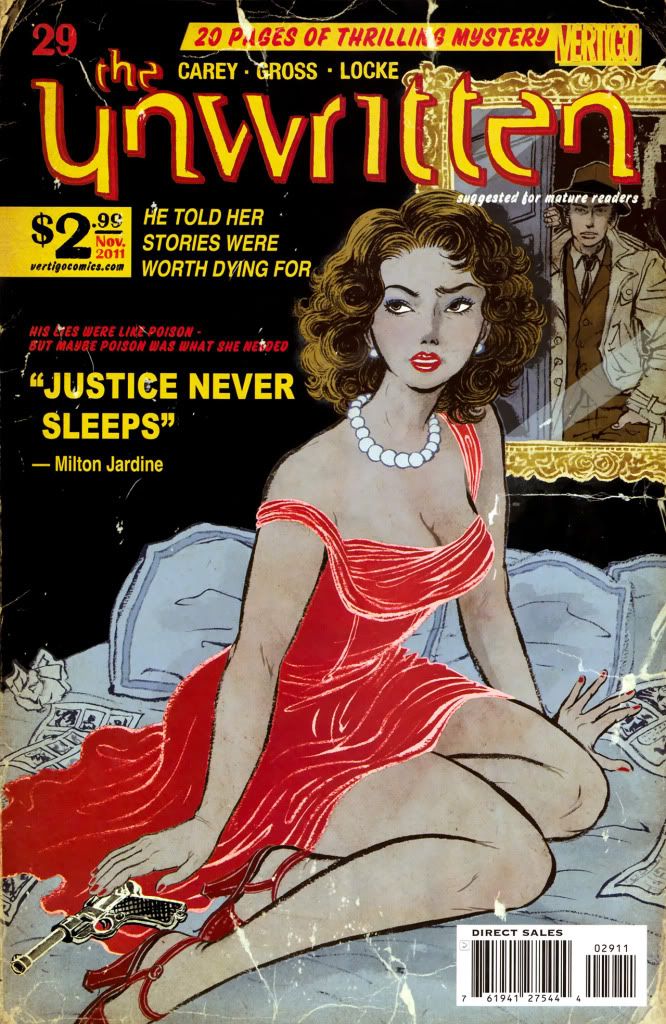
The Unwritten #30 (Vertigo) - Though I'm a couple of weeks late here, this is the best issue yet of Mike Carey and Peter Gross' magical fantasy series. The most recent story arc has been delving into the rather sordid past of Tom Taylor's novelist father Wilson. This issue provides the climax of that story with an especially heartbreaking revelation about the comic book character the Tinker, a costumed hero who seems to have burst into the world from the pages of a short-lived newspaper serial. This series is, at heart, about the profound effect of fiction on those who read it and create it — as this issue makes clear, so many of this series' characters exist at a sort of junction between reality and fiction, their lives shaped by the stories that at times seem more real to them than "real life" itself. That's especially true of the Tinker, whose devastating story forms the bulk of this issue. As the comic cuts back and forth between a conversation between Tom and the Tinker and flashbacks from Wilson Taylor's journal that elucidate this strange character's past, a truly strange and powerful tragedy begins to take shape. What's especially powerful is the way Gross draws the Tinker at first in a bold, cartoony style that emphasizes his comic book origins, but as the issue goes along and the tragic truth about this character is revealed, his square-jawed heroic countenance fades into a wasted-looking old man.