Showing posts with label Walking Dead. Show all posts

Thursday, May 9, 2013

Weekly Comics: May 8, 2013

3 New Stories (Fantagraphics) - Pamphlet-format comics from indie publishers are pretty rare these days, with most smaller publishers having migrated towards the bookstore market and "graphic novels." So it's nice when something like this comes along, an actual floppy comic with three stories by Dash Shaw. I suspect the demise of Fantagraphics' anthology MOME may have something to do with this release, as these little experiments are exactly the kind of thing that Shaw would've published in those pages. With no regular outlet for these kinds of short stories, which have always formed a significant portion of his artistic output, he's assembled a few of them here. The middle story is a very short "adaptation" of a Girls Gone Wild segment, similar in form to the dating-show adaptations Shaw did in MOME, though not as substantial — he doesn't manage to burrow into the emotional core of this shallow video product the way he had with his earlier TV/video adaptations. "Object Lesson" is a pointed surrealist piece about the current economic situation, a barbed satire in which an out-of-work detective is sent back to high school due to a clerical error, while his family starves and resorts to eating the dog, his wife encouraging him to, "Lower your standards. Abolish your goals. Cower. Give up. Please." Throughout the comic, Shaw's drawings are overlaid on collages of paintings and photographs, full of symbols — Spider-Man, gold coins, a desert vista — that comment on the action and also serve as backgrounds and coloring. It's a potent, ambiguous portrait of a society where standards, goals, and morality have been rendered obsolete, where education is a bad joke, where making money means resigning oneself to serving a ridiculous system. Similarly, the final story depicts a children's prison where kids have been jailed for petty offenses, prevented from deviating in even the smallest ways from a restrictive series of laws and orders. On the chillingly nonchalant final page, the relentlessly upbeat heroine shrugs off the violence she's seen, a sign of how this kind of system encourages detachment and dehumanization. This is undoubtedly a bleak little comic, but as usual with Shaw, it's also formally inventive and unforgettably potent, communicating some very strong emotional and political truths through its blunt symbolism.

Astonishing X-Men #62 (Marvel) - I wasn't reading this title before its recent involvement in the conclusion of David Lapham's Age of Apocalypse, but I figured I'd check in on this follow-up issue in the hopes that some surviving AOA characters might still be hanging around. No such luck, but this issue is a decent enough, low-key character piece. I'm not sure if the book is always like this, but Marjorie Liu does a good job, in the complete absence of action, of providing quiet character beats and relationship dramas. Very simple stuff, as basic as Kitty Pryde leaning her head on Wolverine's shoulder, after getting shuffled to the side by her boyfriend Iceman during an earlier awkward moment. Artist Gabriel Hernandez Walta's elegant, expressive art is perfectly suited to this kind of understated drama; it's all in the body language, the subtle facial expressions, the careful staging of the characters within the frame. I have a feeling things are bound to head into more conventional mutant action soon enough, but I would happily read a quiet little book like this on a regular basis.

Avengers #11 (Marvel) - Jonathan Hickman's dual run on this title and New Avengers continues to sprawl; while New Avengers has been almost unrelentingly dark and grim and single-minded, the adjectiveless title is looser, epic in scope, leaping around from one thing to the next like a careening pinball, crashing from one shard of plot to another. Here, a group of Avengers attempt to infiltrate an A.I.M.-sponsored weapons deal, posing as gambling fun-seekers while they try to suss out clues. With Mike Deodato's glossy art giving the whole thing an Ocean's Eleven heist movie glow, this issue has a lighter tone than most of Hickman's work on these titles so far. It doesn't always work, and some stabs at humor over Black Widow's plan to take violent shortcuts feel very forced, but most of the issue is quite fun. The highlight is Cannonball and Sunspot convincing a couple of A.I.M. agents to skip the obligatory fight scene and have a fun weekend of boozing and partying instead, a sequence that wouldn't be tonally out of place in Matt Fraction's Hawkeye. Meanwhile, to satisfy those seeking some action, a Shang Chi fight scene is threaded through the whole issue. This is a pretty minor piece of the overall puzzle, probably the weakest single issue of Hickman's Avengers yet, and only at the end is an important piece of information delivered. This will be a mere blip in the eventual omnibus (which is the perfect format for these epic Hickman runs) but as a single issue it's just on a slightly lower level than the rest of the series has been.

Avengers Assemble #15AU (Marvel) - Big surprise, but while Age of Ultron itself has been very good, most of these AU tie-in issues are very unnecessary. This one's set in the early hours of Ultron's takeover, and has Captains Marvel and Britain going up against Ultron with the help of some very whimsical British heroes who, if I'm not mistaken, were invented especially for the occasion. Al Ewing guests for regular writer Kelly Sue DeConnick, and Butch Guice is excellent as ever, but it's all pretty much pointless, because what can any of these tie-ins show besides variations on heroes failing to beat Ultron? Ewing indulges in some fun-enough Britophilia, and there are some nice but all-too-brief sequences when the video-game-infiltrating hero Computer Graham matches pixels with Ultron, but otherwise this is pretty forgettable.

Batman #20 (DC) - The conclusion of Scott Snyder and Greg Capullo's Clayface two-parter is just OK, which compared to some of what's gone on in this title, is a minor triumph. Compared to the ridiculous revelations that capped the Owls storyline or the sputtering non-event of the Joker story, a straightforward Clayface battle that ends with the villain viciously imitating the recently dead Damien Wayne is definitely a step up. There are still some rather head-scratching moments, like Batman pretending to wear a DNA mask taken from Bruce Wayne, but for the most part this is decent if unexciting. It's also odd how out-of-step the relatively well-balanced Bruce seen here is with the grief-stricken lunatic Peter Tomasi is depicting in Batman and Robin, one of the problems with there being something like ten Batman-related titles coming out every month. Unfortunately, there's still no sign of Snyder getting back to the tight noirish detective stories of his pre-New 52 Batman work, and since he's now gearing up for what promises to be a full year's worth of excruciatingly boring origin stories, this ship probably isn't going to be righted anytime soon.

Batman & Red Hood #20 (DC) - In the wake of Damien Wayne's death in Grant Morrison's Batman Incorporated, Peter Tomasi's Batman and Robin is being retitled a few times to co-star first Red Robin and now Red Hood, with other Batman sidekicks and friends set to appear in the title in coming months. Other than Morrison himself, Tomasi seems to be the main Bat-writer dealing with the fallout of Damien's death, and specifically its effect on Bruce, as seen most memorably so far in #18, a silent issue in which Patrick Gleason's brooding art captured the grieving father's rage and despair over the loss of his son and crimefighting partner. Now Tomasi and Gleason have Batman working through the five stages of grief with help from his friends, and it's been heartbreaking and really well-done, a very powerful companion piece to Morrison's work — while Morrison barrels forward towards the likely epic conclusion of his years-long run, Tomasi pauses in the shadows, dealing with the emotional meltdown that follows Bruce's personal tragedy. In this issue, Batman is especially brutal, both with the assassins who he and Red Hood bust up (Batman purposefully deadens the nerves in their hands so they'll never be able to shoot a gun, or feed themselves, again) and in his dealings with Jason Todd, the man under the Red Hood mask and once a Robin himself. The issue's climax is really powerful, both in what it says about Batman's grief over Damien, and in the hurt reaction of Jason, who feels like he deserves better than this cruel manipulation. As in the last issue, where Batman tried to recruit Frankenstein to help him bring Damien back to life, Tomasi is dealing with the messy, ugly, awkward reality of grief, and the raw, ferocious emotions spilling across these pages are really compelling.

Chin Music #1 (Image) - A new horror/supernatural series from Steve Niles (of 30 Days of Night fame) and artist Tony Harris. I was anticipating some good gritty horror, but I didn't think much of this virtually impenetrable first issue, which doles out very little text or dialogue or actual plot — for an introductory issue, there's surprisingly little to hold onto here. Some kind of supernaturally powered guy (a google search tells me he's named Shaw, though the issue isn't so informative) is attacked in what seems to be pre-Twentieth Century Egypt. He's burned and stripped down to a skeleton, which somehow still lives, and flees (or is sent) through time to Prohibition-era Chicago, where he quickly comes into contact with Elliot Ness (who barely reacts to the spectacle of an Arabic-speaking living skeleton) and Al Capone. There's just not much here, and the time travel stuff seems very cutesy, the kind of time travel story where a fight between supernatural beings is used as an explanation for the Sphinx losing its nose, and where the main character will immediately meet any famous historical figures who happen to be in his time. The history-changing ending isn't enough of a hook to bring me back for more, nor is Tony Harris' art, which is nice and moody but can't distract from the essential slightness of this issue.

Constantine #3 (DC) - Yeah, so Peter Milligan's run on Hellblazer wasn't the most exciting or greatest in the title's history, but it was good, and I can't stop thinking about it when reading the new tales of Constantine in the mainstream DC universe. Everything Milligan (and many other writers in Hellblazer's storied history) did well has been jettisoned. The supporting cast is anemic and poorly developed, with characters showing up out of nowhere and heading back there as soon as their plot function has been fulfilled. The book is relentlessly plot-driven, with none of the downtime or weird diversions that always made Hellblazer so fun. And most importantly, Constatine's essential aimlessness has been sacrificed. One of the best things about Constantine was always that he wasn't a hero, that he almost never set out to do big quests for their own sake, but now not only does he have a mission, it's a mission that's explicitly spelled out in the intro box that appears on each issue's title page. It's just totally the wrong approach: Jeff Lemire and Ray Fawkes throw in all the superficial signifiers, the cigarettes and British lingo, but the soul, the attitude, the warped and wild aesthetic, is lost in translation.

Fearless Defenders #4 (Marvel) - Cullen Bunn's had a pretty disappointing career at Marvel so far, and this is the first book he's done for them that really has something to recommend it. It's a goofy, pulpy B-movie kind of book, with an all-female cast, and it has a breezy quality to its action and its banter. Will Sliney's art is slick and his women are undoubtedly sexy, but the book thankfully doesn't resort to outright cheesecake. It's pretty much the definition of a fun, lightweight action comic that's easy to read but not necessarily essential.

Infinity - Free Comic Book Day (Marvel) - Despite not going to a comic shop on Saturday, I did snag a couple of FCBD books at my local shop, including this one. This is a teaser for Jonathan Hickman's upcoming Infinity miniseries, a summer event involving Thanos coming to Earth. As expected, it's all set-up to establish a sense of encroaching doom, but it's beautifully illustrated by Jim Cheung, who turns in some of the best work I've ever seen from him. The alien creatures who serve Thanos are just seething with menace. I'm looking forward to this event, which will probably play like a brief, violent outgrowth from Hickman's larger Avengers run. Also included here is a brief and not bad Thanos/Destroyer fight story from 1977, written by Scott Edelman and drawn by Mike Zeck. Plus a very short excerpt of Warren Ellis' upcoming Avengers graphic novel, way too brief to get any idea of what it'll be like, though the back-and-forth patter between Captain America and a few other Avengers has some nice spark to it.

The Private Eye #2 (Panel Syndicate) - This is Brian K. Vaughan and Marcos Martin's new self-published, digital-only, pay-what-you-want comic, which so far is great for reasons well beyond its attention-getting distribution method. It's set in a future where the era of Internet over-sharing backfired in such a spectacular fashion that now everyone is obsessed with privacy, with most people hiding their names and identities behind masks and role-playing constructs of various degrees of complexity, shedding skins whenever they feel like it. It's a fascinating idea and a wonderfully realized world: one of Vaughan's strengths has always been taking fantasy or sci-fi concepts and building very real-feeling worlds around them, and this one is no exception. Martin's gorgeous art (with a big help from colorist Muntsa Vicente) renders this world vibrant and exciting, stuffed with people hiding behind all sorts of masks, as the underground private eye Patrick Immelmann finds that his client has been murdered. Martin lends a noirish neon-lit vibe to the many night scenes here, particularly a haunting trip to a fringe area where abandoned trains and sewer tunnels have been converted into makeshift homes for masked drug users and dealers.

Prophet #35 (Image) - Brandon Graham's revival of Rob Liefeld's Prophet is one of the most ambitious mainstream comics out, a wild and at times barely coherent sci-fi epic that has taken its time showing its hand with regards to what the hell is going on. The picture is a bit clearer now, with an ancient empire starting to re-emerge while rebels gather their forces to resist, and this issue alternates between the two stories, while also alternating between artists, since Graham has gathered a small staple of artists and associated each one with a different set of characters. Simon Roy handles the perspective of the "New-Father" Prophet who serves the empire, while Giannis Milonogiannis draws the "Old Man" Prophet and his group of anti-empire rebels. Graham exploits the contrast between Roy's thick lines and lumpy forms and Milonogiannis' comparatively thin, minimalist work (which is much closer aesthetically to Graham's own art) to delineate the two groups and their stories, which at this point are still very separate but seem fated to unite eventually. As always, there's lots to love here on a sheer conceptual level, from the way Graham treats a battle scene like a video game or a diagram, with little icons representing the gradually depleting forces on each side, to the Old Man's poignant confrontation with an artifact from his past. Also, the previous issue's backup story by Matt Sheean and Malachi Ward continues here, more evidence of Graham's great taste in showcasing indie auteurs doing great sci-fi work. This serial is nicely creepy and ambiguous, concerning a man sacrificed to a giant monster and methodically going to work in the creature's insides.

Suicide Squad #20 (DC) - The first issue of a new run on this title by Image writer Ales Kot. I haven't checked in on this book since its brainless first issue (by Adam Glass), and Kot is certainly a big improvement over that inauspicious debut. It's all setup, but so far it seems like Kot is planning on introducing some interesting plots, and he's got a good handle on the kind of damaged psychologies that made John Ostrander and Kim Yale's Suicide Squad one of the best series of the '80s. I'm still thrown off by the new skinny, sexy Amanda Waller, which remains a bizarre character design choice, but otherwise this is setting up exactly the kinds of frayed minds and bitter tension that should drive this book. Telling a confirmed death-wish case like Deadshot that he now essentially will not be allowed to die is a great start, and Waller, together with her shadowy associate, seems to be pushing all of her inmates to the breaking point in similar ways. Of course, the revelation of Waller's partner in this at the end of the issue is just icing on the bloody cake, since this particular character has been begging for someone to pick up his story since before the New 52 started. A good start, and it's nice for once to be adding a New 52 title back onto my list rather than dropping one.

Thor: God of Thunder #8 (Marvel) - This is great comics. Jason Aaron hasn't exactly been rushing this introductory God Butcher storyline, but the deliberate pacing has allowed Esad Ribic to deliver countless great images along the way, and it's been great fun to watch the story's three versions of Thor struggling against the implacable Gorr. This issue is where it all starts to come to a head, with the young Viking Thor's story finally intersecting with that of the modern Thor and the old Odin-esque one-eyed Thor. Aaron introduces Thor's granddaughters, the future goddesses of thunder — one of whom confesses to "impure thoughts" about her hunky young grandfather — and delivers a kick-ass final page that promises much more adrenaline-fueled action to come.

Ultimate Comics: Ultimates #24 (Marvel) - The President Cap storyline comes to a rather inauspicious end, with Sam Humphries basically shrugging away the one cool idea of his run so far, not that he did too much to really explore Cap as President in the past few issues. Making Captain America the President for the long run would have been bold and provided plenty of potential stories, so it's a shame that Humphries doesn't seem interested in following through on that possibility. Other than that, there's not much here, though it's funny that between this issue and Uncanny Avengers, this week has two separate comics where Thor must destroy falling space debris before it lays waste to a city.

Uncanny Avengers #8 (Marvel) - When Rick Remender brought his epic Uncanny X-Force to a close, I thought that was it, that he'd said all he had to say, but instead the current arc of his new series seems to be just picking up where he left off. It's a credit to Remender that he's been able to tell this many stories about various versions of Apocalypse without it getting a stale, but somehow it's still thrilling to see these threads being picked up yet again, the contagious evil of Apocalypse passed on to yet more new avatars, here with Kang and Red Skull thrown into the mix. Most of the characters from Remender's X-Force aren't here, and the Avengers have been added to the mix, but this still feels like Uncanny X-Force, a sustained study of evil, nature and nurture, the moral implications of violence, and guilt and responsibility.

The Walking Dead #110 (Image) - One of those talky issues where nothing much happens, besides Robert Kirkman backing away a bit from his introduction of a black self-styled "king" who kept a pet tiger, a character who verged on racist caricature when first introduced. Making him a zookeeper who basically feeds off of other people's legends about him redeems the character somewhat, as does acknowledging that he's kind of a male version of fan-favorite Michonne, who self-styled herself as a badass urban samurai with a sword that she's apparently not as well-trained with as she pretends to be (not that that's stopped her from being an actual badass with it all through the series). Anyway, this plot is still crawling towards the eventual big confrontation with the villainous Negan, perhaps a little too slowly even by Kirkman's usual patient standards.

Wolverine #3 (Marvel) - After the frenzied one-two punch of this series' first two issues, Paul Cornell slows things down a bit for this one, as Wolverine teams up with Nick Fury Jr. (yep, still a ridiculous character) to track down some aliens. The slower pace reveals that this maybe isn't as good or fun as it initially seemed to be. Wolverine's new supporting cast seems to be made up of pub-crawling cast-offs from Hellblazer, and their introduction is really awkward, and then there's lots of fighting for very unclear reasons, and by the end it seems as though the only reason to stick around at all is Alan Davis' still-brilliant cartoony art.

Friday, October 28, 2011

Weekly Comics: October 26, 2011

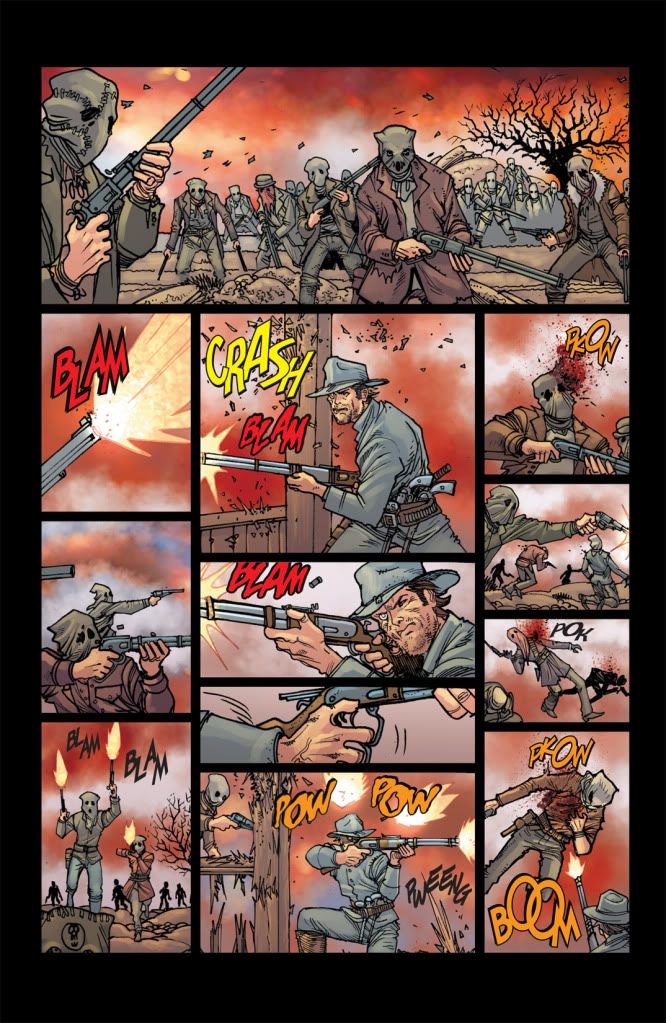
All Star Western #2 (DC) - Some people complained that the first issue of this series was too heavy on text box narration from Amadeus Arkham. Though the text-heavy first issue didn't bother me — it was a good way of delving into the characters of Arkham and bounty hunter Jonah Hex — it is nice to see that the second issue is much lighter on text and moves at a much brisker pace. The secret society that Hex and Arkham stumbled across last issue is now revealed as the same "religion of crime" that's been featured in Grant Morrison's Batman and the Greg Rucka/JH Williams III Batwoman. Between Morrison and Scott Snyder's work with Batman of late, there have been a lot of comics that have delved into the history of Gotham City, and this series now promises to tie in with that work in interesting ways. Justin Gray and Jimmy Palmiotti vary the pace here nicely, with a great shootout composed on a few busy pages full of frantic action panels. There are some occasional awkward moments in the writing (the very first page refers to "a more bloody destination") and even Moritat's generally fantastic artwork isn't always in top form. The staging of a fight scene between Hex and a hulking brute makes it pretty unclear where exactly the characters are in relation to one another, for instance. This issue also introduces a back-up feature about El Diablo, also written by Gray and Palmiotti, and drawn by the great Jordi Bernet, which justifies the book's title as something other than a Jonah Hex solo series. This short piece, in which El Diablo prepares to face down some zombies, is slight (like many backup features) but nicely drawn.

Aquaman #2 (DC) - Well at least this issue goes much lighter on the relentless Aquaman-is-a-joke punchlines from Geoff Johns' first issue. There are still traces of that annoyingly defensive tone, but for the most part integrated much more seamlessly, so this issue's gags — like the way Mera keeps getting called Aquawoman, or the scene where a cop doesn't quite recognize Aquaman without his orange shirt — are funny without being as blunt and obvious. I'm still not totally sold on this series but this is a decent issue, and the deep-sea monsters with their huge razor-sharp teeth are really creepy. Ivan Reis' art is mostly nice, too, especially during the gory battle scenes with the gilled monsters. Reis' youthful, square-jawed Aquaman is a pleasure to watch in action, but his facial expressions vary from awkward to just plain inscrutable. There are too many panels where Aquaman stares blankly straight ahead, his feelings or thoughts unclear. The tonal uncertainty in those moments is emblematic of this series as a whole.

Captain America & Bucky #623 (Marvel) - I've been really enjoying the World War II era stories in this comic of late, more than pretty much anything in Ed Brubaker's Captain America stories since around the time Steve Rogers came back from the dead. The basic gimmick here is that Brubaker, along with co-writer Marc Andreyko, is retelling the stories of this era from the point-of-view of the sidekick rather than the larger-than-life hero, and all of it is informed with an extra level of poignancy by the knowledge of Bucky's ultimate fate as developed during Brubaker's Captain America run. In this issue, Bucky comes face to face for the first time with the horrors of the concentration camps, probably an inevitability considering that this is an attempt to do a gritty war movie version of Bucky's life story. It's appropriately horrifying, the kind of story that never would have appeared in the original World War II Cap and Bucky comics. Chris Samnee's moody, wintery artwork — evoking the feel of David Mazzucchelli's Batman: Year One — makes the images of skeletal, silent prisoners especially heartbreaking. These World War II stories have been so generally good that it's a little disappointing that this series is now moving on, though the promise of checking in on Bucky's years as Soviet assassin the Winter Soldier is equally enticing.

Daredevil #5 (Marvel) - It's really wonderful to see the methodical way that artist Marcos Martin breaks down a fight scene into a flurry of small panels. Martin's art, together with Mark Waid's writing, puts the emphasis on Daredevil's senses: this book continually captures the way that Matt Murdock compensates for his lack of sight by analyzing his surroundings through the input of his other senses, turning each move, each action, into an elaborate but super-fast calculation. On one page, Martin pulls back from a closeup of the interior of an ear as Murdock winnows away all the extraneous sound threatening to overload his senses, honing in on the few important sounds he needs to hear clearly. Waid's writing has a clever, breezy feel to it that emphasizes just how much fun Daredevil is having doing what he does. "Oh, no! Six armed mercs wearing night vision goggles! Whatever will I do?" Murdock thinks, before Martin inserts a perfectly timed panel of a finger flicking a light switch to blind the bad guys. It's whimsical and light-hearted, despite the high-stakes danger and intrigue, although Waid does keep hinting that Murdock's new happy-go-lucky attitude is a defense mechanism to deal with all the trauma inflicted on the character by previous Daredevil writers.

FF #11 (Marvel) - Jonathan Hickman consistently packs an awful lot into 20 pages. This comic features another typically charming scene with Val and Franklin Richards and their assortment of oddball friends, multiple world-ending plots churning into motion, and Reed Richards assembling a huge group of heroes to face the threats closing in from every direction. It's briskly paced, funny and thrilling by turns, and every page has some fun bit of business or a startling twist or some visual stunner. This is dense and exciting, the total opposite of the trend towards decompression that dominates so many other superhero comics these days. What happens in this issue might have been stretched out over a few months in other series — or a few years if Bendis was writing it — but Hickman continues to hurtle forward with so much going on in different corners of the universe. Probably the best sci-fi moment is the revelation of the fate of the two alternate universe Reeds held captive by the Inhumans: a totally unexpected twist that Hickman and artist Barry Kitson brilliantly depict in a few gorgeously outrageous pages. Other writers would have made that the last-page cliffhanger, but Hickman just confidently tosses it out there in the middle of the issue and then moves on, ending with an even bigger cliffhanger. This is an especially strong issue for Hickman's crackling dialogue, too, after a few issues that focused more on epic fight scenes and plot machinations. The banter centering around the Future Foundation kids is crisp as ever, and so is a great scene where She-Hulk and Sue Richards gently, affectionately mock a grumpy Ben Grimm. It's yet another reminder that Hickman's Fantastic Four (which returns for its 600th issue next month) and the spinoff FF are so strong not only for their wild high-concept sci-fi but for their low-key humor and keen grasp of family dynamics.

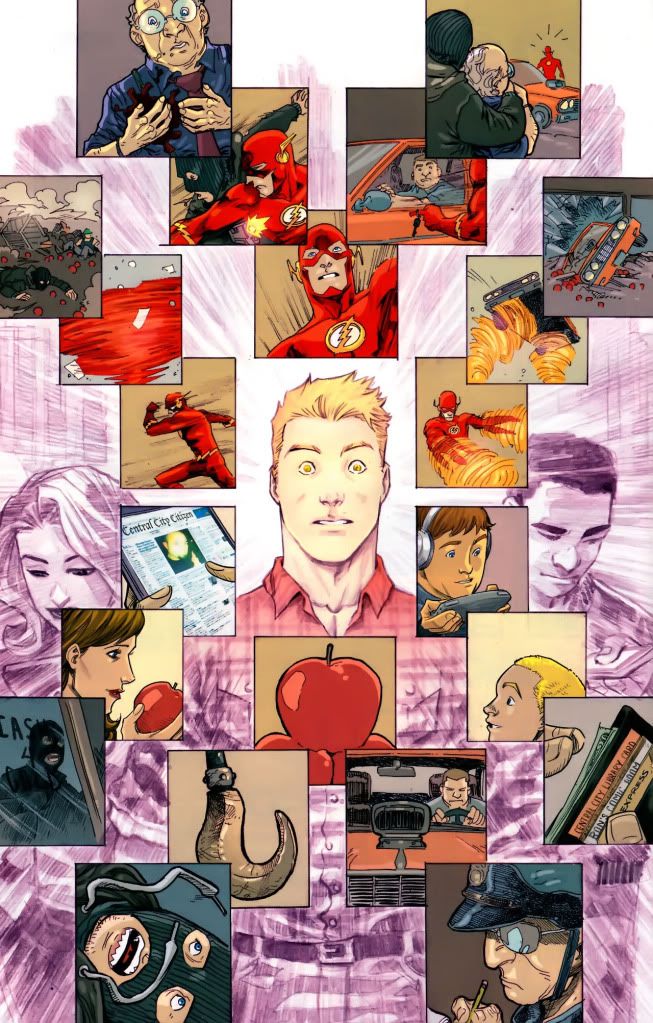
The Flash #2 (DC) - I thought the first issue of this series was really good, but this one ups the ante even more. Artist Francis Manapul and colorist Brian Buccellato also share writing duties on this series, and considering that they're not tested writers with a lot of experience, this book reads briskly and enjoyably, telling its story with more clarity and wit than many of the New 52 books guided by supposedly more seasoned writers. But the art is where this book really shines, the art and how it's used to show Barry Allen in super-fast action. This issue introduces a new wrinkle to the Flash's powers as he realizes that, while he's physically using his powers to their full potential, he hasn't really taken mental advantage of his speed. Needless to say, the pages where Manapul shows Barry flexing his new sped-up mental prowess are jaw-dropping. The pages are filled with small square panels depicting everything Barry sees as he walks around the city, as he takes in all the different aspects of a scene and then foils a robbery without anyone even realizing that he's intervened. This scene reminds me of the Marcos Martin-drawn story in Mark Waid's recent Daredevil #1, and the two books share some similarities in that both are about sensation and heightened ways of experiencing the world. It's brilliantly staged, and suggests the possibility of the Flash as a hero whose heroic acts pass unnoticed, explained away as elaborate coincidences and mishaps.

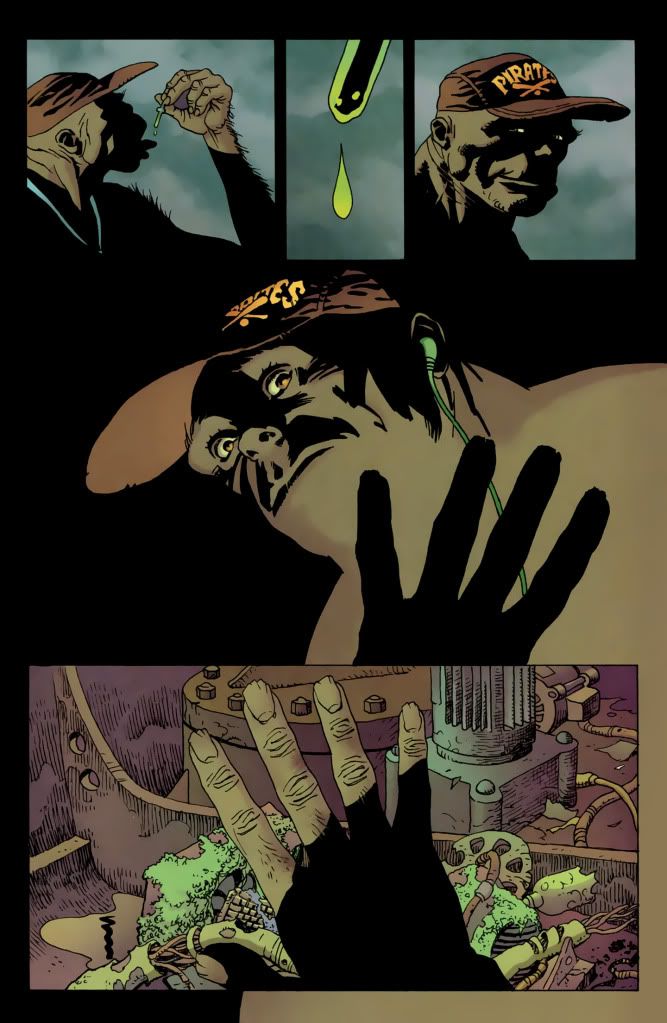
The Incredible Hulk #1 (Marvel) - I could have read quite a few issues of the shaggy, bearded Hulk hiding out underground, chilling with the Moloids and hunting great big monsters. So it's a little disappointing that this situation basically only lasts for the first half of Jason Aaron and Marc Silvestri's new first issue about the big green guy. Silvestri's densely hatched art is instantly striking, though it's puzzling why he needed three inkers as well as Michael Broussard doing "pencil assists." The issue opens with Hulk battling monsters, then brooding while his adoptive underground family feasts and celebrates his successful hunting. These pages are evocative and beautiful, depicting a haunted Hulk vainly trying to escape his past. I'm not as sold on the rest of the issue, as Aaron very quickly — too quickly, I think — breaks Hulk's isolation by bringing in a squad of chatty robots to fight him and teasing what looks to be the larger plot for subsequent issues, involving Hulk's former alter ego Bruce Banner (apparently they're separate beings now?). This was a decent enough first issue, and it's certainly cool-looking, but I'm still a little disappointed that Aaron has so quickly moved beyond what could have been a promising status quo for this book's initial arc.

Justice League Dark #2 (DC) - I didn't really expect to be saying this, but the highlight of this issue is the creepy/kinky relationship drama between Deadman and his girlfriend, Dove. Deadman attempts to get laid by possessing random strangers in the hopes of having an actual physical relationship with Dove, and it's both strangely poignant and really funny, especially when he possesses a girl and clumsily hits on Dove, causing her to storm off. Meanwhile, the main plot with Enchantress simmers a bit after the all-out chaos of the first issue. The villain mainly unleashes some random weirdness on Zatanna and Dove and delivers threatening messages via the radio. Constantine appears briefly too, very much in character, drinking and getting beat up and generally just providing a reassurance that Constantine can exist outside of Vertigo without losing his edge. I like that Milligan seems to be randomly jumping around to different characters, delivering twisted little character beats or offering up visual weirdness for Mikel Janin to draw in his hyper-real style. It's also nice that Janin subtly alters his art to suggest the different worlds of the characters: Constantine's gloomy, heavily hatched pages seem very different from the much brighter, cleaner style of the bar scenes where Deadman and Dove awkwardly banter and argue.

The Mighty Thor #7 (Marvel) - Last month, Matt Fraction wrapped up this series' first arc in a very satisfying fashion. This month, the book is given over to what amounts to a prequel to Fraction's Fear Itself crossover, the story of how Thor's father Odin ascended to become first among the Norse gods. It's just a solid, action-paced issue, an excuse for artist Pasqual Ferry to draw lots and lots of heads being lopped off and bodies torn apart as Odin does battle with the forces of his cruel, warped brother. The best part is Fraction's writing of the bold, overreaching young Odin, whose bravado and leaping into danger is very reminiscent of the child Loki who Fraction created on his last Thor series. It's a decent standalone issue, if not as boldly imaginative as the great stuff Fraction was doing with these characters prior to Fear Itself. What will be really interesting now is to see if Fraction can maintain this series' level of quality with Thor, for the moment, "dead" after the events of the crossover.

Spaceman #1 (Vertigo) - This is the debut of a new nine-issue miniseries that reunites writer Brian Azzarello and artist Eduardo Risso, the creators of the great, pulpy 100 Bullets. It's a post-apocalyptic thriller set in a future wasteland, where the title character Orson — a genetically engineered humanoid manufactured for spacefaring missions — has virtual reality sex via remote hookups and scrounges for scrap metal to feed his drug addiction. The story thus far is a mash-up of various dystopian genre conventions and little meta in-jokes, with a kidnapping plot that revolves around a vicious and transparent satire of Brangelina. There's not enough here yet to tell where this is really going, so this first issue is all about atmosphere, both in terms of Azzarello's goofy, invented future-slang and Risso's typically jaw-dropping, shadowy artwork. Though I can already feel the weird, slangy dialogue growing on me, like a nutty sci-fi twist on the purplish street patter that Azzarello slung throughout 100 Bullets, it's Risso's mostly wordless visual storytelling that provides the issue's most compelling moments. That's why the best sequences are the ones in which Orson in a spacesuit navigates across Mars, in what may be a glimpse of the past or the future or simply a druggy reflection of the main character's inner states.

Venom #8 (Marvel) - Spider Island is yet another big Marvel crossover that I haven't been reading but which is infiltrating books I like anyway. It hasn't derailed Rick Remender's Venom, though, even if the whole concept for this storyline seems spectacularly, amazingly stupid. Remender has wisely chosen not to allow the crossover to completely overwhelm the stories he was telling with this series already, so that even if the events of these issues tie into what's going on over in Amazing Spider-Man and other books, Remender keeps the focus on Flash Thompson dealing with the illness and death of his drunkard father and coping with the Venom symbiote's strengthening hold on him. Though this issue isn't as strong of a standalone issue as Remender's previous two Spider Island tie-ins — for one thing, it ends with a cliffhanger battle that's going to be resolved in Amazing Spider-Man #672, the final issue of the crossover — it's still a character piece as well as a crossover fight scene. Remender weaves the plot together with narration from a letter that Thompson's dad wrote just before he died, so that even as Thompson/Venom brawls with the Spider Queen and teams up with Steve Rogers, the book remains focused on more than the violence. That's what makes Remender's Venom so enjoyable; he does the big dumb action well but never delivers an issue that's just big dumb action. Even if these Spider Island issues haven't been as strong as the series was before the crossover started (and I'm glad it's over) Remender has managed to keep this series on track even while compromising with other writers' stories.

The Walking Dead #90 (Image) - Robert Kirkman's zombie epic has been running for so long now — holy shit, the 100th issue will be out next year! — that there's a real sense of its characters changing and growing over time. So when, as in this issue, Rick discusses the ways in which these experiences have changed him with Andrea and Carl, or when Maggie lets the pressure of life in the zombie apocalypse get to her again, these moments resonate with everything that's happened to these people in these pages. Rick's ongoing evolution, his struggle with his need to control everything, his increasing comfort with life-or-death decisions, continues to be very compelling, highlighted here by a stunning double-page spread in which he asks Andrea, and by extension the reader, to look into his eyes and really think about what he's seen and done. That expansive portrait, by Charlie Adlard — who's been with these characters nearly as long as Kirkman has — delineates Rick's exhaustion, his numbness, with lidded eyes and heavy shadow. He seems haunted, and the image itself is haunting; in an issue with no zombies, no gore, no violence, this portrait encompasses the horror of this series' premise, the horror of accepting death and violence as an everyday occurrence, just another part of what happens. This is an especially good issue for this kind of low-key character work, which is Kirkman's primary strength as a writer. He's good enough at this stuff that even the last-page romantic twist — which Adlard has been subtly hinting at with body language and visual feints for several issues now — doesn't come off as a gimmick but as a natural outgrowth of these characters and this moment.

Wolverine and the X-Men #1 (Marvel) - Jason Aaron's Schism event, which separated the X-Men into two teams focused around Cyclops and Wolverine, was lame and forced, a perfect example of a story existing solely to justify (weakly) its end point. So it's surprising that the first issue of Aaron's new book, about Wolverine setting up a new mutant school, is a blast from start to finish, totally clearing the air of all the turgid Schism/Regenesis stuff and making it clear just why Aaron was so excited to get to this point. There's just so much to love here, as Wolverine and Kitty Pryde take a breathless tour of the new school's grounds with a pair of frazzled, caricatured state education inspectors in tow, harrumphing everything they see. It's a delight from start to finish. The structure provides an opportunity for Aaron and his artistic collaborator Chris Bachalo — whose energetic manga-influenced style is a perfect fit for this issue's flippant, funny tone — to introduce the huge cast bickering, gossiping and careening through the halls committing all sorts of wackiness. It's fun to see all these underused mutant characters colliding off of one another. I got a special kick out of seeing Doop, from Peter Milligan's classic X-Statix, serving as the school's receptionist. It was also nice, and logical considering Bachalo's presence and the school setting, to see a bunch of alumni from 90s X book Generation X, which I fondly remember as a favorite of my 13-year-old self. This issue is fast and funny and packed with little character beats and visual gags, like the full page shot of mutant terrorist Quentin Quire being kept prisoner with the dragon Lockheed perched threateningly over him. If Aaron and Bachalo can keep this frantic pace and level of energy up over the long haul, they've got a real classic in the works.

Monday, October 10, 2011

Weekly Comics: October 5, 2011


Action Comics #2 (DC) - Grant Morrison's badass new take on Superman continues to be a ton of fun and defy expectations. In this case, the second issue opens with Superman in the custody of Lex Luthor and the US military, strapped to an electric chair and being subjected to probes and tests. Nobody knows his limits, and they're pushing his endurance, trying to figure out what hurts him. But Morrison doesn't let Superman remain defenseless for very long, so the second half of the issue is thrilling and grin-inducing, as Superman busts free of his fetters and begins tearing shit up. Morrison's having fun writing a Superman who's having fun with his powers, a young and angry Supes who at one point playfully twirls around, sending out an arc of heat vision to melt the guns of the soldiers pursuing him. Superman's escape sequence is perfectly staged by Morrison, with delightfully posed panels like the one where he calmly strides up a staircase with soldiers amassed above and below him. He strolls through the base as though he's just taking a walk, confident in the knowledge that these men can't really hurt him, simply enjoying breaking holes in walls, letting bullets bounce harmlessly off his chest and smashing any soldiers who try to stop him. When Luthor shows Superman a decaying alien goat-like creature, claiming that this is Superman's true form, Superman simply laughs, then calmly announces that the tests are over, initiating the rollicking mayhem of the book's second half. Regular artist Rags Morales is here assisted by Brent Anderson, an ominous sign that DC's pressure to keep books on time is already affecting the artists, and the art is pretty inconsistent with a few particularly awkward panels in which Lois Lane's appearance fluctuates wildly. Nevertheless, Morrison easily keeps up the energy and edge and enthusiasm of Action Comics #1, and his snotty, hot-tempered Superman continues to be a joy to watch.

Animal Man #2 (DC) - Somehow, Jeff Lemire and Travel Foreman have managed to top their stellar first issue with an even better second one, which revels in the possibilities of mingled dark humor and grisly horror offered up by this story. This issue is packed with disturbing images, but each new creepy visual is imbued with a sense of discovery and delight that makes this a dazzling, fun read in spite of its dark content. By the fourth page, when Foreman packs a kitchen scene with wonderful little details — Maxine trying to feed milk to a thirsty skeletal Mrs. Pickles, Cliff gleefully using his cell phone to record dead animals doing battle on a garbage can, and then casually heading out the door with a shovel to dig up some more nasty fun — the comic has acquired a hurtling, manic forward momentum where each page seems to top the last in nutty imagination. Foreman's art is, if anything, even better than in the first issue, as he fully embraces the strangeness and reality-warping nature of the crisis in "the Red" that's propelling Buddy and his daughter into danger. His control of facial expressions is virtuosic, ranging from the cartoony pouting of Max to the devastating panels showing Ellen's tearful, confused, angry response to the weirdness tearing her family apart. This is shaping up to be the work of true mad genius promised by Lemire and Foreman's first issue, with no signs of letting up in intensity or inspiration.

The Boys #59 (Dynamite) - This issue does not start promisingly, what with the cliffhanger from last issue — a tense showdown between the Boys and the Seven — almost immediately fizzling out. Things don't get better in the pages packed with verbose word balloons as Hughie spills his resentment of Butcher, which is starting to seem like a broken record in recent issues. But then the Boys return home to find that Butcher's beloved dog has been killed by one of the Seven's superheroes, and Garth Ennis again displays the weird mix of poignancy and brutality that makes his best comics (in which company The Boys, admittedly, usually does not belong) simultaneously so hard to take but so hard to look away from. Because there's something weirdly touching about the psychopathic Female lying down next to the dead dog, mimicking the animal's limp form and closed eyes as Butcher darkly stalks off to do what he needs to. So although the issue started as an anticlimax, by the grisly end it's obvious that the expected war is coming anyway. The final pages, with one line of dialogue repeated like a mantra over and over, are especially effective in that typical ugly Ennis way, with emotions of loss and sadness transmuted into violence and horror.

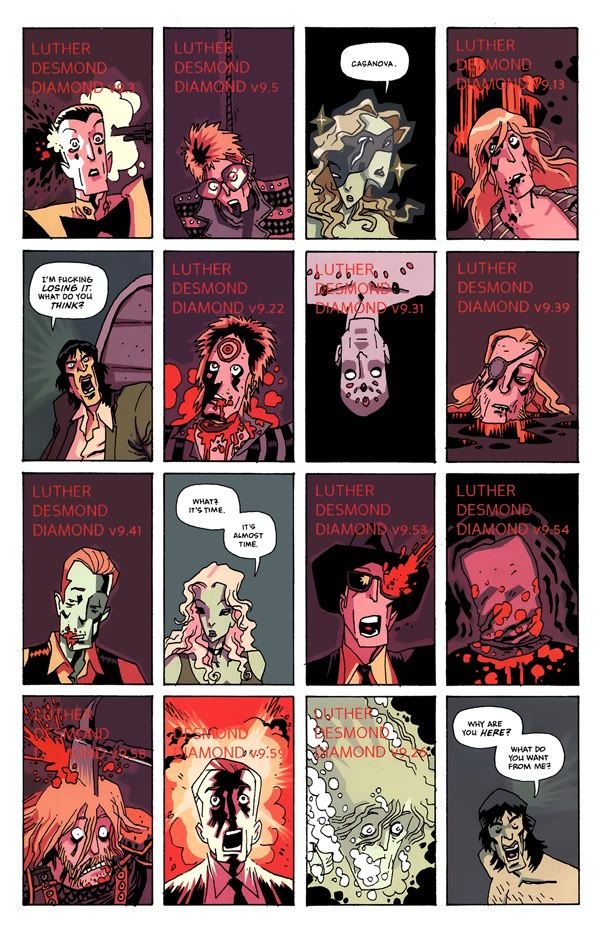
Casanova: Avaritia #2 (Icon) - With this newest Casanova miniseries, Matt Fraction is really digging deeper than ever into the heart and soul of his pandimensional spy thriller. He's using the pop culture riffing and anything-can-happen anti-logic of Casanova to explore some pretty heavy themes. It's all about patterns and repetition — specifically, about escaping from the patterns that threaten to lock Casanova Quinn into a potentially never-ending cycle of destruction and guilt. At the climax of the comic, during a bloody but beautifully visualized action sequence, Fraction replaces the dialogue with placeholders, indicators of the kind of formulaic dialogue that should go here, at this place in the story. And it's just the set-up because when Casanova begins speaking with his own words again, his voice no longer a simple vehicle for action movie clichés, he finally breaks free of the cycle, offers up an alternative to the familiar pattern. It's about free will, man! And it's damn good stuff. Gabriel Bá, more than ever, is drawing Casanova and his future nemesis Newman Xeno — who Casanova must kill, over and over, in one universe after another — as Mick Jagger and David Bowie, locked into a cycle of homoerotic attraction and deadly rivalry. Bá's art is wonderful and trippy, making it seem as though Casanova is living an acid trip, whether he's in "reality" or dreams or skating through interdimensional space, and it's appropriate that in the final sequence one important "version" of Xeno isn't quite sure if he's just really high or if he's actually talking to his would-be assassin.

I was also tickled that, in the typically rambling essay in the back of the issue, Fraction talks about crying while reading Jaime Hernandez's "The Love Bunglers." Right on.

Detective Comics #2 (DC) - The first issue of writer/artist Tony Daniel's Batman serial didn't make much of an impact other than its over-the-top final page, which showed the Joker's face sheered off and pinned to a wall. The rest of the issue was all gritty voiceover and Dark Knight clichés, but I figured I'd give Daniel a second issue to see where he was going with this. Unfortunately, this issue dives headfirst into the blunt, stupid nonsense lurking in the subtext of that first installment, and now I'm done. It's a really goofy comic, although it wants to be anything but: it's the product of someone trying way too hard to create something "dark" and violent, and instead producing unpleasant camp. The issue starts with a weirdly homoerotic scene in which Bruce Wayne is courted by a muscular businessman who strips off his shirt and climbs a rock wall with Bruce while talking business. Then, as if to prove Bruce's hetero bona fides, there's an awkward attempt at a seduction scene with a generic Wayne bimbo, and then things get really goofy. By the time a villainess shows up dressed like she bought a "sexy nurse" outfit at a Halloween costume shop, baring cleavage and wielding a hammer, there's really no redeeming this one.

iZombie #18 (Vertigo) - Since Mike Allred's iconic art is generally the main appeal of iZombie, it's surprising that guest artist Jay Stephens contributes to one of the series' best issues. Stephens has a wonderfully cartoony clear-line style, and Laura Allred's colors here also tend even more towards bold primary colors than usual. The style recalls Tintin and Dick Briefer's Frankenstein, and Chris Roberson's story also evokes the globe-trotting adventures of Hergé or Terry and the Pirates. It's old-school, and enjoyably so, in a very different way from the Universal monster movie retro affection that runs through the rest of the series. Curiously, I'm also reminded of the campy, cartoony climax of the recent American Vampire #19, drawn by Jordi Bernet. I didn't expect much without Mike Allred around (he only provides inks on a few pages) but Stephens, who seems to be mostly involved in animation and kids' comics, really impressed me.

OMAC #2 (DC) - The second issue of Dan Didio and Keith Giffen's manic Jack Kirby pastiche isn't quite as much goofy fun as the first one, but it still offers up plenty of Kirbyesque pleasures. The hapless hero, who as OMAC rampaged throughout the first issue, now reverts to human form and has a frazzled dialogue with the nigh-omniscent satellite Brother Eye, communicating through cell phones and TVs and any other handy electronics. There's something endearing about Brother Eye's motherly, solicitous conversations with Kevin, looking out for the young man's nutrition while maneuvering him into place to battle another super-powered being. It's a good mix of brisk action and light-hearted humor, a very old-school book with a tone to match Giffen's Kirby-aping artwork. This is just big dumb fun.

Severed #3 (Image) - This comic is still all about slow burn buildup rather than all-out horror, but it remains an effective tactic. In this issue, writers Scott Snyder and Scott Tuft have young Jack and Sam finally come face to face with the chilling human (?) monster who's skulked through the shadows of the previous two issues, the man with the filed, hungry teeth hidden behind a false set of normal chompers. There's no gore here, no violence, only a conversation between this predator and his latest targets in which every word subtly and not so subtly teases the absolute horror still to come. At one point, the old man asks the two children, "what's in the future for you?" and framed in the foreground between his outstretched hands is a plate full of picked-clean duck bones and uneaten skin. It's an image freighted with sinister meaning, and artist Attila Futaki continues to give everything in this story weight and hyper-real lushness that adds to the creepy vibe drifting through these pages. Shadows have real depth and the sky is a constant swirl of bright colors giving way to the midnight blue darkness of night. This is a sublimely creepy horror comic, the kind of story best told huddled around a campfire in the dark or curled up in bed with a flashlight. Best of all is the moment when the cannibalistic killer describes exactly what he's going to do to his victims, without them realizing: "he'd feed the duck beer, massage its wings, grant it its every wish... meat is muscles, boys, and muscles remember... everything. Especially the last days. If you're gonna eat an animal, make sure its last days are memorable."

Stormwatch #2 (DC) - This comic continues to be better in terms of crazy plotting and cosmic visual extravagance than in actual writing, but maybe that's okay. It's a wildly entertaining comic, moving at a frenetic pace and leaping from the literal beginning of time to the interior of the moon to Stormwatch's space station HQ to various locales around Earth. It's big and bold and aggressive, and that translates to the dialogue as well. Paul Cornell seems to think he's cleverer than he actually is, and stuff like Adam One's meta joke on the second page just comes off as clumsy and nonsensical. The dialogue is wordy and full of exposition, and there's something really unnatural about nearly every sentence. Every conflict or motivation is bolded and underlined, particularly the struggle over leadership of Stormwatch that runs all through this issue. The dialogue is also still compromised by the necessity of continually introducing characters and describing their powers. Still, Cornell's nutty concepts — lovingly, colorfully realized by Miguel Sepulveda and the rest of the art team — more than make up for the exposition-speak that seems to afflict every character. There's also a genuinely great running gag about how the team's media manipulator convinces the rest of the world's heroes that the chaos on the moon is being caused by low-rent villain the Fox. There are still plenty of seams showing in Cornell's construction, but if every issue is as much fast-moving fun as this, it'll be easy to ignore the problems even if the writing doesn't improve.

Swamp Thing #2 (DC) - It's a little disappointing that Scott Snyder is still leaning heavily on exposition and backstory in his second issue of Swamp Thing. The first issue was an intriguing set-up that teased some really eerie horror to come with a few stunning sequences of odd occurrences happening around the US. Instead of leaping deeper into that territory here, Snyder slows things down for a long infodump where the current Swamp Thing relates a whole lot of history and prophecy to Alec Holland, trying to convince Holland to take on the mantle of Swamp Thing. It's interesting exposition, at least, and Yanick Paquette's layouts — reminiscent at time of JH Williams III — help to jazz up these pages with gorgeous, sprawling guided tours through the concepts that Swamp Thing is talking about. The second half of the issue is then given over to a crisply executed action sequence, although the shock of the new has already worn off with the twisted-head zombies who attack Holland here, and his last-minute rescue by Abby Arcane borders on cheesy. This series still shows a whole lot of promise, and it's still beautiful, but it needs to start moving at a faster pace. If the next issue opens with Abby delivering her own lengthy infodump to Alec, I would not be the least bit surprised, but Snyder will be squandering the potential of a book that promises to be one of the best of the New 52. I did like the shout-outs to former Swamp Thing artists Stephen Bissette and John Totleben embedded in the artwork.

Sweet Tooth #26 (Vertigo) - Jeff Lemire's post-apocalyptic road movie adventure about a boy with antlers is starting a new arc this issue. Issue #25 left off with much of the cast preparing for a trip to Alaska, where they hope to discover the answers to mysteries like the plague that wiped out much of the world population and the animal/human hybrid children who might be connected to the disease in some way. This new arc, though set in Alaska, leaps back in time to 1911 to tell a story that's obviously going to lay some groundwork for the eventual journey of Gus and his friends to the icebound north. Lemire takes a break from the art chores as well, and his friend Matt Kindt lends a distinctive, sketchy but lush watercolor style to this issue's tale of an ill-fated Alaskan expedition. It's a gorgeous book, especially when the expedition reaches Alaska and three men wander off into an icy wasteland rendered with stripes and washes of pale grays and reds sweeping by in the background. It's an abstracted vision of the icy north that increases the sense of dread hanging over the three men. Kindt also achieves some very striking effects, as in the panel where a dog pokes its head up through the wispy, multi-colored strands of the wind and blowing snow, its green eye looking melancholy, a "whimper" enclosed in a speech balloon near its head. Several pages later, the lead character is reflected as a wavery, warped outline in the glossy black eye of a dead dog, and soon after there's a panel where a wooden church's steeple is reflected in the man's eyeglasses. Such echoes and reflections define the haunting visual storytelling going on here.

The Walking Dead #89 (Image) - And Robert Kirkman's epic zombie soap opera continues. There's not much to say about an issue like this, in which not very much happens until the end, ensconsed as it is in the middle of what's shaping up to be a very long storyline about Rick and his band of survivors settling into a more stable community, trying to build a permanent place to live. I can see this storyline stretching out for a very long time, maybe until the end of the series, and I kind of hope it does. In this issue, it seems obvious that among other things Kirkman is setting things up for a more sustained look at the long-running subtext of Rick's son Carl growing harder and colder and tougher in the zombie apocalypse, deadening his emotions in response to everything he's seen and had to do. It's something that Rick hasn't addressed quite as directly as this before, and neither has Kirkman. It's also yet another issue that ends with Rick acting like a badass, and it's interesting that the ending sequence with its series of weapon-wielding portraits of Rick and his friends more or less confirms the fear of the would-be rebels that their community is pretty much being taken over by force. I wonder if Kirkman is going to address that in subsequent issues. He's certainly never shied away from making Rick, the paranoiac control freak, a fairly unsympathetic character, and the antagonists in this plot are definitely not entirely in the wrong.