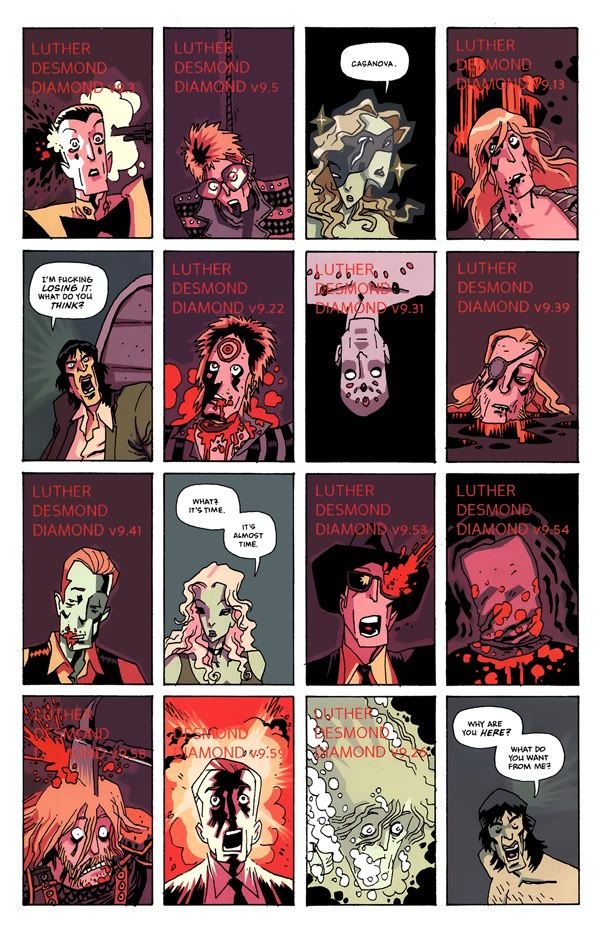
 Action Comics #3 (DC) - Grant Morrison's take on Superman in this book still feels really fresh and original, and I'm loving it so far. There's a great scene here where the Metropolis PD breaks into Clark Kent's apartment and rummages through his stuff, obviously just harassing him simply because of his reporting about important businessmen in the city. This Superman is a crusader for the little guy, both in his secret identity journalism and his cape-and-jeans adventures. This issue also raises the idea that the latter is interfering with the former, because now Lex Luthor is helping to stir up distrust about Superman because of his alien heritage, which allows Clark/Superman's capitalist foes to redirect attention away from their exploitative business deals and corrupt political connections. Morrison also seems to be moving towards Superman examining his Kryptonian roots, and the issue opens with a sequence set on Krypton before its destruction. On the negative side, DC's insistence on getting issues out on time seems to be crippling artist Rags Morales, whose work here isn't quite as inconsistent as in issue #2, but still looks fairly rushed. Gene Ha guests to draw the Krypton sequence (which looks gorgeous and glossy) but apparently even this didn't give Morales enough time to polish the remaining pages. This is a great book, and as the first issue showed, if Morales has enough time it could also be a great-looking book, but it's becoming increasingly obvious that the art is suffering from deadline pressure here.
American Vampire #20 (Vertigo) - Although exposition-heavy writing is often the enemy of good comics, Scott Snyder excels at making exposition and storytelling the center of his work without often succumbing to the pitfalls associated with these devices. In this case, the bulk of this issue is structured as a flashback in which a powerful Shoshone vampiress narrates her life leading up to her conversion into a vampire and the bloody history that followed. It could be clumsy or dull, especially since Snyder is delving into the past of a character who hadn't appeared before the final pages of the last issue, but instead he economically tells a strangely moving tale of a woman who largely drifted through life, barely even realizing how unhappy she was, before the adventures that led to her becoming a vampire. Jordi Bernet, the guest artist on this arc, has a distinctive style that initially seems too cutesy/cartoony to be a good fit for such a dark tale, but he proves adept at rendering gape-mouthed grotesqueries once the vampires make their appearance.
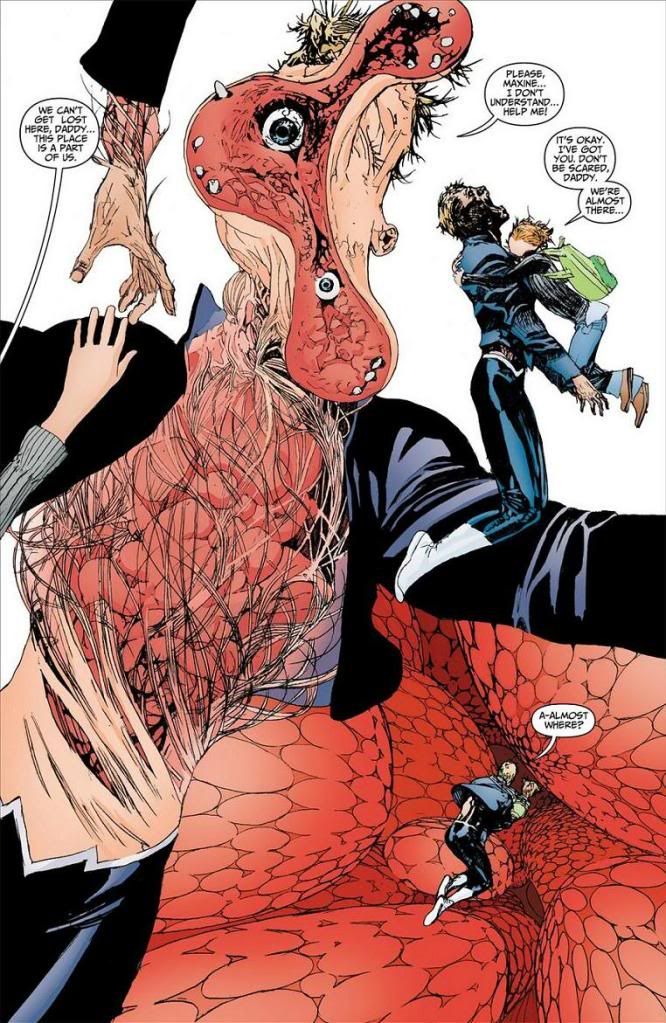
Animal Man #3 (DC) - Since it's pretty much established at this point that I think this series is the awesomest of awesome things, I'm just going to list some of the great stuff that happens in this latest issue. Right on the first page, there's the great visual of Buddy and Max falling into the Red, with Buddy getting twisted into hideous, Cronenbergian forms while Max blithely stretches her arms out with a big smile on her face, looking like she's skydiving and loving it. While the villainous Hunters Three are incredibly creepy, in many ways the benevolent forces of the Red's totems are equally terrifying, and the Red itself looks like a nightmare rather than the touchy-feely spirit-of-all-things hippie place it's described as. Although this issue is heavier on the weirdness and grotesqueries and lighter on the Baker domestic drama, I love the scenes between Ellen and Cliff: she scolds her son's gory video games but then casually joins in, and as they're fleeing from a monstrous attacker she still instinctively tells him not to curse. Travel Foreman's facial expressions are amazing, especially Ellen's pinched look of worry as she moans, "I can't believe I married a superhero." This series is just great: Jeff Lemire has established just the right delicate juggling of tones so that each issue incorporates some humor and surreal absurdity with the horror and slowly building dread. This issue also makes explicit the link between what's happening here and the equally weird goings-on in the Green over in Scott Snyder's Swamp Thing, bringing that eventual crossover closer to fruition.
The Boys #60 (Dynamite) - Not much here except the usual Ennis wallowing-in-filth. I'm not sure I get the point of the subplot with the wife and daughter of Mother's Milk doing mother/daughter porn, except as a way to display even more perversity and to drag these characters through the muck some more. Similarly, the team of superheroes who show up at the end with blatantly sexual names — Astroglide, Stopcock, Trojan — are just an even more dumbed-down than usual version of the same joke that Ennis has been telling since the beginning of this series. I continue to read this series because I want to see the inevitable confrontation between the Boys and the Seven that's been building up since the beginning, and because I'm invested to some degree in the relationship between Hughie and Annie. But issues like this basically just amount to filler, with the only moment that really stands out being the one where Butcher instinctively calls to his dog only to realize that the dog was killed last issue. Those kinds of quietly affecting, very real moments pop up every so often in this otherwise broad, over-the-top series and provide a reminder that Ennis can be much more than a self-conscious shock-purveyor when he wants to be.
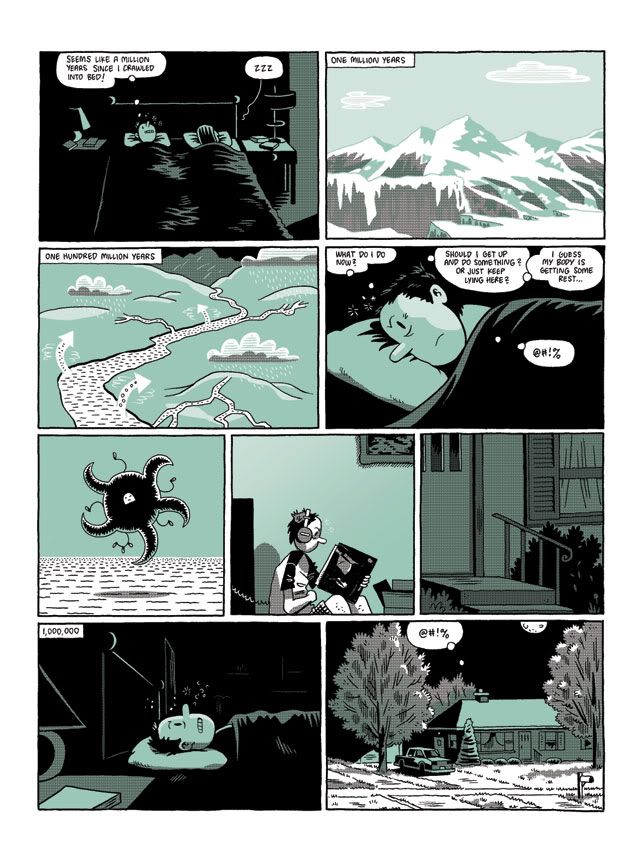 Ganges #4 (Fantagraphics) - The latest issue of Kevin Huizenga's great Ignatz-format series continues the cartoonist's introspective focus on mental states over physical action. The entire Ganges series so far has taken place over the course of a single night in which nothing much of note actually happens. In fact, Huizenga includes a few wry continuity captions of the kind that often appeared in old-school superhero comics, which here serve to remind the reader of just how uneventful this series' "plot" has been. In place of narrative drama, Huizenga delves into the thought processes and imagination of his everyman protagonist Glenn Ganges, tracing the ways in which thoughts lead one into the other, creating the chains and loops of ideas, memories and associations that constitute mental life. It's a remarkably abstract topic for a visual artist to confront, but Huizenga brilliantly makes thinking sensual and tangible, building pages that diagram out ideas and attempt to visually represent the mind's logical dissection of a situation. This issue, like the last one, can be summed up on a physical level as "Glenn Ganges tries to fall asleep and fails," but more than a story about insomnia it's a profound essay on time, mortality, and the intellect.
The most dazzling sequence of this issue comes towards the end, when Glenn begins thinking about what he plans to do with his wife tomorrow, a train of thought that leads him to think back to when he made these plans earlier in the week. From there he begins leaping back further and further in time, visualizing blocks of time as literal blocks floating in grids above his head, representing years, months within years, days within months, hours within days and so on. He's trying to come to grips with how much of his own life he can actually remember and how much has simply drifted by. This somewhat sobering idea connects back to the earlier sequence in which, while trying to pick out a book, Glenn imagines himself accompanied by the Grim Reaper, who admonishes him to choose wisely and not waste his precious time reading or doing something unimportant. In this way, Glenn's thoughts roam freely from minutiae to the biggest philosophical questions facing humanity, as his sleepless mind finds potential profundity in even the most prosaic details. In another sequence, Glenn purposefully chooses a boring theoretical book in hopes that it will help him fall asleep, but as Huizenga lovingly parodies academic-speak, Glenn's mind can't help attempting to visually diagram these confounding sentences, wrestling with the paradoxical ideas and trying to construct coherent thoughts based on what he reads.
In sequences like this, throughout this issue, Huizenga creates utterly engrossing, funny, disarmingly powerful comics from the relentlessly internal, static situation of Glenn lying in bed or wandering around his house in the dark. Huizenga's formal rigor makes each small decision — should I get out of bed or lie here some more, should I read a book, what should I think about, how often should I blink — the origin of a forking path in the protagonist's neural maze. He lays bare the internal processes of decision-making, self-analysis and thought that operate beneath the placid surface of this ordinary suburban husband as he spends a restless night next to his sleeping wife. There are repetitions and dead spaces built into the comic, and moments when the panels run off into the gutters as Glenn's thoughts detour in a whole new direction before returning to the main flow. This is totally exciting, formally ingenious cartooning, another reminder of why Huizenga is one of the very best artists working in comics today.
Moon Knight #7 (Marvel) - As much as I'm sick of Brian Michael Bendis in general, I have to admit that his take on Moon Knight is a fresh, funny, interesting approach to this character. Bendis' Moon Knight is an outright nutcase who shares his head with multiple personalities, embodied as Captain America, Wolverine and Spider-Man. It's a sly parody of the superhero team-up, as Moon Knight constantly has his own mental chorus of famous heroes giving him advice and commenting on his actions. This goofy, oddball premise is well-suited to Bendis' talky, pattering dialogue, as Moon Knight has fast-paced conversations with himself, at one point holding his head in his hands as he moans, "God, I'm hard on myself." Bendis' regular artistic collaborator Alex Maleev is as great as ever here, his gritty art a perfect complement to the urban hysteria of the title's hero. Although I've long since given up on most of Bendis' high-profile titles, this kind of obscure, off-kilter comic may be where he does his best work.
OMAC #3 (DC) - It's usually offputting when something goes out of its way to slavishly pay tribute to a predecessor, but Dan Didio and Keith Giffen are doing such a good job of aping Jack Kirby with this series that it's hard not to enjoy it as the manic homage it is. The Kirby nods go beyond the obvious way in which Giffen has tailored his art to capture Kirby's distinctively brutish, ugly faces and kinetic distortions of body language. The homage extends as well into the narration and the way each issue introduces out-there sci-fi ideas and pieces of technology, describing these innovations with the tone of an owner's manual for futuristic devices, much as Kirby did in the original OMAC series. This issue offers up yet another standalone confrontation in which Brother Eye manipulates the hapless Kevin Kho into battling a monstrous enemy. The pacing is fast and the dialogue is quirkly entertaining, so the issue just barrels by. This is just big dumb fun, a love letter to one of the iconic superhero artists. It's also a reminder that while Kirby has been and continues to be a huge influence on virtually every aspect of superhero comics, his actual style, weird and off-kilter as it is, hasn't often been imitated as completely and affectionately as this.
Stormwatch #3 (DC) - This series is still a mixed bag. Paul Cornell's writing is sometimes clever and sometimes grating, and this issue has a little of both. I loved the lurid, lunatic tone of the few pages where Harry Tanner gloats as he mentally and physically tears apart the giant eyeball at the center of the moon: Harry's a Stormwatch hero and he's fighting a monstrous alien eyeball, but the whole thing has such a sociopathic tone as the hero finds glee in utterly demolishing his adversary. On the other hand, in this issue Cornell unfortunately literalizes the powers of both Jack Hawksmoor and the Projectionist, so that the former literally talks to avatars representing various cities while the latter addresses the media as though she too is engaging in an actual conversation. Both these characters have powers that should have been left more abstract. Otherwise, this is just a big action showcase and the fight scenes are fun and chaotic, with Miguel Sepulveda's glossy art doing an especially good job of rendering the massive, tentacled alien monster that the team encounters in the second half of the issue.
Swamp Thing #3 (DC) - This is the best issue of Scott Snyder's Swamp Thing yet. It's finally all starting to come together and Snyder has now struck a good balance between the eerie horror visuals and the exposition that attempts to untangle the complex back stories of Alec Holland and Abby Arcane. As in this week's Animal Man, this is also the first issue that really makes explicit what the threat is: a young boy with a connection to the Black, the Rot, akin to Swamp Thing's status as an avatar of the Green. There are some really horrifying images here: the issue starts with more creepy/comical overtones as a sick kid hears the voices of mounted fish speaking to him, but things quickly move into more sinister territory. There are some grisly images here, most of them courtesy of guest artist Victor Ibanez, who alternates sections with regular artist Yanick Paquette and winds up drawing most of the gory hospital scenes. Paquette, for his part, continues to recall the classic work of Alan Moore, John Totleben and Steve Bissette on the series. In this case, with Abby's presence, Paquette and Snyder deliberately evoke her appearances in those old Moore issues to emphasize how she's changed in the intervening years; it's a very powerful use of earlier material to deepen the impact of a character's transformation, in ways that go way beyond her new shorter hairstyle. The pace is picking up here, and after a couple of issues that necessarily leaned heavily on explanation, this issue finally launches the horror plot into overdrive.
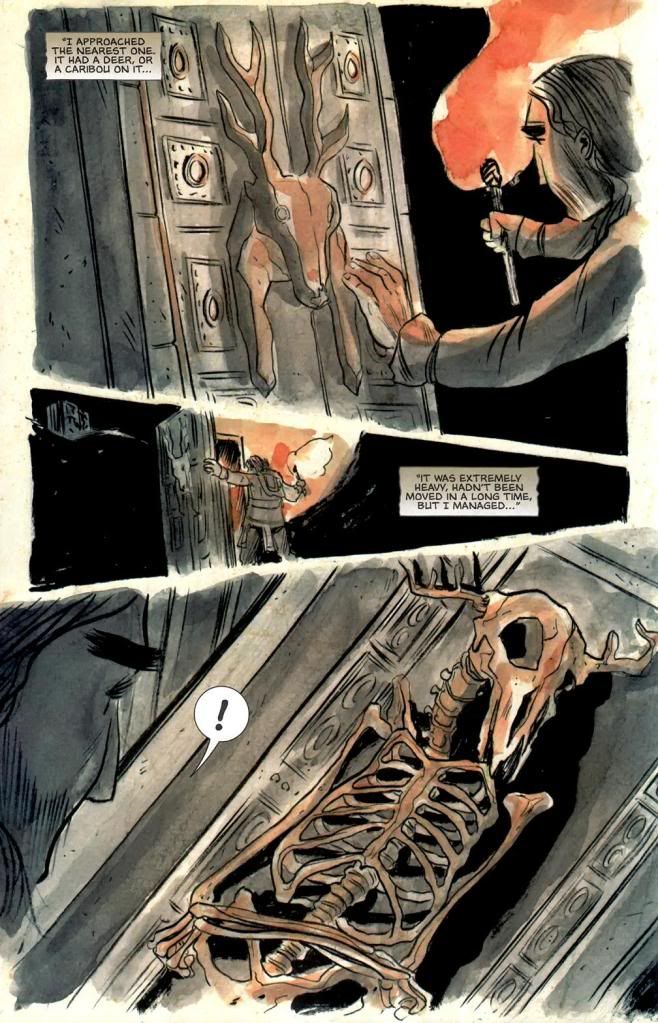 Sweet Tooth #27 (Vertigo) - As much as I love Jeff Lemire's quirky, scratchy art, this most recent arc (of which this is the second of three parts) with Matt Kindt handling the art has been really fantastic. Kindt's wispy, shaky figures and watercolors give a hazy aura to this story that appropriately suggests looking back into the past through the warped, brittle pages of a forgotten journal. Lemire is delving into the past for this arc, suggesting that the origins of the plague and the human/animal hybrids stretch back further than expected. This arc also provides a spiritual/supernatural counterpoint to the theories about the plague's origins offered elsewhere in the book, which have tended to emphasize science and genetic engineering. It's impressive that Sweet Tooth has diverted into a three-issue historical arc that doesn't feature any of the series' regular characters, and the results are absolutely engrossing and creepy and compelling.
 Uncanny X-Men #1 (Marvel) - Following up on last week's Wolverine and the X-Men, this is the other half of the new post-Schism X-Men. This series, written by Kieron Gillen and drawn by Carlos Pacheco, is about the X-Men team led by Cyclops after his fall-out with Wolverine. Whereas Jason Aaron's new series focuses on massive changes to the status quo with Wolverine refounding the mutant school and gathering up a bunch of lesser-known characters, this series doesn't have any such clear change from previous X-Men stories. Wolverine's team is boldly creating something new. Cyclops' team is... continuing to hang out on Utopia. Maybe because of that, this issue just doesn't have the same breathless forward momentum and dazzling anything-can-happen spirit of fun that inflected Aaron's Wolverine and the X-Men. There's no escaping the impression that this series just doesn't have the clear sense of direction that Aaron is bringing to his title.
This is still a decent issue with some playful dialogue, explosive fight scenes, and some high-concept sci-fi threats that make me look forward to seeing where Gillen goes next. As usual, Gillen's writing goes back and forth, for me, from amusing to clunky to just downright puzzling. Case in point this issue is some dialogue with Namor and Hope, meant to be making a modest joke about stealing chairs. But it all goes awry when Namor boldly declares, "to sit in a seat so fine, Namor would take it from any man," which makes it sound like the king of Atlantis is offering to prostitute himself out for comfy chairs. It's hard to tell if Gillen is making a joke of Namor's awkward diction or if Gillen's own sometimes stilted writing is just creating unintended and unfortunate meanings.