Action Comics #2 (DC) - Grant Morrison's badass new take on Superman continues to be a ton of fun and defy expectations. In this case, the second issue opens with Superman in the custody of Lex Luthor and the US military, strapped to an electric chair and being subjected to probes and tests. Nobody knows his limits, and they're pushing his endurance, trying to figure out what hurts him. But Morrison doesn't let Superman remain defenseless for very long, so the second half of the issue is thrilling and grin-inducing, as Superman busts free of his fetters and begins tearing shit up. Morrison's having fun writing a Superman who's having fun with his powers, a young and angry Supes who at one point playfully twirls around, sending out an arc of heat vision to melt the guns of the soldiers pursuing him. Superman's escape sequence is perfectly staged by Morrison, with delightfully posed panels like the one where he calmly strides up a staircase with soldiers amassed above and below him. He strolls through the base as though he's just taking a walk, confident in the knowledge that these men can't really hurt him, simply enjoying breaking holes in walls, letting bullets bounce harmlessly off his chest and smashing any soldiers who try to stop him. When Luthor shows Superman a decaying alien goat-like creature, claiming that this is Superman's true form, Superman simply laughs, then calmly announces that the tests are over, initiating the rollicking mayhem of the book's second half. Regular artist Rags Morales is here assisted by Brent Anderson, an ominous sign that DC's pressure to keep books on time is already affecting the artists, and the art is pretty inconsistent with a few particularly awkward panels in which Lois Lane's appearance fluctuates wildly. Nevertheless, Morrison easily keeps up the energy and edge and enthusiasm of Action Comics #1, and his snotty, hot-tempered Superman continues to be a joy to watch.
Animal Man #2 (DC) - Somehow, Jeff Lemire and Travel Foreman have managed to top their stellar first issue with an even better second one, which revels in the possibilities of mingled dark humor and grisly horror offered up by this story. This issue is packed with disturbing images, but each new creepy visual is imbued with a sense of discovery and delight that makes this a dazzling, fun read in spite of its dark content. By the fourth page, when Foreman packs a kitchen scene with wonderful little details — Maxine trying to feed milk to a thirsty skeletal Mrs. Pickles, Cliff gleefully using his cell phone to record dead animals doing battle on a garbage can, and then casually heading out the door with a shovel to dig up some more nasty fun — the comic has acquired a hurtling, manic forward momentum where each page seems to top the last in nutty imagination. Foreman's art is, if anything, even better than in the first issue, as he fully embraces the strangeness and reality-warping nature of the crisis in "the Red" that's propelling Buddy and his daughter into danger. His control of facial expressions is virtuosic, ranging from the cartoony pouting of Max to the devastating panels showing Ellen's tearful, confused, angry response to the weirdness tearing her family apart. This is shaping up to be the work of true mad genius promised by Lemire and Foreman's first issue, with no signs of letting up in intensity or inspiration.
The Boys #59 (Dynamite) - This issue does not start promisingly, what with the cliffhanger from last issue — a tense showdown between the Boys and the Seven — almost immediately fizzling out. Things don't get better in the pages packed with verbose word balloons as Hughie spills his resentment of Butcher, which is starting to seem like a broken record in recent issues. But then the Boys return home to find that Butcher's beloved dog has been killed by one of the Seven's superheroes, and Garth Ennis again displays the weird mix of poignancy and brutality that makes his best comics (in which company The Boys, admittedly, usually does not belong) simultaneously so hard to take but so hard to look away from. Because there's something weirdly touching about the psychopathic Female lying down next to the dead dog, mimicking the animal's limp form and closed eyes as Butcher darkly stalks off to do what he needs to. So although the issue started as an anticlimax, by the grisly end it's obvious that the expected war is coming anyway. The final pages, with one line of dialogue repeated like a mantra over and over, are especially effective in that typical ugly Ennis way, with emotions of loss and sadness transmuted into violence and horror.
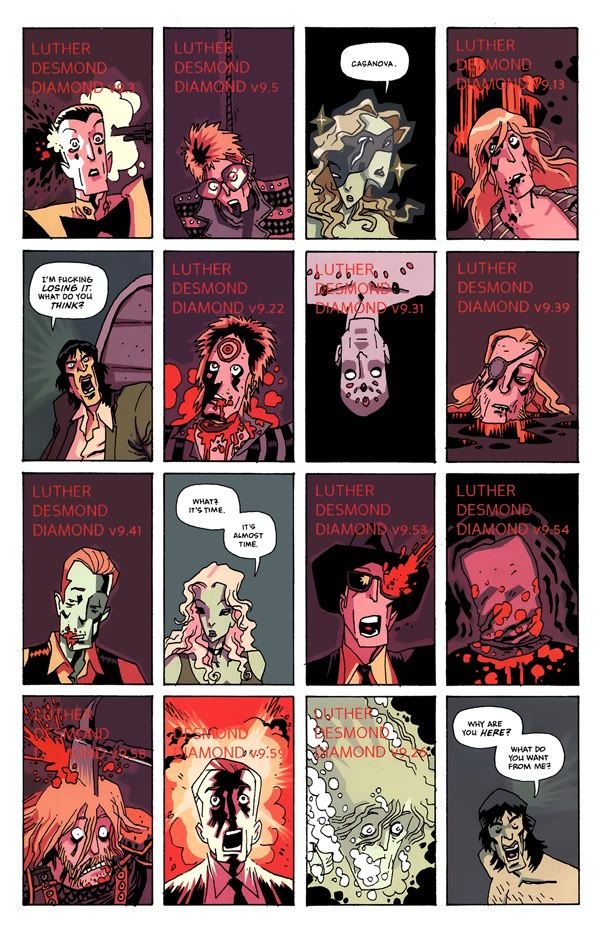
Casanova: Avaritia #2 (Icon) - With this newest Casanova miniseries, Matt Fraction is really digging deeper than ever into the heart and soul of his pandimensional spy thriller. He's using the pop culture riffing and anything-can-happen anti-logic of Casanova to explore some pretty heavy themes. It's all about patterns and repetition — specifically, about escaping from the patterns that threaten to lock Casanova Quinn into a potentially never-ending cycle of destruction and guilt. At the climax of the comic, during a bloody but beautifully visualized action sequence, Fraction replaces the dialogue with placeholders, indicators of the kind of formulaic dialogue that should go here, at this place in the story. And it's just the set-up because when Casanova begins speaking with his own words again, his voice no longer a simple vehicle for action movie clichés, he finally breaks free of the cycle, offers up an alternative to the familiar pattern. It's about free will, man! And it's damn good stuff. Gabriel Bá, more than ever, is drawing Casanova and his future nemesis Newman Xeno — who Casanova must kill, over and over, in one universe after another — as Mick Jagger and David Bowie, locked into a cycle of homoerotic attraction and deadly rivalry. Bá's art is wonderful and trippy, making it seem as though Casanova is living an acid trip, whether he's in "reality" or dreams or skating through interdimensional space, and it's appropriate that in the final sequence one important "version" of Xeno isn't quite sure if he's just really high or if he's actually talking to his would-be assassin.
I was also tickled that, in the typically rambling essay in the back of the issue, Fraction talks about crying while reading Jaime Hernandez's "The Love Bunglers." Right on.
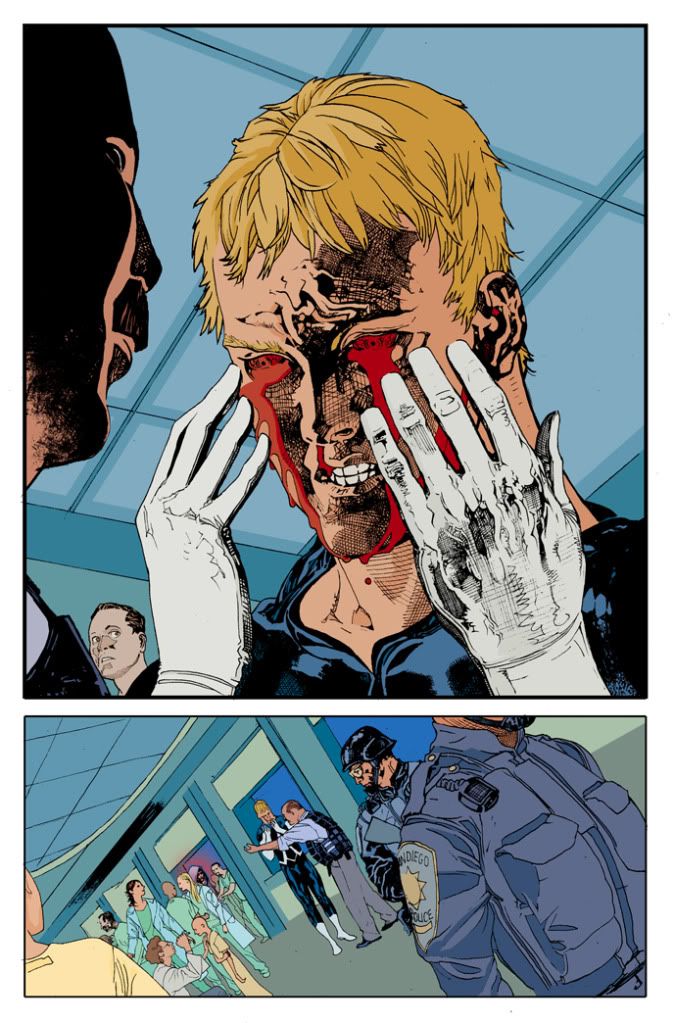
Detective Comics #2 (DC) - The first issue of writer/artist Tony Daniel's Batman serial didn't make much of an impact other than its over-the-top final page, which showed the Joker's face sheered off and pinned to a wall. The rest of the issue was all gritty voiceover and Dark Knight clichés, but I figured I'd give Daniel a second issue to see where he was going with this. Unfortunately, this issue dives headfirst into the blunt, stupid nonsense lurking in the subtext of that first installment, and now I'm done. It's a really goofy comic, although it wants to be anything but: it's the product of someone trying way too hard to create something "dark" and violent, and instead producing unpleasant camp. The issue starts with a weirdly homoerotic scene in which Bruce Wayne is courted by a muscular businessman who strips off his shirt and climbs a rock wall with Bruce while talking business. Then, as if to prove Bruce's hetero bona fides, there's an awkward attempt at a seduction scene with a generic Wayne bimbo, and then things get really goofy. By the time a villainess shows up dressed like she bought a "sexy nurse" outfit at a Halloween costume shop, baring cleavage and wielding a hammer, there's really no redeeming this one.
iZombie #18 (Vertigo) - Since Mike Allred's iconic art is generally the main appeal of iZombie, it's surprising that guest artist Jay Stephens contributes to one of the series' best issues. Stephens has a wonderfully cartoony clear-line style, and Laura Allred's colors here also tend even more towards bold primary colors than usual. The style recalls Tintin and Dick Briefer's Frankenstein, and Chris Roberson's story also evokes the globe-trotting adventures of Hergé or Terry and the Pirates. It's old-school, and enjoyably so, in a very different way from the Universal monster movie retro affection that runs through the rest of the series. Curiously, I'm also reminded of the campy, cartoony climax of the recent American Vampire #19, drawn by Jordi Bernet. I didn't expect much without Mike Allred around (he only provides inks on a few pages) but Stephens, who seems to be mostly involved in animation and kids' comics, really impressed me.
OMAC #2 (DC) - The second issue of Dan Didio and Keith Giffen's manic Jack Kirby pastiche isn't quite as much goofy fun as the first one, but it still offers up plenty of Kirbyesque pleasures. The hapless hero, who as OMAC rampaged throughout the first issue, now reverts to human form and has a frazzled dialogue with the nigh-omniscent satellite Brother Eye, communicating through cell phones and TVs and any other handy electronics. There's something endearing about Brother Eye's motherly, solicitous conversations with Kevin, looking out for the young man's nutrition while maneuvering him into place to battle another super-powered being. It's a good mix of brisk action and light-hearted humor, a very old-school book with a tone to match Giffen's Kirby-aping artwork. This is just big dumb fun.
Severed #3 (Image) - This comic is still all about slow burn buildup rather than all-out horror, but it remains an effective tactic. In this issue, writers Scott Snyder and Scott Tuft have young Jack and Sam finally come face to face with the chilling human (?) monster who's skulked through the shadows of the previous two issues, the man with the filed, hungry teeth hidden behind a false set of normal chompers. There's no gore here, no violence, only a conversation between this predator and his latest targets in which every word subtly and not so subtly teases the absolute horror still to come. At one point, the old man asks the two children, "what's in the future for you?" and framed in the foreground between his outstretched hands is a plate full of picked-clean duck bones and uneaten skin. It's an image freighted with sinister meaning, and artist Attila Futaki continues to give everything in this story weight and hyper-real lushness that adds to the creepy vibe drifting through these pages. Shadows have real depth and the sky is a constant swirl of bright colors giving way to the midnight blue darkness of night. This is a sublimely creepy horror comic, the kind of story best told huddled around a campfire in the dark or curled up in bed with a flashlight. Best of all is the moment when the cannibalistic killer describes exactly what he's going to do to his victims, without them realizing: "he'd feed the duck beer, massage its wings, grant it its every wish... meat is muscles, boys, and muscles remember... everything. Especially the last days. If you're gonna eat an animal, make sure its last days are memorable."
Stormwatch #2 (DC) - This comic continues to be better in terms of crazy plotting and cosmic visual extravagance than in actual writing, but maybe that's okay. It's a wildly entertaining comic, moving at a frenetic pace and leaping from the literal beginning of time to the interior of the moon to Stormwatch's space station HQ to various locales around Earth. It's big and bold and aggressive, and that translates to the dialogue as well. Paul Cornell seems to think he's cleverer than he actually is, and stuff like Adam One's meta joke on the second page just comes off as clumsy and nonsensical. The dialogue is wordy and full of exposition, and there's something really unnatural about nearly every sentence. Every conflict or motivation is bolded and underlined, particularly the struggle over leadership of Stormwatch that runs all through this issue. The dialogue is also still compromised by the necessity of continually introducing characters and describing their powers. Still, Cornell's nutty concepts — lovingly, colorfully realized by Miguel Sepulveda and the rest of the art team — more than make up for the exposition-speak that seems to afflict every character. There's also a genuinely great running gag about how the team's media manipulator convinces the rest of the world's heroes that the chaos on the moon is being caused by low-rent villain the Fox. There are still plenty of seams showing in Cornell's construction, but if every issue is as much fast-moving fun as this, it'll be easy to ignore the problems even if the writing doesn't improve.
Swamp Thing #2 (DC) - It's a little disappointing that Scott Snyder is still leaning heavily on exposition and backstory in his second issue of Swamp Thing. The first issue was an intriguing set-up that teased some really eerie horror to come with a few stunning sequences of odd occurrences happening around the US. Instead of leaping deeper into that territory here, Snyder slows things down for a long infodump where the current Swamp Thing relates a whole lot of history and prophecy to Alec Holland, trying to convince Holland to take on the mantle of Swamp Thing. It's interesting exposition, at least, and Yanick Paquette's layouts — reminiscent at time of JH Williams III — help to jazz up these pages with gorgeous, sprawling guided tours through the concepts that Swamp Thing is talking about. The second half of the issue is then given over to a crisply executed action sequence, although the shock of the new has already worn off with the twisted-head zombies who attack Holland here, and his last-minute rescue by Abby Arcane borders on cheesy. This series still shows a whole lot of promise, and it's still beautiful, but it needs to start moving at a faster pace. If the next issue opens with Abby delivering her own lengthy infodump to Alec, I would not be the least bit surprised, but Snyder will be squandering the potential of a book that promises to be one of the best of the New 52. I did like the shout-outs to former Swamp Thing artists Stephen Bissette and John Totleben embedded in the artwork.
Sweet Tooth #26 (Vertigo) - Jeff Lemire's post-apocalyptic road movie adventure about a boy with antlers is starting a new arc this issue. Issue #25 left off with much of the cast preparing for a trip to Alaska, where they hope to discover the answers to mysteries like the plague that wiped out much of the world population and the animal/human hybrid children who might be connected to the disease in some way. This new arc, though set in Alaska, leaps back in time to 1911 to tell a story that's obviously going to lay some groundwork for the eventual journey of Gus and his friends to the icebound north. Lemire takes a break from the art chores as well, and his friend Matt Kindt lends a distinctive, sketchy but lush watercolor style to this issue's tale of an ill-fated Alaskan expedition. It's a gorgeous book, especially when the expedition reaches Alaska and three men wander off into an icy wasteland rendered with stripes and washes of pale grays and reds sweeping by in the background. It's an abstracted vision of the icy north that increases the sense of dread hanging over the three men. Kindt also achieves some very striking effects, as in the panel where a dog pokes its head up through the wispy, multi-colored strands of the wind and blowing snow, its green eye looking melancholy, a "whimper" enclosed in a speech balloon near its head. Several pages later, the lead character is reflected as a wavery, warped outline in the glossy black eye of a dead dog, and soon after there's a panel where a wooden church's steeple is reflected in the man's eyeglasses. Such echoes and reflections define the haunting visual storytelling going on here.
The Walking Dead #89 (Image) - And Robert Kirkman's epic zombie soap opera continues. There's not much to say about an issue like this, in which not very much happens until the end, ensconsed as it is in the middle of what's shaping up to be a very long storyline about Rick and his band of survivors settling into a more stable community, trying to build a permanent place to live. I can see this storyline stretching out for a very long time, maybe until the end of the series, and I kind of hope it does. In this issue, it seems obvious that among other things Kirkman is setting things up for a more sustained look at the long-running subtext of Rick's son Carl growing harder and colder and tougher in the zombie apocalypse, deadening his emotions in response to everything he's seen and had to do. It's something that Rick hasn't addressed quite as directly as this before, and neither has Kirkman. It's also yet another issue that ends with Rick acting like a badass, and it's interesting that the ending sequence with its series of weapon-wielding portraits of Rick and his friends more or less confirms the fear of the would-be rebels that their community is pretty much being taken over by force. I wonder if Kirkman is going to address that in subsequent issues. He's certainly never shied away from making Rick, the paranoiac control freak, a fairly unsympathetic character, and the antagonists in this plot are definitely not entirely in the wrong.