Showing posts with label Legion of Super-Heroes. Show all posts

Wednesday, September 21, 2011

DC's New 52, Week 3 (September 21, 2011)


The third week of DC's New 52 is here now, with 12 first issues released this week. This was a pretty fun week, with a couple of titles I had low expectations for that actually surprised me. The first two weeks were largely predictable in terms of what I figured I'd like and what I guessed I wouldn't, so it was nice to get a few fun curveballs this time around.

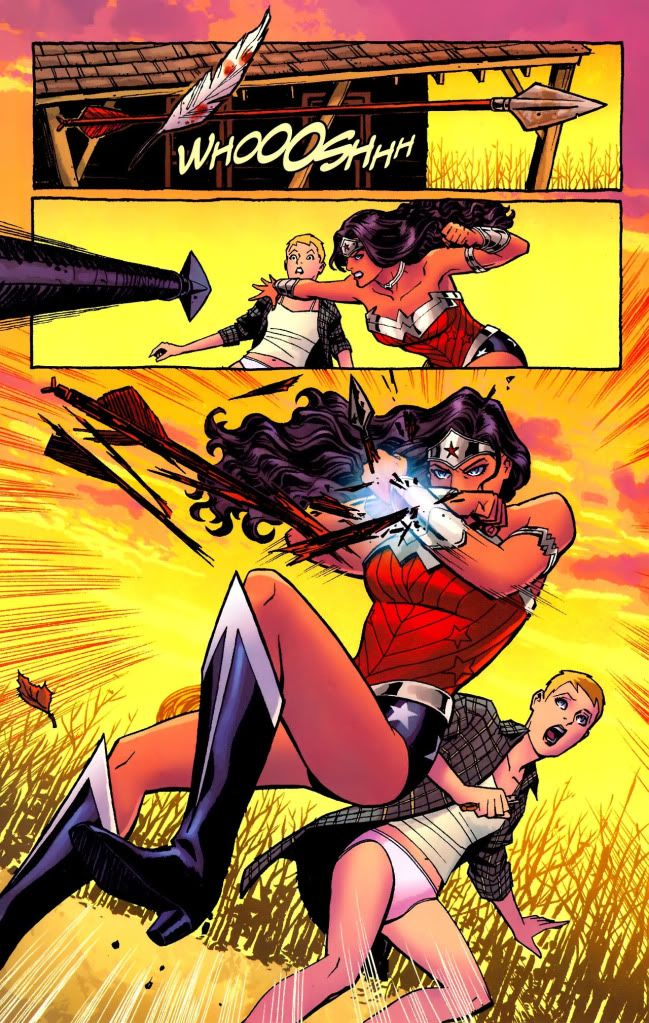
1. Wonder Woman #1 - This was the book I was most looking forward to this week, and it does not disappoint in the least. In fact, if anything it still managed to surprise me with just how great it is. Brian Azzarello brings a gritty, horrific sensibility to this title that at first seems jarring against the bright, bold colors of Wonder Woman but actually makes perfect sense considering all the blood, betrayal and gore involved in the Greek myths that form the foundation for these characters. This first issue dispenses with the exposition-heavy approach of a lot of the other New 52 debuts, and just hurtles into the middle of what looks to be a satisfyingly bloody, imaginative epic. Artist Cliff Chiang has a cartoony, thick-lined style that makes the bloodier moments pop off the page, and there are some really great images and ideas here: best of all the mysterious figure who chops the heads off a pair of horses so that human torsos can grow out of the severed necks, creating a bloodthirsty centaur warriors. Chiang's Diana radiates red-cheeked beauty and purity, a shining icon of strength and goodness, coolly slicing through any obstacles in her way. This is exciting, energetic comics storytelling. Azzarello's writing isn't as pun-filled and pulpy as it can sometimes be, as his excesses wouldn't be a good fit here, but there's still some clever, punchy writing. In particular, there's a thread of clever caption boxes that epitomize the mix of creepy and whimsical that makes this issue so great. One of the most fun and vibrant of the new DC books so far.

2. Batman #1 - Scott Snyder is tackling Batman's name title coming off of a very strong run on the other big Batman book, Detective Comics, just before the reboot. This issue doesn't immediately hit the heights of creepy, suspenseful greatness that that 11-issue run had, but that's because like most of the other New 52 first issues, Snyder is starting slow here, taking his time to introduce the characters. To that end, the issue starts with a brawl that introduces a few heavies from the rogues' gallery, and then has Bruce Wayne attending a party with three generations of Robins in tow, where he meets a few more of Gotham's regular residents. The device that Snyder uses to introduce these characters through captions is a bit clumsy, but probably is necessary considering that the new readers that DC is aiming for here presumably aren't familiar with the fact that there has been more than one Robin, for instance. In any event, Snyder seems to be setting up another grisly mystery, and there's a lot of pleasure to be found in the details — like the fact that the Riddler, glimpsed in the middle of the introductory Arkham Asylum battle, has his hair shaved into a question mark, or the red sneakers that Bruce's son Damien wears with his tuxedo. Greg Capullo's art is quite nice, too, just gritty enough to be a good fit for Snyder's Gotham.

3. Catwoman #1 - If there was any doubt as to what this comic was going to be about from the glossy pin-up cover, the very first panel of the very first page erases that doubt: it's a closeup of Catwoman in a bra, or more accurately a closeup of her chest, since her face is mostly out of frame. And more or less remains that way during the subsequent rushed chase sequence as she puts her costume on halfway, escaping a few steps ahead of some murderous thugs coming to kill her. The pacing and framing is frenetic and suggests the chaotic movement of this ace thief gathering up her few possessions — including a carrier full of entertainingly startled-looking cats — and leaping away from danger. This is a fast-paced, garish, sexy-silly comic propelled by the bold, sexualized art of Guillem March, which has the smutty European vibe of a Milo Manara, with lots of curvy female bodies and cartoony, expressive faces. There's sex, action, blood, and only the briefest interludes for some shreds of character development before a fetishy sex scene between Catwoman and Batman that, amusingly enough, provides the issue's title: "And Most of the Costumes Stay On." It's dumb and regressive as hell, but writer Judd Winick seems to know it and wallow in it, so it winds up being weirdly charming and entertaining and self-aware.

4. Green Lantern Corps #1 - This is some good cosmic fun courtesy of writer Peter Tomasi and the art team of Fernando Pasarin and Scott Hanna. This book is built around two of Earth's Green Lanterns, Guy Gardner and John Stewart, who seem to be having as much of a problem fitting in on Earth as Hal Jordan over in Geoff Johns' main Green Lantern title. Seems to be a theme: it's tough being a Lantern when you're not in space beating up alien bad guys. This first issue establishes a mysterious and apparently very deadly threat — there's some well-done, methodically drawn gore that has a creepy horror-in-space vibe — and then sends Guy and John off to confront it, accompanied by a bunch of generic alien Lanterns. The art is better at cosmic weirdness than humanity or Earthbound drama, but that's fine since the series seems to have quickly left Earth behind anyway. This seems like a solid set-up for some bloody, enthusiastically mindless alien action.

5. Supergirl #1 - As an origin issue where Supergirl crashes to Earth and fights off some armored-up government storm troopers, this issue does a decent job of establishing the character in the midst of an extended fight scene. She's confused by her surroundings and reacts believably to what she only slowly realizes is not a dream, which gives a charge of energy and emotion to what could've been a by-the-numbers origin story. One neat meta touch: when Supergirl's super hearing kicks in, flooding her senses with random snippets of sound, she hears bits of dialogue from some of this week's other DC issues. It helps that it's all attractively drawn by Mahmud Asrar, whose art is kinetic and distinctive, with thick, strong linework. Superman shows up at the very end to tease the next issue, dressed, unfortunately, in his ridiculous-looking, unnecessarily elaborate new costume — if this is the alternative, it's too bad he's not sticking with his jeans-and-t-shirt look from Grant Morrison's Action Comics. This is a basic superhero first issue but it has some promise.

6. Captain Atom #1 - Wow. This comic has a really big disconnect between the quality of the artwork and the quality of everything else. This is one gorgeous-looking book, courtesy of artist Freddie Williams II, though in fact as much if not more credit in this case has to go to colorist Jose Villarrubia, whose bright tones and colored-pencil-like shading define the art style of this issue on equal terms with Williams' linework. This is very striking work: the titular Doc Manhattan-like hero seems to glow and radiate energy, and the high-contrast world around him is shadowy and bold, delineated by huge blocky areas of black that make the glowing blue Captain Atom stand out even more. The problem is that the writing doesn't come anywhere near this level; this isn't as bad as JT Krul's abysmal Green Arrow, but it's still really pedestrian, packed with clunky, overly wordy dialogue and awkward internal monologues. The only thing sillier than the disaster movie conceit of a volcano in Manhattan is the way that Doc, oh sorry Captain Atom actually addresses the volcano like it's a supervillain: "Okay, what do you say, hot magma? How about we cool you off — big time." Not to mention the fact that the book's best aspects, like the identity-blurring nature of the hero's powers, are largely cribbed from Alan Moore's Watchmen. This is certainly a good-looking book. It's just a shame it's not actually a good one.

7. Nightwing #1 - A lot of these New 52 first issues aren't bad so much as standard, and this one is pretty much the definition of that tendency. Dick Grayson's always a decent character, and he's got some new wrinkles now after playing Batman during Grant Morrison's Batman and Robin, but this first issue doesn't add a whole lot to that foundation. Dick fights a couple of boring supervillains and visits the circus he used to belong to before his parents were murdered. There's a bit of a hook in the late-issue line about "the fiercest killer in all of Gotham," which presumably ties in to the revelation on the last page of Scott Snyder's Batman #1, but I'm not sure it's enough to come back. The workmanlike art by Eddy Barrows and JP Mayer is OK, and some of the fight scene splash pages towards the beginning aspire to second-rate JH Williams III, but all in all this issue is just average and uninspiring.

8. Birds of Prey #1 - This one's disposable and almost instantly forgettable, as rather generic heroines Black Canary and Starling square off against a bunch of literally faceless foot soldiers. Writer Duane Swierczynski tries to spice things up by shuffling the narrative chronology, flashing back to earlier scenes to break up what would otherwise be an issue-long fight scene, but there's nothing to these characters and it's all very dull and rote. Likewise, Jesus Saiz's art is competent enough but not exactly exciting, and the colors are alternately washed-out and glossy so that things don't seem to quite fit together as part of a coherent visual world.

9. Blue Beetle #1 - This is another of those undistinguished titles about which there really isn't much to say. It's kind of the Spider-Man template, the high-schooler who suddenly gets great power, but there's not much to make this take on that familiar concept stand out. Other than all the Spanish dialects, I guess, since the characters are mostly Hispanic — which means, of course, that there has to be a gang member with a red headband. Whatever, it's all silly and slight.

10. DC Universe Presents #1 - This title is intended to be a catch-all for various characters who can't sustain their own titles — although considering some of the dodgy, pointless characters that DC did give books to, it's hard to imagine who would meet those requirements. As a matter of fact, at least for this first arc, the book will be about Deadman, who is actually a pretty interesting and unique character. Or he should be, anyway, but this is mostly just dull, despite one nice sequence in which the body-hopping Deadman leaps from one host body to the next trying to speak to an old acquaintance. The upshot of this series is that, with the right characters and the right creative teams, this could be a good vehicle for short stories and standalone arcs that wouldn't sustain an ongoing title. This first arc doesn't look like anything special, though.

11. Legion of Super-Heroes #1 - Oof, this is just lousy. This group of futuristic heroes is connected to the ones unmoored in time in the similarly bad Legion Lost, and this issue suffers the same failings as that one, only magnified. This is a HUGE cast of characters, none of whom I've ever heard of before, and it seems like there's three new characters introduced (with caption boxes listing their names and powers) on every page. It's exhausting, and it makes my eyes just glide off the page when all that seems to be happening is handing out sound bites for twenty or thirty interchangeable aliens. This would be bad no matter what, but it's especially galling since the stated mission of the New 52 is to streamline things and bring in new readers, and I can't think of any other book in this whole relaunch that's less friendly to new readers. Maybe that's unavoidable — it's hard to imagine this nonsense ever being readable, let alone good — but it's still a big failing.

12. Red Hood and the Outlaws #1 - I didn't think it was possible, but this is pretty much as dumb as Hawk and Dove. I don't know much about former Robin Jason Todd's return to life in recent years, but if the character's always been this bad he should've stayed dead. Here he seems to be a low-rent DC version of Deadpool, a mercenary who's constantly cracking wise, making jokes of a staggering level of badness. (I was actually stunned by the corniness of a certain "tanks" pun.) A whole bunch of pages are totally given over to ogling yellow-skinned alien Starfire in a bikini, making much of the fact that she has sex with pretty much anyone who comes into her orbit, which is about the extent of her characterization. And when she's not center-stage, the rest of the issue is spent ignoring the fact that there's been a reboot, choosing instead to refer extensively to the continuity and pasts of these characters in the most ambiguous and confusing way possible. Seriously, the issue ends not with the conventional "to be continued" but "to be explained," which is really not a good sign.

Thursday, September 15, 2011

DC's New 52, Week 2 (September 14, 2011)


This week, I continue my examination of DC's New 52 initiative with my reviews and rankings of the 13 books from the second full week of the new line. My reviews of the first week's releases are here.

I'll also be following up on Monday with my thoughts on a few other non-DC releases. Once the New 52's first month is over, this column will be expanding into a proper roundup of everything I'm reading week by week.

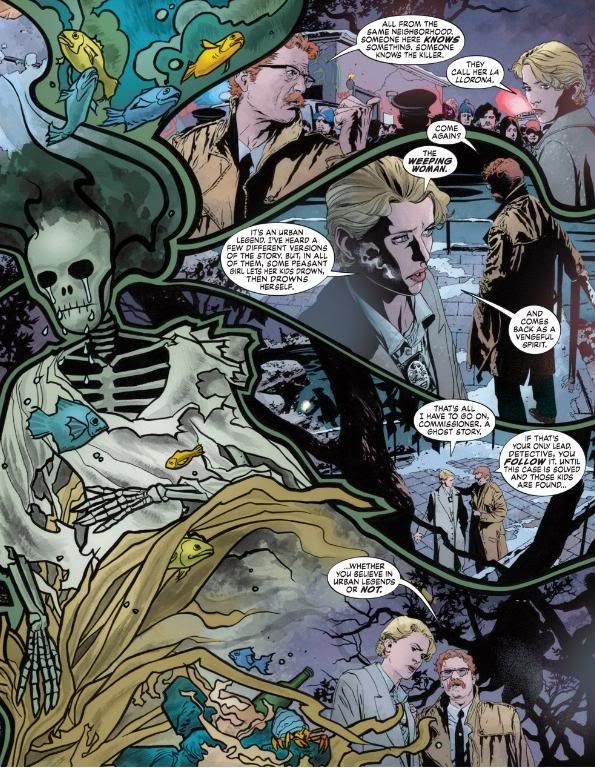
1. Batwoman #1 - The Greg Rucka/J.H. Williams Batwoman stories in Detective Comics were some stunning, exciting comics, largely because of Williams' brilliant layouts, with their kinetic intensity and startling double-page spreads. Now Williams has taken this great character — a red-haired ex-military lesbian who's taken up the mantle of the bat — into her own solo series, and Williams has also gone (more or less) solo, writing and drawing with some writing assistance from W. Haden Blackman. This character hasn't been changed a bit by the reboot; Williams' Batwoman was already in progress before the relaunch, and he reportedly only made a few tweaks to slot the character into the new status quo. The long-awaited result is gorgeous, as expected, and apparently no amount of exposure to Williams' idiosyncratic style can get one used to it, because it's still pretty overwhelming. In one of the best double-page sequences, a police crime scene investigation is arranged in panels circling around the central image of a skeleton, but in contrast to the grim procedural in the radial panels, the skeleton itself is almost whimsical, a dreamlike, haunting image that's an eerie evocation of the story's supernatural themes.

Batwoman, who unlike her iconic model is defined as much by red as by black, is a perfect fit for Williams' bold style, and the fight scenes where she goes tumbling and leaping across the page are as astonishing as they were in Detective Comics. Williams has a keen sense of motion, and that motion is communicated as much by the placement of panels as by the figures within the panels. This is great, all set-up like so many of the other New 52 books, but in this case one hardly notices and it's all over too quickly.

2. Demon Knights #1 - This is just a straight-up blast. It's one of the oddball outliers in the New 52, set in the Dark Ages with a cast of warriors, magicians and demons. It's written by Paul Cornell, who wrote last week's Stormwatch #1, and while it's saddled with a few of the same speaking-in-exposition problems as that title, the overall tone is much breezier and cleaner, and Cornell is much more successful here at setting things up without getting bogged down in the details. Instead, the story moves at a propulsive pace to introduce the demon Etrigan, trapped in the body of a man, and his companion Xanadu, and rapidly throw them into what promises to be an epic battle, with sorcerers and dragons on the opposing side. It's good fun, briskly readable and clever. The art, by Diogenes Neves and Oclair Albert, is gorgeous, too, finely detailed and expressive, with an Old World sensibility that's perfectly suited to the story and the setting. The best moment, simultaneously creepy and exhilarating, is the scene where the evil sorcerers speak to a demon through a possessed baby, a sign of the kind of warped imagination this series will have to offer. This promises to be a gory, riotous romp.

3. Frankenstein: Agent of S.H.A.D.E. #1 - Banking on the appeal of Grant Morrison's version of this iconic character from his Seven Soldiers project, writer Jeff Lemire recasts Frankenstein's monster as a member of a superhuman organization tasked with dealing with the paranormal. And now he's got a team of partners similarly modeled on the famous Universal monsters. As one would expect, Lemire and artist Alberto Ponticelli deliver a fun, freaky tour through the world of S.H.A.D.E., with the organization's headquarters — a microscopic complex housed in a 3-inch metal ball that floats through the world — providing an array of magic and pseudoscientific delights. Ponticelli's loose but detailed art is perfectly suited to both the crowded high-tech corridors of S.H.A.D.E. headquarters and the bloody chaos of the big fight scenes at the end of the issue. In comparison to last week's Animal Man #1, this was always going to be the comparatively conventional Lemire book from the new DC line, but it's still a promising start.

4. Green Lantern #1 - Green Lantern is, along with Batman, one of the characters whose status quo isn't changing much during the New 52 relaunch, so it's definitely to the credit of writer Geoff Johns that, even though I haven't been following this series, I had no problem at all getting caught up to speed as he leaps back into the already-in-progress story here. The pink-skinned Sinestro is a new Green Lantern, somewhat against his will, former Lantern Hal Jordan has been stripped of his powers and is struggling to readjust to life on Earth, and these two come together by the end of the issue. It's set-up for what looks to be a war against Sinestro's own one-time allies, who have enslaved his homeworld. It's not the most exciting issue, but it does a good job of setting up the characters and the conflicts; it's clear, concise Storytelling 101. A lot of these first issues (notably last week's Stormwatch) have struggled with exposition overload, but Johns gets all the necessary information out quickly without making it seem like his characters are spitting out constant plot summaries and descriptions. On the negative side, the Earthbound story with Hal and his girlfriend Carol Ferris is not especially compelling, and Johns resorts to well-worn clichés like the scene where Carol thinks Hal is going to propose, but instead he just makes an innocuous financial request. I also couldn't believe Johns included the laughable scene where Hal, still thinking like a hero, busts in on what looks like domestic abuse but is actually just a movie set. Seems like every struggling hero does that at one point or another. Still, despite some of the lame plotting in Hal's story, this was a decent first issue that had a tougher job to do than some of the other debuts, since Johns isn't really working with the clean slate that most of the other titles have.

5. Superboy #1 - Despite the reset continuity, most of the DC New 52 aren't telling origin stories for the characters. This book is an exception, tracing the early life of the clone Superboy, raised in a tank in a government lab until he breaks out just before being terminated. It's a decent origin story, internally narrated by the self-aware (and overly wordy) Superboy, but the art, by R.B. Silva and Rob Lean, provides most of the pleasure here. The style is bold and cartoony, with thick black lines defining the outlines of characters and objects. The ending is very abrupt, and seems to be setting up Superboy's involvement with the Teen Titans, but before that rushed conclusion this is fine if rather standard superhero fare.

6. Batman and Robin #1 - Much like last week's Detective Comics #1, this is a safe, even boring middle of the road Batman story. The idea that Bruce Wayne wants to finally get past the founding trauma that made him Batman is nice, though the dialogue between Bruce and his son Damian (the newest Robin) in that scene is really heavy-handed. Peter Tomasi's dialogue is awkward in general, actually. The rest of the book is basic superhero action, with a radiation-themed villain hiding in the shadows and dipping people in pools of glowing green sludge to "erase" them. The art by Patrick Gleason and Mick Gray is good enough, the writing is clunky ("because I'm tired of marking the night I watched my father bleed out from his sucking chest wound and my mother from a hole in her throat.") and the whole thing is fairly unexciting. It does have the most laugh-out-loud ridiculous cameo appearance of the purple-hooded woman who apparently appeared in the Flashpoint miniseries that initiated this reboot. This woman appears randomly in the background of every New 52 first issue, which is very silly to begin with, but her glowing purple form in the background of a swim meet here definitely takes the prize as her goofiest manifestation yet.

7. Deathstroke #1 - For some reason this week seems to be a dumping ground for a lot of DC's grim and gritty blood-splattered titles. Of those books, Deathstroke acquits itself best, because it at least shows some traces of a sense of humor, and because it makes an attempt to give its central character some personality and some emotion. Even if the latter basically amounts to Slade Wilson's anger at realizing that he's a mercenary whose rep has lost its luster, that's still more character and motivation than is seen in some of these other first issues. Joe Bennett's art, balanced between gritty/gory and cartoony, strikes the perfect tone as well, and the fact that there's room here for a tossed-off joke at competitor Marvel's expense — Deathstroke slices the head off a startled J. Jonah Jameson lookalike, sending his cigar flying — suggests that this isn't a comic that takes itself too seriously.

8. Resurrection Man #1 - This issue contains a pun that's one of the most cringeworthy pieces of writing I've come across in the new DC comics so far: "I can taste the metal of his piercings. Thankfully I can't taste the metal playing on his iPod." Ugh. So yeah, it apparently took two writers, Dan Abnett and Andy Lanning, to come up with that. This comic should probably get trashed just for that, and for some of the other clunkers sprinkled through the dialogue, but in spite of its lame writing it does have an intriguing central character, a guy who's always coming back to life with new abilities. The Resurrection Man himself is cool enough that the two scenes here where he comes back to life are the definite highlights. The art, by Fernando Dagnino, is rough, sketchy and shadowy in a way that recalls a lot of old Vertigo series; it's sometimes appealing and sometimes really awkward-looking, especially in some of the postures and the sexed-up drawings of the female bad guys. So this is a really strange book: poorly written, unevenly drawn, and yet somehow still just a bit compelling if only because it's not yet another forgettable superhero riff. This isn't a strong start, at all, but at least there's some hope of improvement.

9. Mister Terrific #1 - This issue starts off well enough, with a light and charming aerial fight sequence that feels like what last week's Static Shock was trying to be. Then the main character, a tech entrepreneur who calls himself, with a mix of humility and arrogance, "the third smartest man in the world," goes into the inevitable flashback exposition mode, which inexplicably transitions into him telling his story to a girlfriend. Then there's some mystery, some heavy-handed sparring between the girlfriend and one of Mr. Terrific's admiring assistants, and finally a last-minute twist with Mr. Terrific turning bad. It's fun enough, and has some enjoyably cartoony art by Gianluca Gugliotta, but it's not exactly memorable or substantial in any real way.

10. Grifter #1 - Not a whole lot to say about this one. Grifter is one of the Wildstorm characters who DC has absorbed into their main universe with this reboot, but his DC debut isn't terribly thrilling. It's written by Nathan Edmonson, whose dialogue is pedestrian but at least not as ugly as some of the worst offenders from the New 52. The story's a really basic one, about a con man who gets mixed up with some kinds of aliens and is now being pursued by them as well as by the American military and the people he's cheated in his last con. There's some pointless chronological jumping around — a gimmick that a lot of these books engage in, seemingly just to jazz up what's otherwise a very straightforward story. But at this point the threat isn't very well-defined, nor is the central character, so I don't see much point in sticking around.

11. Suicide Squad #1 - Yeah, you know what you're getting the minute you take a look at the cover of this one, which features the Joker's sidekick Harley Quinn with a new busty look and a new super-skimpy costume. This is sheer brains-free mayhem, which opens with the Suicide Squad — a team of death row killers conscripted by force to perform secret missions — captured and being tortured for information about their latest mission. The team is introduced (and tortured) one by one, with the pain triggering flashbacks so we get a glimpse of each member's character and history. It's "gritty," and kind of flippant in its casual brutality, and totally superficial. It'd be redeemed by a better sense of humor, but writer Adam Glass unfortunately doesn't seem to have much to offer in that department.

12. Legion Lost #1 - This is just mediocre in every way. The titular team seems to be a bunch of generic temporally displaced heroes who try to stop a catastrophe in the past (our own time, roughly) and get trapped there instead. Pete Woods' art is some of the worst to mar any of the New 52 books: not as aggressively bad as Rob Liefeld's, but it's lazy and personality-free, which may be even worse in a way. Fabian Nicieza is the writer, and he doesn't add much personality either. The DC editorial edict of explaining everything as if to an audience of two-year-olds continues to be galling, and this book suffers for not really having anything else to offer. Certainly the characters are non-entities: two of them apparently die at the end of the issue, to little effect, both because it's fairly obvious that both could have and probably did escape, and because even if they did die, who cares? And who cares about this comic?

13. Red Lanterns #1 - Maybe it's because I have no familiarity whatsoever with any of these characters, but... what the hell is going on with this comic? It's about these aliens who spit blood from their mouths, and they have a lot of rage, and there's lots of blood and other fluids being spilled, and they're all fighting constantly, and did I mention they're really angry? The word "rage" appears on almost every page. Considering that this whole DC relaunch is supposed to make the DC universe more friendly to new readers, this book can only be considered a failure on that point, since it borders on incoherence. The bulk of the book is exposition, as the main character, Atrocitus, narrates his past and explains why he's so pissed off all the time. Everything around him is a hash of ugly, garish nonsense courtesy of penciller Ed Benes, and the main idea (the universe is an awful place, violence is everywhere) is continually hammered home with not a trace of subtlety. But then, this seems like the wrong place to look for subtlety or intelligence. I do like that there's a (blood-spitting, rage-filled) alien cat that isn't depicted as a humanoid with a cat's fur and head, but actually moves like a cat, on four legs, and pounces on his enemy's heads. This is pretty dismal stuff, though, which is a shame since Peter Milligan at his best is one of the most imaginative and exciting writers in comics. No trace of that writer here.