Thursday, May 16, 2013

Weekly Comics: May 15, 2013

Age of Ultron #8 (Marvel) - Kind of a filler issue, which basically boils down to the idea that, despite Wolverine and Sue Storm having remade the world by killing Hank Pym, everything still sucks big-time. With Ultron out of the picture since Pym never invented the killer robot, the world is instead devastated by magic, as embodied by Morgana Le Fey, who shows up here leading an army of what look like Doombots. It's a basic idea and if things are ever going to get back to normal it probably had to be communicated, but Bendis probably didn't need to dedicate a whole issue to it, and this alternate future isn't nearly as interesting as the original Age of Ultron one. Also, Brandon Peterson's art doesn't have any of the glaring inconsistencies it suffered from last issue, but it's still sketchy and a big step down from Bryan Hitch.

Avengers: Enemy Within #1 (Marvel) - The crossover between Kelly Sue DeConnick's Captain Marvel and Avengers Assemble kicks off here, following up on plots that have been hinted at in Captain Marvel's series lately. As an introduction to this big crossover, this is very underwhelming. Captain Marvel first arc was great but it hasn't reached those heights again, and this issue is a whole lot of nothing, with the only real advance being that a relic of the accident that gave Carol her powers has been stolen. DeConnick has lately been slipping into some pseudo-Bendis chatter dialogue and it never fails to be grating, as seen here in the exchanges between Carol and Spider-Woman. There are some charming bits between Carol and Thor that play much better, but on the whole this is quite disappointing, and I really miss when DeConnick's Captain Marvel was a fun aviation/sci-fi/war/adventure genre mashup rather than the more conventional superhero soap opera it's become.

Batwoman #20 (DC) - There's no question that this series loses a lot when J.H. Williams III isn't on art chores. Trevor McCarthy isn't trying to channel Williams as much as he had been on some of his other arcs, which is probably a good thing, and he's on his way towards defining his own, less grandiose, more grounded look for this series. Better than an imitation, but the fact is that this is about a lesbian redhead with vampire-pale skin who fights crime in sleek black; this book demands grandeur, it demands Williams' commitment to telling the whole story in fanciful double-page spreads. This is a calm-before-the-storm moment, though, so the more subdued style works, and McCarthy's depiction of an all-too-brief meeting between Kate and her lost, thought-dead sister Beth is great, the sisters' white skin against a stark white background, like two ghosts in a void. Too bad Williams can't think of much for them to actually say.

Conan the Barbarian #16 (Dark Horse) - A new arc starts for Brian Wood's Conan, following several arcs that challenged this book's central relationship between Conan and the pirate queen Belit. This is a great start, too, as the reunited lovers relax in a city of pleasure and take a drug, a yellow lotus flower, that sends them on a journey through their own minds and pasts, dealing with the guilt, regret, and uncertainty that have shadowed their romance. The book opens with a sexy, sensual interlude that provides this arc's artist, Davide Gianfelice, with a great opportunity to draw plenty of curves and naked muscles, and then the lovers are off on an internal journey that's as sensual in its own way. Wood skips effortlessly from one memory, one setting, to the next, giving the issue a smoothly surreal vibe as Conan confronts visions of his past, obvious symbols of his conflicted feelings for his pirate queen, the woman who killed his old crewmates and then became his lover, as well as visions of a possible future that was cut off by Belit's recent miscarriage. The art is sumptuous and strangely concrete for an issue concerned with dreams and fantasies. Gianfelice's a perfect fit for this book; as good as some of the other artists have been, Belit and Conan haven't looked this sexy or well-defined since Becky Cloonan drew them.

The Dream Merchant #1 (Image) - A new Nathan Edmondson series with art by Konstantin Novosadov, a new name for me, with a sketchy, cartoony sensibility that reminds me of a less polished or distinctive Nick Dragotta. A not bad debut, but not as conceptually punchy or immediate as Edmondson's best work with the two Jake Ellis miniseries or Dancer. A mental patient haunted by dreams goes on the run with a cute but tired-eyed girl who'd worked in the mental hospital, after they're attacked by a group of creepy black-robed apparitions. Not exactly thrilling out the gate, and the central character is far too defined by his recurring dream and nothing else.

Fatale #14 (Image) - Concluding a recent trip through the past in a series of standalone issues focusing on previous eras' incarnations of the eternal femme fatale. This issue finally returns to Jo, the book's main avatar of the fatally alluring femme, albeit in a tale set during World War II. This is, at last, the story of Jo's first meeting with Walt Booker, then an American military sergeant who rescues Jo from a would-be sacrifice at the hands of the mysterious supernatural cult that's been pursuing her (and her predecessors in this role) so doggedly over the centuries. This is a book where individual issues seldom stand out if only because the series as a whole is so consistently strong: Sean Phillips is doing his usual amazing work here, and Ed Brubaker is building a complex and far-reaching mythology in which, essentially, the usual noir conceit of the doomed man and the dooming woman has a sinister supernatural explanation hidden in the shadows. This is another piece of the puzzle, and with this arc having filled in a lot of back story and history, it will be interesting to see how the series builds on this mythology when it returns to the story's present next issue.

FF #7 (Marvel) - Mike Allred never fails to bring out the best in a comic. Matt Fraction's Fantastic Four has been decent, despite art from the generally unexciting Mark Bagley, but it's in FF, with Allred's aesthetic driving the book, that he's really letting loose and having fun. That this issue opens with an image that's very evocative of Kazuo Umezu's horror manga The Drifting Classroom is presumably no accident; that series trafficked in gruesome gore perpetrated against children, and it's precisely the fear of such disaster that's been driving Scott Lang, still grieving for his daughter as he tries to wrangle a massive new family of super kids. But Fraction and Allred are all about transcending such grief and fear, not wallowing in it, and this issue's battle with the Wizard — a villain pathetically trying to force a family into existence for himself — is positively poppy, packed with images of such vibrancy and good-time superhero fun that it's impossible not to smile. Best of all: the ant-sized Scott discovering that Medusa's eyelashes have the same powers as the rest of her hair. Also, a rather unexpected tie-in to Fantastic Four that makes sense of Blastaar's appearances in that book. This is a consistently fun and funny book that also has a ton of heart, and always makes room for scenes like Scott's emotional admission that he can't avoid every risk to his charges and loved ones. There's also Darla's growing acceptance of her own role, despite her Thing costume, as this group's Johnny Storm, an immature youth gradually growing into responsibility.

Iron Man #10 (Marvel) - Well, this is weird. Last issue introduced the idea that the alien robot 451 was a part of Tony Stark's past, and this issue pursues that thread full-bore with a totally wacky Ocean's 11-style heist movie vibe, complete with gathering-the-team montage. Kieron Gillen really commits to it, unfurling the secret history of Tony's father Howard through this bizarre heist set-up. I'm not sure it really works, and if all this eventually leads to is telling Tony something new about his birth, I'm not sure it will be substantial enough to sustain a full arc, but it's at least interesting so far. And Dale Eaglesham's art, realistic with just a faint cartoony curviness in his line, is a real joy, especially as a replacement for Greg Land.

Monday, May 13, 2013

DC 2000

This unjustly forgotten comic seems to have fallen through the cracks. A spiritual successor to Grant Morrison's DC One Million crossover event, Tom Peyer's two-part DC 2000 never got the attention or the acclaim of its predecessor, and it's slipped into near-complete obscurity in the years since. It's a sad fate for a fantastic book, and a baffling one as well: how could comics this bizarre and funny and smart be so obscure?

Peyer conceives of the book as a clash between two times, 1941 and 2000, and two teams, the JSA and the JLA. It's a dazzlingly intricate time-travel story in which the villainous scientist T.O. Morrow, trying to bring about a future in which he rules everything, mucks about in the past by introducing year 2000 technology to earlier eras, thus accelerating the development of technology and science in various ways. The book's primary theme is the double-edged sword of modern notions of progress, the ways in which rapid advances in science and societal norms have been massive boons in some ways and chilling threats in others. The JSA of 1941 encounter the technology of the future and they are both awed and terrified by it: impressed by the potential of an artificial heart, horrified by the rapid killing potential of an automatic weapon, baffled and overwhelmed by the nearly limitless possibilities of a computer. The group's encounters with these technological marvels allows Peyer the opportunity for some sharp humor about the kinds of things we now take for granted in our technology-dominated era, as well as some subtle critique — about the easy availability of ridiculously powerful guns, especially, with a strong gun control message popping up in the book's subtext several times.

It's also a book about shifts in morality and belief over time, contrasting the relative innocence of the JSA's times — and, implicitly, the kid-oriented comics they appeared in — against the far more complex morality of the JLA's modern age. At one point, the JSA get a glimpse of the JLA's future and they are horrified: World War II waits in the future for them, as does the A-bomb, the '60s counterculture, Nixon's disgrace, rampant drug use, more violent crime, the dismantling of FDR's New Deal. Peyer has artist Val Semeiks — also the artist of One Million — render this panorama of future horrors across a hallucinatory double-page spread, with a long thin panel running across the bottom of the page showing the stunned faces of the JSA. It drives home how much the world has changed, how much comics and heroes have changed.

Moreover, the book's action is continually driven by the morality of the protagonists, by their desire to change the world. It's a parable about how easy it is to be seduced by the lure of power: even the noble icons of the JSA, often held up as holdovers from an earlier, more innocent era, are not immune to it, and when they are given access to modern technology, they run amok with it, meaning well but causing all sorts of havok throughout time in their attempts to make a better world. It's the same impulse that drives the villain himself, trying to remake the world in his own image, to bring about a world suited to his own desire for a bright, shining future. The JSA's motives are more altruistic but their hubris is no less damaging. Only Jay Garrick, the original Flash, resists the impulse, preferring progress to come at its own pace rather than trying to force the world forward too soon — ironically it's the man who moves at inhuman speeds who wants to slow down, to resist the lure of the future and live in the present he already has.

Peyer also engages with morality through his treatment of Dr. Fate and the Spectre, who he views as opposing icons of spirituality, with Dr. Fate representing inclusivity and openness while the Spectre is an avatar of blind faith, tenaciously clinging to a rigid religiously dictated morality rather than embracing the relativism and inquisitiveness of Dr. Fate. The Spectre is in many ways the book's real villain, more than Morrow, because the Spectre's simplistic view of faith leads him to see the JLA as sinners, the time they come from corrupt and evil. For Peyer, the Spectre becomes an embodiment of religious fundamentalism and intolerance, so locked into his own perspective, so assured of the correctness of his own beliefs, that he calls down eternal punishment on those whose views contradict his own.

This is a book with some very big, very serious ideas at its core, but it is not, it should be said, an entirely serious or straight-faced comic. This is no treatise, and a big part of what makes DC 2000 so great is Peyer's ability to balance multiple tones, to approach his ideas with seriousness without sacrificing humor or emotion, without getting overbearingly preachy or grim. This commentary on religion, morality, progress, and technology is all housed within a framework that leaves plenty of room for wit and good old-fashioned superhero action. Semeiks' art is vibrant and energetic, his layouts bursting with vitality and a keen sense of pacing. And at times the book is outright funny, particularly in the sequences where the JSA puzzle over the technology of the future; the group's encounter with a laptop computer is especially hilarious. At other times, Peyer mines genuine, and surprising, emotion from this premise, particularly in a startling sequence towards the end of the second issue where T.O. Morrow must tearfully face a heartbreaking decision, poised to progress from a powerful but somewhat old-fashioned supervillain into a genuinely terrifying monster.

This last-act focus on the villain's humanity and psychology is just one example of this comic's unpredictability and depth. Peyer and Semeiks crafted a fun, smart, tonally varied epic in just two oversized issues, and in many ways these comics are the equal of Grant Morrison's JLA and One Million, from which this miniseries was spun off.

Thursday, May 9, 2013

Weekly Comics: May 8, 2013

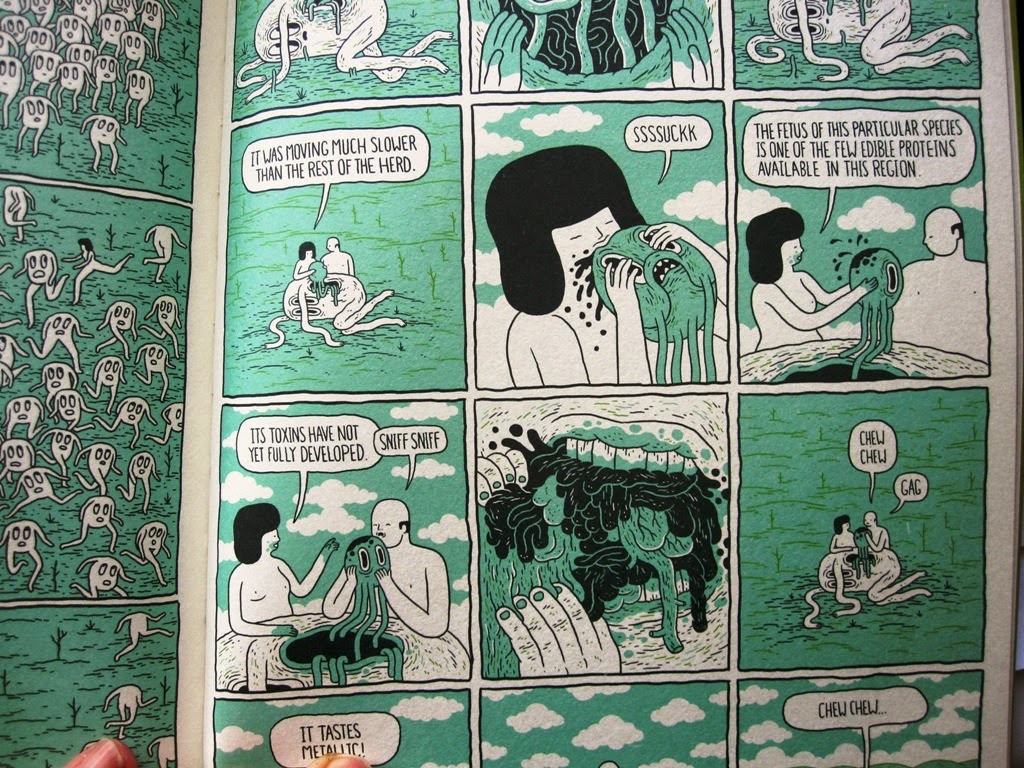
3 New Stories (Fantagraphics) - Pamphlet-format comics from indie publishers are pretty rare these days, with most smaller publishers having migrated towards the bookstore market and "graphic novels." So it's nice when something like this comes along, an actual floppy comic with three stories by Dash Shaw. I suspect the demise of Fantagraphics' anthology MOME may have something to do with this release, as these little experiments are exactly the kind of thing that Shaw would've published in those pages. With no regular outlet for these kinds of short stories, which have always formed a significant portion of his artistic output, he's assembled a few of them here. The middle story is a very short "adaptation" of a Girls Gone Wild segment, similar in form to the dating-show adaptations Shaw did in MOME, though not as substantial — he doesn't manage to burrow into the emotional core of this shallow video product the way he had with his earlier TV/video adaptations. "Object Lesson" is a pointed surrealist piece about the current economic situation, a barbed satire in which an out-of-work detective is sent back to high school due to a clerical error, while his family starves and resorts to eating the dog, his wife encouraging him to, "Lower your standards. Abolish your goals. Cower. Give up. Please." Throughout the comic, Shaw's drawings are overlaid on collages of paintings and photographs, full of symbols — Spider-Man, gold coins, a desert vista — that comment on the action and also serve as backgrounds and coloring. It's a potent, ambiguous portrait of a society where standards, goals, and morality have been rendered obsolete, where education is a bad joke, where making money means resigning oneself to serving a ridiculous system. Similarly, the final story depicts a children's prison where kids have been jailed for petty offenses, prevented from deviating in even the smallest ways from a restrictive series of laws and orders. On the chillingly nonchalant final page, the relentlessly upbeat heroine shrugs off the violence she's seen, a sign of how this kind of system encourages detachment and dehumanization. This is undoubtedly a bleak little comic, but as usual with Shaw, it's also formally inventive and unforgettably potent, communicating some very strong emotional and political truths through its blunt symbolism.

Astonishing X-Men #62 (Marvel) - I wasn't reading this title before its recent involvement in the conclusion of David Lapham's Age of Apocalypse, but I figured I'd check in on this follow-up issue in the hopes that some surviving AOA characters might still be hanging around. No such luck, but this issue is a decent enough, low-key character piece. I'm not sure if the book is always like this, but Marjorie Liu does a good job, in the complete absence of action, of providing quiet character beats and relationship dramas. Very simple stuff, as basic as Kitty Pryde leaning her head on Wolverine's shoulder, after getting shuffled to the side by her boyfriend Iceman during an earlier awkward moment. Artist Gabriel Hernandez Walta's elegant, expressive art is perfectly suited to this kind of understated drama; it's all in the body language, the subtle facial expressions, the careful staging of the characters within the frame. I have a feeling things are bound to head into more conventional mutant action soon enough, but I would happily read a quiet little book like this on a regular basis.

Avengers #11 (Marvel) - Jonathan Hickman's dual run on this title and New Avengers continues to sprawl; while New Avengers has been almost unrelentingly dark and grim and single-minded, the adjectiveless title is looser, epic in scope, leaping around from one thing to the next like a careening pinball, crashing from one shard of plot to another. Here, a group of Avengers attempt to infiltrate an A.I.M.-sponsored weapons deal, posing as gambling fun-seekers while they try to suss out clues. With Mike Deodato's glossy art giving the whole thing an Ocean's Eleven heist movie glow, this issue has a lighter tone than most of Hickman's work on these titles so far. It doesn't always work, and some stabs at humor over Black Widow's plan to take violent shortcuts feel very forced, but most of the issue is quite fun. The highlight is Cannonball and Sunspot convincing a couple of A.I.M. agents to skip the obligatory fight scene and have a fun weekend of boozing and partying instead, a sequence that wouldn't be tonally out of place in Matt Fraction's Hawkeye. Meanwhile, to satisfy those seeking some action, a Shang Chi fight scene is threaded through the whole issue. This is a pretty minor piece of the overall puzzle, probably the weakest single issue of Hickman's Avengers yet, and only at the end is an important piece of information delivered. This will be a mere blip in the eventual omnibus (which is the perfect format for these epic Hickman runs) but as a single issue it's just on a slightly lower level than the rest of the series has been.

Avengers Assemble #15AU (Marvel) - Big surprise, but while Age of Ultron itself has been very good, most of these AU tie-in issues are very unnecessary. This one's set in the early hours of Ultron's takeover, and has Captains Marvel and Britain going up against Ultron with the help of some very whimsical British heroes who, if I'm not mistaken, were invented especially for the occasion. Al Ewing guests for regular writer Kelly Sue DeConnick, and Butch Guice is excellent as ever, but it's all pretty much pointless, because what can any of these tie-ins show besides variations on heroes failing to beat Ultron? Ewing indulges in some fun-enough Britophilia, and there are some nice but all-too-brief sequences when the video-game-infiltrating hero Computer Graham matches pixels with Ultron, but otherwise this is pretty forgettable.

Batman #20 (DC) - The conclusion of Scott Snyder and Greg Capullo's Clayface two-parter is just OK, which compared to some of what's gone on in this title, is a minor triumph. Compared to the ridiculous revelations that capped the Owls storyline or the sputtering non-event of the Joker story, a straightforward Clayface battle that ends with the villain viciously imitating the recently dead Damien Wayne is definitely a step up. There are still some rather head-scratching moments, like Batman pretending to wear a DNA mask taken from Bruce Wayne, but for the most part this is decent if unexciting. It's also odd how out-of-step the relatively well-balanced Bruce seen here is with the grief-stricken lunatic Peter Tomasi is depicting in Batman and Robin, one of the problems with there being something like ten Batman-related titles coming out every month. Unfortunately, there's still no sign of Snyder getting back to the tight noirish detective stories of his pre-New 52 Batman work, and since he's now gearing up for what promises to be a full year's worth of excruciatingly boring origin stories, this ship probably isn't going to be righted anytime soon.

Batman & Red Hood #20 (DC) - In the wake of Damien Wayne's death in Grant Morrison's Batman Incorporated, Peter Tomasi's Batman and Robin is being retitled a few times to co-star first Red Robin and now Red Hood, with other Batman sidekicks and friends set to appear in the title in coming months. Other than Morrison himself, Tomasi seems to be the main Bat-writer dealing with the fallout of Damien's death, and specifically its effect on Bruce, as seen most memorably so far in #18, a silent issue in which Patrick Gleason's brooding art captured the grieving father's rage and despair over the loss of his son and crimefighting partner. Now Tomasi and Gleason have Batman working through the five stages of grief with help from his friends, and it's been heartbreaking and really well-done, a very powerful companion piece to Morrison's work — while Morrison barrels forward towards the likely epic conclusion of his years-long run, Tomasi pauses in the shadows, dealing with the emotional meltdown that follows Bruce's personal tragedy. In this issue, Batman is especially brutal, both with the assassins who he and Red Hood bust up (Batman purposefully deadens the nerves in their hands so they'll never be able to shoot a gun, or feed themselves, again) and in his dealings with Jason Todd, the man under the Red Hood mask and once a Robin himself. The issue's climax is really powerful, both in what it says about Batman's grief over Damien, and in the hurt reaction of Jason, who feels like he deserves better than this cruel manipulation. As in the last issue, where Batman tried to recruit Frankenstein to help him bring Damien back to life, Tomasi is dealing with the messy, ugly, awkward reality of grief, and the raw, ferocious emotions spilling across these pages are really compelling.

Chin Music #1 (Image) - A new horror/supernatural series from Steve Niles (of 30 Days of Night fame) and artist Tony Harris. I was anticipating some good gritty horror, but I didn't think much of this virtually impenetrable first issue, which doles out very little text or dialogue or actual plot — for an introductory issue, there's surprisingly little to hold onto here. Some kind of supernaturally powered guy (a google search tells me he's named Shaw, though the issue isn't so informative) is attacked in what seems to be pre-Twentieth Century Egypt. He's burned and stripped down to a skeleton, which somehow still lives, and flees (or is sent) through time to Prohibition-era Chicago, where he quickly comes into contact with Elliot Ness (who barely reacts to the spectacle of an Arabic-speaking living skeleton) and Al Capone. There's just not much here, and the time travel stuff seems very cutesy, the kind of time travel story where a fight between supernatural beings is used as an explanation for the Sphinx losing its nose, and where the main character will immediately meet any famous historical figures who happen to be in his time. The history-changing ending isn't enough of a hook to bring me back for more, nor is Tony Harris' art, which is nice and moody but can't distract from the essential slightness of this issue.

Constantine #3 (DC) - Yeah, so Peter Milligan's run on Hellblazer wasn't the most exciting or greatest in the title's history, but it was good, and I can't stop thinking about it when reading the new tales of Constantine in the mainstream DC universe. Everything Milligan (and many other writers in Hellblazer's storied history) did well has been jettisoned. The supporting cast is anemic and poorly developed, with characters showing up out of nowhere and heading back there as soon as their plot function has been fulfilled. The book is relentlessly plot-driven, with none of the downtime or weird diversions that always made Hellblazer so fun. And most importantly, Constatine's essential aimlessness has been sacrificed. One of the best things about Constantine was always that he wasn't a hero, that he almost never set out to do big quests for their own sake, but now not only does he have a mission, it's a mission that's explicitly spelled out in the intro box that appears on each issue's title page. It's just totally the wrong approach: Jeff Lemire and Ray Fawkes throw in all the superficial signifiers, the cigarettes and British lingo, but the soul, the attitude, the warped and wild aesthetic, is lost in translation.

Fearless Defenders #4 (Marvel) - Cullen Bunn's had a pretty disappointing career at Marvel so far, and this is the first book he's done for them that really has something to recommend it. It's a goofy, pulpy B-movie kind of book, with an all-female cast, and it has a breezy quality to its action and its banter. Will Sliney's art is slick and his women are undoubtedly sexy, but the book thankfully doesn't resort to outright cheesecake. It's pretty much the definition of a fun, lightweight action comic that's easy to read but not necessarily essential.

Infinity - Free Comic Book Day (Marvel) - Despite not going to a comic shop on Saturday, I did snag a couple of FCBD books at my local shop, including this one. This is a teaser for Jonathan Hickman's upcoming Infinity miniseries, a summer event involving Thanos coming to Earth. As expected, it's all set-up to establish a sense of encroaching doom, but it's beautifully illustrated by Jim Cheung, who turns in some of the best work I've ever seen from him. The alien creatures who serve Thanos are just seething with menace. I'm looking forward to this event, which will probably play like a brief, violent outgrowth from Hickman's larger Avengers run. Also included here is a brief and not bad Thanos/Destroyer fight story from 1977, written by Scott Edelman and drawn by Mike Zeck. Plus a very short excerpt of Warren Ellis' upcoming Avengers graphic novel, way too brief to get any idea of what it'll be like, though the back-and-forth patter between Captain America and a few other Avengers has some nice spark to it.

The Private Eye #2 (Panel Syndicate) - This is Brian K. Vaughan and Marcos Martin's new self-published, digital-only, pay-what-you-want comic, which so far is great for reasons well beyond its attention-getting distribution method. It's set in a future where the era of Internet over-sharing backfired in such a spectacular fashion that now everyone is obsessed with privacy, with most people hiding their names and identities behind masks and role-playing constructs of various degrees of complexity, shedding skins whenever they feel like it. It's a fascinating idea and a wonderfully realized world: one of Vaughan's strengths has always been taking fantasy or sci-fi concepts and building very real-feeling worlds around them, and this one is no exception. Martin's gorgeous art (with a big help from colorist Muntsa Vicente) renders this world vibrant and exciting, stuffed with people hiding behind all sorts of masks, as the underground private eye Patrick Immelmann finds that his client has been murdered. Martin lends a noirish neon-lit vibe to the many night scenes here, particularly a haunting trip to a fringe area where abandoned trains and sewer tunnels have been converted into makeshift homes for masked drug users and dealers.

Prophet #35 (Image) - Brandon Graham's revival of Rob Liefeld's Prophet is one of the most ambitious mainstream comics out, a wild and at times barely coherent sci-fi epic that has taken its time showing its hand with regards to what the hell is going on. The picture is a bit clearer now, with an ancient empire starting to re-emerge while rebels gather their forces to resist, and this issue alternates between the two stories, while also alternating between artists, since Graham has gathered a small staple of artists and associated each one with a different set of characters. Simon Roy handles the perspective of the "New-Father" Prophet who serves the empire, while Giannis Milonogiannis draws the "Old Man" Prophet and his group of anti-empire rebels. Graham exploits the contrast between Roy's thick lines and lumpy forms and Milonogiannis' comparatively thin, minimalist work (which is much closer aesthetically to Graham's own art) to delineate the two groups and their stories, which at this point are still very separate but seem fated to unite eventually. As always, there's lots to love here on a sheer conceptual level, from the way Graham treats a battle scene like a video game or a diagram, with little icons representing the gradually depleting forces on each side, to the Old Man's poignant confrontation with an artifact from his past. Also, the previous issue's backup story by Matt Sheean and Malachi Ward continues here, more evidence of Graham's great taste in showcasing indie auteurs doing great sci-fi work. This serial is nicely creepy and ambiguous, concerning a man sacrificed to a giant monster and methodically going to work in the creature's insides.

Suicide Squad #20 (DC) - The first issue of a new run on this title by Image writer Ales Kot. I haven't checked in on this book since its brainless first issue (by Adam Glass), and Kot is certainly a big improvement over that inauspicious debut. It's all setup, but so far it seems like Kot is planning on introducing some interesting plots, and he's got a good handle on the kind of damaged psychologies that made John Ostrander and Kim Yale's Suicide Squad one of the best series of the '80s. I'm still thrown off by the new skinny, sexy Amanda Waller, which remains a bizarre character design choice, but otherwise this is setting up exactly the kinds of frayed minds and bitter tension that should drive this book. Telling a confirmed death-wish case like Deadshot that he now essentially will not be allowed to die is a great start, and Waller, together with her shadowy associate, seems to be pushing all of her inmates to the breaking point in similar ways. Of course, the revelation of Waller's partner in this at the end of the issue is just icing on the bloody cake, since this particular character has been begging for someone to pick up his story since before the New 52 started. A good start, and it's nice for once to be adding a New 52 title back onto my list rather than dropping one.

Thor: God of Thunder #8 (Marvel) - This is great comics. Jason Aaron hasn't exactly been rushing this introductory God Butcher storyline, but the deliberate pacing has allowed Esad Ribic to deliver countless great images along the way, and it's been great fun to watch the story's three versions of Thor struggling against the implacable Gorr. This issue is where it all starts to come to a head, with the young Viking Thor's story finally intersecting with that of the modern Thor and the old Odin-esque one-eyed Thor. Aaron introduces Thor's granddaughters, the future goddesses of thunder — one of whom confesses to "impure thoughts" about her hunky young grandfather — and delivers a kick-ass final page that promises much more adrenaline-fueled action to come.

Ultimate Comics: Ultimates #24 (Marvel) - The President Cap storyline comes to a rather inauspicious end, with Sam Humphries basically shrugging away the one cool idea of his run so far, not that he did too much to really explore Cap as President in the past few issues. Making Captain America the President for the long run would have been bold and provided plenty of potential stories, so it's a shame that Humphries doesn't seem interested in following through on that possibility. Other than that, there's not much here, though it's funny that between this issue and Uncanny Avengers, this week has two separate comics where Thor must destroy falling space debris before it lays waste to a city.

Uncanny Avengers #8 (Marvel) - When Rick Remender brought his epic Uncanny X-Force to a close, I thought that was it, that he'd said all he had to say, but instead the current arc of his new series seems to be just picking up where he left off. It's a credit to Remender that he's been able to tell this many stories about various versions of Apocalypse without it getting a stale, but somehow it's still thrilling to see these threads being picked up yet again, the contagious evil of Apocalypse passed on to yet more new avatars, here with Kang and Red Skull thrown into the mix. Most of the characters from Remender's X-Force aren't here, and the Avengers have been added to the mix, but this still feels like Uncanny X-Force, a sustained study of evil, nature and nurture, the moral implications of violence, and guilt and responsibility.

The Walking Dead #110 (Image) - One of those talky issues where nothing much happens, besides Robert Kirkman backing away a bit from his introduction of a black self-styled "king" who kept a pet tiger, a character who verged on racist caricature when first introduced. Making him a zookeeper who basically feeds off of other people's legends about him redeems the character somewhat, as does acknowledging that he's kind of a male version of fan-favorite Michonne, who self-styled herself as a badass urban samurai with a sword that she's apparently not as well-trained with as she pretends to be (not that that's stopped her from being an actual badass with it all through the series). Anyway, this plot is still crawling towards the eventual big confrontation with the villainous Negan, perhaps a little too slowly even by Kirkman's usual patient standards.

Wolverine #3 (Marvel) - After the frenzied one-two punch of this series' first two issues, Paul Cornell slows things down a bit for this one, as Wolverine teams up with Nick Fury Jr. (yep, still a ridiculous character) to track down some aliens. The slower pace reveals that this maybe isn't as good or fun as it initially seemed to be. Wolverine's new supporting cast seems to be made up of pub-crawling cast-offs from Hellblazer, and their introduction is really awkward, and then there's lots of fighting for very unclear reasons, and by the end it seems as though the only reason to stick around at all is Alan Davis' still-brilliant cartoony art.

Saturday, May 4, 2013

More Weekly Comics: May 1, 2013

Red She-Hulk #65 (Marvel) - When Jeff Parker changed this title over to focus on the newly Hulked-out Betty Ross instead of her father, the Red Hulk, I hoped he'd take the opportunity to really explore what Betty's feeling about her new form, her ex-husband, her father, anything. Instead, he's thrown her into a pulpy sci-fi spy thriller with Machine Man as her sidekick, delving into the secret history of S.H.I.E.L.D. (and drawing on some of the mythology established by Jonathan Hickman) while Betty tries to prevent a horrible future she'd glimpsed in a vision. It's pretty fun and usually has some high-concept thrills in each issue; here it's a secret base hidden within Mount Rushmore and defended by a quartet of the computer intelligences modeled after some of the worst Marvel villains. Not an especially deep title, but usually a fun one. The art suffers this issue, though, with three artists contributing some shaky and inconsistent work.

Snapshot #4 (Image) - This Andy Diggle/Jock miniseries, originally serialized in Judge Dredd Megazine, comes to a strong end. It hasn't been the flashiest or most memorable comic, but it's been a low-key, twisty mystery with a hook rooted in modern economics and politics. In the end, it's turned out to be one young man's gradual understanding that the world is a fucked-up place and that his confidence in the system and its rules was somewhat misplaced. The book's arc has been pretty interesting, starting with a seemingly ordinary mystery and gradually peeling back more and more layers until it seems as though the whole of society is implicated. This final issue is especially unforgiving, rejecting any possibility of falling back on the law or the usual authorities, even after holding out some hope that a conventional good-guys-save-the-day ending might be in the offing. Meanwhile, Jock's black-and-white art is more stunning than ever, at times approaching the dark density of Frank Miller at his most deranged, but mostly opting for a stark, edgy style with his line art scratched out of big swaths of white space.

Thanos Rising #2 (Marvel) - This is just unnecessary. Do we really need to know that Thanos had a troubled childhood? That his path to cosmic villainhood included the usual serial killer progression of experimenting on animals before moving on to people? That he kills because he had "too much love in [his] heart, and no place to put it"? Jason Aaron's origin story for the villain, intended as a prelude to upcoming cosmic events like Jonathan Hickman's Infinity, sticks strictly to the formulaic and the familiar, turning Thanos into a kind of purple-skinned Dexter. Simone Bianchi makes it look great, at least, though that final page pin-up of Thanos about to unleash his new talents on his skimpily dressed mother is disturbingly sexualized.

Thursday, May 2, 2013

Weekly Comics: May 1, 2013

It's been a long time since I posted here so I figured I'd catch up with some weekly comics. I won't be posting these updates every week, but checking in every once in a while on what's new.

Age of Ultron #7 (Marvel) - Last issue, in which Wolverine and Sue Storm travelled to the past to kill Hank Pym, signalled a big change in this series, and this issue pays that shift off really well. The duo travel back to a present that's now been massively shaken up by the repercussions of that murder; it's great that Bendis is upping the stakes like this, pulling the rug out from under the alternate future that had dominated the first six issues, replacing it with a whole new alternate future. Lots of fun seeing two Wolverines sparring, and there are tons of tantalizing mysteries about the nature of this new reality and what happened after Pym's death to lead to this point. Carlos Pacheco draws the scenes in the past, and they're gorgeous, and then Brandon Peterson takes over for the return to the present, and that's somewhat disappointing. Peterson's faces are really inconsistent, and in particular he makes Sue Storm look really weird in quite a few panels, especially when he tries to make her show emotion and instead just makes her look deformed.

All-New X-Men #11 (Marvel) - A whole issue of people yelling at each other and getting just to the verge of fighting without actually going all the way. And it's pretty fun, actually. Bendis already revealed that the original, time-travelling Angel would join Cyclops' renegade X-Men in the last issue of Uncanny X-Men, so this issue is just an extended exploration of how exactly that happened. Lots of dialogue, most of it dramatic and shrill, but it's refreshing that Bendis doesn't really fall into his familiar rhythms too much here — in general, taking over the X-Men books seems to have freed him up to explore some new voices and to get away, at least sometimes, from his usual writing tics. Not the most exciting issue in its own right but it's another piece of the puzzle and has some nice character beats along the way, particularly between Kitty Pryde and Jean Grey. And Stuart Immonen does a good job of giving the chaos a cartoony sheen.

Animal Man #20 (DC) - Back when I evaluated the first month of DC's New 52 reboot, I predicted that I'd continue enjoying the New 52 "as long as they keep their current creative teams and level of quality." That's turned out to be a very bad joke as DC has squandered almost all the good will and potential generated by the early New 52 successes, constantly shuffling creative teams and generally allowing very few titles to remain or become great. Even Animal Man, which early on was one of the best DC titles, soon lost its distinctive artist Travel Foreman and, even worse, became mired in a boring, purposelessly elongated crossover with Scott Snyder's Swamp Thing. These two books basically took over a year and a half to tell one story, but now it's finally over, leaving Animal Man to (hopefully) recover. This issue is a good sign of that recovery, continuing the metafictional story of a movie that Buddy Baker had starred in. When the first half of this movie played out way back in Animal Man #6, it seemed like filler at best, a stall tactic to keep pace with Snyder's Swamp Thing for the impending crossover. Now, the story takes on new resonances and new meanings in the aftermath of recent events, and this story of a slacker superhero struggling to recover his fractured family weighs heavily on Buddy. There's no direct tie-in to Buddy's real life until the very end of the issue, but there doesn't need to be: every panel seems freighted with secondary meaning and emotion. Very good use of what had previously seemed a throwaway concept, and I hope Jeff Lemire continues to guide this book out of the slog of "Rotworld" with such assurance.

Copra #6 (Copra) - Michel Fiffe's Copra is one of the greatest superhero comics around, especially notable since he does it all himself: writing, art, and self-publishing. Fiffe boldly combines familiar superhero archetypes and tropes — many of them drawn from obvious reference points like Suicide Squad or The Punisher — with a hallucinatory, strangely beautiful art style that renders these action-packed comics fresh and strange. As one letter-writer notes in the back of this newest issue, it's the union of new and old that makes it so special. This issue concludes the opening arc of the series, which focused on a team of government commandos forced to go underground after a villain's destruction of a small town is blamed on the Copra team. This issue is the final showdown with that villain, Vitas, who Fiffe boldly stylizes as an interlocking set of geometric shapes, his head a triangle atop a bulky body with spindly limbs that seem to be latched onto the ovals of his hips and torso. Fiffe's character design sense is impeccable, and over the course of the series' first 5 issues he introduced a massive cast of heroes and villains, all of whom have distinctive individual looks, so that in this issue's all-out melee the characters are clearly delineated even if most readers won't have a firm grasp on names or personalities. The bold style of Fiffe's art and his gorgeous pastel coloring makes these clashes visceral and thrilling in a way that more conventionally realized superhero battles just aren't, and when he cuts loose — as he does on a few pages where Vitas' form is warped by contact with the alien artifact at the center of this conflict — the results are downright stunning. Also notable is the melancholy of this issue's ending, in which Man-Head's final battle with Vitas is overlaid with his captioned memories of the family murdered by the villain, climaxing with a simple, evocative image that the hero succinctly declares "not a stupid memory." Just a great book in every way, and this is a more than satisfying conclusion to the first arc.

Dial H #12 (DC) - This has been one of the best DC titles since its debut: really only Wonder Woman deserves to be on the same tier. China Mieville's dizzying tale of dial-a-hero shenanigans just keeps getting crazier and crazier, adding new wrinkles and new ideas with every issue, never once wasting a moment or settling into a status quo. This issue shakes things up yet again, introducing a whole new cast of dial-users who appear in a frenzied battle in the issue's second half, everything so chaotic that there's hardly a moment yet to absorb quite what is happening here. This is just such a fun book, loaded with humor, bursting with big ideas. While other New 52 titles plod along, repeating familiar stories with familiar characters, Mieville is concocting a whole new lively universe of concepts and characters, starting from the basic premise of an old, forgotten DC title but expanding it at every turn. Alberto Ponticelli seems to be settling in as the new regular penciller now that Frankenstein is gone, and he's a perfect fit, his slightly skewed figures and faces ideal for expressing this title's wild aesthetic.

Earth 2 #12 (DC) - The long lead time involved in comics makes me think that it's just a haunting coincidence that this issue opens with a fight scene staged in the sky above Boston, with the people of Boston looking on in awe and fear. Still pretty unsettling. Anyway, this is the conclusion of the Dr. Fate storyline, which has honestly slowed this book down a bit too much and detracted from its generally strong first year. Here, after all this buildup, the villain is dispatched almost offhandedly, so the story just sputters to a close, having now introduced Dr. Fate as one of the book's heroes. At least the ending signals that Steppenwolf has finally made his presence known, so things should pick up again next month; the Apokolips material in this book has been really good.

Green Arrow #20 (DC) - I'm willing to give Jeff Lemire the benefit of the doubt, but four issues in, his Green Arrow isn't really bad so much as utterly forgettable, with little of substance and little reason to care about any of these characters — the villain Komodo is arguably the most realized character so far, and even he's not too deep. Andrea Sorrentino's art is nice, all moody and shadowy, but doesn't seem especially well-suited to this story, either.

Hawkeye #10 (Marvel) - Matt Fraction's Hawkeye has had a really strong and coherent aesthetic, even when regular artist David Aja is replaced by fill-ins. Francisco Francavilla, this issue's guest artist, doesn't fit as neatly into the series' overall look, but that's appropriate since this issue is a bit of a departure, taking on the perspective of an assassin working for the "bro"-happy mobsters who have dogged Hawkeye throughout this series. It's gorgeous work. Fraction weaves together the assassin's tortured, unhappy past with the present, in which the man, undercover, exchanges some flirtatious banter at a party with the female Hawkeye Kate Bishop. The pages in the present have a warm, calm vibe, with pages laid out in neat rows of square panels, all closeups of faces and hands as these partygoers bond, Kate not realizing who this man actually is. The flashbacks are more fragmentary, with Francavilla's pages exploding into baroque designs, panels fanning out from central acts of violence, yellow and red and orange flowing across the pages to contrast against the cool midnight blue of the Kate pages. Great design, great art, and a haunting story. More proof that this is one of Marvel's very best comics.

Indestructible Hulk #7 (Marvel) - Mark Waid's new take on the Hulk as a S.H.I.E.L.D. agent has been pretty fun right along, but it's reached new levels of insanity with this current arc — drawn by Walt Simonson! — in which Hulk time travels to the past and crosses over to the Asgardian realms, teaming up with Thor against Frost Giants. There's nothing here as wild as last issue's cliffhanger pinup of the Hulk lifting Thor's hammer (though that's paid off nicely with some unexpected humor) but it's just a solid, well-crafted issue of action. And seeing Simonson tackle Thor, one of his signature characters, is always a big pleasure.

Iron Man #9 (Marvel) - Kieron Gillen's Iron Man finally seems to be ramping up in a big way, and this is a promising start to what looks like it's going to be an epic new arc. Dale Eaglesham replaces Greg Land for this issue, and the difference is obvious. Eaglesham's art is as slick and shiny as Land's during the scenes of Iron Man and Death's Head stalking the android 451, all glistening metal surfaces, but with far more personality and weight than any of Land's stiff figures. Then, when Tony's confrontation with 451 gets upended at the end of the issue, and the android makes a big deal of using outdated film reels from the past, the shift in style that Eaglesham pulls off makes the effect as jarring and potent on the reader as it must be for Tony — the lush, shaded grayscale of those movie frames is a great contrast against all the shiny metal that dominates the rest of the issue.

The Movement #1 (DC) - Like a bad punchline, DC's tone-deaf attempt to cash in on the "Occupy" movement reeks of desperation. It's just silly, obviously the result of some out-of-touch editors trying to figure out what young people want, and winding up with teens in masks holding up smart phones and tablets emblazoned with the message "I C U." Gail Simone should know better, but apparently doesn't, so she gamely introduces all these generic teen characters amidst confusing and truncated fight scenes, while Freddie Williams II seems to have settled on a new style to imitate, channeling Sean Murphy and doing OK at it — the linework is decent, though the layouts are unnecessarily cluttered. But even a genuinely amazing artist couldn't really salvage such an ill-conceived project, and there's obviously little chance of this making it past its first year.

Swamp Thing #20 (DC) - Scott Snyder ducked off Swamp Thing after slogging through "Rotworld," leaving Charles Soule to pick up the pieces, with Kano providing the art. Soule's doing a pretty good job so far, dealing very poignantly with the aftermath of "Rotworld," which whatever else it did, left the title character feeling less human than ever, more adrift from what he once was. Here, Swamp Thing is trapped in a nightmare by Scarecrow's fear toxin, facing ghosts of the happy human life he might've had with Abby, while outside in the real world his plant powers run amok and nearly destroy Metropolis. There's a nice moment at the end of the issue where Swamp Thing points out that Superman, too, isn't human and only chooses to act human, though Soule has Supes respond in a pretty lame way, urging Swamp Thing to help people. Pretty good stuff, and Kano's art is more cartoony and clean than his predecessors, though he does ape the inventive layouts of Yanick Paquette, who himself was inspired by Steve Bissette's art on the old Alan Moore run. Nice sense of continuity.

Ten Grand #1 (Image) - The debut of a new series by J. Michael Straczynski and Ben Templesmith, distributed by Image on behalf of the new Joe's Comics imprint. It's a rather unexciting debut: Templesmith's art is fabulous, of course, and well-suited to the story's dark mood and supernatural content, his scratchy lines and eerie color work perfectly capturing the sense of menace lurking within this tale. The problem is that JMS substitutes a whole bunch of clichés for real characterization. The hero was a mob hitman until a rival violently cut short his lovey-dovey relationship with a sweetly generic girlfriend whose death now haunts the hero — and it was going to be his last mission before he ran away with her to live happily ever after! Really! The blending of noir/crime aesthetics with the supernatural reminds me in a general way of Fatale, and of course John Constantine too, so maybe with Hellblazer gone this will fill a hole for someone. But there's not enough in this first issue, beyond Templesmith's art, to really set this apart or suggest that it's going to be anything special.

Winter Soldier #18 (Marvel) - The Winter Soldier is so much Ed Brubaker's creation that it's hard to imagine anyone else shepherding the further adventures of the ressurrected Bucky, but writer Jason Latour and artist Nic Klein have done as good a job as anyone could expect. This series is fast approaching its cancellation — though it will surely be back around the time of the second Captain America movie — but it's been a fine continuation of the moody spy movie vibe of Brubaker's run. This issue marks the climax of a recent arc with Bucky trying to atone for one of his past assassinations, but when he comes face to face with the girl he orphaned, now known as the Electric Ghost, she doesn't seem interested in revenge or atonement or anything else you'd expect. In a nice twist, she spends the issue narrating her gradual process of separating from conventional human emotions, through a horrible childhood in a twisted training program, her life as a spy and assassin, her eventual revenge against those who had guided her life. But for Bucky himself she has no anger, and her rhetoric of transformation and transcendence makes her an intriguing villain. Klein's is fantastic throughout, switching between the moody blue-and-gray murkiness that has usually characterized this series' dark spy adventures, and a more cartoony style to illustrate the Ghost's childhood.

Worlds' Finest #12 (DC) - I'm not entirely sure why I'm still reading this companion series to Earth 2. It's usually just mildly pleasant, and it almost always features a whole squad of artists struggling to cobble together the visuals, but there's something about it that I find charming and enjoyable. The premise of these two women, in an unfamiliar world, taking different approaches to finding their own way in their new home, it's very poignant, and Paul Levitz has done a good job of exploring these characters and their friendship, even if not much has happened on the plot front. This issue is more of the same, though the war with Darkseid's creepy henchman Desaad seems to be heating up. Notably, here Power Girl gets her old costume back, "boob window" and all, which a lot of people will be excited about but I see as a step back — and I'm one of the few who had no problems with her sleek, streamlined newer costume. There's no attempt to explain the costume change here; in flashbacks she still has the old outfit and then when she suits up in the present she's back to the classic design. Meh.

X-Factor #255 (Marvel) - The "Hell On Earth War" is almost at an end now, and none too soon — Peter David's long run on this title has been going through a fallow patch with this arc, which suffers from being way too big for the book. David's X-Factor has excelled at smaller stories and character interactions, and its strengths are lost amidst a giant saga of demons fighting on Earth, even beyond the troubling question of why nobody besides X-Factor seems to have noticed all this city-destroying chaos. There's still room here for a few nice character beats, notably the bafflement and despair of Guido when he realizes that something is very wrong with Monet during their fight. Also, the understated sadness of Layla grieving for Madrox, and Tier finally making a decision. This title is ending soon, but thankfully David is promising some character-based issues about, among others, Layla and Longshot, after this storyline wraps up next issue, so hopefully this book will go out doing what David does best.

X-Men Legacy #10 (Marvel) - One of the big surprises of the Marvel Now initiative, Simon Spurrier's take on Professor X's son Legion has been thrilling and inventive and really cerebral. Literally cerebral, in fact, since much of it takes place in Legion's head, where he must contend with an unruly flock of alternate personalities, each embodying one of his many mutant powers, including a golden apparition of his father who seems to be the most sinister of the bunch. In this issue, Legion confronts another of the anti-mutant agitators who he's been tearing through of late, though this time the man — a victim of multiple mutant catastrophes, which have left him burned and confined to a wheelchair — is surprisingly sympathetic and reasonable in his anti-mutant agenda. Spurrier's been patiently building this story and it's really paying off: both Legion and his love interest/eventual antagonist Blindfold are now fully developed characters, and the sense of dread gradually accumulating like a black cloud over their heads is now really starting to thicken.

Tuesday, April 30, 2013

Crisis On Infinite Earths

This was the start of DC's modern era, a huge crossover event that completely remade the DC universe and inspired many of the big events that would take place in the company's comics for the next 25+ years. DC's history and continuity, far more than their competitor Marvel's, was always incredibly complex and convoluted, with multiple versions of various characters and parallel universes that represented the many smaller companies that had gradually been absorbed into the shared DC continuity. Crisis sought to fix all this, to streamline and simplify DC continuity, to consolidate or eliminate the multiple versions of characters and worlds, to bring it all together into one, presumably simpler continuity.

To perform this simplification, they concocted, of course, a ridiculously complex and mind-bending 12-issue event that stars nearly every character DC owned at the time, and that spans all the alternate universes that the event was dedicated to eliminating. It's dense and at times utterly baffling to a DC newbie, and its massive cast is full of faces that are likely to be familiar only to hardcore DC fans. But it's also really compelling, much to my surprise, and it's a much more entertaining read than I expected it to be. Marv Wolfman's story is sprawling and ambitious, but despite the huge cast and cosmic stakes, there are great human-scale character beats spread throughout the epic, especially at the midway point, when an entire issue is dedicated to the Flash and the curiously pitiful villain Psycho Pirate.

George Perez's artwork is nice too, slick and suitably epic. The cramped, dense layouts sometimes do an effective job of conveying the story's manic pace and sprawl, but at other times they're just cluttered and difficult to follow, an inelegant jumble of panels. At his best, Perez can cram a page with details, and uses all those tiny reaction panels and small insets to convey the multitude of perspectives and layers that epitomizes this saga — it's probably best in the first issue, with Pariah hopping around from universe to universe as they're each destroyed in turn, but Perez displays flashes of brilliance throughout. That he just as often verges into incoherence is perhaps unavoidable given the scope of this tale and the sheer amount of stuff he has to cram into every page. The story itself is over-long, too. There's no way this needed to be 12 issues long. After the Anti-Monitor is defeated the first time, there's a lag and a few issues dedicated to more-or-less unrelated fights between heroes and villains before everybody gets back to the main threat again, and all of that is pretty dull and pointless. Wolfman's not the most subtle writer, either, and when he aims for pathos — as in Supergirl's grand sacrifice or Uncle Sam's speech to prepare the heroes for battle — he often goes overboard with the sappy melodrama. Most of the time, though, his purple prose is well-suited to this story's overblown action.

This is far from a perfect book, to say the least. It's often silly, and at times it grinds to a halt in order to deliver some obvious editorial rejiggering, since after all one of the stated aims of the whole project was to remake and smooth over certain characters and parts of the DC Universe. This becomes especially obvious towards the end, as some of the more problematic characters are killed off or shunted off into alternate realities — after all, it was pretty obvious DC wouldn't want a universe with 2 Supermen or Wonder Women running around at the same time, in the same universe. Still, for all its problems, there's a real sense of energy and emotion in this book, which prevents it from feeling like a mere exercise in corporate restructuring. It's weird and epic and full of good moments. For its impact and influence on the future of DC's comics, it would be an important book no matter what, but I was happy to learn that it's also a pretty good book.

Wednesday, June 6, 2012

Ssso while my interest in Animal Man is being consumed by The Rot ... really I don't get why they would make a "character" out of that anyway. The Annual even took great pains to explain that The Rot itself wasn't interestingly evil at all, just things in normal life that had become a little unbalanced. What is The Rot anyway, what does it signify? Auto-destructive Unamericanism which you have to flee in a trailer from? Seems like poor Rot has come under the influence of these foreign agentssss with the funny accentsss ... I think I'd prefer if DC had reshuffled Ann Nocenti to write this title instead of her goofy (though somewhat enjoyable) Green Arrow revamp, and we'd at least have some sensible environmental issues ...

Well, so while my interest in Animal Man has gone to waste, I did take a curious look at how its former artist Travel Foreman would fare with his new title, Birds of Prey. The very first impression is that for a writer who needed something easier on the nerves due to personal hard times it looks like a frying pan into the fire situation, because the carnage here grabs immediate emotional hold, with this tableau inspired by photos of real people having died horribly during the Civil War: 


But that's just the wake-up call and from then on the body count is restricted to people who are already dead. Anyway the art is spectacular. Inks are handled by Jeff Huet (who had inked Foreman on AM sometimes), which makes the black patches that cross faces somewhat lighter, and the moves somewhat easier, though the uncertainty of anatomy becomes a little riskier through his services. The heavy foreshortening, often strengthened by hatchings or straight lines that follow the ground, the flat geometrical architecture, clean-surfaced and empty, together with wonderful colors by one Gabe Eltaeb, which in their lightnessness look like they've turned stale through chemical reaction, combine to a sort of early renaissance mood. A beach party in this world would be like this here Masaccio.


Upstream I've lamented the strange computer-rendering of a house or a car in Animal Man, how utterly incompatible they seemed to the very expressive linework, but here I love these contradictions. Pictorial space seems digitally collaged together, it's structured in askew layers which despite the steep foreshortening make no sense at all, which funnily seems to give it a sort of old-school quality. Movements are frozen or expressed by lines which would usually define surface. See this panel with the car an absolutely solid, unmovable object yanked from a standstill to a rampant posture by the glare of its headlights, while the concrete surface we stand upon comes crashing toward us like a waterfall. Similarly, on the lower right, the floor is pulling itself from under the pews ...


The story? I don't know, pleasant enough. Probably some cheesecake would have served it better. The jokes merely disrupt the mood and, though the issue is mostly composed of action  and bonding rituals between the women, there hovers an air of indecision about them, of pauses that correspond to the empty digital spaces. Here's an interesting panel after the deed, the composition centering on the lid of the freight car that has just been closed to contain the threat, while the heroines linger each alone with their blues, two with even their heads cut off by the image frame.


So while I don't suppose it's a good comic by any proper standards, I'm really looking forward to how the series will continue ...